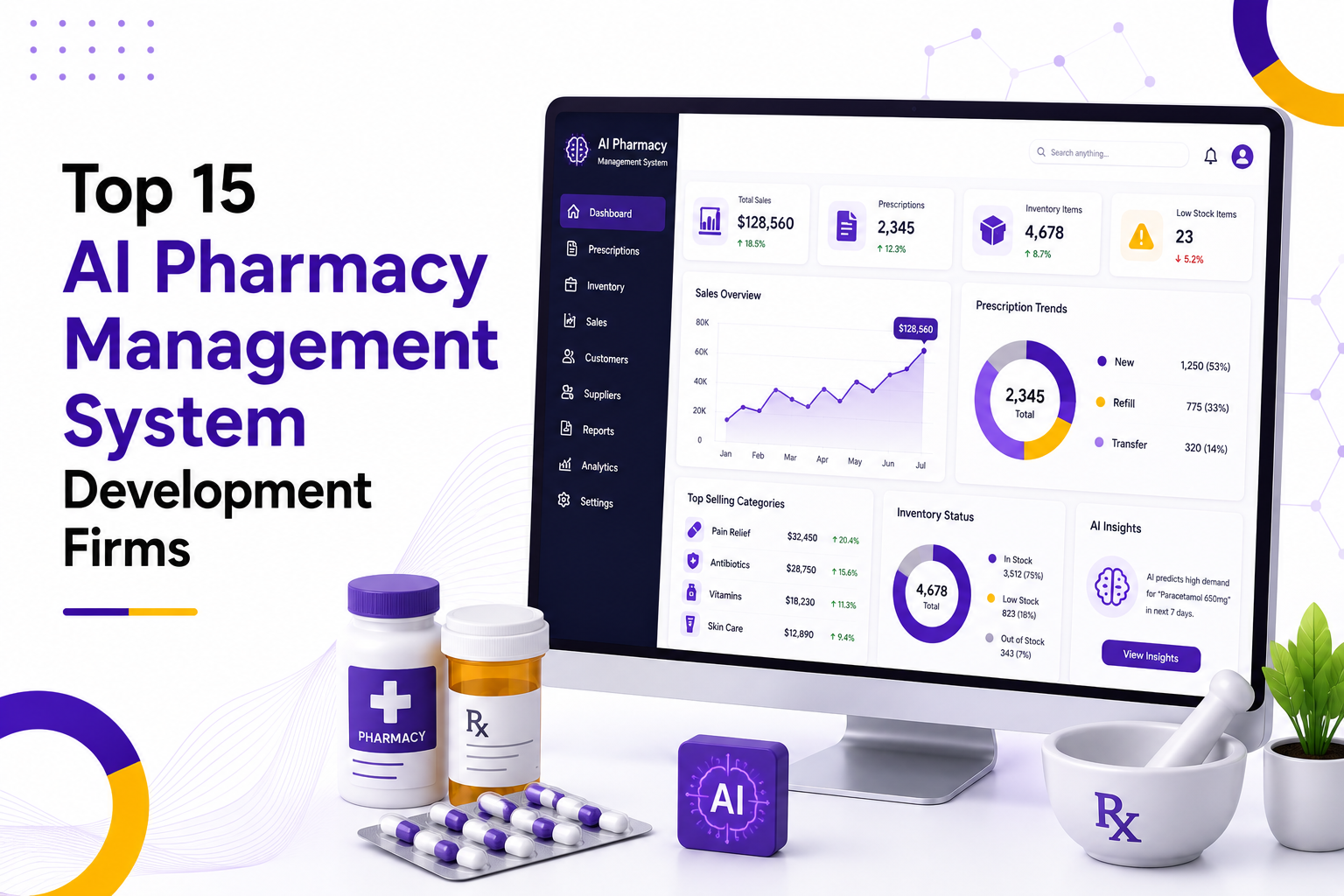

A pharmacy today runs on more data than most hospitals did a decade ago. Prescriptions, insurance claims, drug interaction checks, refill schedules, and inventory counts all move through the same few screens, and when that software is slow or disconnected, the whole store feels it. That is why so many pharmacy owners and healthcare founders are now looking to build or upgrade their own AI Pharmacy Management System instead of settling for generic, off the shelf tools that were never built for how pharmacies actually operate in 2026.
Picking the right development partner for this kind of project is not simple. You need a team that understands pharmacy workflows, regulatory pressure, and how to use AI in ways that actually reduce errors rather than add new points of failure. Some vendors are excellent at mobile design but weak on compliance. Others can pass a HIPAA audit blindfolded but have never built anything a patient actually enjoys using. Finding a team that covers both sides well is the whole game.
To make that search easier, we have put together a list of 15 AI Pharmacy Management System development companies worth knowing about, along with what each one does well and who they tend to suit best. We looked at real project history rather than marketing copy, and we tried to include a mix of large enterprise firms, mid sized specialists, and flexible hourly teams so there is a fit here whether you are an independent pharmacy or a growing regional chain.
What a Modern AI Pharmacy Management System Actually Does
Before comparing vendors, it helps to know what you are shopping for. A well built AI Pharmacy Management System goes far beyond digitizing paper records. It typically handles prescription intake and verification, flags drug interactions before a pharmacist even looks at the order, predicts refill timing so shelves are never caught short, and automates the reporting pharmacies need for compliance audits. The strongest systems also connect to insurance networks, point of sale hardware, and electronic health records, so information does not have to be re entered by hand across five different screens.
The AI layer matters most in the parts of the job that used to eat a pharmacist's entire shift. Instead of manually cross checking every new prescription against a patient's history, the system does it in seconds and only surfaces the cases that genuinely need a human decision. That shift, from manual checking to exception based review, is the real reason pharmacies are investing in this technology now rather than waiting another few years.
There is also a financial argument that founders tend to underestimate at first. Expired inventory, missed refills, and duplicate insurance claims quietly drain margin every single month, and most independent pharmacies have no easy way to see exactly where that money is going until it shows up in a quarterly report. A properly built system surfaces those numbers in real time, which means owners can catch a stocking mistake or a billing error within days instead of finding out three months later during a financial review.
Compliance is the other piece that cannot be an afterthought. In the United States, that generally means HIPAA for patient data protection and DSCSA for tracking prescription drugs through the supply chain, along with state specific pharmacy board rules that vary more than most founders expect. A good development partner will ask about these requirements during the very first planning conversation, not after the design is already finished, because retrofitting compliance into a system that was not built with it in mind is expensive and often means rebuilding core parts of the architecture from scratch.
How We Picked These Companies
Every firm on this list has real, verifiable experience building healthcare or pharmacy software, not just a generic portfolio page that mentions AI in passing. We looked at how long each company has worked in regulated healthcare environments, whether they understand requirements like HIPAA and DSCSA, and how transparent they are about pricing and engagement models. We also weighed practical factors that founders care about day to day, including team size, communication style, and whether a company can support a project long after launch rather than disappearing once the app ships.
None of these companies are ranked strictly first to last. A firm that sits lower on the page is not necessarily weaker, it may simply suit a different budget or project size than the one above it. Read through the specialization and best fit notes for each entry rather than assuming position on the list reflects overall quality, since the right choice depends far more on your specific situation than on any single ranking.
With that criteria in mind, here are the 15 development firms we think deserve a spot on your shortlist this year
HireFullStackDeveloperIndia is built for founders who want one team handling both the patient facing app and the backend systems behind it, rather than coordinating two separate vendors. That full stack setup tends to reduce miscommunication during an AI Pharmacy Management System build, since the same engineers who design the database schema are also writing the interface pharmacists use every day. Clients typically choose this route when speed and coordination matter more than having specialists for every single layer of the stack. It also tends to keep costs down, since you are not paying overhead for separate frontend and backend account managers coordinating between two agencies.
● Single team covering frontend, backend, and database work
● Cost effective hourly and dedicated hiring models
● Fast onboarding for founders who need to move quickly
Jelvix has spent more than a decade serving healthcare clients, and pharmacy management sits squarely inside its core expertise alongside remote patient monitoring and telemedicine platforms. Most of its engineering staff sit at mid level or senior level, which tends to matter a lot when a project touches sensitive patient data and cannot afford rookie mistakes. The company is GDPR compliant and ISO 27001 certified, two credentials worth checking for whenever you are evaluating a partner for regulated software. Its project managers also tend to have direct healthcare domain knowledge, which cuts down on the back and forth that usually happens when a generalist team has to be taught pharmacy terminology from scratch.
● Over a decade of healthcare focused software delivery
● ISO 27001 certified with GDPR compliant data handling
● Experience integrating pharmacy systems with EHR platforms
As the name suggests, this firm lives and breathes backend work, which is where most of the heavy lifting in pharmacy software actually happens. Inventory syncing, insurance claim processing, and drug database lookups all depend on backend architecture that can handle thousands of transactions without slowing down. Backend Development Company specializes in exactly that kind of infrastructure, building systems designed to stay fast and stable even as a pharmacy chain grows from a handful of locations to dozens. The team is also known for writing clear technical documentation, which makes it easier for an in house team to take over maintenance later if that becomes the plan.
● Deep specialization in scalable backend and API architecture
● Experience handling high volume transaction processing
● Works well alongside an existing frontend or design team
Intellectsoft focuses on enterprise grade healthcare applications, and its medication management work includes secure messaging, analytics dashboards, and integration with third party healthcare systems. The company leans on AI, cloud infrastructure, and IoT to help hospitals and pharmacy chains build platforms that can support future growth rather than needing a rebuild every few years. That forward looking approach makes Intellectsoft a reasonable fit for larger pharmacy operations planning a multi year technology roadmap. The company also runs its own internal research group, which means clients sometimes get early access to features other agencies are still years away from offering.
● Enterprise scale experience with hospitals and pharmacy chains
● Strong track record in analytics and medication safety tools
● Combines AI, cloud, and IoT for connected healthcare platforms
Hourly Developers built its entire model around flexibility, which is exactly what most pharmacy founders need when scope keeps shifting during early development. Instead of locking clients into a fixed price contract before requirements are fully known, the company lets you hire developers by the hour and scale the team up or down as the roadmap evolves. That structure works particularly well for an AI Pharmacy Management System build, where features like refill prediction or interaction alerts often get refined after real pharmacists start testing the product. Clients also appreciate being able to bring in extra hands during a crunch period, such as before a compliance audit, without renegotiating an entire contract.
● Transparent hourly billing with no long term lock in contracts
● Engineers experienced in HIPAA compliant healthcare software
● Comfortable joining mid project to extend an existing team
Arkenea has worked exclusively in healthcare technology for well over a decade, which means every engineer on staff already understands clinical workflows before a project even starts. The company has built custom pharmacy management tools that handle drug and medical device inventory, supply chain tracking, and the reporting pharmacies need for audits. Client reviews consistently point to strong communication and a genuine understanding of healthcare regulation, which is not something every generalist agency can claim. Founders who have worked with larger, slower moving healthcare vendors in the past often mention Arkenea's responsiveness as a noticeable improvement.
● Healthcare only focus with no distractions from unrelated industries
● Strong Clutch reputation built on long term client relationships
● Experience with drug inventory, supply chain, and audit reporting
iQlance carries ISO 9001, ISO 13485, ISO 27001, and ISO 27701 certifications, which together cover quality management, medical device software, information security, and data privacy. For a pharmacy business handling protected health information, that combination of certifications is worth more than a flashy portfolio. iQlance's healthcare work includes prescription assistance applications and records optimization tools built specifically for pharmaceutical organizations, along with broader hospital inventory and CRM systems. The company also offers post launch maintenance packages, which is useful for founders who do not want to hire an internal engineering team right away.
● Four separate ISO certifications covering quality and security
● Direct experience with prescription assistance applications
● Handles both software development and systems integration
HireAIDevelopers focuses specifically on the artificial intelligence layer that separates a modern pharmacy platform from a basic record keeping tool. That includes drug interaction models, refill prediction algorithms, and natural language processing that can read a handwritten or scanned prescription and turn it into structured data. Pharmacy founders who already have a development team but need specialized AI expertise often bring this company in for exactly that piece of the puzzle. The engineers here also tend to be comfortable explaining model behavior in plain language, which matters when a pharmacist or compliance officer wants to understand why the system flagged something.
● Focused specifically on AI and machine learning implementation
● Experience with prescription OCR and natural language processing
● Can integrate into an existing development team as specialists
Relevant Software runs a senior heavy team, with the vast majority of its engineers at senior level, and the company holds both HIPAA and ISO 27001 compliance along with GDPR alignment for European clients. Recent healthcare projects include AI powered analytics systems that process tens of thousands of medical records automatically, which shows the company can handle the kind of data volume a growing pharmacy chain eventually runs into. Client satisfaction scores have remained consistently high across its healthcare portfolio. That consistency tends to matter most on longer engagements, where a change in senior staff partway through can otherwise derail months of progress.
● Senior heavy engineering team with strong client satisfaction scores
● HIPAA, ISO 27001, and GDPR aligned development practices
● Delivery offices across both Europe and the United States
Wildnet Edge has built a reputation specifically around pharmacy software, including integrations with e-prescription networks like Surescripts and connections into existing pharmacy management systems. The company pays close attention to regulatory compliance, covering HIPAA, GDPR, and FDA requirements where relevant, which matters for any pharmacy business operating across multiple states. It tends to suit founders who want deep engineering depth over flashy design, since its strength sits firmly in complex backend and integration work. Its offshore delivery model does require more active project management from the client side, so it works best for founders who can dedicate real time to weekly check ins.
● Specific track record with e-prescription network integrations
● Documented compliance experience across HIPAA, GDPR, and FDA rules
● Strong fit for complex, integration heavy pharmacy projects
Softeq brings decades of engineering experience to custom healthcare software, with particular strength in medication management platforms that include refill reminders, secure messaging, and wearable device integrations. The company focuses heavily on encryption and data protection standards, which is worth checking closely if your AI Pharmacy Management System needs to sync with fitness trackers, glucose monitors, or other connected patient devices down the line. Softeq also has hardware engineering roots, so it tends to handle device pairing and firmware level issues more smoothly than agencies that only work in software.
● Strong background in wearable and connected device integration
● Heavy focus on data encryption and protection standards
● Decades of general engineering experience beyond just healthcare
OpenXcell has been building software since 2009 and has carved out a reputation for delivering strong results at competitive pricing, which appeals to pharmacy startups trying to stretch a limited budget as far as possible. The company's flexible dedicated team model lets founders assemble a custom group of specialists under OpenXcell's own proven workflows rather than managing every hire individually. Its experience with healthcare eCommerce platforms and real time communication features fits naturally into pharmacy delivery and refill ordering features. The tradeoff, as with many cost conscious offshore firms, is that strategic product consulting is lighter than what you would get from a premium US based agency.
● Cost competitive pricing without cutting corners on quality
● Flexible dedicated team model with proven internal workflows
● Relevant experience in healthcare eCommerce and real time features
BairesDev operates as a nearshore partner for many US companies, which means overlapping working hours and fewer communication delays compared to teams on the other side of the world. The company provides dedicated healthcare development teams that have worked on patient facing applications, telemedicine platforms, and healthcare analytics solutions at enterprise scale. For a pharmacy chain planning a large, multi year platform rather than a quick minimum viable product, that scale and experience can be a real advantage. The size of the organization also means it can absorb staff turnover on a project without leaving a client stuck waiting for a replacement engineer.
● Nearshore model with strong overlap for US business hours
● Large enterprise scale organization with deep bench strength
● Experience spanning telemedicine, analytics, and patient facing apps
TechAhead is a mobile consulting firm that excels at connecting software with physical hardware, which matters more than people expect in pharmacy technology. The company has real experience integrating apps with automated dispensing kiosks and smart inventory shelves, so medication counts update automatically instead of relying on manual entry. Its human centered design approach also means the resulting interface tends to be genuinely easy for pharmacy staff to use, not just technically functional. That combination of hardware fluency and usability testing tends to reduce the training time needed when a pharmacy first rolls out a new system to its staff.
● Practical experience connecting apps to physical pharmacy hardware
● Strong focus on IoT enabled smart inventory solutions
● Human centered design approach for staff facing interfaces
Appinventiv works with a wide range of enterprise clients and has built a strong AI practice that shows up clearly in its healthcare portfolio, including patient engagement apps and predictive analytics tools. The company's scale means it can staff large, multi disciplinary teams covering AI engineering, mobile development, and cloud infrastructure under one roof. That breadth makes Appinventiv a solid option for pharmacy businesses that want a single vendor capable of handling nearly every part of a large scale rollout. The size of the company also means project costs tend to sit at the higher end compared to smaller specialist firms on this list.
● Large scale organization capable of staffing full project teams
● Established AI practice with relevant healthcare case studies
● Broad capability spanning mobile, cloud, and enterprise consulting
Questions Worth Asking Before You Sign a Contract
Once you have a shortlist, the real evaluation starts. Ask every vendor how they handle HIPAA and DSCSA compliance in practice, not just on paper, and ask for a specific example of how their system caught a real drug interaction or compliance issue for a past client. Pricing for a custom AI Pharmacy Management System generally ranges from $25,000 for a lean minimum viable product to well over $150,000 for a full enterprise platform with deep integrations, so get a detailed scope breakdown rather than a single round number.
It is also worth asking who owns the code, the data, and the AI models once the project ends. Some agencies retain rights to reusable components they build, which can complicate things if you ever want to switch vendors later. Finally, ask about post launch support. Pharmacy software needs regular updates as drug databases change and regulations shift, so a firm that disappears after launch day is rarely the right long term choice, even if their initial quote looked attractive.
Request references from at least two past healthcare clients, and actually call them rather than just reading the testimonials on a company's website. Ask those references how the vendor handled a delay or a disagreement, since that tells you far more about a working relationship than a polished case study ever will. It is also reasonable to ask for a small paid pilot project before committing to a full contract, which lets you evaluate communication and code quality firsthand without betting your entire budget on a first impression.
On the cost side, it helps to break the number down by feature rather than accepting a single lump sum. Core prescription management and basic inventory tracking tend to sit at the lower end of the range. AI features such as interaction prediction or prescription scanning add meaningfully to the price. Insurance network integrations and multi location support push costs higher still, and each of these pieces can usually be phased in over time rather than paid for all at once, which gives a growing pharmacy more control over cash flow during the build.
Choosing the Right Partner for Your Pharmacy
There is no single best company on this list, only the best fit for your specific pharmacy, budget, and timeline. A small independent pharmacy chasing a lean minimum viable product will value speed and cost control, while a multi location chain planning a five year technology roadmap needs a partner who can handle enterprise scale integrations and long term support. What matters most is picking a team that has actually shipped healthcare software before and can speak plainly about compliance, timelines, and cost without hiding behind jargon.
It also helps to think past the first version of your product. The vendor you choose today will likely be the one you call when regulations change, when you add a second location, or when a competitor launches a feature you now need to match. Weigh that longer relationship as heavily as the initial quote, since a slightly higher price paired with a team that actually understands your business tends to save far more money over a two or three year period than the cheapest bid ever will.
Building an AI Pharmacy Management System in 2026 is no longer an experimental bet. The technology is proven, the vendors are experienced, and the pharmacies that move now are the ones setting themselves up to run leaner and serve patients faster than competitors still relying on outdated software. Take the time to talk to two or three firms from this list, compare how they answer the harder questions, and choose the partner who treats your project like a long term relationship rather than a one time transaction.