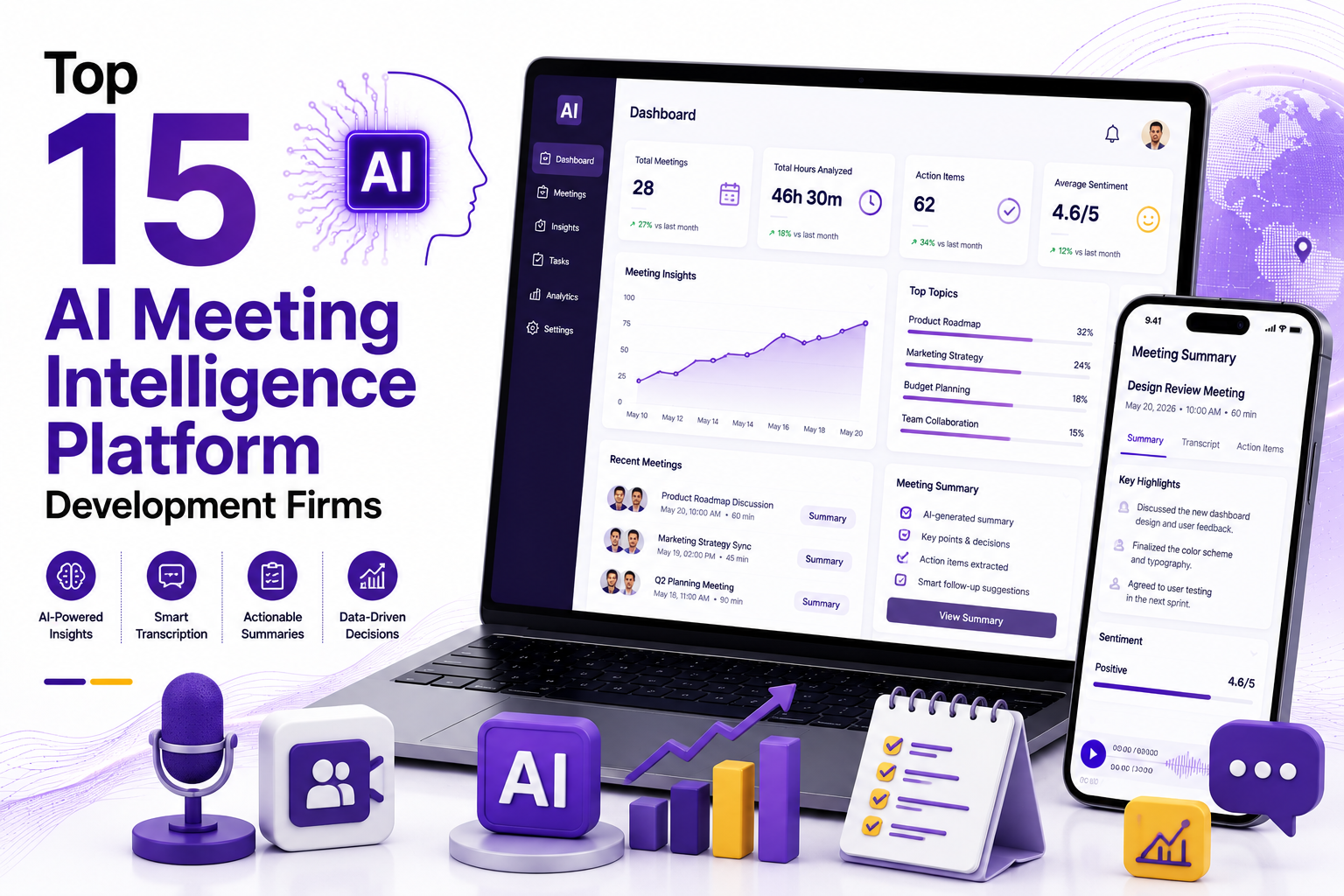

If you have ever walked out of a meeting and forgotten half of what was actually decided, you already understand why companies everywhere are rushing to build smarter meeting tools. The average workweek is packed with calls, standups, and client conversations, and most of what gets said in them simply disappears the moment everyone logs off. That is the exact gap an AI Meeting Intelligence Platform is designed to close. It listens, transcribes, summarizes, and even flags action items, turning a messy hour long conversation into something a team can actually use later.
For founders and decision makers, the real challenge is not deciding whether to build such a tool. It is finding a development partner who genuinely understands natural language processing, speech recognition, and real time data handling well enough to turn the idea into a working product. That is exactly what this list is for. We have put together fifteen firms worth knowing about if you are planning to build, upgrade, or scale an AI Meeting Intelligence Platform in 2026, along with what each one brings to the table.
Why Businesses Are Investing in Meeting Intelligence Right Now
Hybrid and remote work is not going anywhere, and that alone has changed how teams treat their meetings. Instead of relying on someone's rushed notes, companies now expect a searchable record of every call, complete with summaries, sentiment cues, and clear next steps. Sales teams use this data to coach reps, support teams use it to spot recurring complaints, and leadership uses it to keep decisions on record. On top of that, industries like finance, healthcare, and legal services need meeting recordings for compliance reasons, which pushes the demand for secure, well engineered platforms even higher. Add generative AI into the mix, and you get tools that do not just transcribe a call but actually explain what happened in plain language, which is a big part of why 2026 has become such an active year for this space.
There is also a quieter reason this category keeps growing. As teams scatter across time zones, fewer people are actually present for every conversation that affects their work, so a searchable archive becomes the only reliable way to stay aligned. A well built platform does not just save a recording, it turns hours of scattered conversation into a structured knowledge base that new hires, remote employees, and busy executives can catch up on in minutes instead of sitting through a replay. That shift in expectation is exactly why so many founders are now looking seriously at building their own tool instead of relying on a generic, one-size-fits-all vendor.
What to Check Before You Hire a Development Firm
- Hands-on experience with speech to text engines, NLP, and large language models, not just general app development.
- A portfolio that includes real time data processing, since live meeting audio cannot afford lag.
- Clear data security practices, especially if the platform will handle sensitive client conversations.
- Transparent, upfront pricing instead of vague hourly estimates that change mid-project.
- Willingness to support the product after launch, not just hand it over and disappear.
Features Worth Expecting From a Modern Platform
Not every meeting intelligence tool needs the same feature set, but a handful of capabilities have become standard enough in 2026 that it is worth pushing back if a development firm cannot deliver them. Automatic speaker identification is one, since a transcript that does not separate who said what is barely usable in a business setting. Real time transcription during the call itself, rather than only after it ends, is another, and it has become especially important for sales and support teams who want live prompts while a conversation is still happening.
- Automated summaries and action item extraction, ideally editable so users can correct anything the model gets wrong.
- Integration with calendar tools, video platforms, and CRMs so meetings sync without manual work.
- Searchable archives that let a user find a specific topic across months of past calls in seconds.
- Sentiment and talk-time analytics, which sales and coaching teams rely on heavily.
- Role based access controls, so sensitive meetings are not visible to the entire company by default.
A firm that has actually shipped a comparable product before will usually bring these up unprompted during early conversations, which is a decent signal that they understand the space rather than treating it as just another CRUD application with a transcription API bolted on.
How Pricing Usually Works Across These Firms
Pricing for this category tends to fall into three rough buckets. Hourly engagement, where you pay for actual development time and retain flexibility to adjust scope as you learn more, generally runs between $20 and $95 an hour depending on the firm's location and seniority mix. Fixed-price MVP packages, which suit founders who want a clear budget ceiling for an initial version, typically land between $15,000 and $45,000. Dedicated team retainers, where a firm assigns a consistent group of engineers to your project on a monthly basis, are the most common choice once a product moves past the MVP stage and needs sustained development over 6 to 12 months.
Whichever model you choose, be careful about vendors who quote a single flat number without asking detailed questions first. A meeting intelligence build has a lot of moving parts, from model selection to storage costs to compliance requirements, and a firm that skips those questions during the sales conversation is more likely to hit you with scope changes and surprise costs once development is already underway.
The Top 15 AI Meeting Intelligence Platform Development Firms
1. HireFullStackDeveloperIndia
HireFullStackDeveloperIndia offers full stack teams based in India, giving founders a cost-effective way to build both the user facing dashboard and the AI powered backend without stitching together separate vendors. The firm is a common choice for startups that want something close to an in-house team without carrying in-house overhead. Their developers typically cover React or Angular on the frontend and Node.js or Python on the backend, which pairs well with most AI meeting intelligence tooling, and time zone overlap with US and UK clients is usually manageable with a few hours of daily overlap built into their working hours. Contracts are commonly structured as dedicated monthly hires rather than fixed-bid projects.
2. HireAIDevelopers
HireAIDevelopers focuses specifically on connecting businesses with vetted AI engineers who specialize in speech recognition, large language model integration, and real time analytics dashboards. Because the team works almost exclusively on AI projects, they tend to move faster on the trickier parts of a meeting intelligence build, such as tuning a model to accurately separate speakers or summarize a noisy call. Engagement is usually hourly or on a dedicated monthly basis, depending on project scope, and they are often brought in mid-project when an existing team needs extra AI specific expertise rather than a full end to end rebuild. This makes them a practical option for founders who already have a product team but need deeper NLP knowledge for a few months.
3. Backend Development Company
As the name suggests, this firm's strength sits in backend architecture, which happens to be the hardest part of a meeting intelligence build to get right. Processing a live audio stream, running it through a transcription engine, and pushing structured data into a dashboard in near real time requires solid API design and infrastructure planning. Backend Development Company is often brought in as a technical partner alongside a frontend team, or hired to handle the entire backend independently, including message queues, webhook handling for calendar and video tools, and database design for storing transcripts and summaries at scale. They tend to work with Python, Node.js, and PostgreSQL, with Redis or Kafka layered in for real time event handling.
4. Hourly Developers
Hourly Developers works on a flexible, pay-as-you-go hiring model that lets startups bring on AI and full stack engineers without committing to a large upfront contract. The team has hands-on experience building NLP based transcription and summarization systems, and their pricing tends to be friendlier for early stage founders who want to test an idea before scaling it. Clients typically start with a small dedicated pod, usually two to four engineers, and expand the team once the product proves itself, which keeps early development costs manageable. Their stack generally covers Python for the AI layer and React or Node.js for the product side, and most engagements are billed hourly or on a monthly retainer, so budgets stay predictable even as the scope shifts during the build.
5. Appinventiv
Appinventiv is a larger, internationally recognized firm with a long track record across mobile, web, and AI development. They have delivered natural language processing and generative AI products for enterprise clients, which makes them a solid pick for companies that need a partner capable of handling complex compliance requirements alongside the core product build. Their size means higher rates, but also more structured project management, dedicated quality assurance, and access to specialists in areas like data engineering and cloud architecture that smaller firms may not have in-house. Enterprise buyers tend to favor them when the project involves multiple stakeholders and formal sign-off processes.
6. LeewayHertz
LeewayHertz has built a strong reputation around generative AI and large language model based products, including custom AI copilots for enterprise workflows. For a meeting intelligence platform, this matters because summarization quality often comes down to how well a team can fine tune an LLM for a specific use case rather than relying on an out of the box model. LeewayHertz tends to attract mid to large sized businesses that want a genuinely custom AI layer rather than a templated solution, and they typically handle model selection, fine tuning, and evaluation as a dedicated phase of the project before any frontend work begins.
7. Markovate
Markovate positions itself as an AI-first product studio, and it shows in how they approach conversational AI and workflow automation projects. Beyond the AI engineering, they put real effort into user experience design, which matters a lot for a meeting intelligence tool since the dashboard is where users will actually spend their time reviewing summaries and searching past calls. They are a good fit for founders who care equally about how the product looks and how well the AI performs, and their process usually includes a dedicated design sprint before development starts, which can shorten the number of revision rounds later on.
8. Matellio
Matellio works across custom software and AI development, with a client base spanning healthcare, fintech, and logistics. Their focus on cloud native architecture and rapid MVP development makes them a practical choice for a founder who wants to launch a lean version of an AI meeting intelligence tool, gather feedback, and then invest further based on real usage data rather than guesswork. They generally offer fixed-price MVP packages alongside dedicated team engagements, giving early stage founders a clearer sense of cost before committing to a longer build.
9. Debut Infotech
Debut Infotech is best known for blockchain work, but the team has also delivered a good number of NLP based applications, and their documentation and reporting practices tend to be more thorough than average. For decision makers who want detailed progress reports and clear milestones throughout a build, this level of transparency can be a meaningful advantage, especially on a longer term project. They typically run in two week sprints with recorded demo sessions at the end of each cycle, which keeps non-technical founders in the loop without needing to read through code.
10. Simform
Simform is a product engineering firm with deep DevOps and cloud expertise across AWS and Azure. Since a meeting intelligence platform needs to scale as call volume grows, especially for enterprise customers running hundreds of meetings a day, having a partner who understands cloud infrastructure from day one can save a lot of rework later. Simform is generally suited to companies planning for scale rather than a quick proof of concept, and their engagements often include a dedicated infrastructure review to plan for cost efficient scaling before the product even reaches a large user base.
11. Intellectsoft
Intellectsoft is an enterprise software consultancy with an established track record and strong compliance practices, which makes them well suited to regulated industries that need meeting recordings to meet standards like HIPAA or GDPR. Their process tends to be more formal, with dedicated project managers and structured sprint reviews, which larger organizations often prefer over a smaller, more informal vendor relationship. They also maintain in-house security and QA teams, which can shorten the vendor assessment process for enterprise buyers who need to clear internal procurement checks before signing a contract.
12. ScienceSoft
ScienceSoft has been in the IT consulting space for over two decades and brings deep experience in speech recognition and data engineering. Their processes are ISO certified, which can matter a great deal to founders selling into enterprise or government clients who ask detailed questions about vendor practices during due diligence. They are typically chosen by companies that value process maturity as much as raw development speed, and their proposals usually include a detailed technical architecture document before any coding begins, which helps set clear expectations early in the relationship.
13. Konstant Infosolutions
Konstant Infosolutions is a full stack and mobile app development company known for budget friendly pricing without cutting corners on quality. While their core strength is general software development rather than deep AI research, they partner well with AI specialists and are a reasonable choice for startups that need a capable all-round team to handle the non-AI parts of the product, such as onboarding flows, billing, and admin dashboards. They have been operating for over 15 years and offer both fixed-price and hourly engagement models depending on how well defined the project scope is.
14. Space-O Technologies
Space-O Technologies is a product development studio that has built a name around fast MVP delivery. For a founder who wants to validate whether an AI meeting intelligence idea actually has demand before investing heavily, Space-O offers a quicker, lower cost path to a testable product. It is not the firm for a fully polished enterprise build, but it works well as a starting point, and many of their clients later bring on a larger firm from this list once the MVP has proven there is real user demand worth scaling.
15. Biz4Group
Biz4Group rounds out the list as an AI-focused development company with real experience in custom large language model fine tuning, workflow automation, and third-party integrations. They have a strong presence in the US market and tend to work with companies that already have a clear product vision and simply need an experienced technical team to execute it. Their engagements often start with a short discovery phase to map out data flows and compliance needs before any development begins, which reduces the odds of a costly architecture change later in the project. For businesses building a serious, investor-ready AI Meeting Intelligence Platform, Biz4Group is worth including in the shortlist.
Questions Worth Asking on Your First Call
Before signing with anyone on this list, it helps to come prepared with a short set of questions rather than letting the vendor run the entire conversation. Ask which speech-to-text engine they plan to use and why, since the answer usually reveals whether they have actually built something similar before or are learning on your budget. Ask how they plan to handle accents, background noise, and overlapping speakers, because these are the details that separate a demo that looks good from a product that actually works in a real, messy meeting. Ask what happens if the model misidentifies a speaker or produces an inaccurate summary, since every AI system makes mistakes and a firm with real experience will already have a plan for graceful correction rather than pretending the problem does not exist.
It is also worth asking directly about data ownership and where recordings and transcripts will be stored. Some firms default to storing data on their own infrastructure during development, which is fine for a prototype but not something you want carried into production without a clear migration plan. A vendor who answers these questions clearly and without hesitation is usually one who has actually shipped something like this before, rather than one reading from a sales script written for generic software projects.
Final Thoughts
Choosing the right partner to build an AI Meeting Intelligence Platform is less about finding the biggest name on the list and more about matching a firm's actual strengths to what your product needs right now. A very early stage startup validating an idea does not need the same partner as an enterprise rolling out compliance-heavy meeting recordings across a global sales team. Look closely at each firm's past AI work, ask direct questions about how they handle real time processing and data security, and get a clear, written estimate before committing. Do that, and you will walk away with a development partner who can actually turn your idea into a working product, not just a slide deck full of promises.
It also helps to remember that this list is a starting point, not a final answer. The right fit depends on your budget, your timeline, and how much of the AI work you plan to own internally versus hand off entirely. Some founders prefer to start small with an hourly team to prove the concept works, then bring on a larger, more established firm once real users are relying on the product daily. Others go straight to an enterprise grade partner because compliance and scale are non-negotiable from day one. Either path can work, as long as the decision is based on a clear understanding of what each firm actually does well, rather than which name happens to sit at the top of a search result.