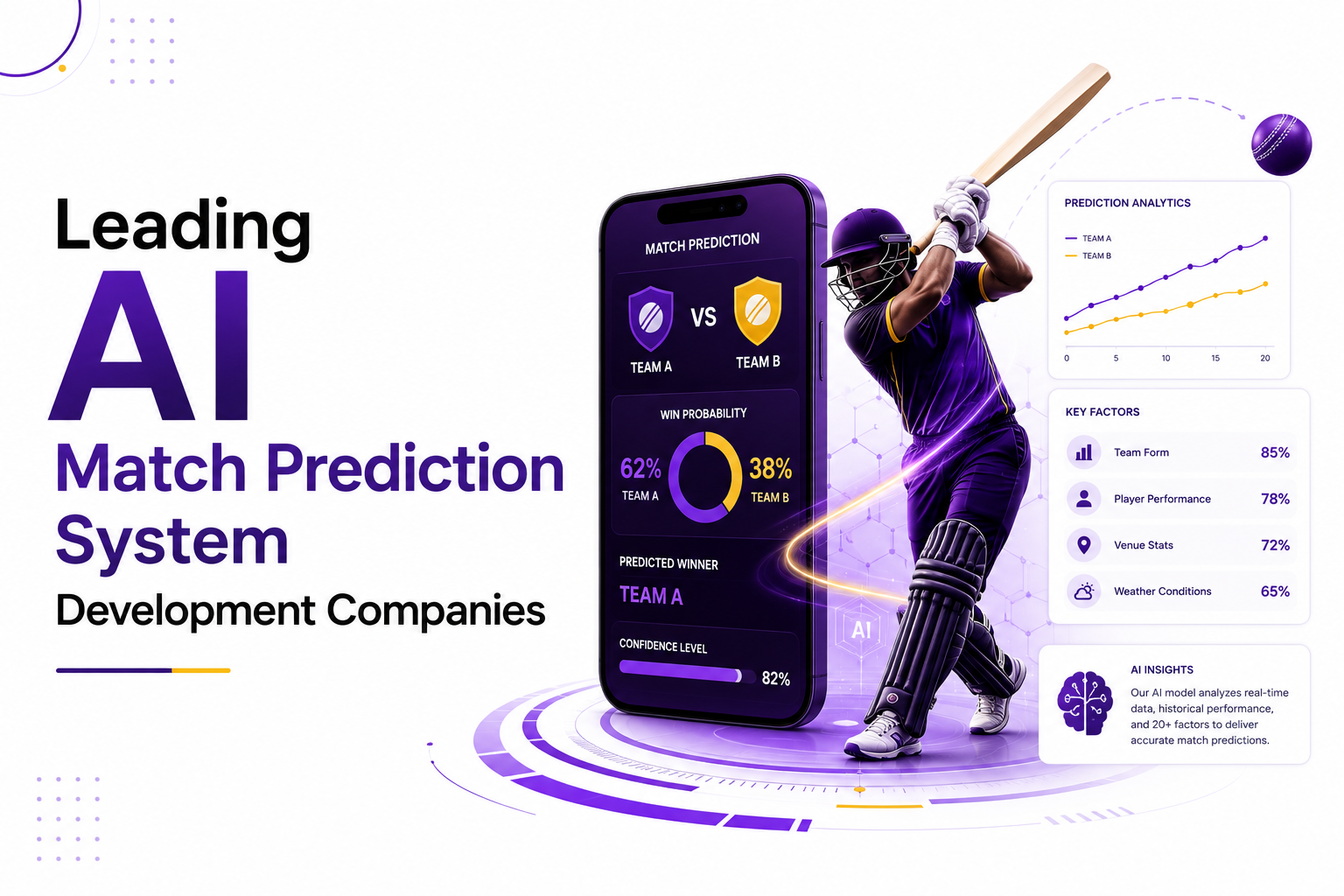

Sports fans used to argue about who would win a match over a drink at the pub. Now they open an app, look at a probability score, and get their answer before kickoff. That shift did not happen by accident. It happened because a small group of specialized engineering teams figured out how to turn years of match data, player form, and live statistics into predictions people actually trust.
If you are reading this, you are probably trying to build something similar. Maybe it is a fan engagement feature for your platform, a fantasy sports add on, or a full prediction product aimed at bettors and analysts. Whatever the use case, the company you hire to build your AI Match Prediction System will decide how accurate, fast, and trustworthy the final product feels to your users. A weak model built on thin data will show its cracks the moment a big match produces a surprise result.
This guide breaks down 20 AI Match Prediction System development companies worth evaluating in 2026. Some specialize in sports betting technology, some come from a broader AI and data science background, and a few started in fan engagement before moving into prediction. We have kept the descriptions practical, covering what each company is actually known for, so you can shortlist faster and skip the generic sales pitches.
The market has also matured quickly. A few years ago, most prediction features were simple probability displays bolted onto an existing app. Heading into 2026, the better vendors are shipping systems that adjust in real time as a match unfolds, factor in player fatigue and substitutions, and explain their reasoning in plain language instead of a bare percentage. That shift raises the bar for what counts as a credible development partner, which is exactly why this list focuses on companies with real delivery history rather than marketing pages alone.
Why Such Apps Are Built?
Before comparing vendors, it helps to understand why businesses commission an AI Match Prediction System in the first place, because the reasons shape what a good build actually looks like. Sportsbooks and betting operators use these systems to generate live odds and adjust them the moment a red card, injury, or momentum shift changes the probability of an outcome. Getting this wrong by even a few percentage points can cost real money, which is why odds engines get the most engineering attention of any prediction use case.
Fantasy sports platforms build lighter versions of the same technology to help users pick lineups, showing win probabilities and projected player performance instead of betting odds. Media companies and broadcasters build prediction features purely for engagement, letting viewers guess scores or outcomes during a live broadcast to keep them watching through halftime and beyond. Some of this work has nothing to do with gambling at all. Sports federations, coaching staff, and scouting departments now commission prediction tools that analyze player fatigue, tactical patterns, and historical matchups to support team strategy, not consumer betting.
Startups also build these systems to compete in the growing prediction market category, where users stake small amounts of money or reputation points on yes or no outcomes across sports, esports, and even non sporting events. Each of these paths needs a different mix of data pipelines, model accuracy, and regulatory awareness, which is exactly why picking the right development partner matters more than picking the cheapest one.
Underneath any of these use cases sits the same basic stack. A data ingestion layer pulls in historical results and live match statistics, a modeling layer turns that data into probabilities, and a presentation layer explains those probabilities to a user in a format they can actually act on. Companies that only excel at one of these three layers tend to produce a product that looks impressive in a demo but struggles once real users and real match volume hit the system.
HireFullStackDeveloperIndia specializes in building the complete product around a prediction engine, covering both the frontend dashboards users interact with and the backend systems that keep everything running. Their full stack approach means clients do not need to coordinate separate frontend and backend vendors.
This matters for prediction products because the user interface has to communicate probability and confidence clearly without overwhelming casual sports fans, something their design and development teams have handled across multiple sports and fantasy projects.
WeAlwin Technologies works specifically in the sports prediction and fantasy sports space, which is a narrower focus than most companies on this list. Their platforms typically cover match exploration, victory probability displays, player performance projections, and secure wallet systems for users who wager on outcomes.
Because the team builds both pure prediction tools and full betting platforms, they can tailor the scope depending on whether a client wants a compliance light engagement feature or a complete wagering product with payment rails built in.
Backend Development Company focuses on the infrastructure layer that most prediction products depend on but rarely talk about publicly. Their engineers specialize in building systems that can ingest live match statistics from multiple data providers and push updated predictions to thousands of concurrent users without lag.
For an AI Match Prediction System that needs to update odds or win probabilities in near real time during a live match, backend performance is often the deciding factor between a smooth user experience and one that frustrates people during the most important moments of a game.
Suffescom Solutions has built a name in the prediction market space, offering platforms that let users trade on yes or no outcomes with near real time probability updates. Their sports betting prediction offerings pull from live data feeds and combine them with AI models trained on historical trends.
With over a decade in the industry and a large in-house team, Suffescom is well suited for clients who want a partner capable of handling both the AI modeling side and the surrounding product, from wallets to compliance friendly architecture.
LeewayHertz built its reputation on custom AI development rather than templated products, and that shows up in how they approach sports prediction work. Their teams have experience building computer vision tools that track player movement, which feeds naturally into predictive modeling for match outcomes.
Clients who have worked with well known sports brands describe LeewayHertz as strong on the research and modeling side, making them a good fit for organizations that want a scientifically rigorous prediction engine rather than a quick, off the shelf build.
Hourly Developers built its reputation on a simple idea, letting clients hire experienced AI and software engineers by the hour instead of committing to a fixed project scope upfront. For companies exploring an AI Match Prediction System without knowing exactly how big the final build will be, this model removes a lot of early risk.
The team has worked across sports analytics dashboards, fantasy contest engines, and real time scoring features, which means they understand the specific data handling challenges that come with live match environments. Clients that need to scale a team up during a busy sports season and scale it back down afterward tend to find this arrangement particularly useful.
Appinventiv is one of the larger names on this list, with a track record that includes work for global brands like KFC, Adidas, and IKEA. Their AI division has the resources to build custom prediction models rather than relying on generic frameworks, which matters when accuracy is the entire value proposition of the product.
Because Appinventiv operates at enterprise scale, they tend to be a better fit for larger sports brands, media companies, and betting operators that need a partner capable of handling both the technical build and long term support across multiple markets.
Osiz Technologies has grown into a large development house covering AI, blockchain, and general enterprise software, which gives them flexibility when a prediction platform needs more than just a model. Their teams have worked on predictive analytics tools across several industries, sports included.
For clients who want their AI Match Prediction System tied into a broader digital ecosystem, such as a loyalty program or a crypto based reward system, Osiz has the cross domain experience to connect those pieces without bringing in a second vendor.
HireAIDevelopers focuses exclusively on the AI and machine learning layer, which is useful for clients who already have a product team but need specialized talent to build or retrain the prediction models themselves. Their developers work across regression models, classification systems, and ensemble methods commonly used in sports forecasting.
Because the team works on a dedicated hire basis, clients get direct input into how the model is trained and validated, which many product owners prefer over a black box style engagement where the modeling logic stays hidden inside a vendor's internal process.
Antier Solutions has been in the technology consulting space for close to two decades and has more recently expanded heavily into AI powered prediction markets. Their offerings cover both the modeling side and the decentralized infrastructure needed for platforms where users trade on outcome probabilities.
Antier tends to work with clients building at the intersection of AI and blockchain, so they are worth shortlisting if your prediction platform involves tokenized rewards, smart contract settlement, or decentralized data verification alongside the core forecasting engine.
Maruti Techlabs positions itself as a product development partner rather than a pure outsourcing vendor, working closely with early stage teams to shape the product alongside the engineering. Their AI practice covers everything from data pipeline design to model deployment.
Teams building an early version of a prediction product often choose Maruti Techlabs because of this consultative approach, since the company tends to push back on scope that does not serve the core user need instead of simply building whatever is requested.
Konstant Infosolutions has over two decades of experience in mobile and web development, and has expanded its service line to include AI and predictive analytics work in recent years. Their long operating history means they have survived multiple technology cycles, which speaks to consistent delivery quality.
Clients working with Konstant for an AI Match Prediction System benefit from a team that already understands mobile heavy use cases, since most sports and fantasy audiences engage with predictions through a phone rather than a desktop browser.
Matellio operates as an IT consulting firm with a strong lean toward AI and IoT projects, and their US headquarters gives them an advantage for clients who prioritize working within US time zones and data handling expectations.
Their consulting first approach means they typically start engagements with a discovery phase to map out data sources and model requirements before writing any code, which tends to reduce costly rework later in the project.
Sportz Interactive is one of the longest running names in sports technology, with clients that include major cricket boards, football federations, and global broadcasters. Their focus has historically been fan engagement, which naturally overlaps with prediction features built to keep audiences interacting during live matches.
Because they have worked directly with sports rights holders for over two decades, Sportz Interactive brings domain knowledge that pure software vendors often lack, particularly around what actually keeps fans engaged during a broadcast versus what looks good in a pitch deck.
ValueCoders has built a large outsourcing practice over two decades, with AI and machine learning now forming a meaningful part of their service catalog. Their scale allows them to staff prediction projects quickly without the long ramp up time smaller boutique studios sometimes need.
Clients who want a straightforward outsourcing relationship, with clear timelines and predictable costs, tend to gravitate toward ValueCoders over more consultancy style firms, especially when the prediction feature is one part of a larger product rather than the entire business.
Simform operates at a larger scale than most companies on this list, with a co-engineering model that embeds their team directly alongside a client's internal engineers. This works well for organizations that already have a data science function but need extra engineering capacity to ship faster.
Their client roster includes names like HP and Red Bull, which suggests they are comfortable operating under the kind of scrutiny that comes with building for well known consumer brands, a useful signal for sports organizations with a large public audience.
ScienceSoft has one of the longest operating histories on this list, having been in business since 1989. That longevity translates into a mature delivery process, which larger organizations tend to value when the project involves sensitive match data or regulated betting markets.
Their AI practice covers predictive analytics broadly, not just sports, so clients get a team that brings modeling techniques from other industries into the sports prediction space, sometimes surfacing approaches a sports focused vendor might not consider.
Plurance focuses specifically on ready to customize prediction scripts, which appeals to businesses that want to launch faster without building every component from the ground up. Their AI sports prediction software leans on statistical modeling to interpret team form and historical matchups.
This white label style approach means the initial build tends to be quicker and cheaper than a fully custom AI Match Prediction System, though clients should ask clearly about how much customization is realistically possible once the base script is in place.
Teqnovos is a newer entrant compared to some names on this list, but has built a focused practice around AI powered sports betting prediction software. Their process emphasizes structured data collection before any model training begins, which is a sound approach for teams new to this space.
Because they are a smaller shop, Teqnovos tends to offer more direct access to senior engineers during the build, which some founders prefer over larger firms where communication can get routed through several layers of project management.
DataEximIT brings a data engineering first mindset to prediction projects, which matters because the quality of any forecasting model depends heavily on how clean and well structured the underlying data pipeline is. Their team spends real time on this groundwork before model development starts.
Clients building an AI Match Prediction System that pulls from several data providers, such as live score feeds, historical archives, and player injury reports, tend to benefit from this data centric approach since mismatched or delayed feeds are one of the most common causes of inaccurate predictions.
What to Check Before You Hire a Development Partner
A few things separate a prediction product that earns user trust from one that gets abandoned after its first bad week. Ask any shortlisted vendor how they source historical and live match data, since a model is only as good as the feeds behind it. Ask how the system handles sudden events such as injuries or weather delays, because static models that only look at pre match stats tend to fall apart during live play. If your product touches betting or wagering in any form, confirm the company has actually shipped something inside regulated markets before, since compliance mistakes here are expensive to unwind later.
Cost is worth discussing early and honestly. A basic prediction feature bolted onto an existing app can cost as little as $15,000 to $25,000, while a full scale platform with live odds, multiple sports coverage, and its own trained models can run past $150,000 depending on scope and data licensing fees. Get a breakdown of what is included in that number, particularly ongoing model retraining, because prediction accuracy tends to drift as a new season introduces new teams, transfers, and playing styles.
Also look at who actually stays on the project after launch. Prediction systems are not a build once and forget product, since models need retraining as sports seasons progress and new patterns emerge in the data. Ask whether the vendor offers a retainer for ongoing model tuning or whether support ends the day the app ships, because that answer often matters more to long term accuracy than the initial build quality.
Conclusion
There is no single best company on this list, only the one that matches what you are actually trying to build. A sportsbook needing live odds engines has different priorities than a media company adding a light prediction feature to keep viewers engaged during halftime. Match your shortlist to your actual use case before you compare price sheets.
What separates the companies worth hiring from the ones to avoid usually comes down to how honestly they talk about data. Any vendor promising near perfect accuracy for an AI Match Prediction System straight out of the gate is overselling the technology. Sports outcomes carry genuine uncertainty, and the goal of a good prediction system is to reduce that uncertainty meaningfully, not to eliminate it entirely. Pick a partner who is upfront about that distinction, and the rest of the build tends to go smoothly.