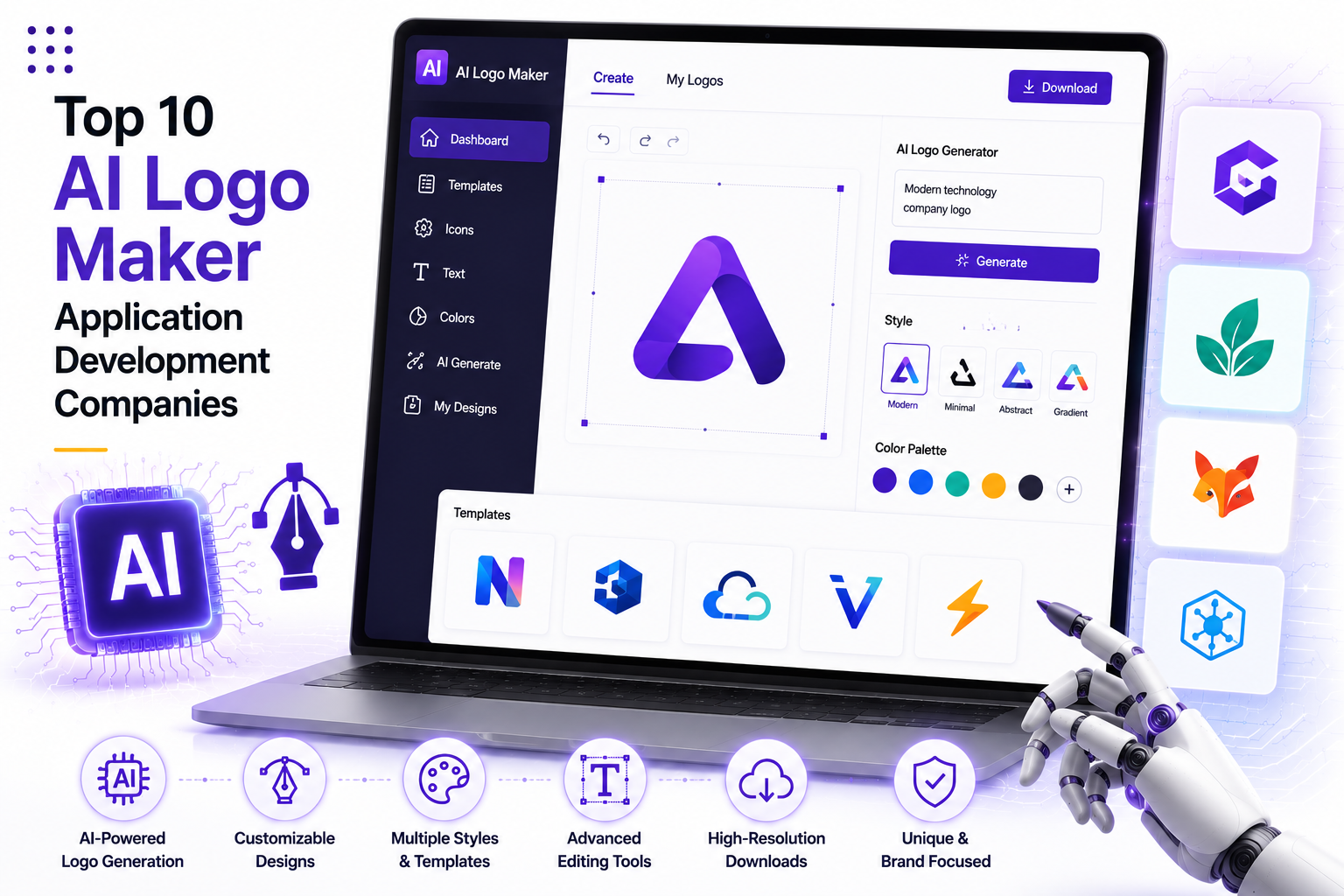

Every founder who has tried to get a logo designed knows the drill. You brief a designer, wait a week, get three options back, none of them feel quite right, and you start the whole process again. That entire cycle is exactly what an AI Logo Maker Application is built to remove. Instead of waiting on a human designer's calendar, users type in a brand name, pick a style or industry, and watch dozens of usable logo concepts appear within seconds.
That shift is a big part of why so many entrepreneurs are no longer asking whether they should build one of these tools, they are asking who should build it for them. And that second question turns out to be a lot harder to answer than it first sounds. A logo generator is not just a form connected to an image API. It needs a properly trained design engine, a font and icon library that actually looks professional rather than generic, an export pipeline that supports different file formats and resolutions, and a pricing or subscription layer that does not feel bolted on as an afterthought. Get any one of those pieces wrong and the finished product feels cheap, no matter how polished the marketing site looks.
There is also a growing expectation gap. Users who have already tried tools like Canva or Looka come in with a baseline sense of what "good" looks like, so a new AI Logo Maker Application cannot just be functional, it has to feel genuinely fast and visually confident from the very first generation. That raises the bar for whoever ends up building it, and it is a big part of why so many first-time founders underestimate the real engineering effort involved before they start collecting quotes.
It also helps to remember that this is not purely a design project or purely a software project, it sits somewhere in between, and that in-between space is exactly where a lot of otherwise capable development teams struggle. A team with strong mobile app experience might not know how generative image models behave under production load. A team that understands machine learning deeply might not have the design sensibility to make the output look genuinely professional rather than generic. The company you eventually hire needs to be comfortable operating in both worlds at once, not just one of them.
This guide is built for exactly that decision. Below, you will find ten development teams that have genuinely shipped design, branding, or generative AI tools, along with what each one is actually good at, how they typically structure engagements, and who they tend to be the best fit for, so you can shortlist with real confidence instead of guessing from a homepage full of buzzwords.
None of these AI Logo Maker Application development companies are ranked strictly best to worst. A team that is a great fit for a bootstrapped founder testing an idea over a weekend might be the wrong fit for a funded startup that needs enterprise-grade uptime from day one, and the reverse is just as true. Read each entry with your own current stage in mind rather than treating position on the list as a verdict.
What to Check Before You Hire
Before jumping into the list, it helps to know what actually separates a capable team from one that has simply added "AI" to its pitch deck. Look for three things in particular. First, evidence of prior work in design tools, creative software, or generative image systems, not just generic mobile or web app development. A team that has never touched a design product will spend your budget learning the basics that specialized teams already know.
Second, ask for a real answer on how they plan to train or fine-tune the logo generation model. That could mean adapting existing diffusion models, using vector-based generation for cleaner scalable output, or blending a rule-based design system with AI suggestions. Vague answers here are usually a warning sign that the team has not actually thought past the marketing pitch. Third, get clarity on licensing early. Logos need to be commercially usable and legally clean for the end business, so the development team should be able to explain, in plain language, how their generation pipeline avoids reproducing existing trademarked designs or copyrighted artwork.
A quick but useful test is to ask each shortlisted company to walk you through a previous project, end to end, including what went wrong along the way. Teams with genuine experience tend to answer that question comfortably, with specific examples. Teams that are stretching their capabilities usually keep the answer vague or steer the conversation back to features instead of process.
Why the Right Partner Matters More Than the Feature List
Almost every agency you talk to will claim they can build "AI-powered" anything. The real difference shows up in the details nobody puts on the homepage, things like how the tool handles vector versus raster output, how fast generation actually runs once thousands of users hit it at the same time, and whether the interface feels intuitive to a small business owner who has never opened a design tool in their life. A strong AI Logo Maker Application succeeds or fails on those unglamorous engineering choices, which is exactly why the company you choose to build it matters just as much as the original idea itself. Two teams can pitch the same feature list and still deliver wildly different products, because execution quality rarely shows up in a proposal document.
This is also where checking references pays off more than reading testimonials on a website. A five-minute call with a past client, asking specifically how the team handled a missed deadline or a scope change, tells you far more than any case study page ever will.
The Top 10 AI Logo Maker Application Development Companies
1. Hourly Developers
Overview: Hourly Developers works with startups and growing product teams that need to build AI-driven design and branding tools without hiring an entire in-house engineering department from scratch.
Core Expertise: Generative AI integration, SaaS product engineering, full-stack development, and API-driven design tools built to scale with user demand.
Engagement Model: Hourly, dedicated team, and fixed-scope project options, which makes it easier to start small and expand the team as the product proves itself in the market.
This structure also makes it easier to swap specialists in and out as the project moves from prototype to a full production release.
Best For: Founders who want a flexible development partner that can move from a rough prototype to a production-ready AI Logo Maker Application without a long, expensive onboarding cycle.
Why They Stand Out: Their flexible hiring structure means you are not locked into a rigid, long-term contract before you even know whether the underlying product idea will work.
Good to Know: Founders often start with a small paid pilot sprint before committing to a larger build, which keeps early-stage risk manageable.
2. Backend Development Company
Overview: As the name suggests, this team's strength sits squarely in the infrastructure layer, the part of an AI logo tool that most users never see but every single one of them depends on.
Core Expertise: API architecture, cloud infrastructure, database design, and the scalable backend systems that keep a design generation engine fast and stable under real traffic spikes.
Engagement Model: Project-based development along with ongoing backend maintenance, monitoring, and scaling support after launch.
They typically get involved early enough to help shape the technical architecture rather than simply inheriting decisions made by someone else.
Best For: Teams that already have a front-end design or UX partner in place and specifically need a reliable, high-performance backend to support AI image generation at meaningful scale.
Why They Stand Out: A logo generator that slows down or crashes under load loses users fast, and backend reliability is precisely where this company puts most of its engineering attention.
Good to Know: Worth asking specifically about their experience with GPU-based inference queues, since that infrastructure choice affects both speed and hosting cost.
3. HireFullStackDeveloperIndia
Overview: This company connects businesses with experienced full-stack development talent based in India, giving founders access to skilled engineers at a more accessible price point than many Western agencies.
Core Expertise: Full-stack web and app development, responsive front-end interfaces, and backend integration for SaaS and design-tool products of varying complexity.
Engagement Model: Dedicated developer hiring on monthly or hourly terms, with the flexibility to scale the team up or down as project needs change.
Regular async updates and shared project boards are commonly used to keep communication smooth despite the distance and time difference.
Best For: Founders working with a defined and limited budget who still want experienced, dedicated engineers rather than a rotating pool of unpredictable freelancers.
Why They Stand Out: Cost-effective access to genuine full-stack talent without sacrificing the technical depth needed to build a design product people actually enjoy using.
Good to Know: Time zone overlap can be limited depending on your location, so confirm daily communication windows before the contract is signed.
4. HireAIDevelopers
Overview: True to its name, this team focuses specifically on artificial intelligence development, including the machine learning components that power generative design and branding tools.
Core Expertise: Machine learning model integration, generative AI, computer vision, and natural language processing applied to creative and design-focused applications.
Engagement Model: Dedicated AI engineers available on flexible hourly or project-based contracts, with options to add specialists as the model matures.
They are also comfortable working alongside an existing in-house team rather than insisting on owning the entire build themselves.
Best For: Businesses that already have a product vision and interface design in place but need specialized AI talent to actually build the generation engine behind an AI Logo Maker Application.
Why They Stand Out: Their narrow, focused specialty in AI development means less time spent explaining basic machine learning concepts and more time actually building and refining the model.
Good to Know: Because their focus is narrow, pairing them with a separate design or front-end partner often produces the strongest overall result.
5. Brainvire
Overview: Brainvire is a long-established digital transformation company that has expanded its services into AI-powered product development for retail, e-commerce, and SaaS clients around the world.
Core Expertise: Enterprise software development, e-commerce platform engineering, cloud solutions, and applied AI integration across a wide range of industries.
Engagement Model: Structured project delivery with dedicated account management and project management support throughout the build.
Clients typically get a named project lead who stays consistent throughout the engagement rather than rotating staff mid-project.
Best For: Businesses that want an established company with a broad enterprise track record rather than a smaller, newer AI-focused shop still building its reputation.
Why They Stand Out: Their scale means they can support a design tool from an early prototype through enterprise-level deployment without you needing to switch vendors midway through growth.
Good to Know: Their enterprise-oriented process can mean a longer discovery phase upfront, which suits teams that already have a clear specification ready.
6. Octal IT Solution
Overview: Octal IT Solution is a software and mobile app development company that has built a diverse portfolio spanning multiple industries, including creative, media, and design-focused tools.
Core Expertise: Mobile and web app development, UI and UX design, and AI feature integration tailored for consumer-facing products.
Engagement Model: Fixed-price and dedicated team models, chosen depending on how well-defined the project scope already is.
Their design and engineering teams tend to work in parallel rather than in sequence, which shortens the overall build timeline.
Best For: Founders who want strong design and user experience work alongside the technical build, since the interface is often what quietly makes or breaks a logo maker tool.
Why They Stand Out: Their design-forward approach means the finished product does not just function correctly, it also looks and feels like a premium tool from the very first launch.
Good to Know: Their portfolio leans toward consumer apps, so ask for specific examples of generative or design-tool work rather than general mobile projects.
7. Konstant Infosolutions
Overview: Konstant Infosolutions has been building custom software and mobile applications for over two decades, with a steadily growing focus on AI-enabled features for its clients.
Core Expertise: Custom software development, mobile app engineering, and AI integration work for both business and consumer-facing applications.
Engagement Model: Dedicated development teams paired with milestone-based project delivery for predictable progress tracking.
Clients often cite their thorough documentation and testing process as a reason projects rarely need major rework after launch.
Best For: Businesses that value a long operating history and a proven delivery process over working with a newer, less battle-tested development team.
Why They Stand Out: Two decades in the industry means they have already solved most of the common technical problems that tend to trip up first-time AI product builders.
Good to Know: Their longer operating history is reassuring, though it is still worth confirming which internal team members have hands-on generative AI experience.
8. Space-O Technologies
Overview: Space-O Technologies is known for building AI and mobile-first applications, with prior experience across generative tools and consumer app design work.
Core Expertise: AI and machine learning app development, mobile-first product design, and cross-platform engineering for iOS and Android alongside the web.
Engagement Model: Dedicated teams with transparent hourly and fixed-cost pricing structures shared upfront before work begins.
They also tend to build with performance budgets in mind, keeping generation times fast even on older or lower-end devices.
Best For: Founders who want their AI Logo Maker Application to work just as well on mobile as it does on desktop, since a large share of small business owners will discover and use the tool from a phone first.
Why They Stand Out: Their mobile-first development philosophy addresses a gap that many desktop-focused design tool competitors tend to overlook entirely.
Good to Know: If your primary user base is desktop-based small business owners, confirm that the mobile-first approach will not add unnecessary complexity to your timeline.
9. Fingent
Overview: Fingent is a custom software development company that partners with businesses across healthcare, logistics, and retail to build applied, practical AI solutions.
Core Expertise: Custom AI and software engineering, data-driven product design, and cloud-native application architecture built for long-term scale.
Engagement Model: End-to-end project ownership, from initial discovery through deployment and ongoing post-launch support.
This ownership model tends to reduce miscommunication since one team is accountable for the full experience, not just their individual piece.
Best For: Businesses that want a single accountable partner managing the entire build, rather than coordinating multiple separate vendors for design, AI, and backend work.
Why They Stand Out: Their end-to-end ownership model reduces the coordination overhead that often slows down multi-disciplinary AI products with too many moving parts.
Good to Know: Their broad industry background is a plus, but ask directly about prior design or creative-tool experience before assuming it transfers cleanly.
10. Suffescom Solutions
Overview: Suffescom Solutions has built a strong reputation in emerging technology development, including AI, blockchain, and generative design tools for startups worldwide.
Core Expertise: Generative AI development, blockchain integration where relevant, and custom software engineering tailored for early-stage products.
Engagement Model: Flexible project-based and dedicated team hiring, with dedicated support for startups building their very first AI product.
They also tend to offer smaller starter packages, which suits founders who want to test feasibility before committing to a larger budget.
Best For: Early-stage founders who want a team comfortable working with ambiguous, evolving product requirements rather than a fully locked and rigid specification.
Why They Stand Out: Their comfort with early-stage ambiguity makes them a genuinely practical option for founders still refining exactly what their logo tool should include.
Good to Know: Their comfort with shifting requirements is valuable early on, so pair it with clear milestone checkpoints to keep the budget predictable.
Making the Final Call
None of these ten AI Logo Maker Application development companies are a wrong choice on paper, and that is precisely what makes the decision feel harder than it should. The real work is matching their individual strengths to what your product actually needs right now, not what it might need two years from now. If you are still validating the core idea, a flexible, hourly-friendly team keeps your financial risk low while you learn what users respond to. If you already have traction and real users, and simply need to scale reliably, a company with deeper enterprise experience and stronger backend infrastructure becomes the smarter long-term bet.
A practical next step is to book a short call with two or three names from this list rather than all ten. Ask them the licensing and model-training questions directly, in plain language, and pay close attention to how specifically they answer. Vague, marketing-heavy responses usually mean the technical depth is thinner than the sales pitch suggests. Let their answers, not their homepage design, make the final decision for you.
It also helps to walk into that call with your own priorities written down beforehand, whether that is speed to launch, long-term scalability, or working within a tight starting budget. Founders who go in with a clear sense of what matters most tend to ask sharper questions and end up with a much better-matched partner than those who simply collect proposals and compare price tags at the end.
A well-built AI Logo Maker Application can turn a slow, expensive, and often frustrating design process into something a small business owner finishes before their morning coffee gets cold. The company you choose to build it decides whether that promise actually holds up once real users show up expecting it to work flawlessly.
There is no universal right answer here, only the right answer for where your product and your budget currently stand. Treat this list as a starting shortlist rather than a ranking to follow blindly, run your own conversations, and pick the team whose questions to you sound sharper than their answers about themselves.