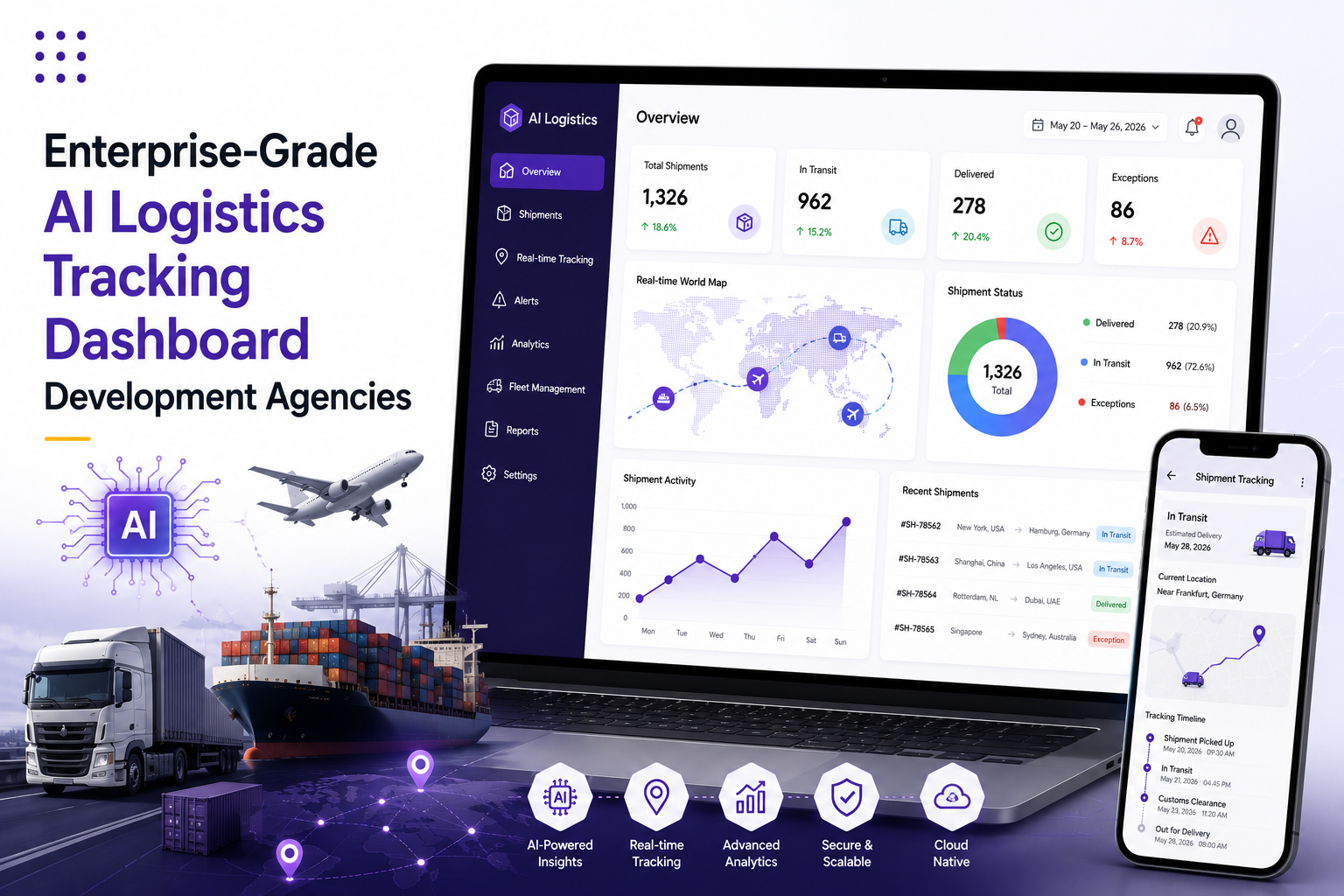

Somewhere in your operations team's inbox right now, there's a spreadsheet nobody trusts. Maybe it's a shipment tracker that three people update manually, or a dashboard that shows yesterday's data as if it were today's. If you're a founder or CEO reading this, you already know the cost of that gap. A late shipment nobody flagged in time. A warehouse manager who finds out about a stockout from a customer complaint instead of a system alert. This is exactly why demand for a proper AI Logistics Tracking Dashboard has moved from "nice to have" to "board-level priority" in the last two years.
The tricky part isn't deciding you need one. It's figuring out who should build it. Search "logistics software development company" and you'll get hundreds of agencies, most claiming the exact same things: AI-powered, real-time, enterprise-grade, scalable. Very few of those words tell you anything useful when you're the one signing a contract worth six figures.
This blog is built for that exact moment of decision-making. We've put together a list of 15 development agencies that build logistics dashboards, fleet visibility tools, and AI-driven tracking systems, along with what each one actually specializes in, so you can shortlist with confidence instead of guessing based on a homepage. No jargon, no filler, just the information a decision-maker needs before picking up the phone.
We also won't pretend every agency on this list is right for you. A team that's great at rebuilding an enterprise TMS from the ground up might be overkill if you're a fast-growing 3PL that just needs shipment visibility live in ten weeks. A boutique AI-first studio might be exactly what you need if forecasting accuracy is your biggest pain point, but the wrong fit if your real problem is 40 disconnected data sources that need to be untangled first. Read this less like a ranking and more like a map, then match the pin on the map to the problem sitting on your desk right now.
Why an AI Logistics Tracking Dashboard Matters More in 2026
Logistics used to run on static reports. Someone pulled numbers at the end of the day, built a summary, and sent it around. That model breaks the moment your operation scales past a handful of vehicles or warehouses, because by the time a report is ready, the situation on the ground has already changed.
An AI Logistics Tracking Dashboard replaces that lag with a live picture. It pulls data from GPS devices, telematics hardware, carrier APIs, and warehouse systems, then uses machine learning to flag delays, predict ETAs, and highlight bottlenecks before they turn into customer complaints. For a CEO, that translates into fewer surprises, tighter margins, and a team that makes decisions on facts instead of guesswork.
There's also a talent angle here that founders tend to underestimate. Building this kind of platform in-house usually means hiring a mix of backend engineers, data scientists, and frontend developers, then keeping them busy long after launch to handle new integrations. Most companies find it faster and considerably cheaper to bring in a development agency that has already solved these problems for other clients, rather than assembling that team from scratch and learning the hard lessons on their own timeline.
The numbers back this up too. Industry research on AI in supply chain operations has repeatedly pointed to double-digit reductions in logistics costs and meaningfully lower forecasting errors once predictive tools replace manual reporting. Even a modest improvement in on-time delivery accuracy or warehouse turnaround compounds quickly across thousands of shipments a year, which is exactly why boards are asking for this now instead of treating it as an IT wish list item for next year's budget.
What to Check Before You Hire a Development Agency
Not every software vendor that mentions AI has actually built logistics systems that survive real-world load. Before you shortlist anyone, look at three things: whether they've shipped tracking dashboards for companies your size, whether they understand integration with ERPs, telematics providers, and carrier networks, and whether they offer long-term support instead of a one-time handoff. A polished portfolio means little if the agency disappears after launch while your dashboard needs constant tuning as your fleet or warehouse network grows.
Pricing models vary just as much as capability, so it helps to know what you're comparing. Some agencies quote a fixed price for a defined scope, which works well if your requirements are locked in. Others offer dedicated teams billed monthly, which gives you more flexibility if the project is likely to grow once the first version ships. And a few operate as staff augmentation partners, embedding engineers directly into your existing team rather than running the project independently. None of these models is inherently better, but the wrong one for your situation can quietly add months to a timeline.
Location matters more than most decision-makers expect too. Agencies based in India and Eastern Europe often deliver the same technical depth as US or Western European firms at a noticeably lower hourly rate, which is why a large share of the agencies below operate from those regions or run distributed teams across them. That doesn't mean location alone should decide anything. What matters is whether the specific team assigned to your project has actually shipped logistics software before, regardless of where their office sits on a map.
With that in mind, here are 15 agencies worth putting on your shortlist.
15 Development Agencies Building AI Logistics Tracking Dashboards in 2026
Making the Final Call
Reading through fifteen agencies can feel like more work than the hiring decision itself, so here's the shortcut. If your priority is unifying messy telematics and carrier data, look closely at RemoteState or A3logics. If AI-driven forecasting is the whole point of the project, HireAIDevelopers and RTS Labs deserve a longer conversation. If you already have a product vision and just need dependable engineering behind it, Backend Development Company or HireFullStackDeveloperIndia can plug in without much overhead. And if this dashboard is part of a much larger transformation, Computools or EPAM Systems have the scale to match.
There's no universal "best" agency here, only the right fit for your operation's size, budget, and technical mess. What matters most is picking a partner who has actually shipped a working AI Logistics Tracking Dashboard before, not one that simply talks about AI convincingly in a sales call. Ask for a real walkthrough of a past dashboard, ask how they handle integration failures, and ask what happens six months after launch. The answers to those three questions will tell you more than any portfolio page ever could.
It's also worth having an honest internal conversation before you approach any of these agencies. Get clear on your must-haves versus your nice-to-haves. A retailer chasing last-mile visibility has a very different priority list than a manufacturer trying to track inbound raw materials across three continents, even though both might describe their need the same way on a call. Write down which carriers, ERPs, and hardware you're already using, because that single document will save weeks of back-and-forth during the discovery phase with any agency you shortlist.
Budget conversations tend to go smoother too when you walk in with a rough number in mind rather than asking an agency to guess your ceiling. Most CEOs find it useful to think in phases: a working version that proves the concept with your core data sources, followed by a second phase that adds AI-driven forecasting, anomaly detection, and deeper integrations once the first version is already earning its keep. That approach spreads risk and gives you an early off-ramp if a partnership isn't working out the way you hoped, instead of locking six months of budget into a single all-or-nothing build.
Finally, remember that the agency relationship rarely ends at launch. Shipment volumes grow, new carriers get added, warehouses open in new regions, and your dashboard needs to keep pace with all of it. Before signing anything, get clarity on what post-launch support actually looks like, how quickly the team responds when something breaks during peak season, and whether ongoing improvements are billed separately or included in an existing retainer. A cheap build with no support plan almost always ends up costing more over two or three years than a slightly pricier partner who sticks around.
None of the fifteen agencies above are interchangeable, and that's the point. The right one depends less on who has the shiniest case study and more on how honestly they answer questions about your specific mess of carriers, warehouses, and legacy systems. Take your shortlist, put the same three or four questions to each of them, and let the quality of their answers, not their marketing page, make the final call for you.