
If you have spent the last few evenings with a dozen browser tabs open, each one a different agency's homepage promising to be the best fintech partner you'll ever hire, you are not alone. Every founder building a lending product eventually hits this exact wall. The technology itself, credit models, document verification, disbursal workflows, is only half the challenge. The other half is figuring out who can actually build it well, on time, and without turning your compliance requirements into an afterthought.
Lending is one of those spaces where a half finished product can do real damage. A buggy checkout page annoys a shopper for a minute. A buggy credit decision can lock a real person out of a loan they genuinely qualified for, or worse, approve one they cannot repay. That is why founders in this space tend to spend more time vetting development partners than in almost any other industry, and why a simple, honest comparison list is more useful here than another glossy case study page.
This list is not a ranked popularity contest. It is a practical rundown of 15 development agencies that founders and decision makers are genuinely considering in 2026 when they set out to build an AI Loan Approval Platform, along with the kind of details you would actually want to know before picking up the phone. No fluff, no recycled marketing copy, just what each company tends to be good at and who they tend to suit best.
What Does an AI Loan Approval Platform Actually Do?
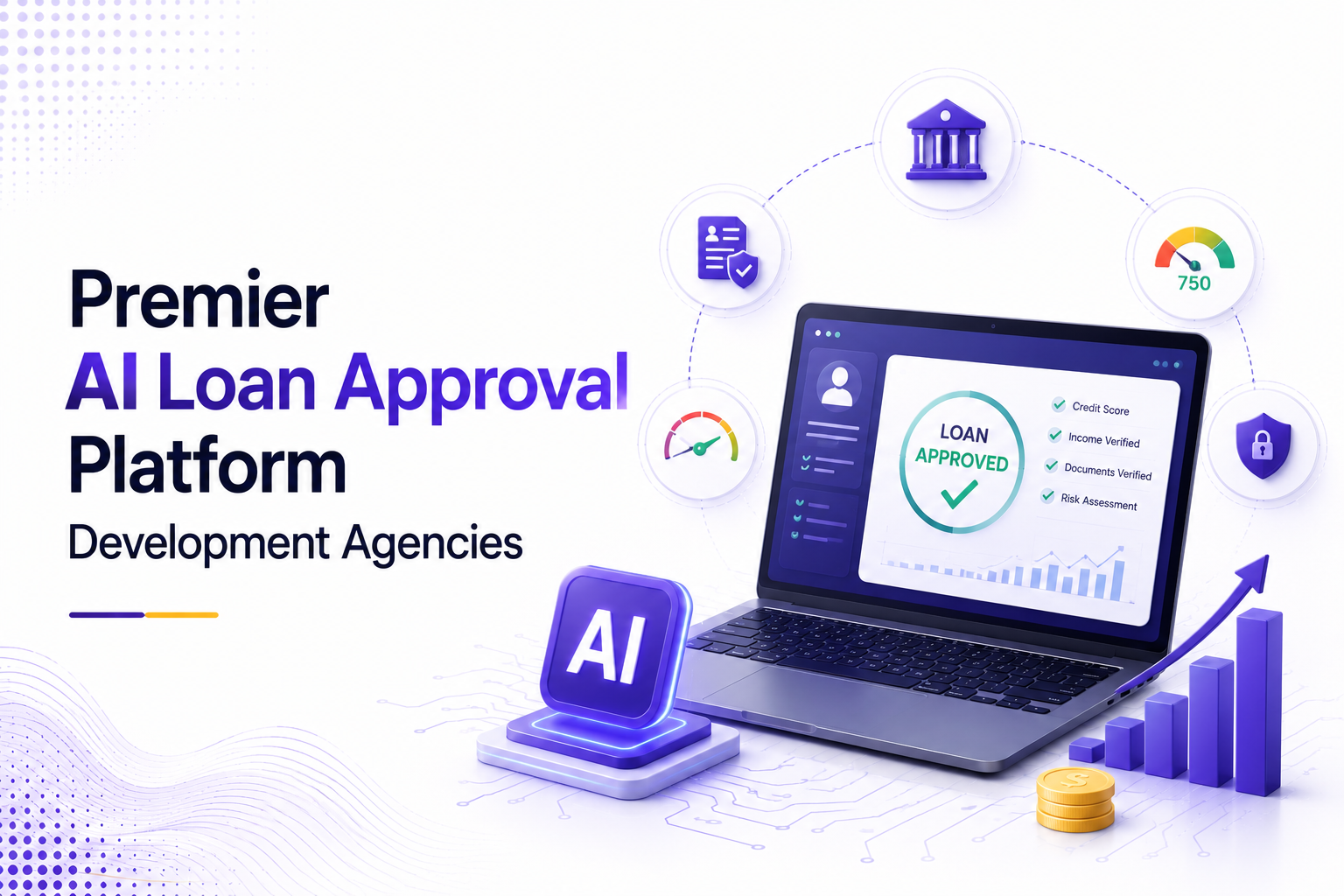
An AI Loan Approval Platform is basically software that helps banks, NBFCs, or lending startups decide who should get a loan, without a human manually checking every single application.
In simple words, when someone applies for a loan online, this platform takes over the boring, repetitive parts of the process and makes the decision faster and more accurate using artificial intelligence.
Here's what it actually does, step by step:
- Collects the application: Takes in the borrower's details, like income, employment, ID proof, and bank statements, usually through a simple online form.
- Verifies documents automatically: Uses AI to scan ID cards, salary slips, and bank statements instead of a person checking them manually. This is often called document OCR (basically, the computer "reads" the document).
- Checks credit history: Connects with credit bureaus (like CIBIL in India or Experian in the US) to pull the person's credit score and repayment history.
- Look at extra data too: Many modern platforms also check things like bank transaction patterns or bill payment history, especially useful for people who don't have a long credit history.
- Runs a risk score: The AI model looks at all this data and calculates how likely the person is to repay the loan on time. This is the "brain" of the platform.
- Makes a decision: Based on that risk score, it either approves, rejects, or flags the application for a human to review manually.
- Explains the decision: A good platform doesn't just say yes or no, it also gives reasons, which is important for regulations and for the borrower to understand.
- Disburses the loan: Once approved, it can trigger the actual money transfer to the borrower's account, sometimes within minutes.
So in short, instead of a loan officer spending days going through paperwork, the AI Loan Approval Platform does most of that work in minutes, while still keeping things accurate, fair, and compliant with lending rules.
What to Look For Before You Sign a Contract
A polished portfolio page will only tell you so much. The real differences between agencies tend to surface once you start asking about the day to day realities of building and running a lending product. Here is a short checklist worth working through with any vendor you are seriously considering.
- Fintech or lending specific project history, not just generic AI experience
- A clear approach to data security and regulatory compliance
- Transparent pricing and engagement models, whether hourly, dedicated team, or fixed scope
- Willingness to explain their AI models rather than treating them as a black box
- Post launch support, since lending platforms need ongoing monitoring and updates
None of these points are deal breakers on their own if an agency is missing one, but together they give you a fairly reliable picture of how a team actually operates once the contract is signed and the real work begins. Keep this list handy while you go through the profiles below.
Budget expectations are worth setting early too. A basic MVP with a rules based approval engine can start around 15,000 to 25,000 dollars, while a full AI driven decisioning system with multiple integrations and ongoing model training tends to land somewhere between 60,000 and 150,000 dollars depending on scope and region. Agencies that quote well below this range for a genuinely AI powered product are usually cutting corners somewhere, often in security testing or in the depth of the underlying model, so it pays to ask exactly what is included before comparing two proposals side by side.
15 Development Agencies Worth Shortlisting in 2026
Here is the list, presented company by company so you can quickly scan for the details that matter most to your project.
Hourly Developers
Hourly Developers has built a name for itself among founders who want flexibility without losing control over quality. Instead of locking clients into rigid packages, the company works on transparent hourly and dedicated hiring models, which is a big deal when you are building something as data heavy and compliance sensitive as an AI Loan Approval Platform. Their engineers are comfortable with machine learning pipelines, credit scoring logic, and secure API integrations with banking and NBFC systems. What founders tend to like most is the ability to scale the team up or down as the project moves from prototype to production. If you want a partner who treats your fintech idea like their own product rather than just another contract, Hourly Developers is worth a serious look in 2026.
HireAIDevelopers
As the name suggests, HireAIDevelopers focuses almost entirely on artificial intelligence and machine learning talent, which makes them a natural fit for anyone building a lending or credit risk product. Their teams typically work on model training, fraud detection layers, and automated decisioning engines that sit at the heart of a modern AI Loan Approval Platform. Clients often mention their structured onboarding process, where a technical lead maps out the data architecture before a single line of code is written. This upfront planning tends to save a lot of rework later, especially when regulatory reporting requirements change mid project. For CEOs who want deep AI expertise rather than a generalist dev shop, this is one of the more focused options on the market.
Backend Development Company
Backend Development Company, true to its name, specializes in the server side architecture that keeps a lending platform stable under real world traffic. Loan approval systems live and die by how well they handle concurrent applications, third party credit bureau calls, and document verification workloads, and this is exactly where their team shines. They work with Node.js, Python, and Java stacks, and they are known for building microservices that can be updated independently without taking the whole system offline. Founders comparing vendors often bring them in specifically for the infrastructure and database design phase, even when the front end or AI modeling is handled elsewhere. Their focus on uptime and secure data handling makes them a dependable long-term support partner for financial products.
HireFullStackDeveloperIndia
HireFullStackDeveloperIndia has built its reputation on offering experienced full stack talent at competitive rates, which appeals strongly to startups watching every dollar of runway. Their developers handle everything from the customer facing loan application forms to the underlying decision engines, so founders do not need to juggle separate front end and back end vendors. The company is often chosen by teams that already have a rough product roadmap and simply need hands-on execution without months of discovery calls. Communication happens through daily standups and shared project boards, which keeps distributed teams on the same page across time zones. For a founder who wants speed without sacrificing the quality of a compliance heavy financial product, they are a practical middle ground. Their pricing structure is also fairly transparent upfront, which makes it easier to compare their proposal against other vendors without hidden surprises later in the project.
ValueCoders
ValueCoders is one of the more established outsourcing names in India, with a track record spanning software teams that build everything from e-commerce platforms to fintech tools. Their fintech unit has experience with loan origination systems, KYC automation, and integrating third party credit scoring APIs, all of which are core building blocks of a reliable lending product. Clients frequently mention their structured project management process, which includes weekly sprint reviews and clear documentation, something founders comparing multiple vendors tend to appreciate. Because the company has scaled to a fairly large in-house team, they can staff bigger projects quickly without the delays smaller shops sometimes face. They are a solid pick for founders who want an established partner with proven delivery discipline.
OpenXcell
OpenXcell brings a product engineering mindset to fintech projects, meaning they tend to push back on vague requirements and ask the hard questions early, which actually saves founders time down the line. Their teams have worked on risk scoring dashboards, automated underwriting logic, and mobile lending apps, giving them practical exposure to the kind of regulatory and security considerations that come with financial software. They also run an in-house innovation lab that experiments with newer AI models, which sometimes finds its way into client projects as an added value add rather than a separate cost. Founders who want a partner that thinks about the product roadmap, not just the code, often shortlist OpenXcell early in their vendor search.
Matellio
Matellio positions itself as a digital transformation partner for banks, NBFCs, and fintech startups, and their portfolio reflects a fair amount of work on credit and lending automation. They tend to start engagements with a discovery workshop that maps out the entire loan lifecycle, from application intake to disbursal, before recommending a technical architecture. This process heavy approach can feel slower at first, but it usually results in fewer surprises once development begins. Their engineers are comfortable with cloud native architectures on AWS and Azure, which matters a lot for platforms that need to scale during peak application seasons. For founders who value a consultative style over a purely execution focused vendor, Matellio is a strong contender.
Intellectsoft
Intellectsoft has worked with mid sized and enterprise clients across banking, insurance, and lending, giving them a level of exposure to regulatory nuance that smaller agencies sometimes lack. Their teams have handled projects involving automated credit decisioning, document OCR for loan applications, and integrations with core banking systems, which are all pieces founders need when scoping out a serious lending product. They also maintain a dedicated quality assurance practice, running security and performance testing as a standard part of every sprint rather than an afterthought. This can add a bit to the timeline, but for a product handling sensitive financial data, that extra diligence is usually worth it. Larger startups with bigger budgets tend to gravitate toward Intellectsoft for this reason.
Appinventiv
Appinventiv has built a broad portfolio across mobile and web app development, and their fintech division has delivered projects touching digital lending, insurance, and wealth management. They are known for combining design led thinking with engineering, so the resulting loan application flows tend to feel less clunky than what founders sometimes get from purely backend focused shops. Their teams also have hands-on experience with AI driven credit risk models and chatbot based customer support for lending apps, which can be a nice add-on for startups wanting a more modern user experience. Because they work with a wide range of industries, some founders prefer to pair them with a more specialized fintech partner for the compliance heavy backend pieces.
SoluLab
SoluLab has carved out a niche in blockchain, AI, and fintech development, which puts them in a good position for founders exploring newer approaches to credit assessment, such as alternative data scoring or decentralized identity verification. Their engineering teams are comfortable building custom machine learning models trained on transaction history, repayment behavior, and alternative credit signals, all of which feed into a modern underwriting engine. They also offer a fairly flexible engagement model, ranging from a dedicated team to a fixed scope project, which suits founders who are not yet sure how their requirements will evolve. Startups exploring more experimental or non traditional lending models often find SoluLab receptive to unconventional ideas that bigger, more process heavy agencies might hesitate to take on.
Konstant Infosolutions
Konstant Infosolutions has been around long enough to have worked across several technology cycles, and their fintech projects include loan management systems, payment gateway integrations, and customer onboarding portals. Founders often mention their responsiveness during the proposal stage, with detailed cost breakdowns and realistic timelines rather than vague estimates. Their development team works primarily out of India, which keeps costs competitive while still maintaining regular overlap hours with clients in the US and Europe. They are not exclusively an AI shop, so founders building a heavily model driven decisioning engine may want to pair them with a specialized data science partner, but for the surrounding platform, application forms, admin dashboards, and reporting tools, they are a dependable choice. Their long operating history also means they have a decent bench of QA and DevOps staff to draw from, which smaller boutique shops sometimes lack.
Debut Infotech
Debut Infotech has increasingly focused on AI and blockchain projects over the past few years, and their team has picked up practical experience building credit scoring models and fraud detection systems for lending clients. They tend to work well with early stage founders who need a partner comfortable moving from a rough idea to a working prototype quickly, without months of upfront paperwork. Their pricing tends to sit on the more affordable end compared to larger agencies, which makes them attractive to bootstrapped startups watching their budget closely. That said, founders planning a larger enterprise grade rollout may want to confirm the team size and scaling capacity upfront, since Debut Infotech is a leaner shop than some of the bigger names on this list.
Aalpha Information Systems
Aalpha Information Systems has a long standing reputation for custom software development, and their fintech work includes loan origination platforms, credit risk dashboards, and secure document management systems. They tend to assign a dedicated project manager to every engagement, which founders often cite as a reason communication stays smooth even across long term projects. Their engineering team has experience integrating with third party credit bureaus and payment processors, both of which are essential when building a functional lending product rather than just a demo. Aalpha also offers a hybrid engagement model where part of the team works onsite for clients who want that option, alongside a larger remote team, giving founders some flexibility in how closely they want to manage day to day development. Their experience spans well over a decade of custom software delivery, which shows in how methodically they scope out edge cases before development begins.
Zibtek
Zibtek is a US based software development company that pairs American project management with an offshore engineering team, which appeals to founders who want a local point of contact but still need to manage development costs. Their portfolio includes fintech projects covering loan servicing platforms, automated underwriting tools, and customer facing lending portals. Because their account managers are based in the US, time zone overlap and contract structuring tend to feel more familiar to American founders compared to fully offshore agencies. Zibtek is generally a good fit for startups that want the cost benefits of an outsourced engineering team without giving up the comfort of dealing with a local business entity for contracts, invoicing, and ongoing support conversations. Their willingness to sign under US style contracts and terms also tends to simplify legal review for early stage founders working with a lean legal budget.
Space-O Technologies
Space-O Technologies has built a reputation primarily in mobile app development, but their fintech portfolio has expanded to include lending apps, expense tracking tools, and AI powered budgeting assistants. Their strength lies in building polished, user friendly mobile experiences, which matters a lot for consumer facing lending products where drop off during a loan application can directly hurt conversion rates. They typically pair a UI or UX designer with the development team from day one, rather than treating design as a separate phase, which tends to shorten the overall project timeline. Founders building a mobile first lending product, rather than a purely backend or enterprise facing system, often find Space-O a natural fit for their shortlist.
Final Thoughts
There is no single right answer here. The best fit depends on your budget, your timeline, and how much of the AI and compliance work you already understand versus how much you need a partner to guide you through. What matters most is picking a team that has genuinely worked on financial software before, asks good questions during the proposal stage, and is upfront about trade offs rather than promising everything at once.
It is also worth remembering that this decision does not need to be permanent. Plenty of founders start with a smaller, cost conscious team to validate the product, then move to a larger, more specialized agency once the platform proves itself and application volumes grow. What matters in that first phase is momentum and a partner who genuinely listens, not necessarily the biggest name on the list.
Whichever names from this list you end up calling, treat the first conversation as a filter. A team that truly understands how to build an AI Loan Approval Platform will talk about data pipelines, explainability, and compliance before they talk about pricing packages. That single conversation usually tells you more than any portfolio page ever will.