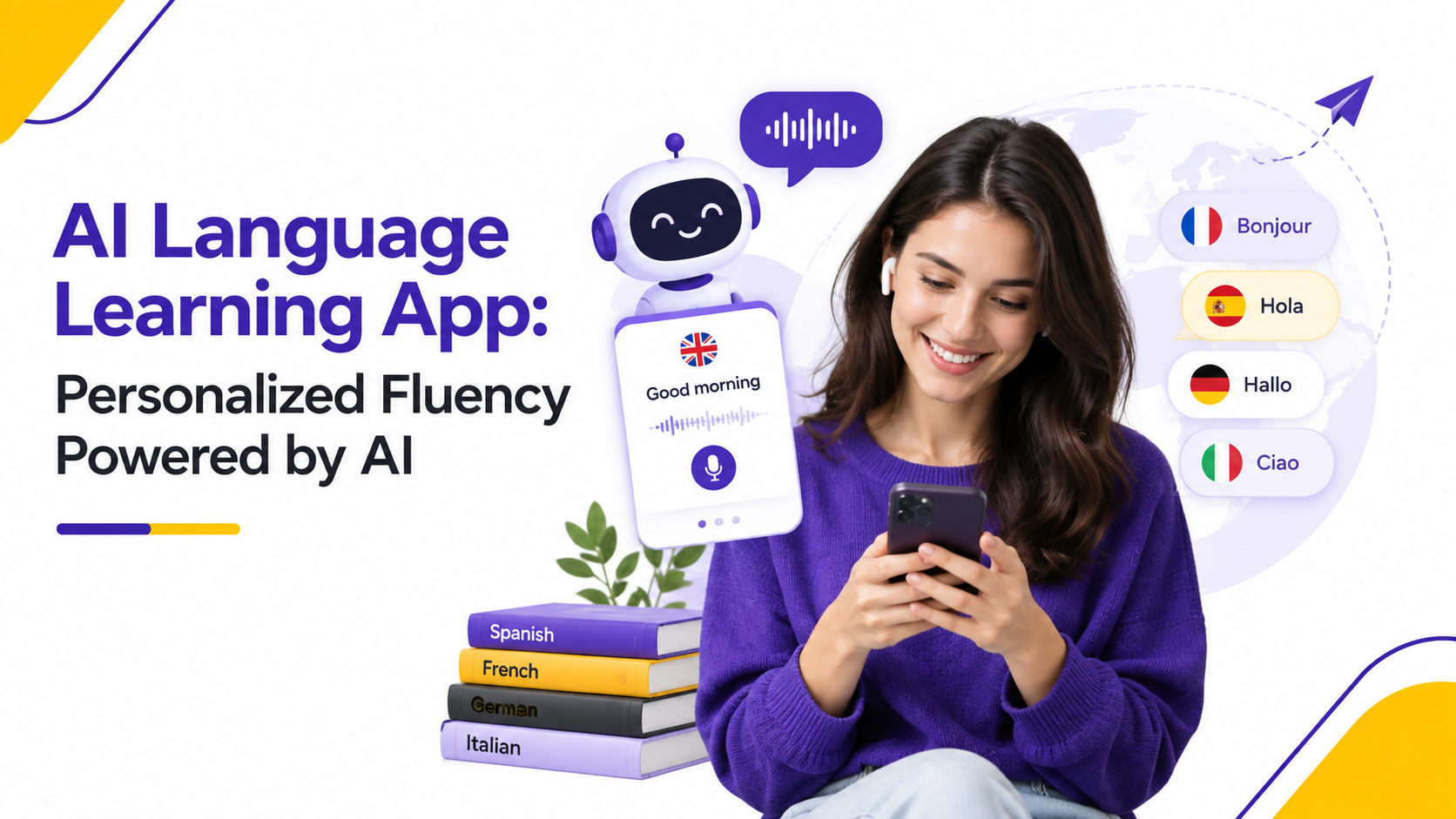

Ask five people how they are learning a new language this year, and at least three will mention an app before they mention a classroom. That shift did not happen by accident. It happened because the software got smarter.
An AI language learning app no longer just quizzes you on flashcards and waits for you to fail. It listens to how you actually speak, notices where you hesitate, and rebuilds the next lesson around your specific gaps. For founders and product teams watching this space, that difference is the entire business opportunity.
The old model of language software was static. You bought a course, worked through fixed units in a fixed order, and the app had no real idea whether you understood a concept or just got lucky on a multiple choice question. That gap between looking correct and actually being fluent is exactly what modern AI models are built to close.
This guide breaks down what makes these apps work, what a strong build actually includes, and what separates a genuinely useful AI language learning software product from one that just bolts a chatbot onto an old curriculum. Whether you are scoping a build internally or comparing outside teams to hire, the same technical questions apply.
What Is an AI Language Learning App?
At its core, an AI language learning app is a piece of software that uses machine learning, natural language processing, and speech technology to teach a language in a way that adjusts to the person using it. Instead of every learner moving through the same fixed unit order, the app watches performance in real time and reshapes the path forward.
That might mean slowing down on verb conjugation because a learner keeps missing it, or skipping ahead on vocabulary the learner has already proven they know. It might mean listening to a spoken sentence and flagging the exact syllable where pronunciation drifted off. None of this is guesswork. It runs on models trained to recognize patterns in how people actually acquire language, then act on those patterns immediately rather than waiting for a weekly test.
It is worth separating this from earlier versions of digital language tools. Plenty of older apps used the word smart loosely, mostly meaning the app tracked which lessons a user completed. A true AI driven build goes further because it makes decisions. It chooses what to show next, how difficult to make it, and when to intervene, based on a constantly updating picture of that one learner rather than a generic curriculum everyone shares.
That distinction matters for anyone comparing products or planning a build, because it changes what actually needs to be engineered. A content library is a content problem. An adaptive learning experience is a data and modeling problem, and it needs to be treated that way from the earliest planning stages rather than added on as a feature later.
Why AI Language Learning Software Is Having a Moment in 2026
The global market for language learning applications is projected to reach roughly $6.7 billion in 2026, with steady double digit growth expected through the next decade as demand for cross border communication and remote work keeps climbing. That growth is not just about more downloads. It reflects a real change in how people expect to learn.
Natural language understanding accuracy in mainstream apps has now crossed the 95 percent mark, which means grammar and pronunciation feedback can go far beyond a simple right or wrong answer. Platforms that lean into adaptive algorithms are seeing engagement climb by close to 30 percent compared to static, one size fits all courses. Learners are not just tolerating AI language learning software anymore. They expect it.
For anyone building or investing in this space, that expectation raises the bar. A product without adaptive feedback in 2026 reads as outdated the moment a user compares it to something that talks back.
There is also a corporate angle that is easy to underestimate. Businesses expanding into new markets increasingly buy language training as a benefit for relocating or globally distributed staff, and they want measurable proof it works, not just a completion certificate. That has pushed demand toward apps with detailed skill level reporting that a manager or HR team can actually read and act on.
None of this means every app needs every advanced feature on day one. It means the direction of the market is clear enough that skipping AI entirely is no longer a safe default for a new language learning product.
Investor interest has followed the same pattern. Products that can point to real engagement lift from adaptive features, rather than just download numbers, tend to have an easier time making the case that their technology is a genuine moat rather than a content library anyone could replicate.
Core Features Inside a Modern AI Language Learning App
Not every feature needs to be built on day one, but these are the pieces users have come to expect from serious language learning software. Think of this less as a checklist to build all at once and more as a map of where the product needs to end up.
Most successful launches start with three or four of these done well rather than all eight done shallow. Speech recognition, adaptive sequencing, and a basic analytics dashboard tend to be the highest impact starting point, with conversational AI and offline mode following once the core model has enough real usage data to be reliable.
How AI Actually Personalizes the Learning Journey
Personalization sounds like a marketing word until you see the mechanics behind it. Here is what is really happening under the hood.
Building a Learner Profile From Day One
The moment someone starts a lesson, the app begins collecting signals. Response time, accuracy on specific grammar patterns, pronunciation clarity, and even how often a learner replays an audio clip all feed into a profile that updates continuously rather than sitting still after an initial placement test.
Adjusting Difficulty Without the Learner Noticing
Good adaptive systems do not announce themselves. A learner who is breezing through past tense exercises will start seeing slightly more complex sentence structures worked in, while someone who is struggling gets a few extra low pressure repetitions before the difficulty ramps back up. The transition feels smooth, not like a sudden test.
Turning Mistakes Into the Next Lesson
This is where an AI language learning app earns its name. Instead of storing an error in a report nobody reads, the system feeds that mistake directly into what gets taught next. Miss three questions on subjunctive mood and the following session quietly rebuilds itself around that gap.
Over weeks of use, this compounds. A learner who struggles with a particular sound or grammar rule will see it resurface at increasing intervals, spaced out just enough to test whether the correction actually stuck, rather than repeated so often that it feels like punishment.
Reading Beyond the Right or Wrong Answer
A well built model does not just mark an answer correct or incorrect. It looks at how close the answer was, how long it took to respond, and whether the mistake was a spelling slip or a genuine misunderstanding of the grammar rule. Those are very different problems, and treating them the same wastes a learner's time.
Who Actually Benefits Most From an AI-Driven Approach
Personalization is not equally valuable to every kind of learner. Here is where it tends to make the biggest difference.
AI Language Learning Software vs Traditional Course Apps
It helps to see the difference laid out side by side, since the gap is not always obvious from a marketing page alone.
Must-Have Features Checklist Before You Call It an AI Product
A quick way to test whether a product genuinely qualifies as AI driven, or is just using the label, is to run it against this short list.
• Feedback that changes the next lesson, not just a score at the end
• Speech recognition tuned for accents, not just one standard dialect
• A conversation mode that can hold context across several exchanges
• Analytics that break fluency into separate skills instead of one blended number
• A model that keeps learning from aggregate user data over time
The AI Technologies Powering These Apps
A handful of technical building blocks show up again and again across serious language learning software.
• Natural language processing (NLP), which lets the app parse grammar, meaning, and intent in what a learner types or says
• Automatic speech recognition (ASR), tuned specifically for language learners rather than native speaker dictation
• Generative AI, used to create unlimited conversation scenarios instead of relying on a fixed script library
• Machine learning models that predict which words or grammar points a specific learner is likely to forget next
• Text to speech engines that produce natural sounding audio across dozens of languages and accents
• Sentiment and confidence detection, which some apps use to notice frustration and slow the pace before a learner disengages
None of these pieces work well in isolation. The strongest AI language learning software stitches them together so speech recognition, adaptive sequencing, and generative conversation all feed the same learner profile instead of operating as separate bolted on tools.
How These Apps Get Built, Step by Step
For teams scoping a build, the process tends to follow a fairly consistent arc.
1. Define the learning model first
Before any code gets written, the pedagogy needs to be settled. Which languages, which proficiency levels, and which teaching method the AI will reinforce, since this decision shapes every technical choice that follows it.
2. Choose or train the speech and NLP models
Teams either fine tune existing speech and language models on learner specific data or, less commonly, build proprietary models from scratch. Fine tuning existing models is usually faster and cheaper, and it is the more common path for teams outside the largest platforms.
3. Build the adaptive engine
This is the logic layer that decides what a learner sees next based on performance signals, usually the most time intensive part of the build. It needs to be designed early because nearly every other feature ends up feeding data into it.
4. Design the conversation and content layers
Dialogue trees, generative prompts, and lesson content get built and connected to the adaptive engine so difficulty can flex in real time. Content teams and engineers typically work in parallel here rather than in sequence, to keep the timeline reasonable.
5. Test with real learners across accents and skill levels
Speech recognition in particular needs testing across a wide range of accents before launch, since accuracy gaps here directly hurt trust in the product. This stage is where most timeline overruns happen, and it is worth budgeting extra time for it.
6. Launch, then keep training the model
The AI keeps improving after launch as it collects more usage data, so the roadmap never really has a finish line. Teams that treat launch as the end of the AI work tend to see their adaptive accuracy stall within a few months.
Signs the AI Model Is Actually Working, Not Just Present
A working adaptive system leaves a specific trail of evidence. Here is what to look for, whether you are testing your own build or evaluating a finished product.
• Repeat mistakes drop off within a handful of sessions instead of resurfacing indefinitely
• Session difficulty feels appropriately challenging rather than either too easy or randomly hard
• Speech feedback correctly recognizes near misses instead of rejecting anything that is not a perfect match
• Two learners with different weak points are shown noticeably different content within the same week
• Engagement metrics improve over time rather than staying flat once the novelty of a new app wears off
What to Look for in AI Language Learning App Development Companies
Founders evaluating AI language learning app development companies are usually comparing teams on price first and capability second. That order should probably flip.
Building a language app that simply stores lessons in a database is a very different job from building one that can score pronunciation, hold an open conversation, and adapt in real time. Not every development shop that lists AI on their homepage has actually shipped a speech recognition pipeline or trained an adaptive difficulty model before.
Price comparisons across proposals can also be misleading if the scope is not identical. A quote that looks cheaper might simply be excluding the adaptive engine, the accent testing, or the retraining pipeline that keeps the model improving after launch, all of which show up as change orders later if they were never scoped in the first place.
It also helps to ask how a team handles the boring parts of an AI build, like data labeling, edge case testing, and ongoing model monitoring. These are not the parts anyone puts on a portfolio site, but they are usually the difference between a demo that impresses in a meeting and a product that holds up once thousands of real learners with different accents and habits start using it daily.
Questions worth asking before signing a contract
• Have they shipped a product with real time speech recognition, not just text based chat features
• Can they show how their adaptive engine actually adjusts content, not just describe it in a pitch deck
• Do they have experience with the specific languages and accents your target users speak
• How do they handle model retraining and data privacy once the app is live and collecting learner data
• What does their post launch support and iteration process look like, since these products keep evolving after release
The strongest AI language learning app development companies tend to talk about failure cases as readily as success stories, since an honest team will tell you upfront where their adaptive models still struggle.
Common Challenges Teams Run Into
Even well funded, well intentioned builds run into the same handful of problems. Knowing them ahead of time is far cheaper than discovering them after launch.
• Speech recognition that performs well on one accent but poorly on others, which quietly alienates entire user segments
• Adaptive systems that adjust difficulty too aggressively, making learners feel punished rather than supported after a few mistakes
• Content libraries that are large but shallow, leaving the AI with too little material to meaningfully personalize around
• Underestimating how much ongoing data and retraining an adaptive model needs after launch to keep improving
• Treating AI as a single feature to add later instead of the core architecture the whole product is built around
• Skipping a feedback channel for learners to flag when the AI got a correction wrong, which is often the fastest source of model improvement available
What Influences the Cost of Building One
Budget conversations tend to circle back to the same handful of variables, and understanding them ahead of time makes it much easier to compare quotes from different teams on equal footing.
None of these variables move independently. Adding a fourth language, for instance, does not just mean more content. It usually means more speech model tuning, more accent testing, and a larger QA pass before that language is ready to ship, which is why scope creep on language count is one of the most common ways budgets drift.
Where AI Language Learning Apps Are Headed Next
The tutor led, live instruction segment is still growing at a healthy pace even as AI adoption climbs, which suggests the future is not AI replacing human teachers outright. It looks more like AI handling the repetitive, data heavy parts of learning while live instruction covers nuance, culture, and real conversation practice.
Expect more apps to blend the two, offering AI driven daily practice with optional live sessions layered on top. Expect speech recognition to keep narrowing its accent gaps, generative AI to make conversation practice feel less scripted, and progress tracking to get more granular as models get better at isolating exactly which skill needs attention.
Corporate and institutional buyers are likely to push this shift further. As more companies fund language training for globally distributed teams, expect demand for reporting that ties learning progress to actual on the job outcomes, not just app usage minutes, which will pressure vendors to build more sophisticated analytics than most currently offer.
The apps that win the next few years will likely be the ones that treat the AI as the product, not a feature bolted onto an existing course library.
Conclusion
There is no shortage of apps promising to make you fluent. The ones that actually deliver share a common thread: a genuine AI language learning app does real work in the background, noticing patterns, adjusting difficulty, and correcting pronunciation in ways a static course simply cannot.
Whether you are building one of these products or choosing a partner to build it for you, the questions worth asking stay the same. Does the feedback loop actually change what happens next for the learner, or does it just log a score and move on? Get that answer right, and the rest of the product tends to follow.
The market has already made its preference clear. Learners are choosing software that adapts to them over software that expects them to adapt to it, and that gap is only going to widen as the underlying models keep improving.