
Picking a development partner for a connected device project is a strange kind of decision. It is technical enough that a wrong choice can quietly cost months of rework, yet it is often made by people whose day job is not engineering at all. Founders, operations heads, and product managers get handed the task, told to “find an IoT team,” and left to figure out how to tell a genuinely capable agency apart from one that is simply good at marketing itself.
If you have ever tried to Google “best IoT development company” at 11 pm with a half-finished product roadmap open in another tab, you already know the problem. Every agency website looks the same. Same stock photos of glowing circuit boards, same claims of being “industry leaders,” same vague promises of “end to end solutions.” None of that tells you who can actually take your sensors, your data streams, and your business rules, and turn them into a monitoring system that your operations team will trust at 3 am when a machine starts overheating.
That is really what this article is about. Connected devices are everywhere now, in factories, warehouses, hospitals, farms, and even city streets, and the real value only shows up when someone builds the software layer that watches all of it, makes sense of it, and warns you before something breaks. That software layer is what people mean when they talk about an AI IoT Monitoring Platform, and building one well is a genuinely specialized skill. Below, we have put together ten development agencies worth shortlisting in 2026, along with the kind of practical detail a founder or decision maker actually needs before picking up the phone.
What Exactly Is an AI IoT Monitoring Platform, and Why Should You Care
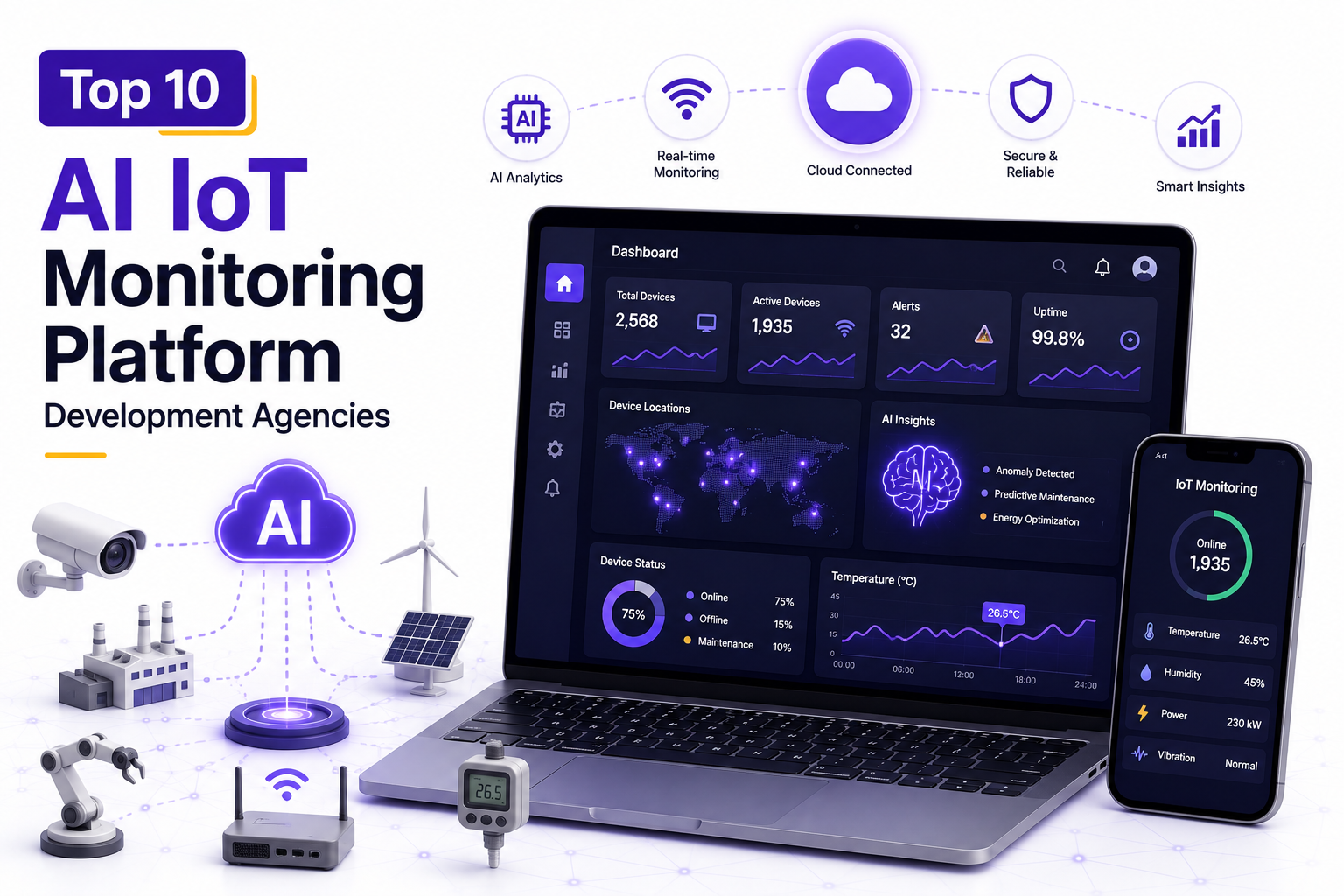
In plain terms, an AI IoT Monitoring Platform is software that collects data from connected devices and sensors, runs it through machine learning models, and gives you a live picture of what is happening, along with predictions about what might happen next. Instead of a technician manually checking a dashboard every hour, the system flags anomalies on its own, predicts equipment failures before they occur, and sends alerts to the right person at the right time. For a manufacturing plant, that could mean catching a failing motor bearing weeks in advance. For a logistics company, it could mean knowing a refrigerated truck is losing temperature before the cargo spoils. The technology has matured a lot heading into 2026, and the agencies that build these systems well combine three skills that rarely live in the same team: solid IoT engineering, real machine learning experience, and an understanding of how businesses actually operate on the ground.
What has changed heading into 2026 is not the basic idea, monitoring connected devices has been around for a while, but how affordable and reliable the AI layer has become. A few years ago, predictive analytics on sensor data was expensive to build and often unreliable in practice, mostly useful for large enterprises with dedicated data science teams. Today, cloud providers ship pre-trained models and managed machine learning pipelines that smaller development agencies can plug into and customize, which means a mid-size business can now afford a monitoring platform that would have required a six figure in-house data team not long ago. That shift is exactly why so many new agencies have entered this space, and why picking the right one matters more than ever.
What to Check Before You Hire One
A few things matter more than a polished portfolio page. Ask about their experience with real time data pipelines, since a monitoring platform that lags behind by ten minutes defeats the purpose. Ask how they handle device diversity, because most businesses run a mix of old and new hardware, not a single clean sensor type. And ask about their pricing model upfront, because hourly, fixed cost, and dedicated team arrangements all suit different project stages.
It also helps to ask how a team handles data security, since a monitoring platform is only as trustworthy as the pipeline feeding it, and a single weak link in device authentication can undo months of good engineering. Look for teams that talk about encryption, access control, and audit logs without being prompted, since that usually signals they have shipped production systems before rather than just prototypes. Finally, ask for a reference client in a similar industry. A company that has built a fleet monitoring system for a logistics business may not automatically transfer that experience to a hospital equipment monitoring project, even though both fall under the same broad IoT umbrella.
Budget honesty matters too. Some agencies quote a low starting number to win the deal and then add costs later for things like cloud hosting, third party API fees, or ongoing model retraining. Ask what is included in the quoted price and what happens after launch, since a monitoring platform is never really finished. Sensors get added, business rules change, and models need retraining as conditions shift, so the relationship with your development partner usually continues well past the initial launch date. With that context in mind, here is the list.
A Few Trends Shaping These Projects in 2026
Edge computing has quietly become a default requirement rather than a nice extra. Instead of sending every single reading up to the cloud, more platforms now process data closer to the device itself, cutting down on latency and bandwidth costs while still syncing the important summaries upward. Agencies that understand edge architecture, not just cloud dashboards, tend to deliver systems that hold up better once real device volume kicks in.
There is also a growing expectation that monitoring platforms explain their alerts rather than just issuing them. A prediction that simply says “anomaly detected” is far less useful to a technician than one that says which sensor triggered it and why the pattern looks unusual. The better agencies on this list build that explainability into their models from the start, rather than bolting it on after clients complain that they cannot trust a black box.
The Top 10 AI IoT Monitoring Platform Development Agencies in 2026
1. Hourly Developers
Hourly Developers, operating as HourlyDeveloper.io, tops this list for a simple reason: flexibility paired with genuine technical depth. The company has been serving clients since the mid 2000s and has built a reputation around hiring models that scale with a project, whether that means one developer for a few weeks or a full dedicated team for years. Their engineers work across Python, Node.js, and cloud platforms, and the company lists IoT solutions and analytics among its core service lines alongside web and mobile development.
Best for: Startups and mid-size businesses that want a cost-effective, in-house-team feel
Engagement model: Hourly, part-time, full-time, and dedicated team hiring
Strengths: Fast onboarding, transparent communication, and a track record with enterprise clients including large public sector projects
For a business that wants to build an AI IoT Monitoring Platform without committing to a rigid, one-size-fits-all contract, Hourly Developers offers one of the more adaptable starting points on this list. Their willingness to scale a team up or down mid-project is genuinely useful for monitoring platforms, since requirements tend to shift once the first batch of live sensor data starts coming in and stakeholders see what is actually possible.
2. HireAIDevelopers
HireAIDevelopers, found at hireaidevelopers.io, positions itself purely around artificial intelligence, which is a useful angle if the machine learning side of your monitoring platform is your biggest concern. The company reports a team of more than 180 developers and over 120 completed AI projects, with services spanning custom AI model development, data engineering, and ongoing maintenance and support after launch.
Best for: Companies that already have IoT hardware and data flowing, but need the AI layer built or improved
Engagement model: Project based and dedicated resource hiring
Strengths: Deep focus on data engineering, meaning the unglamorous but critical work of cleaning and structuring sensor data before it ever reaches a model
This kind of specialization matters more than people expect. A monitoring system can have flawless hardware and a beautiful dashboard, but if the machine learning model behind the alerts was trained on messy or inconsistent data, it will either miss real problems or flood your team with false alarms until nobody trusts it anymore. Teams that treat data engineering as a first-class discipline, rather than an afterthought, tend to avoid that trap.
3. HireFullStackDeveloperIndia
HireFullStackDeveloperIndia has been active since 2004 and is based out of Ahmedabad, India, with a team that covers full stack, backend, and frontend work under one roof. Their listed specialties include MEAN and MERN stack development, Microsoft Azure integration, .NET Core, and AI-driven development, which makes them a reasonable fit for teams that want one vendor handling both the device side and the dashboard side of a monitoring build.
Best for: Businesses that want a single team covering the full technology stack, from database to user interface
Engagement model: Hourly, part-time, and full-time contracts, with NDAs signed as standard practice
Strengths: Broad technology coverage and a client onboarding process built around detailed requirement analysis before development starts
Having one team own both the device-facing backend and the user-facing frontend can cut down on the miscommunication that often happens when two separate vendors have to coordinate on data formats and API contracts. For businesses that have felt the pain of two agencies blaming each other when something breaks, that alone can be worth the trade-off.
4. Backend Development Company
As the name suggests, this agency concentrates on the part of the system most users never see but every monitoring platform depends on completely. Backend Development Company builds the APIs, database architecture, and microservices that pull data from thousands of devices and keep it flowing without bottlenecks. For an AI IoT Monitoring Platform specifically, this is the layer that decides whether alerts arrive in real time or five minutes too late.
Best for: Businesses that already have a frontend or IoT hardware partner and specifically need robust backend infrastructure
Engagement model: Project based development and ongoing backend maintenance contracts
Strengths: Deep specialization in database design, third party integrations, and performance optimization for high traffic systems
It is easy to underestimate how much backend work goes into a monitoring platform until you are the one debugging why data from three thousand devices is arriving out of order. A team that specializes purely in this layer tends to catch scaling issues early, long before they turn into a production outage that erodes user confidence in the system.
5. Softweb Solutions
Softweb Solutions, an Avnet company, has built a name for itself specifically in IoT and AI analytics, which makes it one of the more directly relevant names on this list. The company works on digital twins, predictive maintenance systems, and IoT dashboards for manufacturing and industrial clients, with a global delivery setup spanning the United States and India.
Best for: Mid-size to large enterprises in manufacturing or industrial sectors
Engagement model: Consulting led engagements followed by full project delivery
Strengths: Strong background in predictive maintenance, which is one of the most requested features in any modern monitoring platform
Being backed by a large distribution and technology group also gives Softweb access to hardware partnerships and supply chain knowledge that smaller boutique agencies simply do not have. For a manufacturer trying to connect an entire factory floor rather than a handful of test devices, that kind of backing can shorten the path from pilot to full rollout considerably.
6. ScienceSoft
ScienceSoft has been in custom software development since 1989, which is a long enough history to have watched IoT evolve from a buzzword into a standard business tool. The company is ISO certified and offers IoT application development alongside cloud architecture and AI or machine learning integration, giving clients a fairly complete menu under one contract.
Best for: Enterprises that value formal processes, documentation, and certified quality standards
Engagement model: Fixed price and time and material contracts
Strengths: Long operating history and a broad service catalog that reduces the need to bring in multiple vendors
Businesses that have been burned before by vendors overpromising and underdelivering often gravitate toward firms with this kind of longevity, simply because there is a paper trail of decades of delivered projects to evaluate rather than a slick but unproven pitch deck.
7. Intellias
Intellias built much of its reputation in automotive and industrial technology, and that background carries over well into connected device monitoring. The company has engineering hubs across Europe and works on projects that combine embedded systems knowledge with cloud and data platforms, which matters when a monitoring solution has to talk to specialized industrial hardware rather than generic consumer sensors.
Best for: Businesses in automotive, industrial automation, or manufacturing that need hardware-aware software teams
Engagement model: Dedicated development teams and long-term partnerships
Strengths: Genuine embedded systems expertise, which is rarer to find than general app development skill
Plenty of software agencies can build a clean web dashboard, but far fewer can also debug a firmware issue causing a sensor to send corrupted readings. When your monitoring platform depends on hardware that was never designed with modern connectivity in mind, that dual skill set stops being a nice-to-have and becomes essential.
8. Binariks
Binariks works across IoT and healthcare technology, two fields that share a common thread: both need monitoring systems that are accurate, secure, and reliable enough that people can act on the alerts without second guessing them. The company builds cloud native IoT platforms and has experience handling the kind of compliance requirements that come up in regulated industries.
Best for: Healthcare, wellness, or any business operating under strict data compliance rules
Engagement model: Project scoped development with dedicated QA and compliance review
Strengths: Comfort working within regulated environments where data handling mistakes are not an option
Regulatory comfort is not something every agency can claim honestly. Building a monitoring dashboard is one thing, but building one that also passes an audit and holds up under a compliance review is a different level of discipline, and it usually shows in how carefully a team documents its own processes from day one.
9. Prevas
Prevas is a Swedish engineering firm with deep roots in embedded systems and industrial IoT, and it tends to show up on shortlists for clients in manufacturing, energy, and heavy industry. The company's strength is less about flashy dashboards and more about the unglamorous groundwork of getting reliable data out of industrial machinery in the first place, which is the foundation any monitoring platform is built on.
Best for: Heavy industry and manufacturing businesses that need rock solid hardware integration before software even enters the picture
Engagement model: Long-term engineering partnerships and consulting
Strengths: Decades of embedded and industrial systems experience across European manufacturing clients
For businesses running older industrial equipment that was never built to be smart, this kind of hands-on engineering background often matters more than software polish. Getting a forty-year-old machine to reliably report its status is frequently the hardest part of the whole project, and it is a problem software-only teams tend to underestimate.
10. Oxagile
Oxagile rounds out the list with a focus on real time data processing and streaming analytics for connected devices. The company builds systems that handle continuous data streams from sensors and equipment, which is exactly the kind of architecture that keeps an AI IoT Monitoring Platform responsive instead of showing stale information.
Best for: Businesses whose main pain point is data latency or scaling issues in an existing IoT setup
Engagement model: Project based development and technical consulting
Strengths: Strong background in streaming data architecture and real time analytics pipelines
Latency problems are usually invisible until they are not. A dashboard that looks perfectly fine in a demo can quietly fall behind by several minutes once real device volume hits it, and by the time anyone notices, the alert that mattered has already come and gone. Teams that specialize in streaming architecture are the ones who catch this before it ever reaches production.
Making the Final Call
None of these ten agencies are interchangeable, and that is actually good news. It means the decision comes down to what your business genuinely needs rather than picking whichever name shows up first in search results. If flexibility and cost matter most right now, Hourly Developers or HireFullStackDeveloperIndia give you room to scale the team as the project grows. If the AI layer is your bottleneck, HireAIDevelopers deserves a serious look. If you are dealing with heavy industrial hardware, Prevas or Intellias bring the embedded systems background that generalist agencies simply do not have, and if your backend infrastructure is the weak point, Backend Development Company or Oxagile are built specifically around that kind of problem.
It also helps to remember that this is rarely a one-and-done hiring decision. Most businesses start small, a pilot covering one product line or one facility, before rolling the platform out more broadly. Choosing a partner who is comfortable working that way, starting lean and scaling as the results prove themselves, tends to reduce risk far more than committing to a massive, all-at-once contract on day one. Whichever direction you choose, take the time to have a real technical conversation before signing anything. Ask hard questions, request a small proof of concept if the budget allows it, and pay attention to how clearly the team explains their approach, since a partner who cannot explain their plan in plain language will struggle to explain a production issue to you six months from now. A good AI IoT Monitoring Platform is not something you buy off a shelf, it is something you build together with a team that actually understands your devices, your data, and your business.