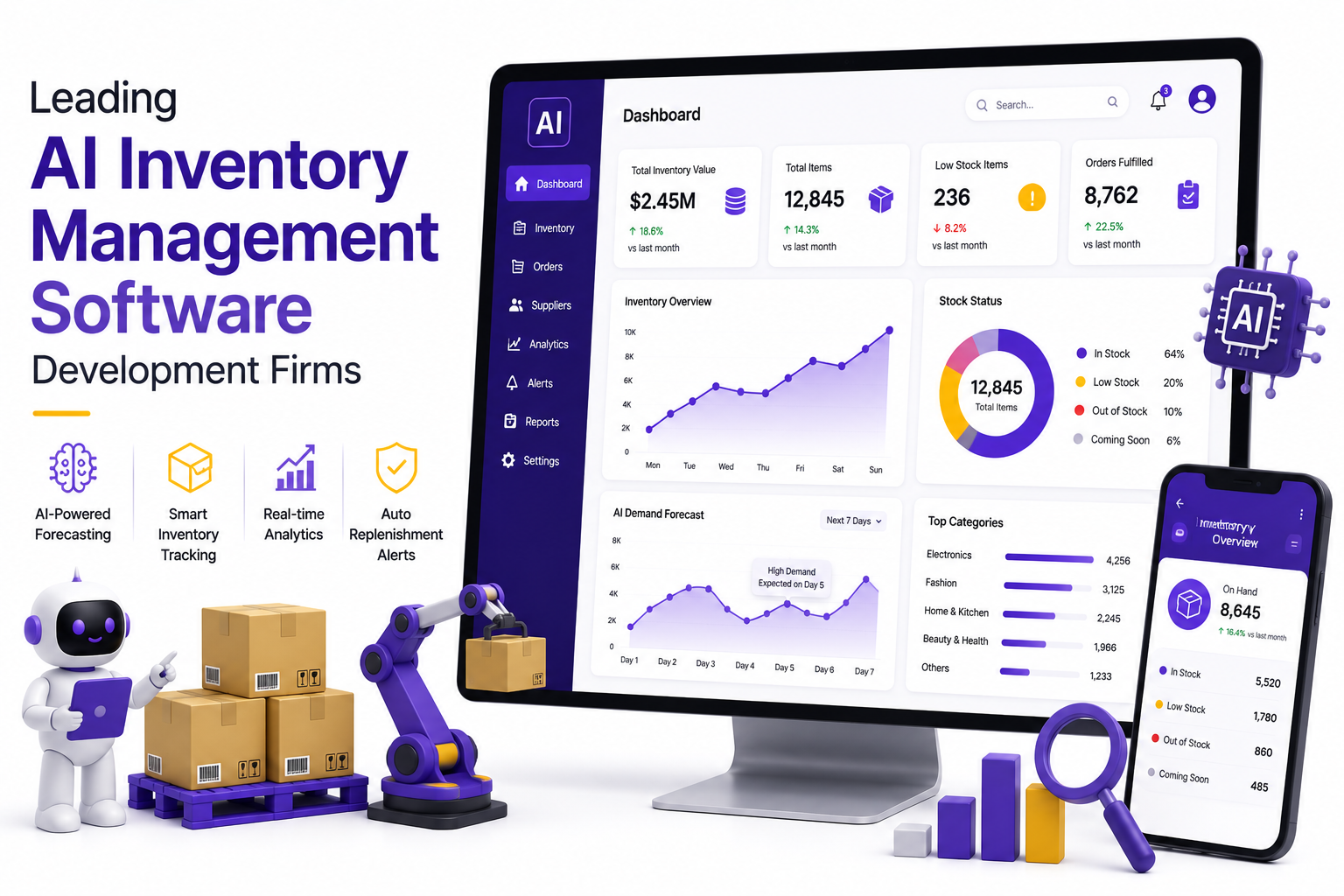

Running out of stock during a sales spike costs revenue. Sitting on excess inventory ties up cash you could use elsewhere. Most retail and logistics leaders know this tension well, and by 2026 the fix is not a bigger spreadsheet or a new dashboard. It is software that actually predicts demand, flags reorder points before a shelf goes empty, and adjusts as conditions change.
That is where AI Inventory Management Software comes in. Instead of static rules, these systems learn from sales history, seasonality, and supplier lead times to make smarter calls about what to stock and when. Building or customizing this kind of platform is a specialized job. It blends machine learning, real time data pipelines, and deep knowledge of supply chain operations, which is not something every development shop can pull off well.
If you are a CEO or founder trying to shortlist a partner to build or upgrade your inventory system, you have probably noticed the market is crowded. Some firms specialize in retail specific models. Others focus on warehouse automation or supplier integrations. A few handle the full stack, from data pipelines to a polished dashboard your team will actually use.
This guide walks through 20 AI Inventory Management Software companies worth evaluating in 2026, what each one does well, and where they tend to fit best, so you can narrow your search without spending weeks on discovery calls.
What to Look For Before You Hire
Before diving into the list, it helps to know what actually separates a good build partner from one that will leave you with a system your team avoids using.
Look for firms with real experience in demand forecasting models, not just generic software development. Ask how they handle data quality issues, since even the best algorithm produces bad recommendations if the underlying sales and supplier data is messy. Integration matters too. Your new system needs to talk to your existing ERP, POS, or warehouse management tools without a six month migration project.
Pricing structures vary widely, from fixed price builds for smaller scopes to dedicated team models for ongoing development. Team size and location also affect both cost and communication style, so it is worth clarifying time zone overlap and reporting cadence early in your conversations.
Top AI Inventory Management Software Development Companies to Consider in 2026
1. Hourly Developers
Hourly Developers works on a flexible, pay as you go model that suits companies who want to test an idea before committing to a full build. Their team has shipped inventory dashboards, demand forecasting modules, and reorder automation for small and mid sized retailers. Because you pay only for hours logged, this is a solid option if your AI Inventory Management Software project is still evolving and you want to avoid locking into a fixed scope too early. Weekly time reports and short check-ins mean you can redirect the team toward whichever feature matters most that week, rather than waiting for a formal change request. Many early stage retailers start here simply to validate whether a forecasting model actually improves their reorder accuracy before investing in a bigger build.
2. Chetu
Chetu has built a reputation as a full spectrum custom software vendor, and their supply chain division covers inventory forecasting, barcode and RFID integration, and warehouse management builds. They tend to work with mid market and enterprise clients who need a system that connects to several existing tools at once. Their size means they can staff a project quickly, though smaller businesses sometimes find their process more structured than a boutique shop. Because they operate across so many industries, their teams have usually already solved similar integration problems before, which can shorten the discovery phase considerably. Expect formal documentation and a dedicated project manager throughout the engagement.
3. Backend Development Company
Backend Development Company focuses almost entirely on the server side and data layer, which matters a great deal for inventory systems since most of the real work, forecasting models, stock level calculations, and supplier syncing, happens behind the scenes. They partner well with businesses that already have a front end team or design in place and just need a dependable backend built around real time stock data. Their engineers spend real time on query performance and data consistency, which becomes important once an inventory system is handling thousands of stock keeping units across multiple locations. This narrow focus tends to produce a more stable backend than a generalist shop juggling frontend work at the same time.
4. Appinventiv
Appinventiv works across mobile and web platforms and has a dedicated AI and machine learning practice that includes inventory forecasting tools. Their portfolio includes retail and logistics apps built for global brands, and they typically run projects using an in-house team with clear milestone based delivery. Expect a fairly formal proposal and scoping process compared to smaller vendors. Their teams often pair a data scientist with a product manager from the start, which helps translate forecasting accuracy into business metrics executives actually track, such as reduced stockouts or lower holding costs. This can be reassuring for founders who are less interested in the technical details and more focused on measurable outcomes.
5. Intellias
Intellias has strong roots in enterprise software for retail and logistics, including inventory optimization engines used by larger distribution networks. Their engineering teams often work directly alongside a client's internal staff rather than as a fully outsourced unit, which suits companies that want more hands-on collaboration during the build. Their background in large scale logistics platforms means they are comfortable with the messier realities of multi warehouse operations, including conflicting stock counts across regions and supplier delays that most smaller vendors have not encountered at scale.
6. HireFullStackDeveloperIndia
HireFullStackDeveloperIndia offers dedicated full stack teams that can take an inventory project from database design through to a finished dashboard. Because the whole stack sits with one team, handoffs between frontend and backend developers are minimal, which tends to speed up smaller to mid sized builds. Their India based delivery model also keeps hourly rates competitive. Founders who have worked with them mention fewer miscommunications between design and engineering since one team owns both sides of the build, and revisions to the forecasting dashboard tend to move faster as a result.
7. Softweb Solutions
Softweb Solutions leans heavily into IoT and AI, and their inventory work often includes sensor based stock tracking alongside the software layer. This makes them a good fit for warehouses or manufacturers who want hardware and software to work together, rather than treating inventory tracking as a purely digital problem. Their forecasting models frequently pull in sensor data such as temperature or shelf weight, which adds a layer of accuracy that pure software vendors cannot easily replicate without hardware partnerships of their own.
8. ThirdEye Data
ThirdEye Data is built around data engineering and machine learning first, which shows in how they approach inventory projects. Rather than starting with the dashboard, they typically start with the data pipeline, cleaning and structuring sales and supplier data before any forecasting model gets built on top. That order of operations tends to produce more reliable predictions later on. Businesses that have struggled with previous forecasting attempts because of inconsistent historical data often find this approach worth the extra time it takes upfront, since the resulting model tends to hold up better once live sales data starts flowing through it.
9. DataEximIT
DataEximIT works across custom software and data driven applications, with inventory and supply chain projects making up a meaningful part of their portfolio. Clients often mention their responsiveness during the discovery phase and their willingness to adjust scope as requirements shift, which matters for inventory projects since needs tend to evolve once the system goes live. Their smaller team size compared to some competitors on this list tends to translate into more direct access to senior developers rather than being routed through several layers of account management.
10. Iflexion
Iflexion has decades of experience in enterprise software and counts retail and logistics among its core industries. Their inventory builds often integrate with legacy ERP systems that many larger companies still run, which can save significant time compared to a rip and replace approach. For businesses running older SAP or homegrown ERP setups, this kind of experience matters more than it might seem, since integration mistakes with legacy systems are usually where inventory projects run over budget.
11. Binmile
Binmile positions itself as a technology partner rather than a pure vendor, often staying involved after launch to refine forecasting models as real sales data comes in. Their inventory projects frequently include a phased rollout, starting with one product category before expanding across a full catalog. This staged approach lets a business confirm the forecasting model is actually improving reorder decisions before committing budget to a full catalog rollout, which reduces the risk of an expensive rebuild later.
12. HireAIDevelopers
HireAIDevelopers, as the name suggests, focuses specifically on artificial intelligence talent, and their inventory work centers on the forecasting models themselves rather than general software builds. If your business already has a dashboard or ERP in place and just needs a smarter prediction engine layered on top, this kind of specialist team can be a faster route than a full service agency. Because they are not also building the surrounding dashboard or user interface, their engagements tend to be shorter, and pricing is usually tied to model performance benchmarks rather than a broad, fixed project scope.
13. Net Solutions
Net Solutions has built a strong practice around retail and ecommerce platforms, and their inventory work tends to sit inside larger ecommerce builds rather than as a standalone product. This makes them a strong fit for online retailers who want stock management, storefront, and checkout all working from the same data layer. Their experience with high traffic ecommerce sites also means they tend to think about how inventory forecasting behaves during flash sales or seasonal spikes, not just under normal daily demand.
14. Konstant Infosolutions
Konstant Infosolutions offers a broad development portfolio that includes mobile apps, web platforms, and AI integrations, with inventory and warehouse projects appearing regularly in their case studies. Their fixed price project options can appeal to businesses that want cost certainty upfront rather than an open ended hourly arrangement. This works particularly well for a business that already knows exactly which features it needs and would rather lock in a budget than manage an ongoing hourly relationship.
15. WebClues Infotech
WebClues Infotech runs both custom development and a growing AI practice, and their inventory related work often starts with a short discovery sprint to map out exactly what forecasting and automation features will move the needle for a specific business. That upfront scoping step tends to reduce surprises later in the build. Founders who prefer to see a clear roadmap and cost breakdown before signing a contract tend to appreciate this structured start, even if it adds a week or two before development itself begins.
16. Matellio
Matellio works across a wide range of industries and has a dedicated supply chain and logistics practice, with inventory forecasting as one of several AI services they offer. They are known for detailed proposal documents that outline architecture decisions before development starts, which some clients find reassuring and others find slower than they would like. If your team includes technical stakeholders who want to review architecture choices before committing budget, this upfront documentation style tends to be a better match than a vendor who prefers to start building immediately.
17. Existek
Existek is a smaller, engineering focused shop that tends to work closely with a client's internal product team rather than taking over the entire project. Their inventory work often involves extending an existing platform rather than building one from the ground up, which keeps costs lower for businesses that already have core systems in place. Because their team is smaller, communication tends to happen directly with the developers doing the work, without extra layers of account managers relaying updates back and forth.
18. Trigent Software
Trigent Software has a long history in enterprise IT services, and their supply chain practice covers inventory optimization for manufacturing and distribution clients. Their delivery model often includes both onshore and offshore teams working together, which can help with time zone coverage during active development phases. For businesses that need near constant availability during a critical rollout window, having a team that can hand off work across time zones can shorten the overall calendar time a project takes.
19. TatvaSoft
TatvaSoft offers custom software development with a Microsoft leaning technology stack, which suits businesses already running on tools like Dynamics or Azure. Their inventory projects frequently connect directly into these existing Microsoft environments rather than requiring a separate system to maintain. This can meaningfully cut down on training time for internal staff, since much of the resulting system will look and behave like the Microsoft tools employees already use day to day.
20. Rishabh Software
Rishabh Software has built inventory and warehouse management systems for over two decades, and their case studies span retail, manufacturing, and healthcare supply chains. Their long operating history means they have likely seen most of the edge cases that come up in inventory projects, from multi warehouse syncing to seasonal demand swings. Businesses in regulated industries like healthcare supply chains may find their experience with compliance and audit trail requirements particularly useful compared to a vendor whose background is purely in retail.
Choosing the Right Fit
Twenty companies is a lot to sift through, but you do not need to contact all of them. Narrow the list first by matching your situation. A small business piloting its first forecasting model probably needs a different partner than a distribution network integrating with three warehouses.
Start conversations with two or three firms whose specialization lines up with where you are today. Ask each one for a short technical call rather than a sales pitch, and pay attention to how well they understand your existing data and systems before they start recommending a build. The right AI Inventory Management Software partner should be asking you more questions than answering them in that first call.
Whichever firm you choose, treat the build as an ongoing relationship rather than a one time project. Forecasting models improve with tuning, and the vendors who stick around to refine their work after launch tend to deliver the most value over time.