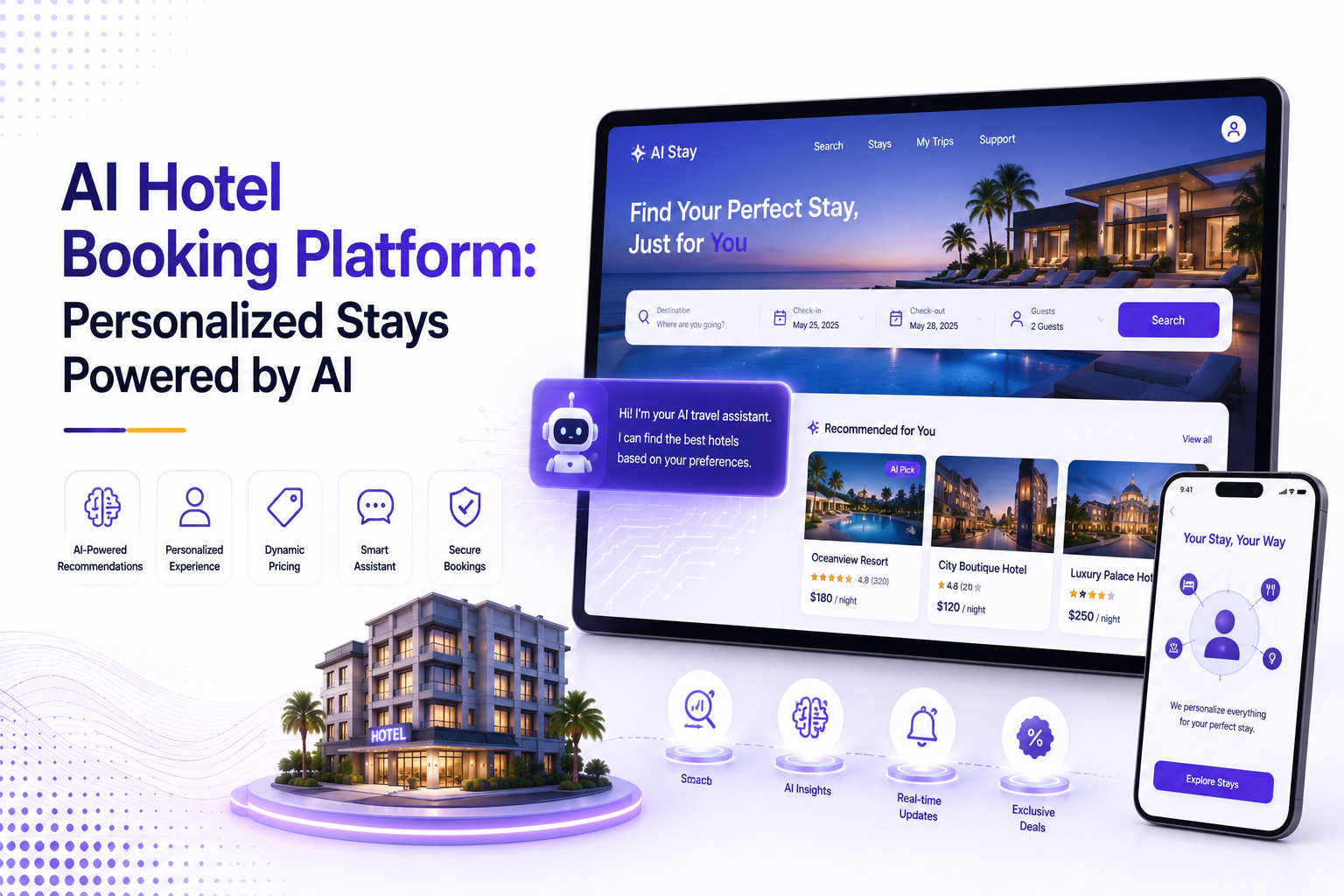

Travel booking has changed dramatically over the last decade. What used to be a process of browsing dozens of tabs, comparing prices manually, and calling hotel front desks has evolved into a few taps on a smartphone. Yet even with this convenience, most travelers still feel like they're searching through a maze of generic listings that don't understand what they actually want. This is exactly the gap that an AI hotel booking platform is designed to close.
By combining machine learning, natural language processing, and real-time data analysis, an AI hotel booking platform doesn't just show travelers a list of rooms — it understands their preferences, predicts their needs, and curates stays that feel tailor-made. For hotels and travel businesses, this shift isn't optional anymore. It's becoming the standard that guests expect, and the businesses that fail to adapt risk losing bookings to more intelligent, more responsive competitors.
In this article, we'll explore what an AI hotel booking platform is, how it works, why personalization matters so much in the hospitality industry, the technology stack behind modern AI travel booking software, and how to choose the right AI hotel booking platform development companies to bring your vision to life.
What Is an AI Hotel Booking Platform?
An AI hotel booking platform is a digital system — typically a web application, mobile app, or both — that uses artificial intelligence to help travelers search, compare, and book hotel accommodations. Unlike traditional booking engines that rely on static filters like price range, star rating, and location radius, an AI-powered platform continuously learns from user behavior, booking history, seasonal trends, and even external signals like weather or local events to recommend stays that genuinely match what a traveler is looking for.
At its core, the platform blends several AI capabilities:
- Recommendation engines that suggest hotels based on past behavior and stated preference
- Natural language processing (NLP) that allows guests to search using conversational queries like "a quiet boutique hotel near the beach with a pool"
- Predictive analytics that forecast demand, adjust pricing, and anticipate cancellations
- Chatbots and virtual assistants that handle guest queries, booking modifications, and support requests 24/7
- Computer vision that helps categorize and tag property photos automatically for better searchability
Together, these components transform a hotel booking platform from a passive listing site into an intelligent travel companion that actively works to find the best match for every guest.
Why Personalization Matters in Hotel Booking
Personalization isn't just a buzzword in travel technology — it directly impacts business outcomes. Guests who feel understood are more likely to complete a booking, spend more on add-ons, and return for future stays. A few reasons personalization has become central to modern hospitality platforms:
1. Reduced Decision Fatigue
Travelers today are overwhelmed with choices. A single city search can return hundreds of properties. An AI-driven platform narrows this down intelligently, surfacing the handful of options most likely to satisfy the traveler's specific needs, rather than forcing them to sift through irrelevant listings.
2. Higher Conversion Rates
When a platform shows relevant results immediately, users are far less likely to abandon their search. Personalized recommendations shorten the path from browsing to booking, which directly improves conversion rates for hotel businesses and travel agencies.
3. Increased Customer Loyalty
Guests remember platforms that "get" them. If a system consistently recommends stays that align with a traveler's taste — whether that's budget hostels for backpackers or luxury suites for business travelers — it builds trust and encourages repeat usage.
4. Dynamic Pricing Advantages
AI doesn't just personalize what guests see; it also helps hotels optimize what they charge. By analyzing demand patterns, competitor pricing, and booking velocity, AI systems can recommend or automatically adjust room rates to maximize occupancy and revenue.
Core Features of a Modern AI Hotel Booking Platform
Building a platform that truly stands out requires more than a basic booking form connected to a database. Below are the features that distinguish a genuinely AI-powered platform from a conventional one.
Smart Search and Filtering
Instead of rigid dropdown filters, AI-enabled search allows users to type natural queries and receive relevant results. The system interprets intent — for example, distinguishing between "family-friendly resort" and "romantic getaway" — and ranks properties accordingly.
Personalized Recommendations
Using collaborative filtering and content-based filtering models, the platform studies what similar users booked, what the current user has browsed, and what attributes (amenities, location, price sensitivity) matter most to them, then serves tailored suggestions.
AI Chat Assistants
Conversational assistants can handle common tasks like answering questions about cancellation policies, suggesting alternate dates when a preferred room is unavailable, or helping with itinerary planning — all without human intervention.
Dynamic Pricing Engine
Machine learning models analyze historical booking data, local events, seasonality, and competitor rates to recommend optimal pricing in real time, helping hotels balance occupancy and profitability.
Sentiment Analysis on Reviews
Rather than displaying raw star ratings, AI can process thousands of guest reviews to extract sentiment around specific aspects — cleanliness, staff friendliness, noise levels — giving travelers a more nuanced picture than a single number ever could.
Fraud Detection and Secure Payments
AI-powered fraud detection systems monitor transaction patterns to flag suspicious bookings, protecting both the platform and its users from payment fraud.
Voice Search and Multilingual Support
With NLP advancements, many platforms now support voice-based search and multilingual interactions, making booking accessible to a broader, more global audience.
Predictive Maintenance and Inventory Management
On the hotel operations side, AI can predict room availability issues, anticipate maintenance needs, and optimize inventory allocation across booking channels.
How AI Travel Booking Software Works Behind the Scenes
Understanding the mechanics of AI travel booking software helps clarify why these platforms perform so much better than legacy systems. Here's a simplified breakdown of the process:
- Data Collection — The platform gathers data from multiple sources: user behavior (clicks, searches, time spent), booking history, third-party integrations (weather, events, flight data), and property information from hotel partners.
- Data Processing and Feature Engineering — Raw data is cleaned and transformed into structured features that machine learning models can use — for instance, converting "user viewed 5 beachfront hotels in the last week" into a preference score.
- Model Training — Algorithms such as collaborative filtering, gradient boosting, and neural networks are trained on historical data to predict what a user is likely to want or book next.
- Real-Time Inference — When a user interacts with the platform, the trained models generate predictions instantly — recommending hotels, adjusting search rankings, or suggesting prices.
- Continuous Learning — As new data flows in from user interactions, the models are periodically retrained or fine-tuned, allowing recommendations to improve over time.
- Feedback Loops — User actions (bookings, cancellations, reviews) feed back into the system, refining future predictions and closing the loop between AI output and real-world outcomes.
This pipeline runs continuously and largely invisibly, which is exactly the point — the best AI systems feel effortless to the end user even though sophisticated computation is happening behind every search result.
Business Benefits of Investing in an AI Hotel Booking Platform
For hospitality businesses, travel agencies, and OTAs (online travel agencies), building or upgrading to an AI-powered platform delivers measurable advantages:
- Improved booking conversion rates through relevant, timely recommendations
- Reduced customer acquisition costs as personalized experiences increase organic referrals and repeat visits
- Optimized revenue management through dynamic, AI-driven pricing strategies
- Lower operational costs by automating customer support through chatbots and virtual assistants
- Better guest satisfaction scores as travelers receive stays that genuinely match their expectations
- Competitive differentiation in a market where most players still rely on outdated, static booking engines
- Data-driven decision-making for marketing, inventory planning, and partnership strategy
These benefits compound over time. The more data a platform collects, the smarter its recommendations become, creating a flywheel effect that strengthens the platform's competitive position.
Key Technologies Powering AI Hotel Booking Platforms
Building a robust AI hotel booking platform requires a thoughtful technology stack. While exact choices vary by project scope and budget, common components include:
- Machine Learning Frameworks: TensorFlow, PyTorch, and Scikit-learn for building recommendation and pricing models
- NLP Tools: Transformer-based models for understanding natural language queries and powering chatbots
- Cloud Infrastructure: AWS, Google Cloud, or Microsoft Azure for scalable hosting and AI model deployment
- Data Pipelines: Apache Kafka or similar tools for real-time data streaming and processing
- APIs and Integrations: Connections to global distribution systems (GDS), property management systems (PMS), payment gateways, and third-party data providers (weather, events, flights)
- Databases: A mix of relational databases for transactional data and NoSQL databases for unstructured behavioral data
- Front-End Frameworks: React, Vue, or Flutter for building responsive, cross-platform user interfaces
Choosing the right combination of these technologies is one of the most critical early decisions in the development process — and it's a major reason why partnering with experienced AI hotel booking platform development companies matters so much.
Steps to Build an AI Hotel Booking Platform
If you're planning to build a platform from scratch, here's a general roadmap that most successful projects follow:
Step 1: Define Your Target Audience and Use Case
Are you building for leisure travelers, business travelers, budget backpackers, or luxury guests? Your AI models and UX design will differ significantly depending on the answer.
Step 2: Conduct Market and Competitor Research
Study existing platforms — both traditional OTAs and newer AI-first entrants — to identify gaps you can fill and features you should prioritize.
Step 3: Choose the Right Technology Partner
This is where selecting experienced AI hotel booking platform development companies becomes essential. The right partner brings not just coding expertise but domain knowledge in travel tech, data science, and AI model deployment.
Step 4: Design the Data Architecture
Decide what data you'll collect, how it will be stored, and how it will flow between your booking engine, AI models, and third-party integrations.
Step 5: Build a Minimum Viable Product (MVP)
Start with core features — search, booking, basic recommendations — before layering in more advanced AI capabilities like dynamic pricing or sentiment analysis.
Step 6: Train and Test AI Models
Use historical or synthetic data to train your recommendation and pricing models, then rigorously test them against real user behavior before full deployment.
Step 7: Launch, Monitor, and Iterate
After launch, continuously monitor model performance, gather user feedback, and refine algorithms to improve accuracy and relevance over time.
Choosing the Right AI Hotel Booking Platform Development Companies
Not all development partners are created equal, and choosing poorly can set your project back months and significantly inflate costs. Here's what to look for when evaluating potential partners:
Proven Experience in Travel Tech
Look for companies with a track record of building booking engines, OTA platforms, or travel-related applications. Domain expertise reduces the learning curve and results in more thoughtful product decisions.
Strong AI and Data Science Capabilities
Building a booking site is one thing; building an intelligent one is another. Ensure the company has genuine machine learning expertise, not just a marketing claim of "AI-powered" features bolted onto a standard CMS.
Transparent Development Process
The best partners provide clear timelines, regular progress updates, and involve you in key decisions throughout the build — from architecture design to model evaluation.
Scalability and Security Focus
Your platform will need to handle growing user traffic and sensitive payment data. Choose a team that prioritizes scalable cloud architecture and robust security practices from day one.
Post-Launch Support
AI models require ongoing maintenance and retraining as user behavior evolves. Confirm that your development partner offers long-term support, not just a one-time build.
When comparing quotes and proposals from different providers, don't just look at cost — evaluate portfolios, request case studies, and where possible, speak with previous clients. The gap in quality between average and excellent AI hotel booking platform development companies is often reflected not in the initial demo, but in how the platform performs and scales six months after launch.
Cost Factors to Consider
The cost of building an AI hotel booking platform varies widely based on several factors:
- Scope of features — A basic MVP with search and booking will cost significantly less than a full-featured platform with dynamic pricing, chatbots, and multilingual support
- AI model complexity — Custom-trained models tailored to your specific data are more expensive than using pre-built AI services
- Third-party integrations — Connecting to GDS systems, payment gateways, and PMS platforms adds development time and licensing costs
- Team location and expertise — Rates vary significantly between regions and between agencies versus freelance developers
- Ongoing maintenance — Budget for continuous model retraining, server costs, and feature updates post-launch
While it's tempting to minimize upfront costs, underinvesting in the AI components often results in a platform that looks smart in a demo but fails to deliver real personalization once live users start interacting with it.
Real-World Use Cases of AI in Hotel Booking
To make this more concrete, here are a few examples of how AI is already reshaping hotel booking experiences:
- Predictive Rebooking: Some platforms analyze a traveler's past trips to proactively suggest rebooking a favorite hotel around the same time next year, based on seasonal travel patterns.
- Dynamic Upselling: AI models identify which guests are most likely to upgrade to a suite or add a spa package, allowing platforms to present these offers at the right moment in the booking flow.
- Automated Customer Support: Chatbots now resolve a large share of routine guest inquiries — check-in times, cancellation policies, amenity questions — without human agents, freeing staff to handle more complex issues.
- Smart Itinerary Building: Beyond just booking a room, some AI travel booking software now suggests complementary activities, restaurants, and local experiences based on a guest's stated interests.
- Fraud Prevention: Machine learning models flag unusual booking patterns — such as multiple high-value bookings from a new account in a short window — helping prevent chargebacks and fraudulent transactions.
These examples illustrate that AI's role in hotel booking extends well beyond the initial search-and-book flow; it touches nearly every stage of the guest journey.
Challenges to Anticipate
Building an AI hotel booking platform isn't without its challenges. Being aware of these upfront helps set realistic expectations:
Data Quality and Availability
AI models are only as good as the data they're trained on. New platforms without historical booking data may need to rely on industry benchmarks or synthetic data initially, gradually improving accuracy as real user data accumulates.
Integration Complexity
Connecting to legacy hotel systems, GDS platforms, and various payment processors can be technically complex and time-consuming, especially when working with international hotel partners.
Balancing Personalization with Privacy
Guests want relevant recommendations, but they also care about data privacy. Platforms need to be transparent about what data is collected and give users control over their preferences, while complying with regulations like GDPR.
Avoiding Algorithmic Bias
If not carefully monitored, recommendation algorithms can inadvertently favor certain hotels, price ranges, or regions, reducing the diversity of options shown to users. Regular auditing of model outputs helps prevent this.
Keeping Up with Evolving AI Capabilities
The AI landscape moves quickly. Platforms need a plan for continuously incorporating new techniques and tools rather than treating the initial build as a finished product.
The Future of AI in Hotel Booking
Looking ahead, several trends are likely to shape the next generation of AI hotel booking platforms:
- Hyper-personalization powered by generative AI, where platforms craft entire itineraries and travel narratives tailored to individual users, not just room recommendations
- Voice-first booking experiences, as smart assistants become more capable of handling complex, multi-step booking conversations
- AI-powered virtual property tours, using computer vision and generative models to create realistic previews of rooms and amenities
- Predictive travel planning, where platforms anticipate a user's next trip before they even begin searching, based on patterns like recurring business travel or annual vacations
- Seamless integration across the entire travel journey, connecting flights, accommodations, local transport, and experiences into a single AI-orchestrated booking flow
Businesses that invest early in flexible, AI-native architecture will be best positioned to adopt these innovations as they mature, rather than retrofitting outdated systems later.
Marketing and Driving Adoption for Your AI Hotel Booking Platform
Even the most technically advanced platform will struggle without a solid strategy to attract and retain users. Once your AI hotel booking platform is built, consider these approaches to drive adoption:
Highlight Personalization in Your Messaging
Travelers are increasingly aware that generic booking sites don't serve their specific needs well. Marketing copy, app store listings, and onboarding flows should clearly communicate how your platform learns and adapts to each user, rather than simply listing standard features like "search," "book," and "pay."
Leverage Data for Targeted Campaigns
The same AI infrastructure that powers in-app recommendations can also inform your marketing efforts. Segment users based on travel patterns — frequent business travelers, family vacationers, budget-conscious backpackers — and tailor email campaigns, push notifications, and retargeting ads accordingly.
Build Trust Through Transparency
Since AI-driven personalization relies on user data, being upfront about what data is collected and how it improves the booking experience builds trust. Consider including a simple, accessible explanation of your AI features in your privacy policy and onboarding screens.
Encourage Reviews and Feedback Loops
User reviews and behavioral feedback are valuable training data for your recommendation engine. Actively encourage guests to rate their stays and provide feedback, both to improve future recommendations and to build social proof for new users evaluating your platform.
Partner with Hotels for Co-Marketing
Many hotel partners are eager to promote platforms that bring them qualified, well-matched guests. Consider co-marketing arrangements, featured placements, or loyalty partnerships that benefit both your platform and your hotel partners simultaneously.
Monitor Key Performance Metrics
Track metrics beyond just bookings — look at recommendation click-through rates, search-to-booking conversion time, repeat booking rates, and customer satisfaction scores. These metrics reveal how well your AI models are actually performing in production, not just in testing environments.
A well-executed go-to-market strategy, combined with a genuinely intelligent product, is what separates platforms that gain sustainable traction from those that quietly fade after an initial launch spike.
Final Thoughts
The shift toward AI-powered personalization in hotel booking isn't a passing trend — it's a fundamental change in how travelers discover and book accommodations. An AI hotel booking platform that genuinely understands user preferences, adapts pricing intelligently, and streamlines the entire booking journey creates real value for both travelers and hospitality businesses.
Whether you're a startup looking to disrupt the OTA space or an established hotel chain modernizing your booking infrastructure, success depends heavily on the quality of your AI travel booking software and the expertise of the team building it. Taking time to carefully evaluate AI hotel booking platform development companies — assessing their technical depth, travel industry experience, and long-term support capabilities — will make the difference between a platform that merely looks intelligent and one that consistently delivers personalized, revenue-driving results.
As AI technology continues to mature, the platforms that succeed will be the ones that treat personalization not as a feature, but as the foundation of the entire guest experience.