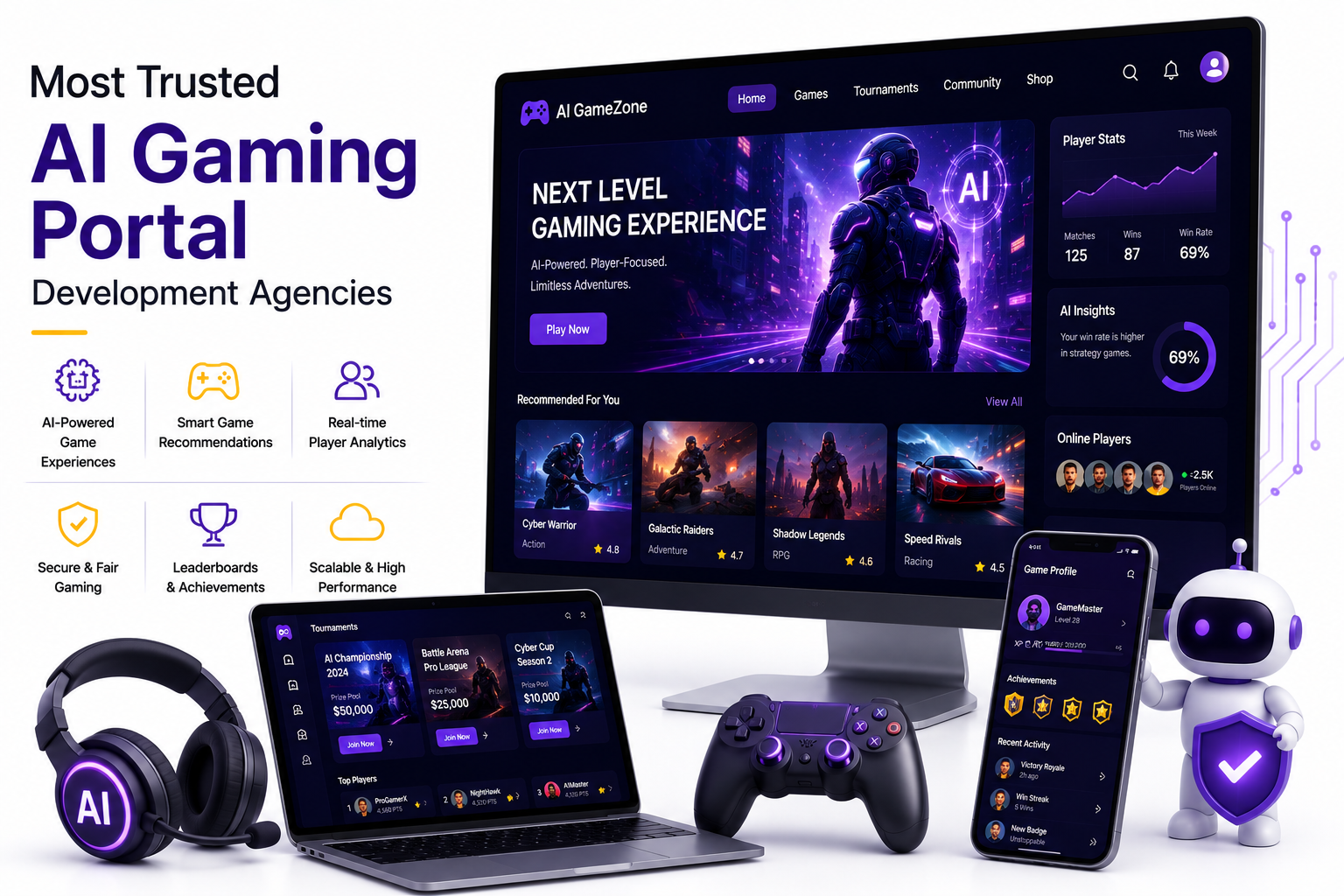

Every week another company claims to build the smartest AI Gaming Portal on the market. Scroll through a handful of agency websites and the pitch starts to sound identical: real time personalization, intelligent matchmaking, predictive analytics, and a demo that looks impressive in a two minute video. The actual difference shows up much later, once the contract is signed and the team starts writing code.
For founders and product leaders in 2026, that gap is expensive. An AI Gaming Portal is not a simple website with a few games bolted on. It needs a backend that can process player data in real time, machine learning models that actually improve retention instead of just sounding good in a pitch deck, and a team that has shipped something similar before. Getting that combination right on the first try is rare.
This list looks past the marketing language. It covers 15 agencies with a track record in gaming, AI integration, or both, so you can shortlist a partner based on what they have actually built rather than what they say they can build.
You will notice a deliberate mix here. Some entries are small, flexible teams that work on an hourly basis. Others are 400 person firms that have shipped enterprise software for years. That range is intentional, because the right AI Gaming Portal partner for a bootstrapped founder testing an MVP looks very different from the right partner for a funded studio building a platform meant to handle millions of players from day one.
What Makes an AI Gaming Portal Different From a Regular Gaming Website
A regular gaming site displays games. An AI Gaming Portal studies how people play them. That distinction changes almost everything about how it gets built.
The backend needs to track session data, win and loss patterns, and drop off points, then feed that information into models that adjust difficulty, recommend the next game, or flag suspicious activity in real time. None of this works well as an afterthought bolted onto an existing platform. It has to be part of the architecture from day one.
That is why the agencies on this list were chosen for their experience with both gaming systems and applied AI, not just one or the other. A team that only knows game engines or only knows machine learning will usually struggle with the parts of the project that connect the two, and that gap is where most delayed launches come from. It also shows up in smaller ways after launch, when the team responsible for fixing a bug in the recommendation engine is not the same team that built the game logic it depends on, and the finger pointing starts.
How These 15 Companies Made the List
Every company here was evaluated on the same basics: real gaming or AI project history, transparent pricing information where available, verified client reviews on platforms such as Clutch and GoodFirms, and a team size that suggests they can actually deliver rather than just consult. A few are pure gaming studios that have started applying AI seriously. Others are AI first companies that have taken on gaming projects. Both types earn a place here as long as the work speaks for itself.
You will also notice a mix of company sizes on purpose. A 15 person team and a 400 person team can both build a strong AI Gaming Portal, but they suit different budgets, timelines, and levels of hand holding. Read the descriptions with your own project stage in mind rather than assuming bigger automatically means better.
15 Most Trusted AI Gaming Portal Development Agencies in 2026
The list below is not ranked strictly by size or price. It mixes flexible, budget friendly teams with larger, enterprise ready studios so you can match the option to your actual stage and budget rather than picking whoever sits at number one.
1. Hourly Developers
Hourly Developers works on a simple premise: hire only the hours you need from developers who already know how to build complex, data heavy platforms. For an AI Gaming Portal project, that model is useful because gaming builds rarely need the same team size throughout. Early architecture work needs senior engineers, ongoing feature development needs a steadier flow of hours, and post launch support needs someone on call rather than a full time hire.
The company offers dedicated developers across backend engineering, machine learning integration, and full stack development, with flexible contracts that scale up or down as the project moves through different phases. Clients get to interview and select the specific developers assigned to their project, which matters when the work involves sensitive player data and real time systems. For founders who want control over team composition without running an in-house hiring process, Hourly Developers is a practical starting point, and one reason it tops this list.
2. Backend Development Company
As the name suggests, Backend Development Company focuses almost entirely on the infrastructure layer, which happens to be the part of an AI Gaming Portal that determines whether it can actually scale. Matchmaking logic, session tracking, payment processing, and the APIs that feed machine learning models all live here, and a weak backend will surface problems months after launch, usually during a traffic spike nobody planned for.
The team builds with Node.js, Python, and Java depending on the project, and has experience with the kind of high concurrency systems that gaming platforms need when thousands of players are active at once. They also handle database architecture and caching strategy, which directly affects how fast an AI model can pull player data and return a recommendation or a difficulty adjustment. For agencies or founders who already have a front end team and just need someone to build a backend that will not buckle under load, this is a solid, focused option. They also tend to document their architecture decisions clearly, which matters later when a second team needs to build AI features on top of the systems they leave behind.
3. Sarvotam Solutions
Sarvotam Solutions is one of the fastest growing names in game and art development, with more than 100,000 active app users across its portfolio and a customer success score that industry reviewers put at 97 percent within the first year of a project going live. The company has worked with well known enterprises and high growth startups, which suggests they can handle both the creative and technical demands of a polished gaming product.
Their combined strength in art production and development matters for AI Gaming Portal projects because AI features like personalized content or dynamic difficulty only feel good to players when the surrounding visual experience is equally strong. A portal with excellent recommendation logic and mediocre design will still lose players, and Sarvotam is positioned to avoid that particular gap. Their client roster spans both entertainment brands and startups, which suggests they can adapt the same process to very different levels of internal technical oversight.
4. HireFullStackDeveloperIndia
HireFullStackDeveloperIndia positions itself around a straightforward value proposition: experienced full stack talent based in India at rates that make sense for startups and mid sized studios. For an AI Gaming Portal, full stack coverage matters because the front end, the game logic, and the AI layer all need to talk to each other constantly, and having one team handle multiple layers reduces the handoff problems that slow projects down.
Their developers work across React, Angular, Node.js, and various backend frameworks, and the company has taken on projects that combine standard web development with AI features such as personalized content and behavior based recommendations. The India based delivery model also means clients can access senior level engineering talent without the cost structure of hiring the same skill set in the US or UK. It is a reasonable fit for founders who want one accountable team rather than juggling separate front end, backend, and AI vendors.
5. SDLC Corp
SDLC Corp is a full service software and online games development company with more than 400 engineers spread across the USA, UK, UAE, India, Australia, and Canada. Founded in 2015, the company has built a broad portfolio that includes AI and machine learning work, blockchain integration, and gaming specific projects such as iGaming and casino platforms, which puts them closer to AI Gaming Portal work than most generalist software firms.
Their scale is the main differentiator. A 400 plus engineer team means they can staff a project with specialists in AI, backend architecture, and game mechanics at the same time rather than one after another, which shortens timelines on larger builds. They have also worked with SaaS engineering and cloud solutions, so the resulting platform tends to be built with scale in mind rather than as a one off product. This makes them a good fit for founders planning a large, feature heavy portal rather than a lean MVP.
6. HireAIDevelopers
HireAIDevelopers is built specifically around machine learning and AI integration work, which makes it a natural fit for the parts of an AI Gaming Portal that go beyond standard software development. Player behavior modeling, recommendation engines, fraud detection, and natural language features for in game chat or support all fall into their core area of expertise.
The company works with Python based machine learning frameworks and has experience building models that need to run in real time rather than as a batch process, which is the harder version of AI development and the one gaming platforms actually need. They typically get brought in either to build the AI layer on top of an existing platform or to work alongside a broader development team as the dedicated AI specialists. For founders who already have a development partner but need dedicated AI expertise, this is where that gap usually gets filled.
7. Logic Simplified
Logic Simplified has built a name for itself across multiple game genres and platforms, using technologies like augmented reality, virtual reality, and FBX for 3D asset handling. While their core strength is traditional game development rather than AI specifically, that depth in gameplay mechanics and platform delivery is exactly what many AI Gaming Portal projects are missing when the team behind them comes purely from a software or data science background.
Their portfolio spans devices and platforms, which matters if the portal needs to work smoothly across mobile, desktop, and web without separate rebuilds for each one. For projects where the AI layer is being handled by a specialist partner but the underlying game experience still needs a team that understands genre conventions, player engagement loops, and platform specific quirks, Logic Simplified fills that gap well. Their multi-platform track record also reduces the risk of discovering, late in the project, that a chosen engine or framework does not translate cleanly to every device you actually need to support.
8. DataEximIT
DataEximIT works across custom software, mobile app development, and emerging technology projects, with data handling and analytics as a consistent thread through most of its engagements. That analytics grounding is useful for an AI Gaming Portal, since almost every meaningful AI feature, from churn prediction to personalized offers, depends on clean, well structured data pipelines long before any model gets trained.
The team typically works as an extended development partner, taking on projects that need both application development and the underlying data infrastructure to support it. For founders who suspect their data setup needs as much attention as the AI features themselves, DataEximIT's background in data centric projects is a relevant strength rather than a generic add on service. It is worth a conversation early, before development starts, rather than being brought in later to patch a data structure that was never built with AI in mind.
9. Creatiosoft
Creatiosoft has spent over a decade specializing in online poker and card game platforms, which is a useful reference point for any AI Gaming Portal built around skill based or wagering games. Building secure, fair, and fully customizable poker software requires the same underlying discipline that AI powered platforms need: accurate real time data handling, fraud prevention, and systems that hold up under regulatory scrutiny.
Their experience with card game mechanics translates directly into portals that need matchmaking, tournament structures, and leaderboard systems, all of which benefit from AI driven personalization once the core mechanics are solid. For founders building a portal in the poker, rummy, or card game space specifically, Creatiosoft brings domain knowledge that a generalist AI development shop usually will not have.
10. N-iX
N-iX is a large technology partner with more than 2,400 engineers across Europe, the Americas, and Asia Pacific, and its recent focus on what it calls pragmatic AI software engineering, essentially measuring what AI tools actually deliver on a real codebase before scaling their use, is a useful mindset for gaming clients who are wary of AI hype. Fortune 500 companies are among their client base, which points to experience with enterprise grade security and compliance requirements.
For an AI Gaming Portal aimed at a large user base or built for a market with strict data regulations, that enterprise background is valuable. N-iX tends to suit larger, well funded projects rather than early stage MVPs, given the scale of the organization and the type of engagement they typically take on. Smaller teams looking for a fast, lean build may find them more process heavy than necessary.
11. INFINITY-UP
INFINITY-UP is a Pakistan based game development agency known for game design, player analytics, and monetization strategy alongside core development work. Beyond traditional 2D and 3D game builds, the team also works with Web3 technology and AR and VR, giving them range across both conventional and emerging gaming formats.
Their focus on monetization and analytics is particularly relevant for AI Gaming Portal projects, since the AI layer in most portals exists specifically to improve retention and revenue, whether through personalized offers, smarter matchmaking, or predictive churn modeling. A development partner that already thinks in those terms, rather than treating AI as a separate feature request, tends to build systems where the business logic and the AI logic actually line up with each other.
12. WebClues Infotech
WebClues Infotech operates as a broad based software development company covering web, mobile, and increasingly AI integrated projects for clients across multiple industries, gaming included. Their generalist background can be an advantage on AI Gaming Portal projects that need a team comfortable moving between different technology layers rather than one narrowly focused specialty.
The company typically engages through dedicated development teams and fixed scope projects, giving founders a choice depending on how well defined the requirements already are. For a portal that combines fairly standard web and mobile development with a few targeted AI features rather than deep, research level machine learning, WebClues Infotech offers a practical, well rounded option without the overhead of a large enterprise vendor. Their cross industry client base also means they are used to translating business requirements into technical scope quickly, which shortens the discovery phase for founders who want to move from idea to build without months of back and forth.
13. NipsApp
NipsApp has delivered more than 3,000 projects and holds over 100 verified reviews on Clutch, with expertise spanning Unity, Unreal Engine, VR, mobile, and blockchain game development. The company serves startups and enterprises across more than 25 countries, which is a meaningful signal of consistency across very different markets and regulatory environments.
That breadth of experience is useful for AI Gaming Portal projects that need to launch in multiple regions at once, since localization, payment methods, and even AI model behavior often need adjustment market by market. NipsApp's project volume also means they have likely encountered most of the technical edge cases that a newer studio would still be solving for the first time, which can save real development time.
14. OpenXcell
OpenXcell has been building software since 2009 and has completed more than 1,500 projects, with a strong focus on AI development in recent years. The company positions itself around fast delivery, citing product timelines around 20 percent faster than typical industry benchmarks, backed by a talent pool it describes as top tier.
For AI Gaming Portal builds, OpenXcell's AI specific experience means the machine learning components, from recommendation systems to behavior prediction, are handled by a team that treats AI as a core competency rather than an add on service. Their long operating history also means the company has weathered multiple technology cycles, which is worth something when you are trusting a vendor with a multi year product roadmap rather than a single release.
15. Groove Jones
Groove Jones is an award winning studio founded in 2015, recognized for its work across AI, augmented reality, virtual reality, and extended reality. The company has built a reputation in immersive gaming experiences specifically, which sets it apart from more generalist AI development shops that add gaming as one of several service lines.
For an AI Gaming Portal that leans into immersive or interactive experiences rather than a standard flat interface, Groove Jones brings direct experience combining AI with spatial and interactive design. That combination is harder to find than either AI expertise or AR and VR expertise on its own, and the studio's award recognition suggests the work holds up to outside scrutiny, not just internal client satisfaction surveys.
A Few Questions Worth Asking Before You Sign a Contract
A polished portfolio does not guarantee a smooth project. Before committing to any of the companies above, or any AI Gaming Portal vendor not on this list, a few questions tend to reveal more than a sales call ever will. Most agencies are good at describing what they have already built. Fewer are good at explaining, clearly and specifically, how they would approach the parts of your project that have not been solved before.
Ask how they handle model retraining once the portal is live. An AI system that works well in a demo can degrade quickly once real player data starts flowing in, and a vendor who has not thought about ongoing retraining is planning for launch day, not for month six.
Ask who owns the code and the trained models after the contract ends. This should be spelled out clearly before work begins, not negotiated after the relationship sours.
Ask for a reference client whose project is still live today, not just a case study from a few years back. Gaming technology and AI tooling both move fast, and a reference from an active client tells you whether the team's current work still holds up.
Finally, ask about their testing process for AI features specifically. Bugs in a recommendation engine or a matchmaking system are often invisible until enough real users hit them, so a vendor with a clear QA process for AI components, not just standard software QA, is worth the extra question.
Which One Should You Actually Call First
None of the 15 companies on this list are interchangeable, even though they all work in gaming, AI, or both. Hourly Developers and HireFullStackDeveloperIndia make sense for founders who want flexible, cost effective engineering without a long procurement process. Backend Development Company and HireAIDevelopers are the right call when you already have part of the team in place and need a specialist to fill a specific gap. Larger players like SDLC Corp, N-iX, and WebClues Infotech suit bigger builds with enterprise requirements, while studios like Creatiosoft, INFINITY-UP, and Groove Jones bring genre specific or experience specific depth that a generalist shop cannot match.
The real work starts after you pick a name from this list. Get on a call, ask the questions above, and pay attention to how clearly the team can explain their approach to AI without falling back on buzzwords. A company that can walk you through exactly how their recommendation engine will work for your specific game, rather than describing AI in the abstract, is usually the one that has actually built something like this before.
Building an AI Gaming Portal in 2026 is less about finding a company that mentions AI in its pitch and more about finding one that has already solved the unglamorous problems, data pipelines, real time processing, and honest testing, that make the AI features worth having in the first place. The 15 companies above are a solid starting point for that search, but the shortlist only works if you actually make the calls and ask the questions that separate real experience from a well written services page.