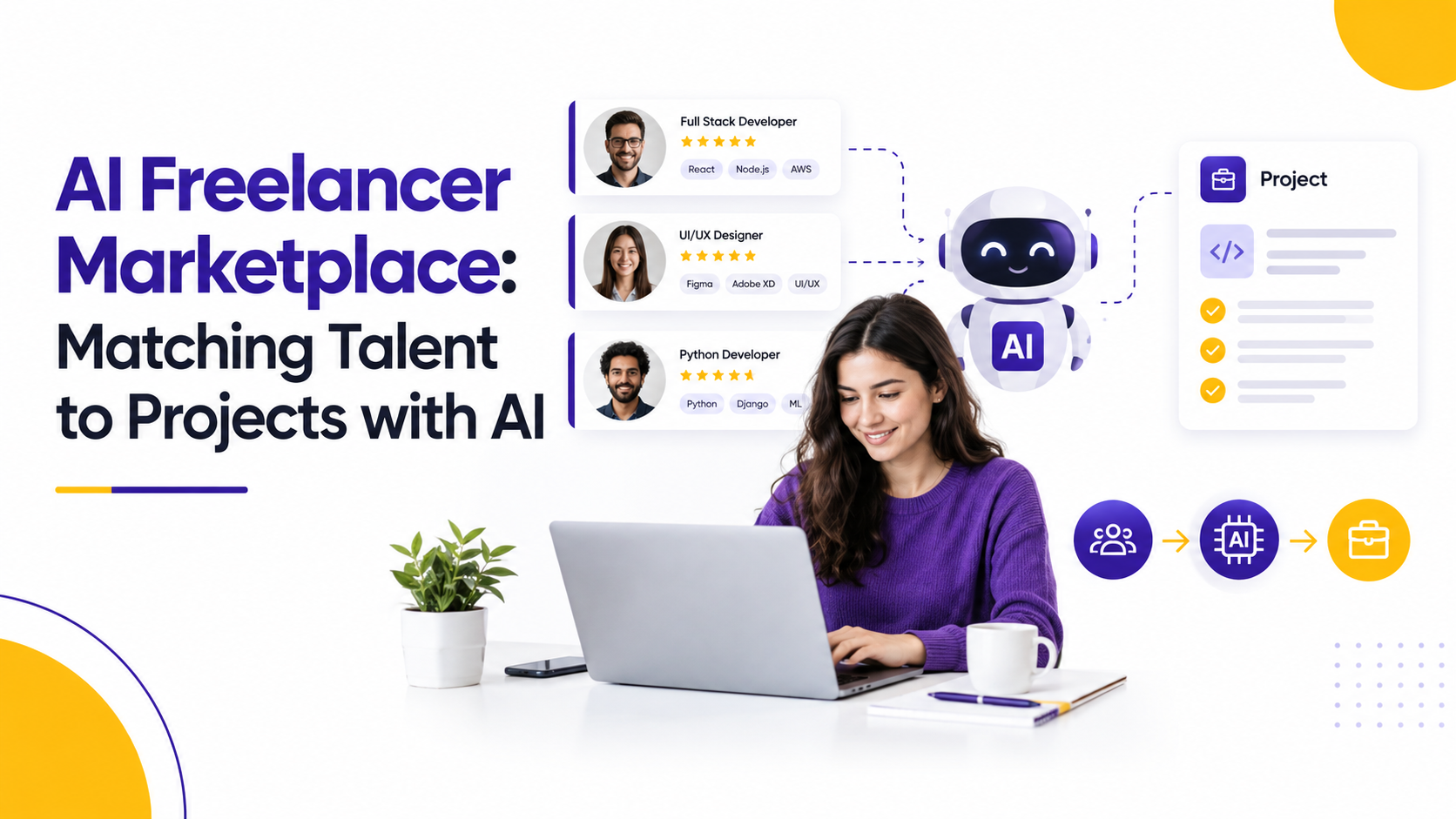

Somewhere between posting a job and actually hiring someone, most freelance platforms lose people. A client scrolls through forty profiles that all sound the same, or a skilled freelancer applies to twenty jobs and hears back from two. That gap between intent and outcome is exactly what an AI freelancer marketplace is built to close.
Instead of relying on filters and keyword search alone, these platforms read the actual substance of a project brief and a freelancer's work history, then connect the two based on fit rather than luck. In 2026, that shift is no longer a nice to have. It is quickly becoming the baseline expectation for anyone building or using a freelance hiring platform, because the sheer volume of freelancers on major platforms has made manual browsing genuinely impractical for most hiring teams.
There is also a quieter shift happening on the talent side. Freelancers who used to rely on constant self-promotion to stay visible are finding that a well-matched platform surfaces their work automatically, based on what they have actually delivered rather than how loudly they market themselves. That changes the incentive structure for everyone involved, and it is part of why the category has grown so quickly.
This guide walks through how matching actually works under the hood, what separates a genuinely useful AI freelance matching platform from one that just has a chatbot bolted on, what it costs and takes to build one, and what to think about if you are planning to commission or evaluate one yourself.
What Is an AI Freelancer Marketplace, Really?
At its core, an AI freelancer marketplace is a hiring platform where machine learning models handle the matching work that a human recruiter or a manual search would otherwise do.
Traditional freelance sites ask you to describe your project, pick a category, and then hope the right people find it. An AI driven platform flips that model. It analyzes the project description, the required skills, the budget, and even the tone of the brief, then actively surfaces freelancers whose past work and stated expertise line up with what the project actually needs.
The difference sounds subtle until you have used both. A keyword search for React developer returns everyone who typed React into their profile, regardless of whether they have built anything close to what you need. A matching model looks at portfolio samples, past project outcomes, and even client feedback patterns to rank who is genuinely likely to succeed on this specific job.
It is also worth separating the marketing use of the term from the technical reality. Plenty of platforms describe themselves as AI powered simply because they added a search bar with autocomplete. A genuine AI marketplace has matching logic sitting between the client and the freelancer at every stage, from the first project description to the final proposal ranking, and that logic keeps improving as more contracts get completed on the platform.
How AI Freelance Matching Actually Works
The phrase AI freelance matching platform covers a fairly wide range of approaches, but most serious implementations rely on a similar core pipeline.
1. Profile and project parsing
Natural language processing models read both the freelancer profile and the client brief, pulling out skills, tools, industries, and project type rather than relying on freelancers to tag themselves accurately.
2. Semantic embedding
Both sides get converted into vector representations, essentially numerical fingerprints that capture meaning rather than exact wording, so a project asking for a checkout flow can still match a freelancer who describes their work as e-commerce payment integration.
3. Similarity scoring
The platform compares embeddings to find freelancers whose work history sits closest to the project's needs, then layers in hard filters like budget range, availability, and time zone.
4. Behavioral signals
Response time, past completion rate, repeat hire rate, and dispute history feed into the ranking, so a freelancer who looks great on paper but has a habit of missing deadlines drops down the list.
5. Continuous learning
Every hire, rejection, and completed contract becomes training data, so the matching model gets sharper the more the platform is used.
Traditional Freelance Platforms vs AI Driven Ones
Core Features That Separate a Strong Platform from a Weak One
Not every platform that claims to use AI actually does much beyond a recommendation widget. Here is what genuinely matters.
• Skill graph mapping: Connects related skills so a search for mobile app developer also surfaces strong Flutter or Kotlin specialists, not just people who typed the exact phrase.
• Smart proposal ranking: Sorts incoming proposals by predicted fit instead of submission time, so clients are not just rewarding whoever applied fastest.
• Automated skill verification: Uses portfolio analysis and, in some cases, short AI graded assessments to confirm claimed expertise.
• Budget and scope forecasting: Estimates a realistic price range for a project based on similar completed contracts, reducing lowball and overpriced bids.
• Fraud and quality signals: Flags suspicious profiles, duplicated portfolios, or unusually inconsistent pricing before a client ever sees them.
• Conversational project intake: Lets a client describe a project in plain language and have the system translate that into structured requirements automatically.
What Businesses Get Out of an AI Matching Approach
For hiring teams, the appeal is fairly practical. Time saved is money saved.
• Shorter time to hire, since the shortlist arrives pre-filtered instead of requiring a manual read through every applicant, which often saves days of back and forth for a single role
• Fewer bad hires, because matching accounts for track record and completed project outcomes rather than just self-reported skills on a profile page
• Better budget accuracy, with AI-driven price benchmarking based on comparable past projects instead of guessing at a fair rate for unfamiliar work
• Reduced screening workload for internal recruiters or project managers, freeing up time for higher value work like interviews and onboarding
• More consistent hiring quality across different departments or regions, since the same matching logic applies everywhere instead of depending on one manager's individual judgment
What Freelancers Get Out of It
Matching is not just a client-side convenience. Done well, it helps freelancers too.
• Visibility based on actual work quality rather than who has the biggest marketing budget for profile boosts
• Fewer irrelevant job invitations, since the system only surfaces projects that genuinely fit their skill set
• Faster path from application to interview, because clients trust the pre-screening
• Fairer competition against oversized agencies that used to dominate search results through volume alone
The AI Technologies Doing the Heavy Lifting
None of this works by magic. A handful of specific technologies show up again and again in serious implementations.
• Natural Language Processing: Parses freelancer bios, portfolio descriptions, and client briefs to extract structured meaning from unstructured text.
• Large language models: Power conversational project intake and can generate clarifying questions when a brief is too vague to match confidently.
• Vector embeddings and similarity search: Enable the semantic matching described earlier, letting the system compare meaning rather than exact keywords.
• Recommendation engines: Rank freelancers and projects using a mix of collaborative filtering and content-based signals, similar in principle to how streaming services rank shows.
• Predictive analytics: Forecast project success likelihood, realistic timelines, and fair pricing based on historical outcomes.
The Data That Actually Powers Better Matching
None of the technology above matters much without the right inputs feeding it. Matching quality is, in the end, a data quality problem more than an algorithm problem.
• Completed project history: The single most valuable dataset a platform has, since it links a specific freelancer to a specific outcome rather than just a claimed skill.
• Structured client feedback: Star ratings alone are weak signals. Feedback broken down by communication, quality, and timeliness gives the matching model far more to work with.
• Proposal and hiring patterns: Which proposals clients actually open, respond to, and hire from reveals preferences that a client may never state explicitly in a brief.
• Skill verification results: Outcomes from graded assessments or portfolio reviews add a layer of confidence beyond self-reported experience.
• Time and budget accuracy: Whether a freelancer historically delivers on the timeline and budget they quote is one of the strongest predictors of future project success.
How a Client Actually Uses the Platform, Step by Step
Here is what the experience typically looks like from the client side once the matching engine is doing its job.
1. Describe the project in plain language, including goals, budget range, and timeline
2. The system parses the brief and asks clarifying questions if anything is ambiguous
3. A ranked shortlist of freelancers appears within minutes rather than days
4. The client reviews AI-generated fit summaries explaining why each freelancer was recommended
5. Messaging, contracts, and milestone tracking happen inside the same platform
6. Post-project ratings and outcomes feed back into the matching model for future searches
Where AI Matching Still Falls Short
It is worth being honest about the limitations, because no platform has fully solved these yet.
• Niche or emerging skills sometimes confuse the model, since there is not enough historical data to match against, which means a genuinely rare specialist can occasionally rank lower than they deserve
• Overreliance on past project data can quietly disadvantage freelancers who are pivoting into a new specialty, even when their underlying skills would transfer well
• Bias in training data can replicate existing hiring patterns rather than correct them, so regular audits matter more than most teams initially expect
• Some clients still prefer human judgment for high-stakes or highly creative hires, and AI ranking works best as a starting point rather than a final decision that gets applied automatically
• Explaining why a match was suggested is harder than generating the match itself, and platforms that skip this step tend to see lower trust from cautious clients
Building One: What Goes Into an AI Freelancer Marketplace
If you are past the point of just using a platform and are now considering building your own, the scope is bigger than a typical marketplace app. Here is the checklist most teams work through before writing a single line of code.
☐ Define whether you are building a general purpose marketplace or one focused on a specific vertical like design, writing, or software development
☐ Decide how deep the AI matching needs to go at launch versus what can be added in a later phase
☐ Map out the data you will need to train useful models, since matching quality depends heavily on having enough completed project history
☐ Plan for payment processing, escrow, and dispute resolution, which are often more time-consuming to build than the matching engine itself
☐ Budget for ongoing model retraining, not just the initial build
☐ Decide on moderation and fraud prevention early, since marketplaces attract fake profiles from day one
Choosing Among AI Freelancer Marketplace Development Companies
Once the scope is clear, most businesses look outside for help rather than building entirely in-house, simply because the combination of marketplace mechanics and applied machine learning is a specialized skill set. Here is what actually separates the good AI freelancer marketplace development companies from ones that will just build you a generic listing site with a chatbot attached.
A capable development partner should be able to show you prior work involving recommendation systems or semantic search, not just marketplace apps in general. Building a two-sided marketplace is a known problem. Building the matching intelligence underneath it is a different skill entirely, and it is worth asking pointed questions about their experience with embeddings, ranking models, and real-time recommendation infrastructure.
Price is naturally part of the decision, but it should not be the only lens. The best of the AI freelancer marketplace development companies out there will ask hard questions about your data strategy before quoting a number, because a matching engine is only as good as what it learns from. If a vendor jumps straight to a fixed price without asking how you plan to source training data or handle cold-start recommendations for a brand new platform, treat that as a warning sign rather than efficiency.
It also helps to ask for a small proof of concept before committing to a full build. A short engagement focused just on the matching logic, using a sample of real or synthetic project data, tells you far more about a team's actual capability than any portfolio deck, and it gives you a low risk way to compare two shortlisted vendors against each other before signing a larger contract.
What to Ask When Evaluating a Development Partner
How These Platforms Typically Make Money
If you are building a platform rather than just using one, the monetization model shapes a lot of your technical decisions early on, including how the matching engine handles pricing predictions.
Whichever model you choose, the matching engine needs clear rules about whether paid visibility ever outranks genuine fit. Getting this wrong quietly erodes trust on both sides of the marketplace, and it usually shows up in falling repeat usage rather than any single dramatic complaint.
Trust and Safety in an AI Driven Marketplace
Matching quality matters, but none of it holds up if the platform is full of fake profiles or unreliable clients. Trust and safety has to be built in from day one, not added after growth starts.
• Identity verification for both freelancers and clients, ranging from basic email confirmation to document based checks for higher value contracts
• Automated detection of duplicated portfolios, which is one of the most common signs of a fraudulent profile scraping someone else's work
• Escrow based payment protection so freelancers are not left chasing unpaid invoices after delivering work
• Dispute resolution workflows that pull in objective signals like message history and delivery timestamps rather than relying purely on manual review
• Rate limiting and anomaly detection to catch bot generated proposals, which have become more common as AI writing tools have gotten cheaper to run at scale
Integrating an AI Freelancer Marketplace Into Existing Workflows
For enterprise clients especially, a standalone platform is only half the value. The ability to plug freelancer sourcing directly into existing tools is what turns occasional use into a habit.
• API access: Lets internal hiring systems pull matched freelancer recommendations directly rather than requiring staff to log into a separate portal.
• Applicant tracking system sync: Pushes shortlisted freelancers into the same pipeline used for full time hiring, keeping records centralized.
• Slack and project tool notifications: Surfaces new matches or proposal updates inside the tools teams already check daily, instead of relying on email.
• Single sign on support: Removes a common adoption barrier for larger organizations with strict identity management policies.
Trends Shaping AI Freelancer Marketplaces in 2026
A few shifts are worth watching if you are building or evaluating a platform this year.
• Conversational project intake is becoming standard, replacing long multi-step posting forms with a single natural language description
• Skill verification is moving toward short AI-graded practical tasks rather than self-reported experience alone
• Platforms are starting to offer AI-assisted proposal writing for freelancers, which raises the bar on proposal quality across the board
• Fraud detection models are getting more sophisticated as fake profile generation using AI tools has also become easier, creating an arms race of sorts
• More platforms are opening up their matching data through APIs, letting enterprise clients plug freelancer sourcing directly into their existing hiring workflows
Where This Approach Fits Best, by Industry
AI matching is not equally valuable everywhere. It tends to pay off fastest in industries where projects are frequent, specialized, and hard to evaluate from a resume alone.
• Software development: Technical portfolios and past project outcomes are unusually well suited to semantic matching, since code samples and delivery history are concrete signals rather than vague self-description.
• Creative and design work: Visual portfolios pair well with image and style based matching, helping clients find a designer whose aesthetic actually fits the brief rather than just their listed software skills.
• Marketing and content: Matching can weigh writing samples, industry experience, and even tone of voice, which matters far more here than in more technical categories.
• Consulting and strategy: Matching by prior client industry and project type helps surface specialists instead of generalists for high stakes engagements.
• Data and analytics: Project outcomes and measurable results, like model accuracy or reporting turnaround time, translate cleanly into training signals for the matching engine.
Metrics Worth Tracking After Launch
Whether you built the platform or just adopted one, a handful of numbers tell you fairly quickly whether the matching engine is actually working.
• Time from project posting to first qualified proposal, which should drop noticeably compared to a non AI baseline
• Match acceptance rate, meaning how often a client actually hires from the AI ranked shortlist rather than searching manually anyway
• Repeat hire rate, since freelancers who get matched well tend to get rehired for future projects on the same platform
• Dispute and refund rate, which should trend down as trust and safety signals improve alongside matching accuracy
• Freelancer retention, since a platform that surfaces relevant work consistently keeps skilled freelancers from drifting to competitors
Common Mistakes to Avoid
Whether you are picking a platform or building one, these are the mistakes that come up most often.
• Assuming any AI label means real machine learning is involved, rather than a simple rules-based filter dressed up in marketing language that behaves no differently from an old keyword search
• Underestimating how much clean historical data a matching model actually needs before it becomes genuinely useful, which often leads teams to launch too early and then blame the algorithm
• Treating trust and safety features as an afterthought rather than a core part of the initial build, which is far more expensive to retrofit once fake profiles have already taken hold
• Ignoring freelancer experience in favor of client-side features, which eventually shrinks the talent pool available to match against and hurts match quality for everyone
• Skipping a pilot phase and rolling out AI matching to the entire platform before validating it against a smaller test group where issues are easier to catch and fix
• Failing to give clients any explanation for why a freelancer was recommended, which makes even accurate matches feel arbitrary and reduces the odds a client actually trusts the shortlist
Conclusion
The freelance hiring problem was never really about finding people. Platforms have listed millions of profiles for years. The real problem was always the time it took to sort through them and the guesswork involved in picking right. That is the specific gap an AI freelancer marketplace is designed to close, and it is why the technology has moved from a nice extra to something closer to table stakes.
Whether you are choosing a platform to hire through, building your own, or trying to figure out which AI freelance matching platform is worth your trust, the questions stay largely the same. What is the model actually trained on, how does it handle situations with limited data, and does it treat freelancers as fairly as it treats the clients paying the bills. Get those answers right and the rest of the build tends to follow naturally.