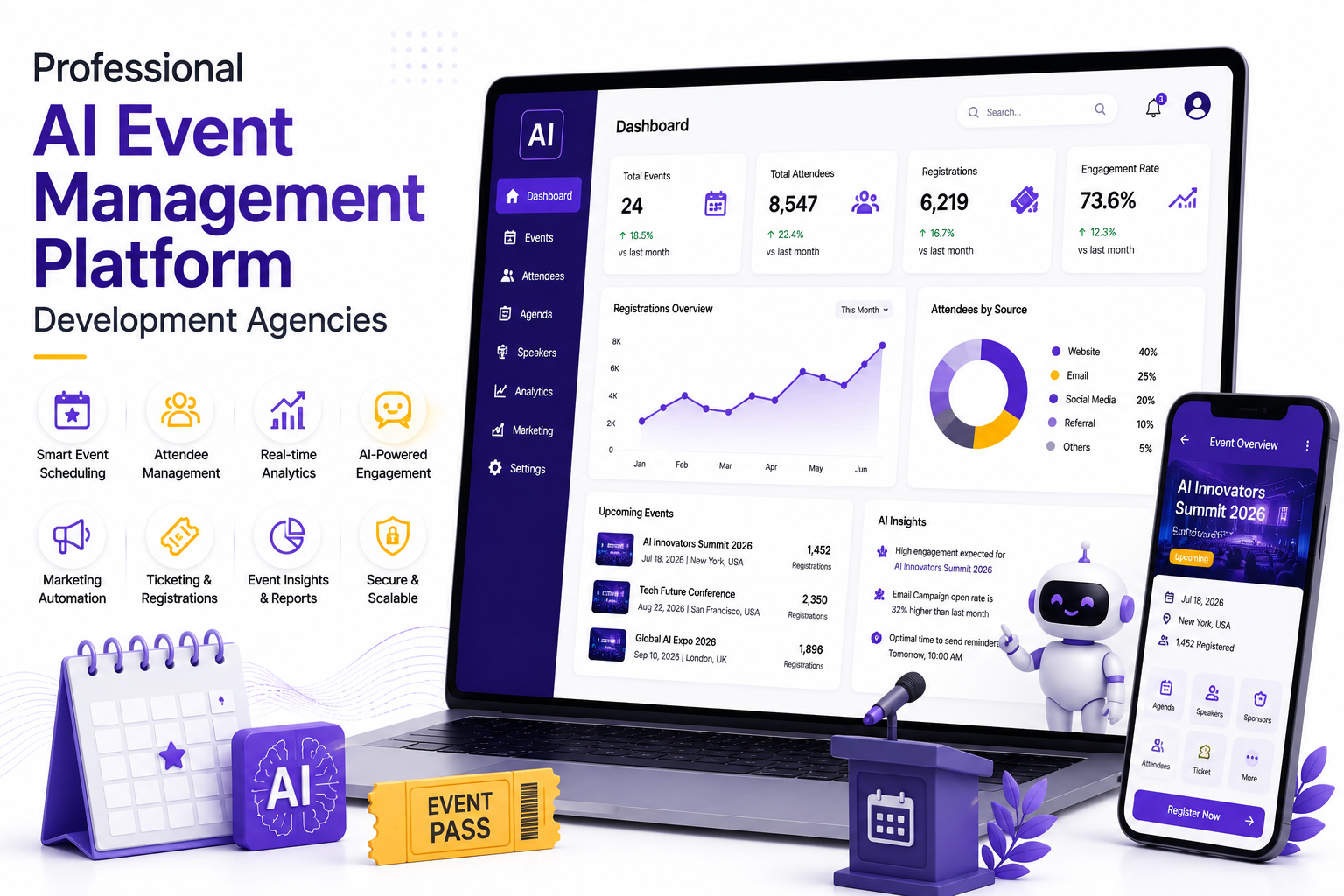

Event organizers used to run on instinct and spreadsheets. In 2026, that approach quietly falls apart the moment an event grows past a few hundred attendees. Sessions overlap, check in lines back up, sponsors want real time engagement data, and attendees expect the same personalization they get from any consumer app. This is exactly why so many CEOs and founders are now searching for a company that can build a proper AI Event Management Platform instead of stitching together five separate tools that were never designed to talk to each other in the first place.
The problem is that the market is crowded. Dozens of agencies claim they can build one, but very few can actually combine event logic, real time data pipelines, and machine learning in a way that holds up during a live event with thousands of concurrent users. Picking the wrong partner usually shows up later, in the form of a platform that looks good in a demo but buckles during check in on the first morning, or a recommendation engine that never actually learns from attendee behavior because nobody built the data pipeline to feed it.
There is also a cost dimension that founders tend to underestimate early on. A platform that gets rebuilt eighteen months after launch because the original team could not scale the AI layer ends up costing far more than paying a bit more upfront for a team that has already solved these problems for other clients. That is the real reason a careful hiring decision matters here more than it does for a typical marketing website or internal tool.
This guide walks through 15 development agencies worth shortlisting in 2026. Each one is evaluated on what actually matters to a founder making a hiring decision: technical depth, industry experience, the kind of AI features they have actually shipped, and how well suited they are to different budgets and event types. Some are generalist app studios that happen to do strong event work, while others build almost nothing else.
It is worth noting upfront that most of these agencies work with clients well beyond their home country, so location on its own should not rule an agency in or out. What matters far more is whether their past work lines up with the type of event you are running, whether that is a single flagship conference once a year or a recurring series of smaller regional meetups that each need their own registration flow and attendee data handled consistently.
What to Look for Before You Hire
Before comparing agencies, it helps to know what separates a genuinely capable partner from one that simply lists AI on their homepage. Look for a team that can talk specifics about attendee matching algorithms, real time analytics dashboards, and how they handle data privacy for registration information. Ask for examples of platforms that ran live events with real attendee volume, not just prototypes built for a sales pitch.
It also helps to ask how a team tests its AI features before a live event, since a recommendation engine or matchmaking model that has only ever been tested on sample data can behave unpredictably once thousands of real attendees start using it at once. A team that can describe a load test they ran, or a specific bug they caught before launch, is usually more trustworthy than one that only talks about features in the abstract.
Budget and timeline matter too. A straightforward event app with basic AI recommendations might cost $15,000 to $40,000, while a full scale platform with predictive analytics, smart matchmaking, and custom integrations can run $60,000 to $150,000 or more, depending on scope. Knowing this range in advance makes it much easier to have a grounded conversation with any agency on this list, and it helps you avoid either overpaying for features you do not need or underfunding a build that quietly cuts corners on the parts that matter most.
It also helps to check how each agency handles post launch support, since an AI powered platform is never really finished the way a simple brochure website might be. Models need retraining as attendee behavior data accumulates, and new integrations tend to come up as an event program grows year over year. Ask specifically what a support agreement includes once the initial contract ends, rather than assuming ongoing help will simply be available on request.
The AI Features Worth Asking About
Not every AI feature adds real value, so it helps to know which ones tend to matter most in practice. Attendee matchmaking, built on interest and behavior data rather than just job titles, consistently drives the highest engagement at networking heavy events. Predictive attendance forecasting helps organizers plan staffing and catering more accurately, and it becomes more useful the more historical event data a platform has access to.
Real time analytics dashboards that update during the event itself, rather than only afterward, let organizers spot a stalled session or an under attended booth while there is still time to react. Chat assistants that can answer logistics questions instantly also reduce pressure on a support team during the busiest hours of an event. When evaluating agencies, ask which of these they have actually shipped, not just which ones they are willing to build.
It is also fair to ask an agency how they measure whether an AI feature is actually working once an event is live, rather than simply assuming it performs well because the underlying model looked accurate during testing. A matchmaking feature that attendees never open, or a chatbot that gets abandoned mid conversation more often than it resolves a question, points to a usability problem that no amount of model accuracy alone can fix.
15 AI Event Management Platform Development Agencies to Consider
1. Hourly Developers
Hourly Developers works with event organizers who want to build or extend a platform without committing to a large fixed price project. Their model lets clients bring on developers by the hour or by the sprint, which suits founders who already have a product roadmap but need extra engineering capacity to add AI features like attendee recommendations or live analytics. Their teams have experience across React, Node, and Python based machine learning services, and they are comfortable joining an existing codebase rather than starting from a blank slate. This matters a great deal for founders who already invested in a platform earlier and simply need it to catch up on the AI side without a full rebuild. Communication tends to happen through short weekly check-ins rather than a rigid milestone contract, which gives founders more visibility into progress and makes it easier to redirect effort if priorities shift midway through a project. For an early stage founder testing whether an AI feature is even worth investing in long term, this lower commitment structure removes a lot of the risk that usually comes with a large upfront contract.
2. JPLoft
JPLoft builds event applications for conferences, exhibitions, and corporate gatherings, with a strong emphasis on AI driven attendee matching. Their engineering team uses machine learning models to pair attendees based on shared interests and professional background, which has become one of the more requested features among clients running networking heavy events. Beyond matchmaking, they also build chatbot layers that answer attendee questions in real time and automation tools that handle marketing segmentation. Their approach to attendee data tends to be structured around clear opt-in consent flows, which helps clients stay comfortable with how personal information is used to power recommendations. Founders running conferences where networking quality is the main selling point to sponsors and attendees alike often find this specialization directly relevant to their goals. Their portfolio includes work across corporate conferences and large trade shows, which gives them a reasonable baseline for handling attendee volumes that scale into the thousands without the matching quality falling apart.
3. Nimble AppGenie
Nimble AppGenie positions itself around custom event applications that scale across device types, using cloud infrastructure to keep data synchronized whether an attendee is on a phone, tablet, or web browser. Their AI and machine learning layer focuses on automation within the event experience itself, including smart scheduling suggestions and adaptive session recommendations. They tend to work with organizers who need a platform that behaves consistently across a wide mix of hardware, which matters more than it sounds for events where attendees range from executives on the latest devices to volunteers using older, budget hardware in the field. Their cloud first architecture also tends to make it easier to add new device types later without a major rebuild. For organizers planning to grow an event series over several years, this kind of forward compatible foundation can save a meaningful amount of rework down the line.
4. Backend Development Company
Backend Development Company focuses on the engineering layer that most event platforms eventually need but rarely plan for early enough: the data infrastructure behind registration, ticketing, and live analytics. Their team builds the APIs, databases, and machine learning pipelines that power features like predictive attendance forecasting and real time engagement scoring. Founders who already have a front end design or mobile app in mind often bring them in specifically to build a dependable backend that can handle event day traffic spikes without falling over. Their engineers spend a fair amount of time on load testing and database indexing before launch, which is exactly the unglamorous work that determines whether check in runs smoothly on the morning of a large event or grinds to a halt at the worst possible moment. Because their focus stays narrow, they tend to pair well with a separate design or front end team rather than trying to own the whole project themselves.
5. Appinventiv
Appinventiv has built a reputation across mobile app development broadly, and its event focused work carries that same emphasis on polish and brand alignment. Their platforms are designed to feel like an extension of a client's brand rather than a generic template, with custom UI work paired with AI features such as personalized session recommendations. They have also picked up industry recognition for AI product engineering, which shows up in how thoroughly their teams document technical decisions during a build. For founders who plan to use their event platform as a visible extension of a broader product or brand strategy, this level of design attention tends to matter more than it would for a purely internal or operational tool, since attendees interact with it directly and form an impression of the brand through it. Their broader mobile development experience also means they are generally comfortable supporting a platform across both iOS and Android without treating either as a lower priority afterthought.
6. Biz4Group
Biz4Group builds AI event management software with a focus on the operational side of running an event, including resource planning and intelligent recommendation engines for sponsors and exhibitors. Their portfolio spans several adjacent AI product builds outside events too, which gives their engineers a broader base of machine learning experience to draw from when a client needs something more specific, like demand forecasting for a multi day conference. This cross-industry exposure often shows up in small but useful details, such as recommendation logic borrowed from a retail project being adapted to suggest relevant sessions or exhibitor booths to an attendee based on their earlier activity during the same event. Organizers managing sponsor relationships closely tend to value this operational lens, since sponsor satisfaction often depends on data the platform can surface automatically rather than reports assembled by hand after the event ends.
7. HireFullStackDeveloperIndia
HireFullStackDeveloperIndia is built around a straightforward idea: give founders direct access to full stack engineers who can own an event platform build from the database layer through to the interface attendees actually use. This end to end ownership matters for event technology specifically, because features like live polling, real time seat availability, and AI powered agenda suggestions all depend on the front end and backend working in close sync rather than being handled by separate disconnected teams. Founders working with a lean internal team often appreciate this model because it reduces the coordination overhead of managing two or three separate vendors, and it means one engineer can trace a bug from the interface all the way back to the database without waiting on a handoff between teams. This single team structure also tends to speed up the process of shipping small fixes during the days immediately before an event, when timelines are tightest and coordination overhead matters most.
8. Dev Technosys
Dev Technosys brings AI, machine learning, and IoT together for event platforms that need more than just software running on a phone. Their computer vision work supports crowd monitoring and event day security use cases, while their natural language processing tools power attendee facing chat features. Organizers running large scale public events with physical safety considerations tend to find their combined software and IoT approach particularly useful, since crowd density data captured through cameras can feed directly into the same platform attendees use for schedules and navigation. This kind of integration is harder to pull off than it sounds, because it requires software and hardware teams to coordinate closely rather than working in isolation. Organizers running festivals or large public gatherings, where crowd safety carries real operational weight, tend to see the most direct value from this combined approach.
9. CrinPro
CrinPro works with businesses and event organizers who need a platform that handles the essentials well before layering on anything more advanced. Their builds cover attendee registration, ticketing, networking tools, and scheduling, with a customer centric process that keeps clients involved throughout development rather than only at the beginning and end. Their scalable approach makes them a reasonable fit for organizers running conferences, exhibitions, and trade shows of varying sizes. Founders who are building their first event platform and want a partner willing to explain trade offs in plain language, rather than assuming prior technical knowledge, tend to find this agency approachable without feeling like anything important got skipped along the way. Their focus on the essentials also tends to keep project timelines shorter and more predictable, which suits founders working toward a fixed event date that cannot easily move.
10. OpenXcell
OpenXcell delivers enterprise grade event platforms for organizations that need to manage complex, multi stakeholder events at scale. Their engineering approach leans toward robustness and long term maintainability, which matters for organizations running recurring annual events where the platform needs to be extended year over year rather than rebuilt. They also bring experience integrating event platforms with existing enterprise systems like CRM and marketing automation tools, which helps large organizations avoid the common problem of event data sitting isolated from the rest of the business. This tends to matter most for organizations where the event team reports into a larger marketing or operations function that expects consistent data across every tool. Their project process also tends to include more formal documentation and handoff materials, which larger organizations often require for internal compliance and knowledge transfer purposes.
11. HireAIDevelopers
HireAIDevelopers focuses specifically on the machine learning layer of an event platform rather than general app development. Founders typically bring them in to build or improve features like attendee matchmaking models, predictive attendance forecasting, and natural language chat assistants, often working alongside another team that owns the broader application. This specialization means their engineers spend most of their time thinking about model accuracy and data quality rather than general software architecture. Because they work across many different client platforms, they also tend to have a clearer sense of which AI features actually get used by attendees after launch, versus which ones look impressive in a proposal but rarely get touched once the event is live. This makes them a useful second opinion even when another agency is leading the overall build, since their sole focus on the AI layer tends to surface gaps that a generalist team might miss.
12. Techanic Infotech
Techanic Infotech builds scalable event solutions for startups, enterprises, and conference management firms, with attendee registration, ticket booking, and AI powered matchmaking among their core offerings. Their teams also work on live streaming integration and push notification systems, which matter for hybrid events where remote attendees need the same level of engagement as people in the room. Their pricing tends to be approachable for founders working with a mid range budget, and they are often chosen by organizers who need a platform capable of handling both in person and remote audiences without treating either group as an afterthought. Startups running their first hybrid conference in particular tend to appreciate the combination of reasonable cost and a fairly complete feature set out of the gate.
13. Y Media Labs
Y Media Labs is known more broadly for premium digital experiences, and that design first sensibility carries into their event platform work. Their strength lies in user centric interface design paired with scalable engineering, which results in platforms that are pleasant to use even under the pressure of a live, fast moving event. Founders who care as much about attendee experience as they do about backend performance tend to gravitate toward this kind of agency, particularly for flagship events where the platform itself becomes part of how attendees judge the quality of the whole experience, not just a functional tool they tolerate for the day. Their process typically leans heavily on early prototyping and attendee testing, which helps catch usability problems well before a live event puts the interface under real pressure.
14. Wildnet Edge
Wildnet Edge builds event platforms with a strong emphasis on third party API integration, including ticketing systems, payment gateways, and live streaming providers. This matters for founders who already rely on tools like Stripe for payments or Vimeo for streaming and want an event platform that plugs into that stack rather than replacing it. Their engineering approach favors robust, future proof foundations over quick, disposable builds, which tends to pay off for organizers running the same event year after year, since the integrations built in year one keep working reliably rather than needing to be patched or replaced with each new event cycle. Founders juggling several existing vendor relationships tend to appreciate a team willing to work within that stack rather than pushing to replace tools that already work well.
15. BairesDev
BairesDev builds custom event planning and management software for a wide range of clients, from conference venues to nonprofit organizations and government agencies. Their scope covers bespoke ticketing with dynamic pricing, attendee tracking with custom APIs, and compliance focused builds for public sector clients. This breadth means they are comfortable adapting an event platform to unusual requirements, such as volunteer coordination for a nonprofit or security compliance for a government hosted event. Founders working outside the typical corporate conference mold, such as sports organizations running tournaments or professional associations coordinating member events, often find that this broader client base translates into fewer surprises when their own requirements turn out to be a bit unconventional. Their global engineering footprint also tends to give clients access to a wider pool of specialized talent than a smaller regional agency could realistically offer.
Final Thoughts
There is no single best agency on this list. The right choice depends on whether you need a full platform built from scratch, extra AI capacity layered onto something you already have, or a partner who understands compliance heavy events in the public sector. What matters most is asking each shortlisted agency to walk you through a real project, including what broke during a live event and how they fixed it, because that conversation tells you far more than any portfolio page or list of past clients.
It is also worth remembering that the agency you hire today will likely still be involved a year from now, fixing bugs, retraining models as your attendee data grows, and adding features you did not think to ask for at the start. That ongoing relationship matters just as much as the initial build, so pay attention to how responsive and communicative a team is during your first few conversations, since that pattern rarely changes once a contract is signed.
Whichever agency you eventually choose, treat the first project as the start of a longer relationship rather than a one time purchase. Event platforms tend to grow in scope faster than founders expect, and the partner who understands your first event well is usually in the best position to help the second and third ones run even more smoothly.
If you are still narrowing things down, start by defining your must have features and your realistic budget range, then bring those specifics to two or three agencies from this list. A serious AI Event Management Platform partner will ask you pointed questions back rather than simply agreeing to everything, and that back and forth is usually the clearest early signal of how the working relationship will actually go.