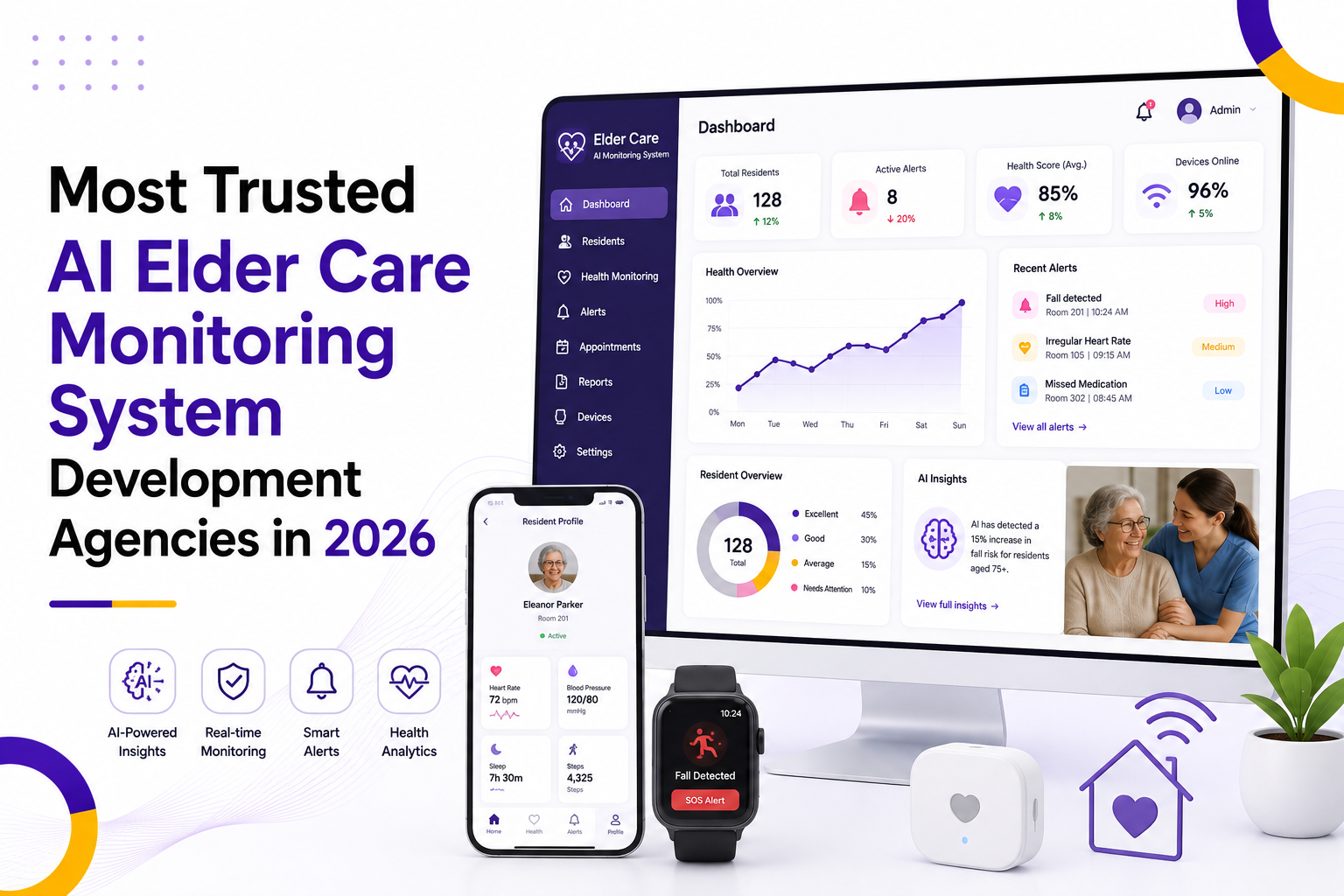
Every founder who has tried to build a senior monitoring product runs into the same problem sooner or later. The idea sounds simple on a whiteboard, a sensor picks up a fall, an app pings a family member, a dashboard shows vital signs at a glance. Then the actual engineering starts and it becomes clear that this is not a typical mobile app project. You are dealing with wearable data, camera based fall detection, medication schedules, HIPAA rules, and a user base that includes people who have never used a smartphone before. Getting all of that right requires a development partner who has actually shipped healthcare software before, not one that is learning the domain on your budget.
That is exactly why this list exists. Below are 20 development agencies that have real experience building an AI Elder Care Monitoring System or closely related healthcare and remote patient monitoring products. Some are large healthcare IT specialists with decades of regulatory experience. Others are leaner teams that move faster and cost less while still understanding what compliance and caregiver alerting actually require. Whichever direction fits your budget and timeline, you will find a grounded, factual profile here rather than a generic pitch built around buzzwords nobody can actually deliver on.
One thing worth saying upfront, this space has grown fast, and it has attracted a lot of agencies that added an elder care case study to their website without ever shipping one to real seniors. The 20 AI Elder Care Monitoring System development firms below were chosen because there is verifiable evidence behind their healthcare claims, whether that is a documented HIPAA compliant project, a published case study, or a specialization that has existed for years rather than months. Use this list as a genuine starting point for outreach, not as a ranked scoreboard, because the right partner for you depends heavily on your budget, timeline, and how far along your product idea already is. Read each profile with your own specific use case in mind rather than skipping straight to the biggest or most recognizable name on the page.
What Makes Elder Care Monitoring Software Different to Build
A typical consumer app can tolerate a bug that annoys a user for a day. An AI Elder Care Monitoring System cannot tolerate a missed fall alert or a delayed medication reminder, because the consequence is not a bad review, it is a real safety incident. This changes how the software has to be engineered from day one. Sensor data has to be processed reliably even on unstable home WiFi, false positives from fall detection algorithms need to be tuned down without missing real events, and family or caregiver notifications need multiple fallback channels in case one method fails.
There is also the question of who is actually using the product. Seniors themselves often need an almost invisible interface, while caregivers and family members need a far more detailed dashboard with trends over time, not just a single alert. Getting this balance right takes a development team that has built for both audiences before, which is why the agencies below are being evaluated on real healthcare project history rather than general app development experience alone.
Data privacy adds another layer most founders underestimate at first. Continuous health monitoring generates a steady stream of sensitive information about a person's daily habits, movement patterns, and medical status, and that data has to be encrypted, stored, and shared according to HIPAA and, for many products, GDPR as well. An agency that treats compliance as an afterthought bolted on before launch usually costs a founder more in rework than one that builds it into the architecture from the very first sprint.
Budget conversations also look different in this space compared to a typical consumer app. Founders sometimes assume the monitoring dashboard is the expensive part, when in reality the sensor integration layer, the alerting logic, and the compliance documentation usually consume the largest share of engineering hours. Any agency quoting a price before understanding how many device types need support and how alerts should escalate is likely underestimating the real scope of the work involved.
Focus: End to end full stack teams covering mobile, web, and backend for healthcare products
HireFullStackDeveloperIndia is built for founders who need one team that can own the entire technical stack of an AI Elder Care Monitoring System, from the caregiver facing dashboard down to the sensor data backend, rather than coordinating between separate frontend and backend vendors.
Their full stack developers work across React, Node, Flutter, and native mobile frameworks, and the company offers dedicated hiring models that let a founder scale the team as the product moves from prototype to a fully monitored production platform. This single team ownership tends to reduce the handoff friction that slows healthcare projects down, since the same engineers who built the backend already understand how the frontend consumes that data.
2. ScienceSoft
Founded: 1989
Headquarters: McKinney, Texas, United States
Team size: 750 plus specialists
Focus: Healthcare IT since 2005, including remote patient monitoring and medical software
ScienceSoft has been working specifically in healthcare IT since 2005, which shows in how deliberately they approach compliance. Their teams hold direct experience with HIPAA, HL7, and FHIR standards, and they have delivered remote patient monitoring platforms that connect wearable sensors, care coordination tools, and clinical dashboards for over 150 healthcare clients.
For a founder who needs a partner comfortable navigating FDA adjacent regulatory questions alongside the actual engineering, ScienceSoft brings a depth of healthcare specific process that fewer generalist agencies can match. Their scale also means they can staff both the AI and clinical integration sides of a project without pulling in a second vendor, which reduces the coordination overhead that often slows down healthcare projects with multiple external partners involved.
3. Appinventiv
Founded: 2014
Headquarters: Noida, India
Team size: 1500 plus specialists
Focus: AI powered healthcare and telemedicine apps with cloud and EHR integration
Appinventiv holds ISO 27001 and ISO 9001 certifications and has built telemedicine and remote monitoring platforms with EHR connectivity for clients spanning startups to enterprise healthcare providers. Their cloud partnerships with AWS, Azure, and Google Cloud give them flexibility in how monitoring data gets stored and processed at scale.
What stands out for elder care specifically is their track record with wearable integrations and AI driven anomaly detection, both core building blocks of a functioning senior monitoring product. Project budgets with them tend to start higher than boutique agencies, so this fits founders with enterprise grade requirements rather than an early prototype budget, particularly those planning a multi region launch from the start.
Focus: Scalable backend architecture for real time monitoring and sensor data pipelines
The backend of an elder care platform carries most of the actual difficulty, since it has to process continuous sensor streams, run anomaly detection without lag, and trigger alerts within seconds of a real event. Backend Development Company specializes purely in this layer, building the infrastructure that sits behind mobile and web interfaces designed by other teams or by the client's in house designers.
Their engineers work extensively with real time data pipelines, queueing systems, and cloud infrastructure built for uptime, which matters enormously when a missed alert has safety consequences. Founders who already have a frontend or design partner and specifically need rock solid backend engineering often bring this team in for exactly that piece of the build, treating them as a specialist subcontractor rather than the primary vendor of record.
5. Simform
Founded: 2010
Headquarters: Sunnyvale, California, United States
Team size: 500 plus engineers
Focus: Cloud native healthcare platforms with FHIR and HL7 interoperability
Simform ranked among the top firms globally in Clutch's Leaders Matrix for custom software development, and healthcare interoperability is one of their clearest specialties. Their engineers have built dedicated practices around FHIR and HL7 data standards, which is exactly what an elder care platform needs when it has to exchange information with hospital systems, pharmacies, or existing electronic health records.
Their extended team model integrates directly into a client's existing engineering department rather than operating as a fully separate vendor, which some founders prefer when they already have internal product leadership and just need extra hands with healthcare data expertise, along with cloud native infrastructure experience across AWS and Azure environments.
6. Matellio
Founded: 2012
Headquarters: San Jose, California, United States
Team size: 200 plus engineers
Focus: IoT based remote patient monitoring and AI integrated healthcare platforms
Matellio has built a decade of experience in custom healthcare software, with a specific focus on IoT powered remote patient monitoring that translates directly to senior care use cases involving wearables and home sensors. Their portfolio includes HIPAA compliant telehealth apps, patient monitoring dashboards, and EHR software.
They have been recognized by Clutch and DesignRush for their healthcare delivery work, and their engineering teams are comfortable combining AI, machine learning, and IoT sensor integration in a single product, which is precisely the technical mix an elder monitoring platform requires from its earliest architecture decisions through to a scaled production release.
Focus: Flexible hourly and dedicated team engagements for healthcare and IoT products
Hourly Developers built its entire model around a problem founders raise constantly, needing senior engineers without committing to a large fixed price contract before the product direction is even settled. For an AI Elder Care Monitoring System, that flexibility matters because early builds often change shape fast as fall detection accuracy gets tuned and caregiver workflows get tested with real families.
The team has delivered wearable integrations, real time dashboards, and HIPAA aware backend systems for healthcare clients, billed purely on hours worked rather than a fixed scope that locks you into decisions made in week one. Founders who want a technical partner that can start within days and scale the team up or down as the roadmap evolves tend to find this model easier to plan around than a traditional agency contract, especially during the early months when requirements are still shifting based on user feedback.
8. Cleveroad
Founded: 2011
Headquarters: Tallinn, Estonia
Team size: 300 plus specialists
Focus: HIPAA and GDPR compliant telehealth and remote monitoring apps
Cleveroad has positioned itself around dual compliance, building products that satisfy both HIPAA in the United States and GDPR in Europe, which matters for any elder care platform planning to serve families across multiple regions. Their telehealth and remote monitoring builds regularly include fall detection, medication tracking, and caregiver alerting modules.
Their European base also gives them a slightly different cost structure than US based firms while still delivering senior level engineering talent, which some founders find useful when trying to balance quality against a tighter early stage budget without giving up on regulatory rigor in either market.
9. DataArt
Founded: 1997
Headquarters: New York, United States
Team size: 3000 plus engineers
Focus: Clinical data engineering with FHIR, HL7, and DICOM standards
DataArt brings almost three decades of software engineering experience, with a healthcare practice built specifically around clinical data standards like FHIR, HL7, and DICOM. For an elder care platform that eventually needs to talk to hospital records or imaging systems, this depth of interoperability knowledge is not something every vendor can offer.
Their scale allows them to staff large, multi disciplinary teams that combine data engineering, AI development, and clinical workflow design under one roof, which suits founders building toward a platform meant for enterprise senior living operators rather than a single family use case where a smaller team would be more appropriate.
10. Chetu
Founded: 2000
Headquarters: Plantation, Florida, United States
Team size: 2500 plus developers
Focus: Custom healthcare software and staff augmentation across multiple technology stacks
Chetu operates as a large scale custom software shop with a dedicated healthcare vertical, offering both project based delivery and staff augmentation depending on what a founder needs. Their experience spans EHR integrations, remote monitoring dashboards, and HIPAA compliant mobile applications.
Because of their size, they can flex team composition quickly if a project's technical requirements shift midway, which happens often in elder care products as founders learn more from early user testing with seniors and their families and need to reprioritize which features ship first.
Focus: Machine learning and predictive analytics for health monitoring platforms
The intelligence layer of an AI Elder Care Monitoring System is what separates a simple alert app from a product that can actually predict problems before they escalate. HireAIDevelopers focuses specifically on this layer, building the machine learning models that detect falls from sensor patterns, flag unusual inactivity, and identify early signs of cognitive or physical decline from behavioral data.
Their engineers work with time series data, computer vision for camera based fall detection, and predictive analytics pipelines, and they are often brought in by founders who already have a product team but need specialized AI expertise that general full stack developers do not have, especially around tuning model accuracy to reduce false alarms without missing genuine emergencies.
12. BairesDev
Founded: 2009
Headquarters: San Francisco, California, United States
Team size: 4000 plus engineers
Focus: Nearshore engineering capacity for large scale healthcare platform builds
BairesDev is one of the larger nearshore staffing and development firms, drawing engineering talent primarily from Latin America to work in close time zone alignment with United States based founders. Their scale lets them staff multiple parallel workstreams at once, which suits elder care platforms that need mobile, backend, and AI development happening simultaneously to hit a launch date.
Their nearshore model also tends to offer real time collaboration during standard US working hours, which some founders find easier to manage day to day compared to fully offshore teams working on an opposite schedule, particularly during the intensive testing phase before a healthcare product goes live.
13. RisingMax
Founded: 2015
Headquarters: New York, United States
Team size: 100 plus engineers
Focus: Healthcare software development and digital administrative process automation
RisingMax has built a reputation as an IT consulting firm with a strong healthcare software delivery track record, particularly around digitizing administrative processes that reduce the operational cost of running a care platform. For elder care products, this translates to smoother caregiver scheduling, billing, and reporting features alongside the core monitoring functionality.
Their consulting first approach means they typically spend more time upfront understanding a founder's specific care model before writing code, which can slow the initial timeline slightly but often produces a more tailored final product that fits the operational realities of the care team using it every day.
14. Intellectsoft
Founded: 2007
Headquarters: Palo Alto, California, United States
Team size: 200 plus engineers
Focus: Digital transformation and custom software with IoT and AI expertise
Intellectsoft has worked with globally recognized brands on digital transformation projects and brings that same rigor to healthcare builds, combining IoT, AI, and enterprise software development under one team. Their client list includes major names outside healthcare too, which speaks to a level of engineering discipline that transfers well into a regulated space like elder care.
Founders who want a partner experienced in enterprise scale software, not just healthcare specific projects, sometimes prefer this broader background when their monitoring platform is being built to eventually serve large senior living operators or insurance partners with strict vendor qualification requirements.
15. Netguru
Founded: 2008
Headquarters: Poznan, Poland
Team size: 900 plus specialists
Focus: Product design and development for web, mobile, and SaaS healthcare platforms
Netguru pairs strong product design capability with engineering, which matters for an elder care platform where the caregiver dashboard needs to communicate complex health data clearly without overwhelming a non technical family member. Their teams have delivered SaaS platforms and mobile apps across multiple regulated industries.
Being based in Poland with offices across several European cities, they offer a cost position between fully offshore firms and US based agencies, while maintaining a design led process that tends to produce a more polished end user experience for both the senior and the caregiver sides of the product.
16. ValueCoders
Founded: 2004
Headquarters: Gurugram, India
Team size: 600 plus developers
Focus: Custom software outsourcing with dedicated healthcare development teams
ValueCoders has over two decades of outsourced software delivery experience, with dedicated teams that have worked on healthcare and remote monitoring builds among many other verticals. Their pricing tends to sit on the more accessible end for founders working with a leaner early stage budget.
They offer flexible engagement models including fixed price, dedicated team, and hourly billing, which gives founders room to start small with a proof of concept before committing to a larger build once the core monitoring logic is validated with real users and their families over several months of testing.
17. Itransition
Founded: 1998
Headquarters: Denver, Colorado, United States
Team size: 3000 plus specialists
Focus: Enterprise software consulting with healthcare and AI implementation experience
Itransition has been operating for over 25 years and has built a broad healthcare consulting practice alongside its custom development work, giving them experience navigating both the technical and operational sides of launching a monitoring platform inside an existing care organization.
Their scale and consulting background suit founders building toward partnerships with senior living communities or home care agencies, where the software has to integrate into established operational workflows rather than launching as a standalone consumer app with no ties to an existing care delivery structure.
18. Innowise
Founded: 2007
Headquarters: Warsaw, Poland
Team size: 2500 plus specialists
Focus: Full cycle software development and IT staff augmentation across healthcare and IoT
Innowise runs a large, multinational engineering team spanning offices in Europe, the United States, the United Kingdom, and the UAE, and works across AI, IoT, and cloud technologies that map directly onto elder care platform requirements. They have delivered over 1,600 projects across a wide range of industries including healthcare.
Their flexible engagement options, from full project ownership to staff augmentation of a founder's existing team, make them a fit for both early stage products and larger platforms needing additional engineering capacity fast, particularly when a launch deadline is already fixed and the internal team is stretched thin.
19. A3Logics
Founded: 2013
Headquarters: Rancho Cucamonga, California, United States
Team size: 150 plus engineers
Focus: AI and machine learning driven software development for healthcare and enterprise clients
A3Logics focuses heavily on AI and machine learning implementation, which fits naturally with the predictive analytics core of an elder care monitoring product. Their teams have experience building custom algorithms for pattern detection and anomaly flagging, skills that translate directly into fall detection and behavioral monitoring features.
They work with both startups and established enterprises, and founders who want an AI first development partner rather than a generalist mobile shop tend to find their technical depth well matched to this kind of build, especially when the product's core value proposition depends on predictive accuracy rather than basic alerting alone.
20. TechMagic
Founded: 2014
Headquarters: Lviv, Ukraine
Team size: 200 plus engineers
Focus: Mobile and web telemedicine development with remote patient monitoring expertise
TechMagic has specialized in telemedicine and remote patient monitoring platforms since 2014, with direct experience building EHR integrations and patient data management systems. Their engineering culture leans toward modern web and mobile frameworks, which tends to result in faster iteration cycles during early product development.
For founders who want a technically sharp team at a mid range price point, comfortable working through the EHR integrations and data management systems an elder care platform eventually needs, TechMagic is worth including in a shortlist alongside larger and more expensive firms with similar technical capability.
How to Actually Choose Between These Agencies
Founders often default to picking the biggest name on a list like this, but the right choice for an AI Elder Care Monitoring System depends more on where your product is in its life cycle than on company size. A founder still validating whether families will trust a camera based fall detection feature needs a lean, fast moving team willing to iterate on a prototype, not a large firm optimized for enterprise scale delivery with long procurement cycles built into every engagement.
Ask every shortlisted agency for a specific example of a healthcare project involving real time alerting, not just a general healthcare portfolio. Alerting is the single hardest technical piece to get right, since it has to work reliably across unstable home networks and reach a caregiver through more than one channel if the first attempt fails. An agency that cannot speak concretely about how they handled this in a past project is likely learning it on your project instead of on their own dime.
It also helps to ask about their approach to false positives directly, since this is where most first time builds struggle the most. A fall detection system tuned too aggressively will exhaust family members with constant false alarms until they quietly turn notifications off, which defeats the entire purpose of the product. A vendor who has already solved this tradeoff on a past project will save you months of trial and error compared to one encountering it for the first time on your budget.
Finally, do not overlook the question of who maintains the product after launch. Elder care platforms need ongoing attention long after the first release, including retraining fall detection models as new device types come to market and patching security issues as compliance standards evolve. Some agencies price maintenance separately from the initial build, while others include a support window in the original contract, so it is worth clarifying this detail before signing rather than discovering it after launch day.
Conclusion
There is no single correct answer among these 20 firms, only the right fit for where your product and budget currently stand. A founder testing an early concept with a handful of families will get more value from a flexible, hourly engaged team than from a large enterprise consultancy built around multi year healthcare contracts. A founder building toward partnerships with senior living operators needs the opposite, a partner who already understands how software gets deployed inside an existing care organization and the procurement process that comes with it.
What matters most is asking direct questions before signing anything. Request references from healthcare specific projects, ask how the team handles missed alert scenarios, and confirm who owns HIPAA compliance responsibility once the product ships. An AI Elder Care Monitoring System carries real consequences when something goes wrong, so the vendor conversation should feel more like hiring a clinical partner than picking an app development shop off a marketing page, and the agencies on this list are a solid starting point for exactly that kind of conversation.
Take your time with the first two or three conversations, since a rushed decision here is far harder to reverse than in most other software categories. The families relying on this product will trust it with something as basic as knowing whether a parent or grandparent is safe today, and that trust is earned through the quality of engineering behind the scenes, not through the polish of a sales deck.
Deep Shah is the business growth expert helping us make accurate decisions in Sales. His understanding and interpretation of customer behavior and current trends are critical factors in building customer-friendly products. Deep Shah also heads the technical team at WebClues and shares his expertise and guidance to help achieve excellent results.
Build Your Agile Team
We provide you with a top-performing extended team for all your development needs in any technology.
Hourly
$20
It Includes
Duration
Hourly Basis
Communication
Phone, Skype, Slack, Chat, Email
Hiring Period
25 Hours (MIN)
Project Trackers
Daily Reports, Basecamp, Jira, Redmime, etc
Methodology
Agile
Monthly
$2600
It Includes
Duration
160 Hours
Communication
Phone, Skype, Slack, Chat, Email
Hiring Period
1 Month
Project Trackers
Daily Reports, Basecamp, Jira, Redmime, etc
Methodology
Agile
Team
$13200
It Includes
Team Members
1 (PM), 1 (QA), 4 (Developers)
Communication
Phone, Skype, Slack, Chat, Email
Hiring Period
1 Month
Project Trackers
Daily Reports, Basecamp, Jira, Redmime, etc
Methodology
Agile
Frequently Asked Questions
How much does it cost to build an AI elder care monitoring system in 2026?
A focused pilot with basic fall detection and caregiver alerts typically runs $40,000 to $80,000. A fuller platform with wearable integration, predictive analytics, and EHR connectivity often reaches $150,000 to $300,000 or more, depending on compliance scope, the number of device integrations, and how many regions the product needs to support at launch.
Do these platforms need FDA clearance before launch?
It depends on the specific claims made. A wellness tracking app generally avoids FDA oversight, but software making diagnostic or treatment claims may qualify as a medical device. Most agencies on this list can advise on classification early, though founders should confirm regulatory scope with legal counsel before finalizing any feature claims publicly.
How long does a typical build take from start to launch?
A minimum viable version with core monitoring and alerting usually takes four to six months. Adding predictive analytics, multiple wearable integrations, and hospital record connectivity extends that to nine months or longer, since each integration requires its own testing cycle against real device data before it can be trusted in production.
Can an existing consumer app be retrofitted with elder monitoring features?
Yes, and it is often cheaper than starting from scratch. Several agencies on this list regularly add fall detection, medication reminders, or caregiver dashboards onto an existing product rather than rebuilding it, provided the underlying backend can support real time sensor data without a major architecture overhaul first. A short technical audit upfront usually clarifies the real scope quickly.
What is the biggest technical mistake founders make in this space?
Underestimating alert reliability. Founders often focus engineering time on the dashboard and forget that a missed fall notification defeats the entire product. The agencies worth hiring build redundant notification channels and test failure scenarios extensively before launch, not just the happy path where every device and network connection works exactly as expected.