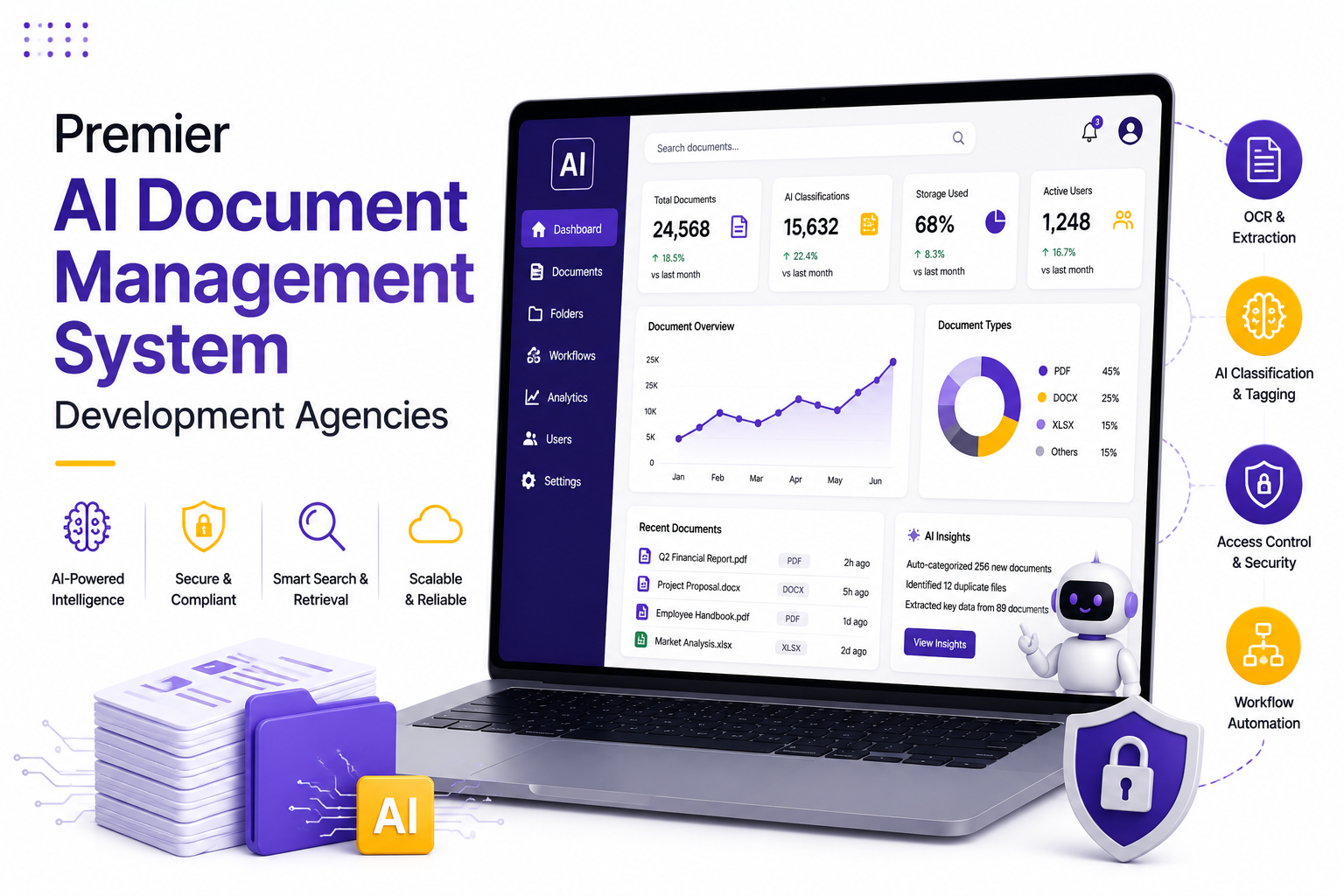

If your company is drowning in contracts, invoices, compliance files, and endless email attachments, you already know the real problem is not storage space. The real problem is finding the right document at the right moment, understanding what is actually written inside it, and trusting that nothing important gets buried or lost between departments. That is exactly what a well built AI Document Management System solves, and it is why more CEOs and founders are now actively searching for a development partner who can build one, instead of settling for a generic off the shelf tool that only checks boxes on a feature list.
The tricky part is that not every software company claiming AI expertise can actually deliver a system that reads your documents, understands context, and scales cleanly as your data grows. Some agencies are strong on document capture and OCR but fall short on natural language search. Others build attractive dashboards but cannot handle multilingual processing or compliance heavy workflows in industries like finance, healthcare, or legal services. Choosing the wrong partner usually costs six figures and a full year of wasted development time, which is a mistake most founders only need to make once.
This guide cuts through that confusion. We have put together 15 development agencies that consistently come up when businesses research who can build a genuine AI Document Management System, along with what each one is actually good at, so you can shortlist with confidence instead of guesswork.
One more thing worth saying upfront. The agencies on this list are not ranked in a strict order of one being better than another, because the right choice depends entirely on your document volume, your industry, and how much you already have built. A five person startup with a handful of contracts has very different needs than a hospital network processing thousands of patient records every week. Read through each profile with your own situation in mind rather than assuming the first name on the list is automatically the best fit for you.
The market itself has also shifted noticeably heading into 2026. A few years ago, most businesses treated document management as a storage problem to be solved with folders and permissions. Now, the expectation is that a system should understand what a document says, not just where it lives. That shift is exactly why picking a development partner with real AI experience, rather than one simply adding a chatbot on top of old storage software, has become such an important decision for growing companies.
Why Businesses Need an AI-Powered Document Management System
Managing business documents is no longer just about storing files in digital folders. As organizations handle thousands of contracts, invoices, employee records, customer documents, and compliance files, finding the right information at the right time becomes increasingly difficult. An AI-powered document management system helps businesses organize, access, and use their documents more intelligently, turning scattered data into a valuable business asset.
Key Benefits of an AI Document Management System
- Find documents in seconds: AI-powered search understands keywords, context, and even natural language queries, making it easy to locate files without digging through folders.
- Reduce manual document handling: Automate repetitive tasks such as document sorting, tagging, data extraction, and filing, allowing employees to focus on higher-value work.
- Improve team productivity: Employees spend less time searching for information and more time making decisions, serving customers, and completing important tasks.
- Enhance data accuracy: AI minimizes human errors by automatically extracting and validating information from invoices, contracts, forms, and other business documents.
- Strengthen security and access control: Sensitive documents can be protected with role-based permissions, encryption, audit trails, and intelligent monitoring to reduce unauthorized access.
- Support regulatory compliance: AI helps organize records, maintain document histories, and automate retention policies, making it easier to comply with industry regulations and audits.
- Speed up business processes: Faster document retrieval and automated workflows accelerate approvals, contract reviews, onboarding, procurement, and other document-heavy operations.
- Enable smarter decision-making: AI analyzes document content to uncover trends, highlight critical information, and provide insights that support better business decisions.
- Improve collaboration across teams: Centralized document storage ensures employees always work with the latest version, reducing duplication and confusion.
- Lower operational costs: By automating document-intensive tasks and reducing paper usage, businesses can significantly cut administrative expenses and improve overall efficiency.
- Scale effortlessly as the business grows: Whether managing thousands or millions of documents, AI-powered systems can handle increasing volumes without compromising performance.
- Deliver better customer experiences: Faster access to customer records, contracts, and support documents enables quicker responses and more personalized service.
- Preserve valuable organizational knowledge: AI makes historical documents searchable and accessible, ensuring important business knowledge remains available even as teams change.
- Integrate with existing business tools: Modern AI document management systems can connect with CRM, ERP, HRMS, accounting software, and cloud storage platforms, creating a seamless digital workflow.
- Future-proof document operations: As AI capabilities continue to evolve, businesses can continuously improve document processing, knowledge management, and workflow automation without overhauling their entire infrastructure.
What to Check Before You Hire a Development Partner
Before you sign anything, it helps to know what separates a solid AI document management build from a rushed one. A few things matter far more than a polished sales pitch.
Most founders make the mistake of comparing agencies purely on price, and end up with a system that looks good in the demo but breaks down once real world documents, with messy formatting, handwritten notes, or inconsistent templates, start flowing through it. Ask every agency you talk to for an example of a document type similar to yours and how their system handled it, rather than accepting a generic feature list.
- Real experience with OCR, natural language processing, and machine learning classification, not just API integrations wrapped in a nice interface
- A track record of handling compliance heavy documents such as contracts, medical records, or financial statements
- Clear communication about timelines, data security, and how the system will scale as document volume grows
- Willingness to explain their architecture in plain language instead of hiding behind jargon
- Support after launch, since document systems need tuning as new document types and edge cases appear
- A clear answer on how the system handles duplicate documents, version conflicts, and access permissions across teams
15 Best AI Document Management System Development Agencies to Watch in 2026
Here is the full list, mixed on purpose so you are not just comparing similar sized firms back to back. Every agency below has been included because their work touches at least one core piece of what a modern AI Document Management System needs to do well in 2026, whether that is accurate extraction, fast search, secure storage, or clean integration with the tools your team already relies on daily.
Hourly Developers
Best for flexible, hourly hiring on document AI projects
Hourly Developers runs on a simple idea. You hire exactly the AI or backend talent you need, for exactly the hours the project requires, without signing up for a rigid monthly retainer. For companies still defining the scope of their AI Document Management System, this flexibility matters. You can bring in a developer to prototype an OCR pipeline this month and scale the team up once the roadmap is confirmed. Their developers work across document classification, metadata extraction, and secure storage design, and clients appreciate the ability to pause or extend engagements without renegotiating a contract every time priorities shift. This model also suits companies that want a technical second opinion before committing to a larger vendor, since you can bring in a specialist for a short diagnostic sprint and get an honest read on what the project will actually take. Teams that have been burned by fixed price quotes that ballooned mid project tend to prefer this transparency.
- Pay only for hours worked, with no long term retainer required
- Developers experienced in metadata extraction and secure storage design
- Easy to scale the team up or down as project scope changes
Matellio
Best for enterprise grade intelligent document processing
Matellio has built a name for itself in enterprise software and AI product engineering, and document intelligence is one of its stronger practice areas. Its teams combine natural language processing and computer vision to build systems that do more than store files. They classify incoming documents, extract structured data, and route everything into existing enterprise workflows. Matellio tends to work well with mid market and enterprise clients who already have some digital infrastructure in place and need an AI layer that fits into it cleanly, rather than a system built entirely from scratch. Their discovery process typically involves mapping existing document flows before writing any code, which reduces the risk of building a system that technically works but does not match how employees actually handle paperwork day to day. That upfront mapping tends to save rework later in the project.
- Combines NLP and computer vision for structured data extraction
- Maps existing document flows before development begins
- Well suited to mid market and enterprise level integrations
Backend Development Company
Best for the engine behind an existing document portal
Backend Development Company specializes in exactly what the name suggests, the architecture, APIs, and database design that quietly power a document system. If you already have a frontend team or a portal your users are comfortable with, this agency focuses on building the AI extraction engine, indexing logic, and storage layer underneath it. Their strength is handling high document volume without slowdowns, which matters once a business moves past a few thousand files and starts processing tens of thousands of contracts, invoices, or records every month. They also spend time on query performance and indexing strategy, so search results stay fast even as the document archive keeps growing, which is often the part of a document system that gets neglected until it starts causing real frustration for daily users.
- Specializes in API and database architecture for high document volume
- Focused on indexing and query performance as archives grow
- Good fit when a frontend or portal already exists
Intellectsoft
Best for computer vision heavy document workflows
Intellectsoft is an established software engineering firm with a dedicated AI and enterprise practice. Their document related work often leans on computer vision, useful when a business needs to process scanned forms, handwritten notes, or images of physical paperwork rather than clean digital text. Intellectsoft typically serves larger enterprise clients that need a partner comfortable navigating internal approval processes, security reviews, and integration with legacy systems that were never designed with AI in mind. Their teams are used to working alongside internal IT departments rather than replacing them, which tends to smooth adoption in organizations where change management matters as much as the technology itself.
- Strong computer vision work for scanned and handwritten documents
- Comfortable integrating with legacy enterprise systems
- Experienced with internal security and approval processes
ScienceSoft
Best for combining OCR, NLP, and automation under one roof
ScienceSoft is a long standing IT consulting and development firm that pairs document management consulting with hands-on engineering. What sets them apart is how they combine OCR, NLP, and robotic process automation into a single unified workflow instead of stitching together disconnected tools. Businesses in regulated industries tend to value their ISO certified development processes, since audit trails and documented procedures matter as much as the finished software when compliance officers get involved. ScienceSoft also tends to offer a longer discovery phase than some competitors, which can feel slower at first but usually prevents costly scope changes once development is already underway.
- Unifies OCR, NLP, and robotic process automation in one workflow
- ISO certified development process with strong documentation
- Popular choice for regulated industries needing audit trails
HireFullStackDeveloperIndia
Best for a single team covering both frontend and backend
HireFullStackDeveloperIndia offers full stack teams based in India, which keeps costs manageable for startups that need both a usable dashboard and the AI logic running behind it, handled by one team instead of two separate vendors. This matters more than people expect, because a document system with a beautiful interface but a weak extraction engine, or a powerful engine with a confusing interface, both fail the end user. Their engagement models are flexible enough to start small and expand as requirements become clearer, which makes them a practical starting point for founders who are not yet certain exactly how sophisticated their document system needs to be. Many clients begin with a basic classification tool and gradually add search and automation features once the initial version proves useful.
- One team handles both the dashboard and the AI logic
- Cost effective full stack talent based in India
- Flexible engagement models suited to evolving requirements
Simform
Best for cloud native, highly scalable systems
Simform is known for product engineering built around cloud native architecture. Their document AI work is typically deployed on AWS, Azure, or Google Cloud, which makes sense for companies that expect document volume to grow quickly and want infrastructure that scales without a redesign. Simform works well for businesses that already think in terms of cloud services and want a partner who speaks that language fluently, rather than one that treats the cloud as an afterthought. Their engineers also pay close attention to cost optimization within cloud environments, which matters once an AI document system starts running continuous extraction jobs across a growing archive.
- Deep experience deploying on AWS, Azure, and Google Cloud
- Focus on scalable architecture for growing document volume
- Attention to cloud cost optimization for continuous AI jobs
Appinventiv
Best for AI features embedded in a broader app
Appinventiv is widely recognized for AI and mobile or web app development, and document intelligence usually shows up as one feature inside a larger product rather than the entire engagement. That makes them a strong fit for companies building a customer facing app or internal tool where document upload, classification, and search need to feel native to the rest of the product experience, not like a separate module bolted on afterward. Appinventiv also brings design resources to the table, which helps when the document workflow needs to feel simple for non technical end users rather than only functional on the backend.
- Document AI built as a feature within a larger app
- Strong design resources for non technical end users
- Experience across both mobile and web platforms
HireAIDevelopers
Best for proprietary AI models instead of third party APIs
HireAIDevelopers focuses purely on AI engineering talent, including developers who build document classification algorithms, custom NLP models, and machine learning pipelines from the ground up. This is the right choice for companies that want to own their model rather than depend entirely on third party AI APIs, which can matter for data privacy, long term cost control, and the ability to fine tune performance on your specific document types over time. Their developers typically start by training on a sample set of your actual documents, then iterate on accuracy before the system ever touches production data, which reduces the chance of embarrassing misclassifications once real users are relying on it.
- Builds custom NLP models rather than relying only on third party APIs
- Trains on sample documents before touching production data
- Suited to businesses prioritizing data privacy and model ownership
InData Labs
Best for predictive analytics layered on document data
InData Labs operates out of Cyprus and serves enterprise clients across the United States, Europe, and Asia. Their strength lies in predictive analytics, computer vision, and data engineering, which they apply to industries such as ecommerce, logistics, and digital health. For a business that wants its AI Document Management System to do more than store and retrieve files, and instead surface trends or predict bottlenecks from the documents flowing through it, InData Labs brings relevant experience to the table. Their background working across three continents also means they are used to handling multilingual documents and different regional compliance expectations within a single build.
- Combines predictive analytics with document data engineering
- Experience across ecommerce, logistics, and digital health
- Comfortable with multilingual and multi region compliance needs
Konstant Infosolutions
Best for SMB budgets with custom software needs
Konstant Infosolutions has built a reputation for custom software development that includes AI powered features like document classification and workflow automation. They tend to serve small and mid sized businesses that need a functional, reliable system without enterprise level pricing. If your priority is getting a working AI document workflow live within a reasonable budget, rather than building the most sophisticated system on the market, they are worth a conversation. They are generally responsive to smaller feature requests after launch too, which suits businesses that expect to keep adjusting the system as they learn what their team actually uses.
- Custom software development at small and mid market pricing
- Includes document classification and workflow automation features
- Responsive to smaller feature requests after launch
DataEximIT
Best for web platforms with integrated AI capabilities
DataEximIT covers software development and AI integration services across web applications and enterprise data projects. Their teams are comfortable connecting a document management layer to existing business systems, which reduces the friction of adopting a new tool. Companies that already run a web platform and simply want to add intelligent document handling to it, without ripping out what already works, tend to find this a practical fit. Their approach tends to prioritize compatibility with what a client already has running, which keeps migration risk low compared to a full platform replacement.
- Connects AI document features to existing web platforms
- Prioritizes compatibility to keep migration risk low
- Covers both software development and AI integration services
Sumatosoft
Best for long term partnerships and steady delivery
Sumatosoft has spent more than 13 years building software that helps organizations make better decisions, and their AI systems frequently use NLP or computer vision to analyze documents, images, and internal data sources. What clients mention most is their transparency around project scope and their focus on long term partnerships rather than one off projects. That steadiness matters for a document system, since requirements tend to evolve well after the initial launch. Clients frequently mention that Sumatosoft keeps detailed documentation throughout the build, which makes it far easier to bring in additional developers later without losing context on decisions made early in the project.
- Over 13 years of experience building decision support software
- Uses NLP and computer vision to analyze documents and images
- Keeps detailed documentation throughout the development process
Net Solutions
Best for established digital product engineering
Net Solutions is a digital product engineering company with experience building custom platforms for enterprise clients, including document workflows enhanced with AI features. They bring a product mindset to the work, focusing on user experience alongside the technical extraction and classification logic, which helps when the people using the document system daily are not particularly technical themselves. Their process usually includes usability testing with real end users before launch, catching confusing workflows early rather than after the system is already live and difficult to change.
- Product mindset balancing user experience with backend login
- Usability testing with real end users before launch
- Experience building custom platforms for enterprise clients
WebClues Infotech
Best for startups scaling into enterprise document needs
WebClues Infotech is a full stack development company building web and mobile applications with AI integrations, including document processing modules. They work across the spectrum from early stage startups to larger enterprises, which means they are used to designing systems that start lean and expand as document volume and complexity increase, without needing a full rebuild every time the business grows. They also tend to offer flexible pricing structures, which appeals to founders who want predictable costs while the business is still figuring out its exact growth trajectory.
- Full stack web and mobile development with AI integrations
- Systems designed to start lean and scale with growth
- Flexible pricing structures suited to early stage companies
Red Flags Worth Watching For
Not every conversation with a development agency goes smoothly, and a few warning signs tend to show up before a project goes wrong rather than after. Watching for these early can save months of frustration.
• Vague answers when you ask how they will handle security and data privacy for sensitive documents
• No willingness to show past work or speak to a reference client in a similar industry
• A fixed price quote given before any discovery call about your actual document types and volume
• Heavy reliance on a single third party AI API with no explanation of what happens if pricing or access changes
• Little mention of testing, quality assurance, or how accuracy will be measured once the system is live
None of these signs mean an agency is dishonest, but they do suggest the discovery process was rushed. A rushed discovery phase almost always shows up later as scope disagreements, unexpected costs, or a system that technically works but does not match how your team actually operates. Taking an extra week to vet an agency properly is a small price compared to redoing a project that was built on the wrong assumptions from day one.
Final Thoughts
Choosing the right partner for your AI Document Management System is less about finding the biggest name on this list and more about matching an agency's actual strengths to your specific problem. A startup that needs one dashboard and a working extraction engine has very different needs than an enterprise processing thousands of compliance documents a month, and the right fit for one is often the wrong fit for the other.
The practical move is to shortlist three or four names from this list, ask each one direct questions about their experience with your document types and compliance requirements, and compare not just their pricing but how clearly they explain their approach. The agencies that can explain their architecture in plain language, without hiding behind buzzwords, are usually the ones that deliver systems your team will actually trust and use every day in 2026 and beyond.
It also helps to involve the people who will actually use the finished system early in the conversation, whether that is your operations team, your compliance officer, or your customer support staff. They are the ones who will notice quickly if search results feel unreliable or if a document gets misclassified, and their feedback during early testing is usually more valuable than another round of vendor demos. A development partner who welcomes that kind of feedback loop tends to be the one worth signing with.