
Somewhere inside every growing company sits a file system nobody fully trusts anymore. Contracts live in three different folders under three different names. The design team stores assets on one drive while finance keeps invoices on another. Nobody can say with confidence which version of a document is the real one, and searching for a single file can eat up twenty minutes of someone's afternoon.
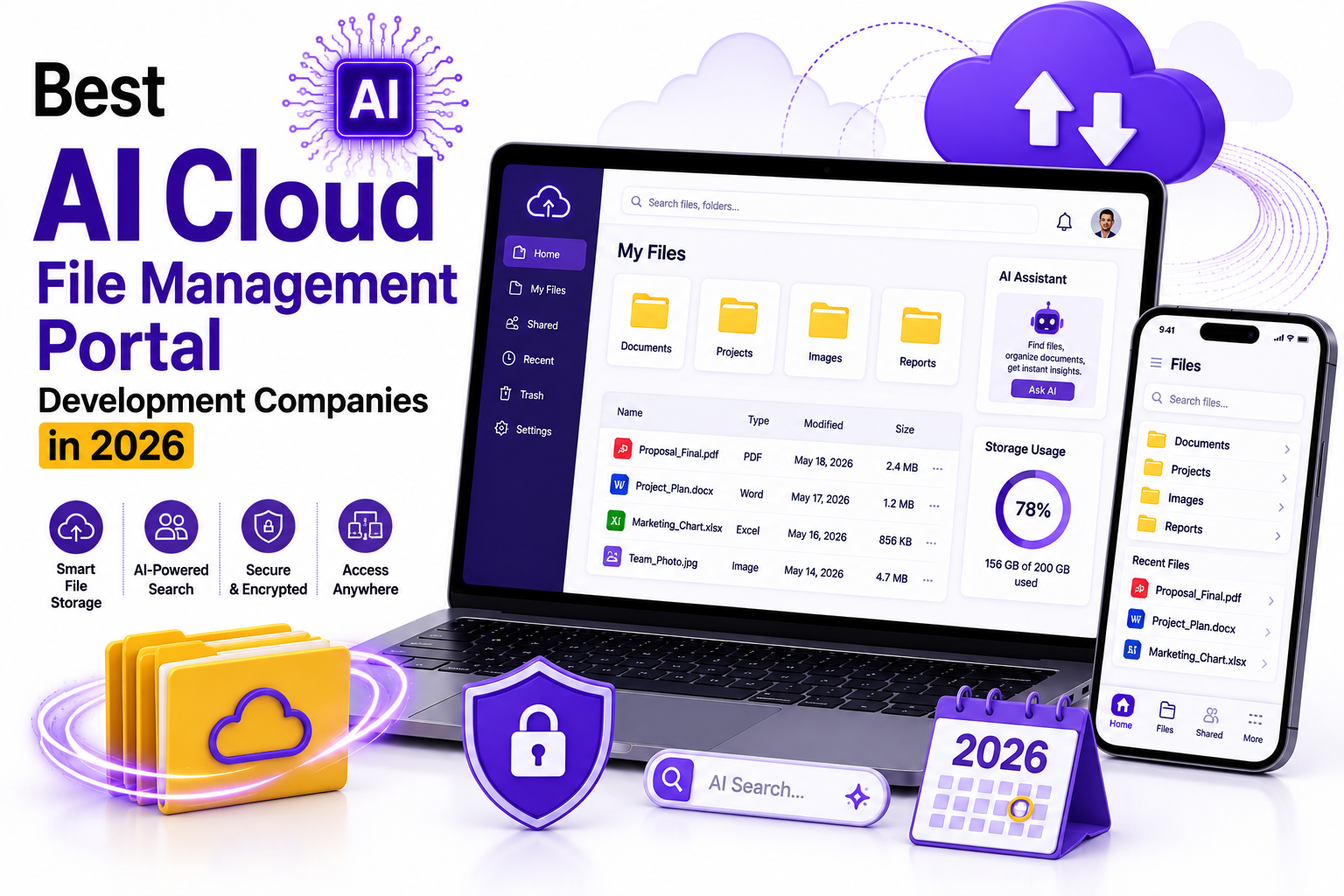
This is exactly the problem a well built AI Cloud File Management Portal is meant to solve. Instead of static folders and manual tagging, these platforms use machine learning to understand what a file actually contains, who should have access to it, and how it relates to everything else in the system. Search becomes instant, duplicate files get flagged automatically, and sensitive documents get the right permissions without someone having to remember to set them.
For CEOs and founders comparing vendors, the challenge is not finding a company that can write code. It is finding one that understands the difference between a basic file storage app and a genuinely intelligent portal that scales with a business, meets compliance requirements, and does not fall apart the moment usage spikes. This guide walks through 15 development companies worth shortlisting in 2026, along with what actually matters when you are choosing between them.
What Makes a Cloud File Management Portal Actually Intelligent
Plenty of vendors will pitch a file storage system and call it AI powered because it has a search bar. The real differentiator is whether the platform can classify documents by content rather than filename, detect duplicate or near duplicate files across departments, and apply access controls based on the sensitivity of what is inside a file rather than which folder it happens to sit in.
A strong AI Cloud File Management Portal also needs to handle version control cleanly, integrate with the tools your team already uses such as Slack, Google Workspace, or Microsoft 365, and stay compliant with regulations like GDPR, HIPAA, or SOC 2 depending on your industry. When you are evaluating a development partner, ask to see how they have handled these specific challenges on past projects rather than taking a features list at face value.
There is also the question of how a portal behaves once it holds real volume. A demo with fifty sample files rarely reveals anything useful. The systems worth paying for are the ones that keep search results fast and relevant once a company has accumulated tens of thousands of contracts, spreadsheets, images, and PDFs across several years of daily use, with employees joining, leaving, and changing roles the entire time.
The Hidden Cost of Getting File Management Wrong
Founders often underestimate how much disorganized files actually cost a business. Every minute an employee spends hunting for the right version of a document is a minute not spent on billable or productive work, and across a company of even fifty people, that adds up to a meaningful chunk of lost hours every month.
There is also a quieter risk around security. Files scattered across personal drives, email attachments, and forgotten shared folders are far harder to secure than documents living inside one governed system with clear permission rules. A properly built AI cloud file management portal reduces that sprawl and gives leadership actual visibility into where sensitive data lives and who can reach it, which matters just as much for audits and investor due diligence as it does for day to day operations.
Top 15 AI Cloud File Management Portal Development Companies
HireFullStackDeveloperIndia builds complete portals from the database layer up through the user interface, which is useful for companies that would rather work with one accountable team than coordinate separate front end and back end vendors.
Their file management projects typically combine a clean, searchable interface with AI features running quietly underneath, things like automatic tagging, content based search, and smart folder suggestions that learn from how a team actually organizes its work over time.
Their pricing tends to sit in the mid range for Indian development firms, and communication happens largely through overlapping working hours with US and European clients, which cuts down on the delays that can come with fully asynchronous handoffs.
Best for founders who want a single team managing the full technology stack, from cloud infrastructure to the screens employees interact with every day
As the name suggests, Backend Development Company focuses on the infrastructure layer that most users never see but every file management portal depends on. Their work centers on building storage architectures that can handle millions of files without slowing down as volume grows.
For an AI driven portal, backend performance is not optional. Every classification model, every search query, and every permission check runs through the backend, so a poorly designed database schema will bottleneck the entire system regardless of how good the front end looks. This firm specializes in exactly that kind of unglamorous but essential engineering.
Their engineers tend to document schema decisions thoroughly, which pays off later when a second vendor or an in house team needs to extend the system without guessing why certain architectural choices were made in the first place.
Best for organizations that already have a front end vision but need serious backend muscle to support high file volumes and complex permission structures.
Fingent has spent over two decades building custom software for mid sized and large enterprises, and file management is one of the areas where that longevity shows. The firm frequently works with companies that are migrating away from clunky legacy document systems toward something modern and searchable.
Their approach tends to emphasize workflow automation alongside storage, so a file does not just sit in the cloud waiting to be found. It moves through approval chains, triggers notifications, and updates related records automatically. That kind of end to end thinking is useful for businesses replacing an outdated intranet based file system.
Because so much of Fingent's client base comes from long term relationships rather than one off projects, expect a discovery process that digs fairly deep into existing workflows before any development timeline gets proposed.
Best for enterprises modernizing legacy document systems who want automation built in from day one rather than added later.
Hourly Developers built its reputation on flexible, hourly based engagement models that let companies scale a development team up or down as a project evolves. For cloud file management work, this matters because requirements tend to shift once real users start uploading real documents.
The team has delivered document intelligence layers that combine optical character recognition with natural language processing, allowing a portal to read a contract, pull out key dates and parties, and file it automatically under the correct client folder. They also handle the less glamorous but equally important work of setting up role based permissions and audit trails.
Clients who have worked with the firm often mention how quickly requirements calls turn into working prototypes, which shortens the usual back and forth between a business stakeholder and an engineering team trying to interpret vague specifications.
Best for companies that want a dedicated team without committing to a rigid fixed price contract, particularly when the file management requirements are still being refined.
Simform operates as an AWS Advanced Consulting Partner and has built a name for itself in cloud native engineering. For file management portals hosted on AWS or Azure, this partnership status often translates into faster access to new cloud services and better cost optimization.
The firm's co-engineering model embeds its developers directly alongside a client's internal team, which some founders prefer over a fully outsourced arrangement. Their data engineering practice is particularly relevant for portals that need to process large volumes of unstructured files and extract structured metadata from them.
Minimum project sizes tend to run higher here than at smaller boutique firms, which reflects the scale of engagement Simform typically handles rather than a lack of flexibility for smaller scopes of work.
Best for mid market and enterprise companies already committed to AWS or Azure who want a partner with deep expertise in those specific ecosystems.
ScienceSoft is one of the older firms on this list, and that history shows in how methodically they approach requirements gathering before writing a single line of code. Their document management practice covers everything from initial audits of an existing file system to full scale AI powered replacements.
Because ScienceSoft also runs an IT consulting arm, clients often get compliance guidance bundled with the development work itself, which matters for industries like healthcare or finance where file access rules carry legal weight rather than just internal policy.
Given the firm's size, project timelines can run on the longer side compared to smaller, more agile studios, so founders in a hurry to launch a minimum viable version should set expectations accordingly during initial conversations.
Best for regulated industries that need compliance expertise woven into the technical build rather than handled as an afterthought.
HireAIDevelopers focuses specifically on the machine learning layer that separates a genuinely intelligent portal from a glorified file cabinet. Their team builds the classification and recognition models that let a system understand a scanned invoice differently from a marketing brief.
Because their specialization is narrower than a full stack agency, they often work as a technical partner alongside another firm handling the broader application, contributing specifically the intelligence layer, things like automated metadata extraction, smart search ranking, and anomaly detection for unusual file access patterns.
Their engagements are frequently shorter and more focused than a full portal build, which makes them a practical option for companies testing whether an AI layer is worth the investment before committing to a larger rollout.
Best for companies that already have a development partner but need deeper AI expertise specifically for document intelligence and classification.
Intellectsoft has built a reputation in enterprise digital transformation projects that span industries like healthcare, finance, and construction. Their file management work sometimes incorporates blockchain based verification for document authenticity, which is a less common but increasingly relevant feature for legal and financial clients.
The firm's Inc. 5000 recognition reflects steady growth rather than a single breakout product, and their client base tends to be mid sized to large enterprises rather than early stage startups, so expect a more structured, documentation heavy engagement process.
Prospective clients should expect a fairly formal proposal process with detailed statements of work, which suits enterprises used to procurement heavy vendor selection but may feel slower to a founder used to moving quickly.
Best for enterprises in regulated sectors that want document authenticity verification alongside standard file management features.
OpenXcell has delivered over a thousand projects across sectors ranging from healthcare to logistics, giving the firm broad exposure to how different industries structure and access their files. That range often helps when a client's requirements do not fit neatly into a single industry template.
Their CMMI Level 3 certification signals a mature, repeatable development process, which is worth noting for founders concerned about consistency and quality control on a longer engagement rather than a quick prototype.
The firm also maintains its own internal software products, which gives its engineers practical experience maintaining live systems over the long term rather than only handing off finished projects and moving on to the next client.
Best for companies wanting a mid sized firm with proven process discipline and experience across a wide range of industries.
DataEximIT works primarily with businesses that are dealing with large, messy datasets and need both the storage architecture and the intelligence layer to make sense of them. Their file management builds often include analytics dashboards showing how documents move through an organization.
That analytics focus is useful for leadership teams who want visibility into file usage patterns, not just a working system. Knowing which documents get accessed most, which departments generate the most storage overhead, and where duplicate content tends to pile up can shape decisions well beyond IT.
Their smaller team size compared to some larger firms on this list often translates into more direct access to senior engineers throughout a project, rather than working primarily through account managers and junior staff.
Best for companies that want usage analytics and reporting built into the portal rather than treating file management as a purely operational tool.
Konstant Infosolutions has over two decades of experience building web and mobile products, and more recently has added AI and cloud consulting to its core offering. The firm tends to work closely with clients through a structured discovery phase before development begins.
Their long track record with startups and Fortune 500 clients alike gives them exposure to both ends of the scale spectrum, which can be reassuring for a founder unsure whether their file management needs will look more like a small business tool or a full enterprise deployment down the line.
The firm's pricing tends to be competitive relative to its experience level, largely because its overhead has stayed lean even as the client roster has grown over more than twenty years in business.
Best for founders who value a long established firm with steady delivery history over a newer or more specialized boutique shop.
WebClues Infotech places a strong emphasis on user experience alongside backend functionality, which shows in how their file management portals are designed. A common complaint about enterprise software is that it works but nobody enjoys using it, and this firm builds specifically to avoid that outcome.
Their post launch support model also stands out, with ongoing maintenance packages that keep a portal updated as cloud providers change their APIs and as a company's file volume and user base grow over time.
Clients frequently note that the firm stays responsive well after launch, which matters for file management systems in particular since usage patterns and edge cases tend to surface only after real employees start relying on the tool daily.
Best for companies that want a portal employees will actually enjoy using, with strong design sensibility built into the development process.
Chetu operates at a scale that few boutique firms can match, with thousands of developers spread across offices in the United States and Asia. That scale allows the company to staff large, complex projects quickly without the long ramp up times smaller agencies sometimes need.
Their client roster skews toward established businesses and Fortune 5000 companies, and their engagement model often works best for organizations that already know their requirements in detail rather than startups still figuring out what they need.
Smaller startups sometimes find the engagement model geared more toward larger scopes of work, so it is worth confirming minimum project size and expected timeline alignment before signing on for a smaller pilot phase.
Best for larger organizations that need to staff a sizable development team quickly and have well defined technical requirements going in.
ValueCoders has built a business around dependable outsourcing relationships, often serving as an extended development team for companies that want to avoid the overhead of hiring in house engineers. Their file management projects tend to combine cloud storage with AI features like automated tagging and smart search.
Because the firm supports so many concurrent client engagements, their processes around scoping, milestones, and communication tend to be well documented, which can reduce the friction that sometimes comes with offshore development partnerships.
Time zone overlap with US clients is generally manageable given their established remote collaboration practices, and their project managers tend to provide regular status updates rather than leaving clients to chase progress reports.
Best for companies that want a reliable outsourcing partner with established processes rather than a boutique studio still refining its methodology.
Itransition has more than 25 years of experience and a client list that includes recognizable names like PepsiCo and Expedia, giving the firm significant exposure to large scale, high stakes software projects. Their file management work often ties into broader digital transformation initiatives rather than standing alone.
The firm's dedicated development center model lets clients essentially rent a team that functions like an internal department, which some enterprises prefer over a project based contract when file management needs are expected to keep evolving for years.
Given the firm's scale and enterprise client history, expect a more formal onboarding process, with detailed contracts and defined governance structures, compared to the lighter weight agreements common among smaller regional agencies.
Best for enterprises planning a long term digital transformation where file management is one piece of a larger technology overhaul.
Innowise has grown steadily since 2007 into a large scale engineering firm with a 93 percent returning client rate, a figure that speaks to consistent delivery rather than one off wins. Their AI and cloud teams frequently collaborate on the same projects, which suits file management builds that need both storage architecture and intelligent features working together from the start.
The firm supports multiple engagement models, from fixed price projects to staff augmentation, giving founders flexibility depending on whether they want a turnkey portal or additional engineers folded into an existing team.
Their high client retention rate is worth paying attention to during vendor selection, since a firm that keeps clients coming back for years tends to be more invested in getting the underlying architecture right the first time.
Best for companies wanting flexible engagement options and a firm with a strong track record of long term client retention.
Questions Worth Asking Before You Sign a Contract
Before committing to any of the firms above, it helps to ask specific, technical questions rather than relying on a sales pitch. How does the platform handle a file that has been edited by two people at once? What happens to search accuracy once the system holds a million documents instead of a thousand? How is data encrypted both in transit and at rest, and does the firm have experience with the specific compliance framework your industry requires?
It is also worth asking to see a live demo rather than a slide deck, and requesting references from clients whose file volume and industry resemble your own. A portal that works beautifully for a 20 person startup may buckle under the demands of a 500 person enterprise with years of accumulated documents, so matching a vendor's proven scale to your actual needs matters more than matching their marketing language to your ambitions.
Red Flags to Watch For During the Selection Process
A few warning signs tend to show up consistently among vendors who overpromise. Watch out for a firm that cannot explain, in plain language, how their document classification model actually works, or one that avoids giving a straight answer about data residency and where files will physically be stored. Vague answers on either point usually mean the underlying architecture has not been thought through.
Pricing structures deserve scrutiny too. A quote that seems dramatically lower than every other firm on this list is worth questioning, since it often means corners are being cut on security testing, load testing, or long term support. The firms that price their work realistically tend to be the ones still around, and still supporting their clients, three or four years after launch.
Final Thoughts
Choosing a development partner for a project like this rarely comes down to which company has the flashiest website. It comes down to which team actually understands the mechanics of search relevance, permission architecture, and compliance requirements well enough to build something that still works cleanly two years and a million files from now.
The 15 firms covered here range from large scale engineering shops to focused AI specialists, and the right fit depends on where your company sits today and where it plans to be. A well executed AI Cloud File Management Portal should feel almost invisible once it is running properly, quietly organizing, securing, and surfacing exactly the file someone needs, right when they need it, without anyone having to think about the system underneath.