
Picture this. Your HR team is drowning in 2,000 applications for one open role, and somewhere in that pile is the perfect candidate you'll never get to, because nobody has the hours to sit through that many videos. That's the exact problem pushing CEOs and hiring leaders toward AI-Based Candidate Video Interview Analysis System Development Companies in 2026. Not because AI hiring sounds trendy on a pitch deck, but because manual screening simply cannot keep pace with the volume of applications modern companies now receive.
If you're reading this, you're probably not looking for a textbook definition of artificial intelligence. You're trying to figure out who can actually build a reliable, bias-aware, well-integrated interview analysis system for your business, and which vendors are worth a serious conversation versus which ones are simply good at marketing themselves. That's exactly what this guide is for. No fluff, no jargon, just a clear, practical look at what these systems do, how the technology actually works behind the scenes, and which development companies are genuinely capable of building one that fits your hiring workflow rather than fighting against it.
By the end of this article, you should have a shortlist you can confidently reach out to, plus enough context to ask them the right questions instead of nodding along to a sales pitch. We'll walk through what these systems actually do under the hood, the different flavors of interview analysis tools that exist depending on your hiring volume, twelve companies worth a serious look, the integrations that actually matter in daily use, and a straightforward build versus buy comparison so you're not left guessing which route fits your business best.
What Is an AI-Based Candidate Video Interview Analysis System?
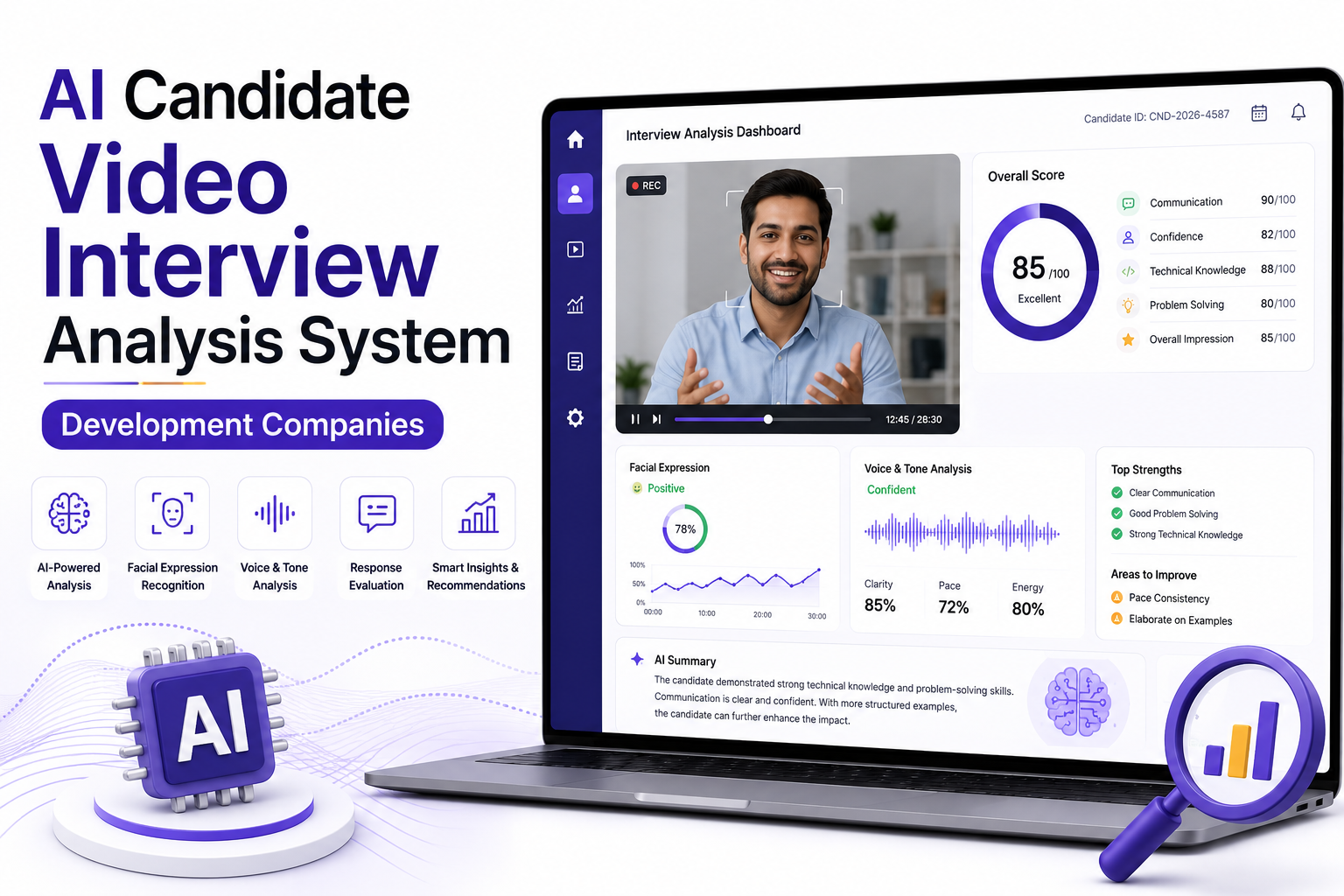
In simple terms, it's software that watches, listens to, and scores a candidate's video interview the way a well-trained recruiter would, except it does it in minutes instead of hours and never gets tired by candidate number 400. These platforms combine several technologies working together behind a fairly simple candidate-facing interface.
AI-powered video interviews let candidates record their answers to pre-set or adaptive questions on their own schedule, so recruiters aren't stuck coordinating calendars just for a first-round screening call. Automated candidate evaluation then takes over, reviewing tone, clarity, and content instead of leaving a tired recruiter to skim through dozens of recordings late in the evening. Underneath that sits speech and language analysis, which converts spoken answers into text and studies word choice, pacing, filler words, and confidence markers to build a fuller picture of how someone communicates under mild pressure.
Good systems also perform resume-to-interview matching, checking whether what a candidate claims on paper actually lines up with what they say out loud. Layered on top is behavioral assessment, which looks at communication style, problem-solving approach, and consistency rather than just surface-level polish or camera presence. All of this feeds into interview scoring, a simple numeric or grade-based output that lets recruiters compare candidates fairly instead of relying purely on gut feeling or who happened to interview well that particular morning. Finally, everything lands on recruiter dashboards, where hiring managers can sort, filter, and review ranked shortlists without digging through folders of raw video files one by one.
How AI Actually Analyzes a Candidate's Interview
The process is more straightforward than most people expect, and understanding it helps when you're evaluating vendors later. It starts when a candidate receives an interview invitation, usually a simple link sent by email or through the company's careers portal, along with clear instructions on time limits and question format. The candidate then records their video responses, answering a set of questions within a given time window, often from their phone or laptop at home rather than a formal office setting.
Once the recording is submitted, the speech is transcribed into text using automatic speech recognition, a step that has become dramatically more accurate over the past couple of years. From there, NLP analyzes the responses, picking apart sentence structure, keyword relevance, and tone to understand not just what was said but how it was framed and delivered. The system then evaluates communication and role-fit metrics, comparing the candidate's answers against the specific skills and traits the role actually requires, rather than a generic one-size-fits-all rubric. Based on all of this, the AI generates interview scores, ranking candidates on clarity, confidence, and relevance to the job description. Finally, recruiters review the ranked candidates, spending their limited time on a genuinely promising shortlist instead of an entire, unsorted applicant pool.
Types of AI Candidate Interview Solutions Development Companies Build
Not every business needs the same kind of system, and a good development partner will usually offer more than one flavor depending on your hiring volume and complexity. Common builds include one-way video interview platforms for asynchronous first-round screening, live AI-assisted interview systems that support real-time conversations with in-the-moment scoring support, and AI candidate screening tools designed purely for high-volume filtering at the very top of the funnel.
Beyond that, companies often build AI hiring assistants that guide recruiters through the entire funnel from application to offer, interview analytics dashboards that turn raw scores into visual, exportable reports for leadership, and full enterprise recruitment platforms for large organizations hiring across multiple departments and regions simultaneously. More specialized builds include campus hiring platforms for graduate recruitment drives, internal mobility assessment systems for promoting from within rather than always hiring externally, technical interview platforms with coding and whiteboard support for engineering roles, and executive hiring solutions built for the added nuance and confidentiality that leadership-level searches demand.
Most businesses don't need all ten of these at once. A retail chain hiring hundreds of frontline staff every month usually cares most about screening speed, while a fifty-person engineering team hiring senior developers cares far more about technical depth than raw throughput. Knowing which category you fall into before your first vendor call saves everyone a lot of back-and-forth, and it helps the development company scope your project accurately instead of quoting for a generic system that doesn't quite match your actual hiring pattern.
With that context out of the way, here's the part you actually came for: a practical, mixed list of companies worth shortlisting when you're ready to build your own system.
12 AI-Based Candidate Video Interview Analysis System Development Companies to Shortlist
1. Hourly Developers
Hourly Developers has built a solid reputation among startups and mid-sized companies that want flexibility more than long, rigid contracts. Their hourly and dedicated hiring model makes them a strong pick if you want to start small, perhaps a proof-of-concept scoring engine, and scale the team up once you see measurable results from an early pilot. They work across AI, machine learning, and full-stack development, and their pricing model appeals to founders who want tight cost control without sacrificing developer quality or communication. Clients typically praise their responsiveness and willingness to adjust scope as requirements evolve mid-project. If your priority is a cost-effective, low-commitment way to test an AI interview analysis build before going all in, this team is genuinely worth a call.
2. HireAIDevelopers
As the name suggests, this company exists specifically for businesses that need dedicated AI talent on demand rather than a generalist dev shop. HireAIDevelopers specializes in machine learning models, natural language processing, and computer vision work, all of which are core building blocks of a candidate video interview analysis system. They typically offer flexible engagement models, letting you bring in a single AI engineer or an entire specialized pod depending on project scope and internal capacity. For companies that already have a product team in place but are missing dedicated AI expertise, this is often the fastest way to fill that specific gap without a lengthy hiring cycle of your own.
3. Backend Development Company
Every AI interview system needs a backend that can handle video uploads, transcription queues, scoring pipelines, and dashboard data without buckling under load, and that's exactly where Backend Development Company earns its name. They focus on scalable server-side architecture, API design, and database optimization rather than trying to be a jack-of-all-trades shop that spreads itself thin. Their engineers are comfortable working with cloud infrastructure, message queues, and the kind of asynchronous processing video analysis pipelines depend on. If your in-house team can handle the AI models but needs a rock-solid backend to support them at scale, this is a sensible and fairly low-risk pairing.
4. HireFullStackDeveloperIndia
This offshore team has built a solid track record delivering full-stack web and mobile applications across eCommerce, fintech, and healthcare, with growing hands-on experience in AI and ML integrations layered onto existing products. Businesses choose them mainly for cost efficiency, since offshore hourly rates run noticeably lower than Western agencies without a major drop in technical quality or project management discipline. They handle both frontend candidate-facing portals and backend scoring logic, making them a reasonable single-vendor option for companies that want one team to own the entire build from end to end rather than coordinating multiple vendors.
5. Appinventiv
Appinventiv is a well-known global player with a strong AI and machine learning practice, serving clients ranging from funded startups to large enterprises across several continents. Their work spans predictive analytics, NLP, and computer vision, all directly relevant to building interview scoring engines that need to interpret both speech and visual cues. They tend to work best with mid-size to large businesses that need a structured, process-driven development approach and have the budget to match that level of rigor. Expect a proper discovery phase, dedicated project management, and a portfolio full of enterprise-grade AI products across HR-tech and adjacent industries.
6. LeewayHertz
LeewayHertz has carved out a name in custom AI development, particularly generative AI, computer vision, and NLP-driven products built from the ground up rather than assembled from templates. Their experience building intelligent automation systems translates well into interview analysis work, where speech-to-text, sentiment detection, and scoring models all need to work together seamlessly and reliably. They're a good fit for businesses that want a genuinely custom-built system rather than a lightly modified off-the-shelf template, especially if you're aiming for a long-term support relationship rather than a single one-off project handoff.
7. Matellio
Matellio positions itself around digital transformation and enterprise software, with dedicated AI and ML development teams that work closely with in-house stakeholders. They're known for taking a consultative approach, spending real time understanding a client's actual hiring workflow before writing a single line of code. This makes them a solid choice for HR-tech startups or enterprises that want a partner who will challenge assumptions and ask hard questions rather than simply execute a spec sheet handed to them without pushback.
8. ValueCoders
ValueCoders has been in the outsourced software development space for a long time and has built a broad portfolio across web, mobile, and increasingly AI-driven applications for clients worldwide. Their appeal lies in dependable delivery timelines and transparent, upfront pricing, which matters a great deal when you're building something as workflow-critical as a hiring system that recruiters will rely on daily. They're often chosen by businesses that value predictability and clear communication over cutting-edge experimentation for its own sake.
9. OpenXcell
OpenXcell offers dedicated development teams across AI, mobile, and web technologies, with a flexible in-house team augmentation model that suits companies wanting direct control over their project without managing full-time hires themselves. Their AI practice covers NLP and computer vision, both directly relevant to interview video analysis and candidate scoring. They tend to work well for companies that already have a clear product vision but need extra engineering horsepower to actually execute it on schedule.
10. Hyperlink InfoSystem
Hyperlink InfoSystem has built a large portfolio spanning mobile apps, web platforms, and AI solutions, with hands-on experience across multiple industries including HR-tech and recruitment specifically. Their sheer scale means they can staff a project quickly, which is genuinely useful if you're on a tight timeline and need to get an MVP interview analysis tool into pilot testing fast rather than waiting months for a team to ramp up. They also offer post-launch support packages for clients who want ongoing iteration.
11. Quytech
Quytech has notable depth in AI, AR, and computer vision development, which is particularly relevant if your interview analysis system needs to go beyond speech and also read facial expressions or body language cues responsibly. They've delivered projects across retail, healthcare, and enterprise HR tools, and tend to attract clients who want a technically adventurous partner willing to experiment with newer model architectures rather than sticking strictly to proven, conservative approaches.
12. Konstant Infosolutions
Konstant Infosolutions rounds out this list as a dependable, mid-market development company with experience across custom software, AI integrations, and enterprise dashboards built for non-technical end users. They're a sensible pick for businesses that want a straightforward, no-surprises development partner for building the recruiter-facing side of an interview analysis platform, including reporting, exports, and dashboard tooling that HR teams can actually navigate without training.
Essential Integrations to Look For
Whichever company you shortlist, make sure their system plays nicely with the tools your HR team already relies on every day. At minimum, look for solid support for Applicant Tracking Systems (ATS) and HRMS platforms, since interview data is only genuinely useful once it flows straight into your existing hiring records instead of sitting in a separate silo. Sourcing and outreach usually run through LinkedIn, so integration there saves a lot of manual copy-pasting between systems that don't talk to each other.
For the interviews themselves, check compatibility with Microsoft Teams, Zoom, and Google Meet, since live or hybrid interview formats depend heavily on these tools working smoothly in the background. Scheduling should sync cleanly with Outlook Calendar and Google Calendar so nobody accidentally double-books a candidate slot during a busy hiring week. Internal collaboration tools like Slack and standard email services help recruiters get notified the moment a new score is ready for review, cutting down on constant manual dashboard checking. Depending on your hiring risk profile, you may also want identity verification tools to confirm candidates are who they claim to be before an offer goes out, and coding assessment platforms if you're hiring for technical roles that genuinely need more than a conversation to evaluate fairly.
None of these integrations are optional extras in practice. A system that scores candidates brilliantly but sits disconnected from your ATS just creates another dashboard your recruiters have to remember to check, which defeats much of the point of automating the process in the first place. Ask any vendor upfront for a list of pre-built connectors versus integrations that would need custom development, since that single detail often has a bigger impact on your total project cost than the AI model itself.
Build vs Buy: Should You Develop a Custom Platform or Use an Off-the-Shelf Solution?
This is usually the real decision point once you've seen what's actually out there, and there's no universally right answer that applies to every business. It depends heavily on your hiring volume, your available budget, and how specific and unusual your evaluation criteria genuinely are. A fast-growing startup hiring for a handful of roles a month has very different needs than an enterprise processing thousands of applications a week across a dozen countries, and the right answer often looks completely different for each of them.
It also helps to think about how long you expect to use the system. A short-term hiring spike might not justify months of custom development, while a company that plans to keep scaling its hiring for years is often better served owning the platform outright rather than renting access to someone else's roadmap.
If your hiring criteria are fairly standard and you just need something working next week, buying an existing solution usually makes more practical sense. But if you're building a hiring product of your own, or your evaluation criteria are unusual enough that no off-the-shelf tool quite fits the way your team actually works, partnering with one of the AI-Based Candidate Video Interview Analysis System Development Companies listed above is almost always the better long-term move, even if it costs more upfront and takes a little longer to launch.
Final Thoughts
So, where does that leave you? Probably somewhere between genuinely excited about what AI can do for your hiring pipeline and a little wary of picking the wrong partner for something this important to your business. That's a completely fair place to be, and it's a better starting point than blind confidence in whichever vendor pitched you hardest.
The good news is that you don't have to decide today. Shortlist two or three names from this list, ask each of them the same set of questions about bias testing, data security, and integration support, and see who actually answers clearly instead of dodging behind buzzwords and glossy case studies. The companies that talk plainly about limitations, timelines, and real costs are usually the ones worth working with.
At the end of the day, choosing among AI-based candidate video interview analysis system development companies isn't just a technical decision anymore, it's a hiring strategy decision that will shape how your team screens talent for years to come. Choose the partner who understands that difference, and the rest tends to fall into place naturally.