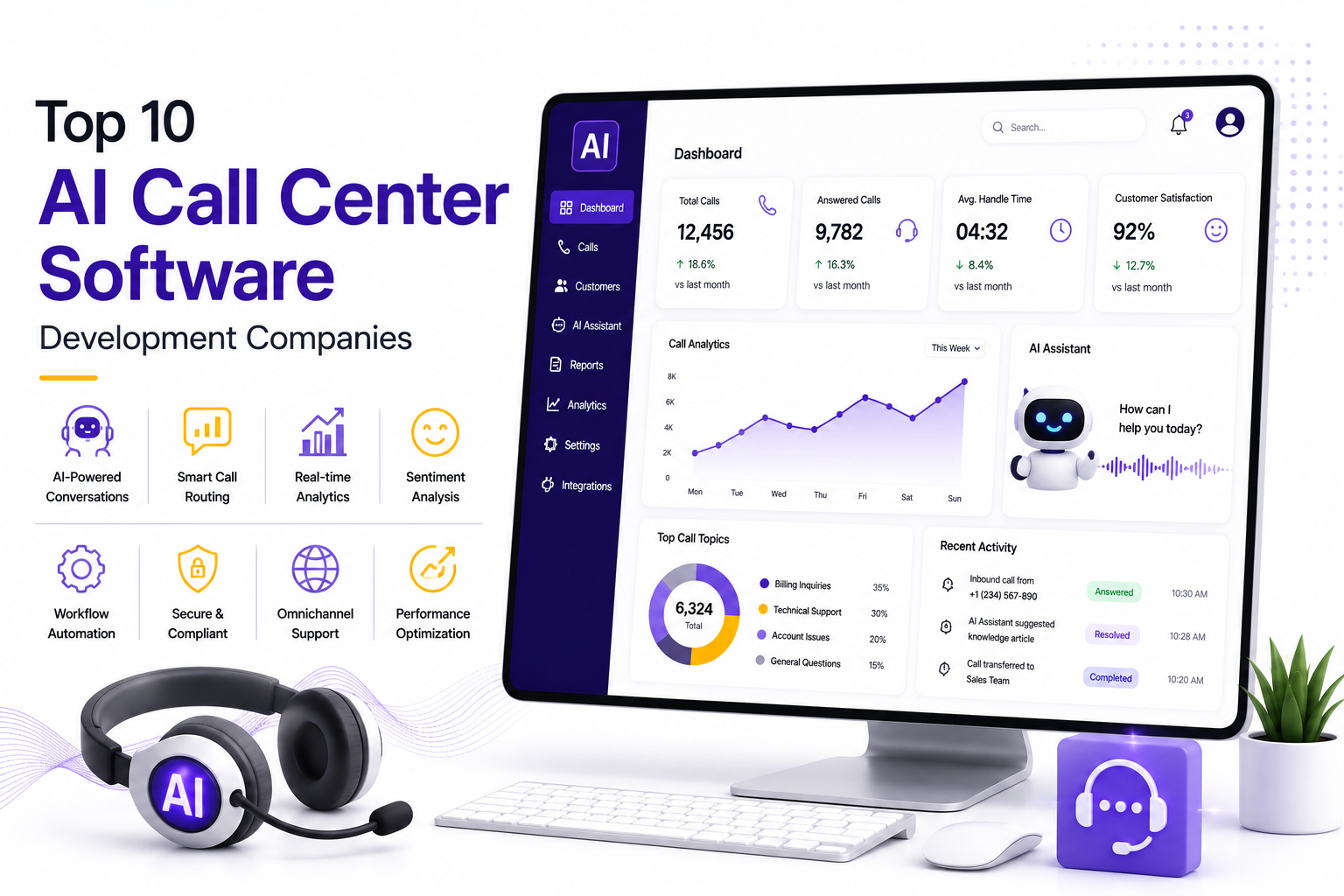

Call centers built around scripts and hold music are losing ground fast. Customers now expect answers in seconds, not minutes, and most support teams cannot staff enough humans to keep up with call volume that spikes without warning. That gap is exactly why so many CEOs and founders are now shortlisting vendors that can build them a working AI Call Center Software system instead of just selling them a license.
The problem is that not every development company that claims AI expertise can actually ship a voice bot that understands context, routes a frustrated caller correctly, or plugs cleanly into an existing CRM. Some are AI consultancies with no telephony experience. Others are call center software resellers with almost no custom engineering depth. If you are trying to build or upgrade your AI Call Center Software stack in 2026, the company you pick matters as much as the technology itself.
This guide breaks down ten AI Call Center Software development companies worth shortlisting, what each one is actually good at, and where they tend to fit best. No filler, no vague buzzwords, just what a decision maker needs to compare options and move forward with confidence.
A quick note before the list. Some of the names below are large, established engineering firms with over a decade of history, while others are leaner, hourly billed teams built for founders who want to move fast on a smaller budget. Both approaches work. What matters is matching the company to the size and maturity of your own project instead of defaulting to whichever name shows up first in a search result.
Why AI Call Center Software Matters More in 2026
Voice AI has moved past the noisy chatbot phase. Modern platforms can hold a full conversation, check an order status, update a CRM record, and hand off to a human agent only when the situation actually needs one. That shift changes the math for support teams. A call that once needed 4 to 6 minutes of agent time can now be resolved in under a minute without ever reaching a person.
Cost is the obvious driver, since a human agent conversation typically runs into double digit dollars per call while an automated one costs a fraction of that. But the bigger shift for 2026 is coverage. Businesses can now answer every call, at any hour, in multiple languages, without hiring a night shift or an overseas team. For CEOs evaluating vendors, the real question is not whether AI belongs in the call center. It already does. The question is which development partner can build it well, integrate it cleanly, and keep it compliant as regulations around AI generated conversations continue to tighten.
There is also a talent retention angle that founders tend to underestimate. Call center roles have historically suffered from high turnover, and every departing agent takes institutional knowledge with them. A well built AI layer absorbs the repetitive, low value calls, which frees human agents to handle the complex, high stakes conversations that actually require judgment. That shift tends to improve job satisfaction for the humans who remain, alongside the efficiency gains for the business.
What to Look For Before You Hire a Development Partner
Before comparing companies, it helps to know what actually separates a strong build from a shaky one. Look for:
• Real telephony experience, not just chatbot or mobile app portfolios
• Proven CRM and helpdesk integrations, such as Salesforce, HubSpot, or Zendesk
• Multilingual, sentiment aware voice models rather than scripted IVR trees
• Clear data privacy and compliance practices, since call recordings involve sensitive customer data
• Transparent pricing, whether hourly, fixed scope, or dedicated team
None of these are dealbreakers on their own, but a vendor missing three or more of them usually signals a team that is learning on your project rather than bringing proven experience to it. Ask for a reference client in a similar industry before signing anything.
Top 10 AI Call Center Software Development Companies to Watch in 2026
Here is the shortlist, spread across established outsourcing partners and specialized AI engineering teams. Positions are not a strict ranking. Fit depends on your budget, timeline, and how deep your integration needs actually go.
1. Hourly Developers
Hourly Developers works well for companies that want to test an AI call center build without committing to a long fixed price contract. As the name suggests, the entire engagement model is built around flexible, hourly billed development, which makes it a practical starting point if you are not yet sure how large your AI Call Center Software project will end up.
The team handles voice bot development, IVR modernization, and integration work with CRMs and helpdesk tools, and clients can scale the engaged hours up or down as requirements shift. This suits founders who want to pilot an automated call flow for one department, measure results, and only then commit to a bigger rollout.
What stands out is the lack of long onboarding cycles. Because billing is hourly, teams can start on a narrow, well defined task such as building a single intent handling flow, without needing to sign off on a full multi month scope first. For CEOs who have been burned before by overpriced fixed bid contracts that ballooned in cost, this model offers a lower risk entry point. It is a strong fit for small and mid sized businesses that want to move fast on a pilot before scaling their investment further.
Because the model is hourly rather than fixed scope, project timelines also tend to stay realistic. There is less incentive to pad a proposal with unnecessary features just to justify a large upfront number, which keeps early conversations focused on what a business actually needs rather than what sounds impressive in a sales deck.
2. Appinventiv
Appinventiv is a Noida based digital engineering company founded in 2015 that has grown into a team of more than 1,600 technology specialists working out of India, the United States, the United Kingdom, the United Arab Emirates, and Australia. The company has delivered more than 3,000 digital products and has built a strong reputation for AI led engineering at enterprise scale.
For call center work specifically, Appinventiv brings experience in natural language processing, generative AI integration, and cloud native architecture, all of which matter when building a voice system that needs to hold a real conversation rather than follow a rigid script. Their teams have also worked across regulated industries such as banking and healthcare, which is useful if your call center handles sensitive customer data and needs to meet strict compliance requirements.
Appinventiv tends to work best with mid sized to large enterprises that need a fully custom build rather than an off the shelf integration, and the company has been recognized by Clutch and other industry bodies for its AI product engineering work. If your budget supports a comprehensive, enterprise grade rollout and you want a partner with genuine depth across AI, cloud, and mobile, Appinventiv is worth a serious look.
The company's own AI product, InventivAI, along with more than 100 delivered generative AI solutions across industries, also suggests a team that experiments internally rather than only implementing whatever a client asks for. That internal experimentation often translates into faster problem solving when a call center project hits an unusual edge case mid build.
3. Backend Development Company
Backend Development Company focuses on exactly what its name implies, the infrastructure layer that keeps an AI call center system running reliably under real world call volume. Voice AI looks simple from the customer's side, but underneath it there is a lot of backend work happening, including real time call routing, database lookups, session handling, and API calls to CRMs and telephony providers, all of which need to hold up when call volume spikes without warning.
The team specializes in building this backend layer so it does not buckle during a product launch, a seasonal spike, or an unexpected surge in support requests. That includes designing systems for low latency response times, since a laggy voice bot feels broken to a caller even if the underlying AI model is accurate. They also handle the less visible but critical work of logging, monitoring, and failover planning, which many vendors gloss over until something breaks in production.
This company is a strong fit for businesses that already have a front end voice interface or a chosen AI model in mind and need a technically solid backend to support it at scale. It is less suited to founders who want a single vendor handling the entire stack end to end, since the focus here is specifically backend architecture and reliability engineering.
That narrower focus can actually be an advantage for businesses that already have a front end vendor picked out but keep running into performance problems once real call volume hits the system. Bringing in a specialist for the backend layer alone is often faster than asking a generalist team to rebuild infrastructure they did not design in the first place.
4. Maruti Techlabs
Maruti Techlabs has been building software since 2009 out of its Ahmedabad headquarters, and over that time it has developed a specific reputation for chatbot and conversational AI work, which makes it a natural fit for AI Call Center Software projects. The company started as a small dotNet focused team and has since grown into a full product engineering shop with expertise spanning artificial intelligence, machine learning, robotic process automation, and cloud native development.
Their conversational AI work is where the call center relevance really shows. Maruti Techlabs has built natural language processing systems that handle everything from intent detection to sentiment analysis, and their client work spans insurance, healthcare, and legal technology sectors where accurate, compliant conversation handling actually matters. One documented project involved refining an audio detection model to hit above 90 percent accuracy within a single second, which is the kind of precision benchmark that matters directly for voice based call handling.
Maruti Techlabs works with both startups and Fortune 500 companies, and its long track record of 15 plus years gives it more institutional experience than many newer AI focused shops. For CEOs who want a partner that has already solved messy real world conversational AI problems rather than one still learning on your dime, Maruti Techlabs is a credible option.
The company also runs its own R&D team dedicated to new product exploration rather than only client delivery work, which is part of why it has been recognized as a category leader in AI services by several industry review platforms. For a call center project, this often means access to accelerators and reusable components instead of a build that starts completely from zero.
5. ValueCoders
ValueCoders has been running as a software outsourcing company since 2004, based out of Gurugram, India, and today its team of more than 650 developers has delivered over 12,500 projects for clients across 38 plus countries. That scale matters if you need a partner who can move fast, staff up quickly, and has already navigated the kind of edge cases that come up in large custom builds.
On the AI side, ValueCoders offers dedicated artificial intelligence, machine learning, and chatbot development services alongside its core software engineering practice. This means an AI call center build here typically comes bundled with broader capabilities, such as CRM customization or ecommerce integration, if your project needs those pieces built alongside the voice AI layer.
Clients like Panasonic, Thomson Reuters, and Yale University have worked with ValueCoders, which points to a company comfortable operating at an enterprise level while still serving smaller businesses through its staff augmentation model. The company also maintains offices in London, Austin, and Dubai in addition to its India headquarters, which helps with time zone coverage for international clients. ValueCoders suits founders who want an established, well reviewed outsourcing partner rather than a boutique specialist shop.
Because the team already maintains dedicated practices in ecommerce, fintech, and healthcare integrations, a call center build here rarely stays a standalone project. Many clients end up folding a CRM upgrade or a customer portal into the same engagement, which can simplify vendor management for a founder who would rather not coordinate three separate contracts at once.
6. HireFullStackDeveloperIndia
HireFullStackDeveloperIndia is built around a straightforward pitch, giving businesses access to full stack development talent without the overhead of building an in house team from scratch. For an AI call center project, that full stack range matters because the work spans multiple layers, from the voice interface and natural language processing on the front end down to the databases, APIs, and server infrastructure that keep everything running.
Rather than handing off different pieces of the project to different specialized vendors, HireFullStackDeveloperIndia positions its developers to own an entire feature from end to end, which can shorten the back and forth that usually happens when a frontend team and backend team are figuring out how to talk to each other. This is particularly useful for AI call center builds, where a voice response, a CRM update, and a database write often need to happen within the same second.
This company works well for founders who want a single accountable team rather than juggling multiple vendors, and who are looking for the cost advantages that come with an India based development model. It is a reasonable choice if your project needs broad technical coverage without the premium price tag of a large enterprise consultancy.
Because the developers here are full stack rather than narrowly specialized, communication overhead tends to stay low. A single engineer can often answer a question that would otherwise require pulling in a separate frontend lead and backend lead, which shortens the feedback loop during the messier middle stretch of a build when requirements are still shifting.
7. OpenXcell
OpenXcell was founded in 2009 and has grown into a team of more than 500 experts working out of its headquarters in Ahmedabad, India, alongside a presence in the United States. Over the years the company has delivered more than 1,000 projects, and its recent focus has shifted heavily toward artificial intelligence, including custom large language model integration, AI agents, and chatbot development, all of which apply directly to AI Call Center Software work.
The company has publicly launched its own AI chatbot product, IntelliBot, along with ChatGPT integration services for business clients, which shows a level of hands on AI product experience beyond just contracted client work. For call center specific builds, OpenXcell's team can handle everything from strategy and consulting through to the actual development of voice agents, GPT based integrations, and the AIOps layer needed to monitor a live system after launch.
OpenXcell serves industries including healthcare, finance, ecommerce, and logistics, giving it exposure to the kind of compliance and data handling requirements that come up often in call center deployments. This is a solid fit for founders who want a partner with proven, recent AI specific delivery experience rather than a generalist shop that recently added AI to its service list.
OpenXcell also publishes regular research on emerging AI development trends across different regions, which is a useful signal that the team stays current rather than relying on the same playbook it used a few years ago. For a fast moving category like call center automation, that habit of tracking the market closely tends to matter more than it looks on paper.
8. HireAIDevelopers
HireAIDevelopers does exactly what the name promises, connecting businesses with developers who specialize specifically in artificial intelligence rather than general purpose software engineering. For an AI call center project, this focus matters because the hardest part of the build usually is not the telephony or the interface, it is getting the underlying AI model to actually understand intent, context, and tone accurately across thousands of different calls.
The team here works on natural language understanding, model fine tuning, and the ongoing training needed to keep a voice AI system improving after launch rather than getting stuck at its initial accuracy level. This ongoing improvement piece is often skipped by vendors who treat call center automation as a one time build instead of a system that needs regular retraining as call patterns and customer expectations shift.
HireAIDevelopers is a good fit for businesses that already have their infrastructure and CRM systems in place and specifically need strong AI talent to build or improve the intelligence layer sitting on top. It is less suited to founders starting completely from scratch who need a single vendor handling the full technology stack, since the focus here stays narrowly on the AI development itself.
This narrow focus also tends to suit businesses running an ongoing improvement cycle rather than a one off launch. Bringing in specialized AI talent on a rolling basis to retrain models, adjust for new call patterns, or fix accuracy drift is often more cost effective than keeping a full stack team on retainer for work that is fundamentally about the intelligence layer, not the surrounding infrastructure.
9. Simform
Simform has been operating since 2010 out of Ahmedabad, India, with client facing offices across the United States and Canada, and today the company works with more than 1,000 engineers across cloud, data, and AI focused projects. Simform holds Microsoft Azure Expert MSP status, a distinction held by fewer than 105 companies worldwide among Microsoft's partner network, which signals a genuinely deep cloud engineering bench.
What makes Simform relevant to call center automation specifically is its dedicated agentic AI practice, covering large language model integration, multi agent orchestration, and low code AI agent development on Microsoft's Power Platform. This means Simform can build a system that does more than answer questions, one where the AI agent can actually take multi step actions such as verifying an account, checking an order, and updating a record within a single call.
Simform typically serves mid market and enterprise clients across high tech, fintech, healthcare, and retail, and its collaborative engineering delivery model means client teams work closely alongside Simform's engineers rather than handing off a spec and waiting. This works best for companies that already have some internal technical capacity and want a collaborative partner rather than a fully outsourced black box.
Simform's recent recognition in industry reports on generative AI service providers also reflects a shift the company has been making toward production ready AI rather than proof of concept work. For a call center project, that shows up as a bias toward measurable outcomes, such as reduced handling time or fewer escalations, instead of a system that only performs well in a demo environment.
10. TechAhead
TechAhead has been building software since 2009 and now operates out of Agoura Hills, California, with additional development teams in India and Dubai supporting clients across time zones. The company holds SOC 2 Type II and ISO 42001 certifications, which matter for AI Call Center Software specifically because those systems handle recorded customer conversations and sensitive account data that need to meet strict governance standards.
TechAhead has built a dedicated practice around agentic AI, retrieval augmented generation, and enterprise grade AI governance, and it holds partner status with OpenAI in addition to working across Microsoft, Google, and AWS ecosystems. The company has delivered more than 2,500 apps and platforms for clients including Audi, Disney, and AXA, giving it experience handling AI deployments at genuine enterprise scale rather than just pilot projects.
For a call center build, this translates into systems that are not only conversational but auditable, with the risk controls and evaluation processes that regulated industries increasingly require as AI generated conversations come under closer scrutiny. TechAhead suits larger organizations that need enterprise grade governance built into the system from day one, rather than bolted on after a compliance review flags a gap.
The company's client roster, which includes household names across entertainment, automotive, and insurance, also suggests a team comfortable navigating the procurement and legal review processes that come with large enterprise contracts. That experience can shorten the vendor onboarding phase considerably for a business already familiar with slow moving corporate approval chains.
Final Thoughts
Picking a development partner for AI Call Center Software is less about finding the single best company on this list and more about matching your project's actual shape. A fast moving startup piloting one automated flow needs a very different partner than an enterprise rolling out a fully agentic, audit ready system across multiple markets.
What should not change across those scenarios is diligence. Ask every vendor on your shortlist for a live demo of a call flow they built previously, not just a slide deck. Ask what happens when the AI gets something wrong mid call, and how quickly a human can step in. Ask how the system handles data retention, since call recordings sit in a different risk category than most other customer data.
The companies covered here range from flexible hourly teams to enterprise grade governance specialists, and all ten are capable of shipping real, working systems rather than proof of concept demos that never survive contact with actual call volume. Start with the two or three that match your budget and technical maturity, get a working prototype in front of real callers, and let the results guide the rest of the decision.
One last thing worth remembering. The vendor you pick today does not have to be the vendor you use forever. Plenty of businesses start with a lean, hourly pilot to prove the concept, then move to a larger enterprise partner once the case for a bigger rollout is obvious. Treat the first build as a test of the idea, not a permanent commitment, and the decision becomes a lot less stressful.