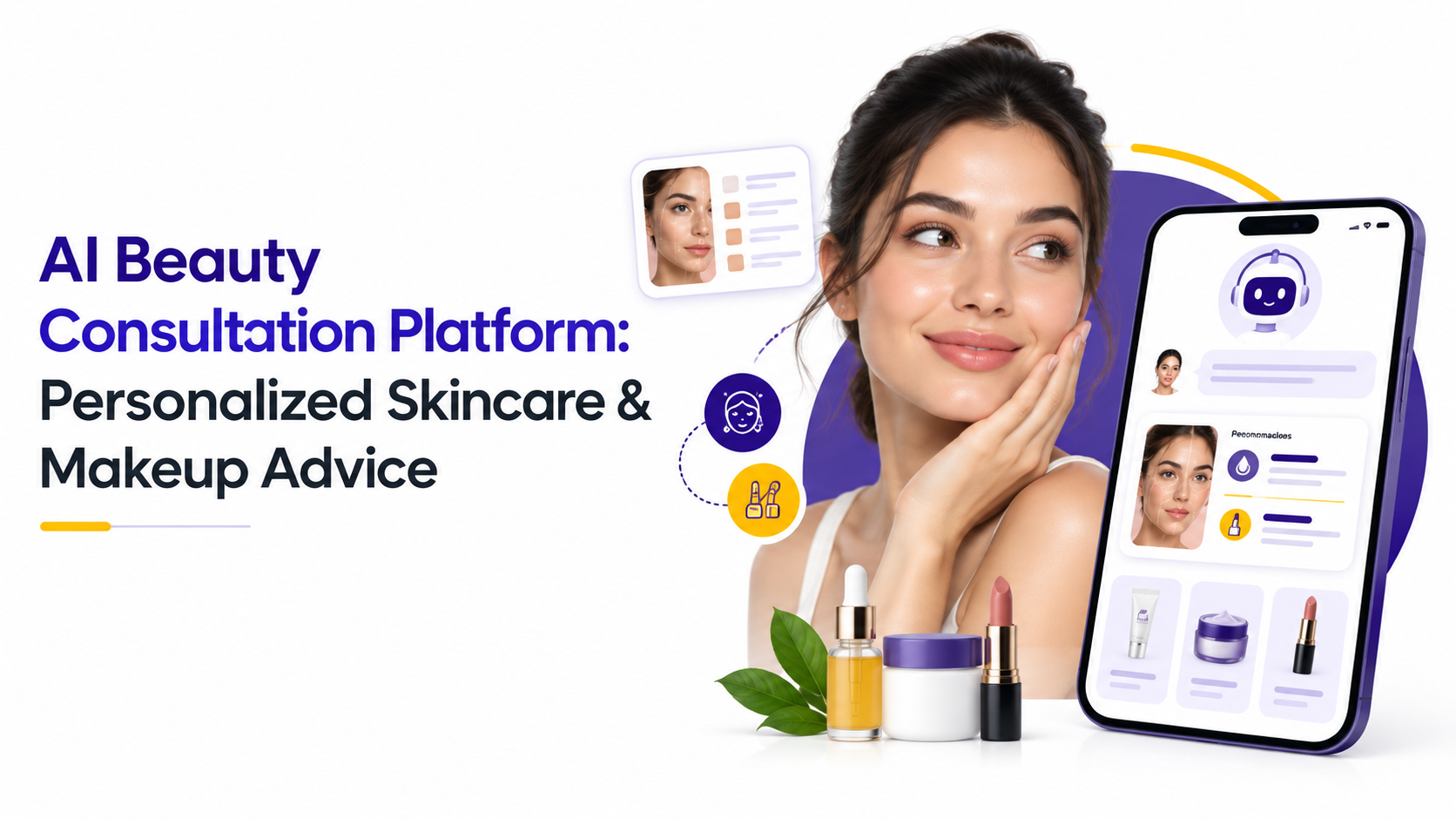

Ask ten people what skincare routine actually works for them, and you will get ten different answers, most of them borrowed from a friend, a video, or a product label that promised more than it delivered. That guesswork is exactly what an AI beauty consultation platform is built to remove. Instead of generic advice, it looks at a person's actual skin, hair, or face shape and builds a recommendation around that, the same way a knowledgeable consultant working in a physical store would, except it works at three in the morning and never runs out of patience for a fifth follow up question.
The category is not niche anymore. The global AI in beauty and cosmetics market was valued at 5.3 billion dollars in 2026 and is on track to more than double by 2030, growing at close to 20 percent a year. That kind of growth usually means one thing: brands that ignore it now will be catching up to competitors later, and catching up in software almost always costs more than building early.
This guide breaks down how these platforms actually work, what separates a good one from a gimmick, what it realistically costs to build in 2026, and what founders should know before commissioning one. No company names, no sales pitch, just the mechanics and the decisions that actually matter.
What Is an AI Beauty Consultation Platform, Exactly
Strip away the marketing language and an AI beauty consultation platform is a software layer that takes an image or a short questionnaire from a user, runs it through a trained model, and returns a personalized recommendation. That could be a skincare routine, a foundation shade, a hairstyle, or a product bundle. The output feels like advice from a knowledgeable consultant, except it is generated in seconds and scales to millions of users at once without hiring a single extra staff member.
What makes it different from a static quiz is the analysis layer underneath. A basic quiz asks questions and matches answers to predefined categories, which is cheap to build but shallow in what it can actually tell someone. A proper platform reads actual skin texture, tone, pore visibility, or facial geometry from an image and adjusts its output based on that data, not just answers people give about their own skin, which are often inaccurate because most people cannot objectively judge it themselves.
You will also see this same category described as an AI beauty tech app when it ships as a product built primarily for mobile built for one brand, rather than a licensed platform used across many retailers. The underlying technology is largely the same. What differs is the business model wrapped around it, which matters more for planning than it might first appear.
• Skin and face analysis using computer vision, typically from a selfie or short video
• A recommendation engine that maps analysis results to specific products or routines
• A conversational layer, usually a chatbot, that handles follow up questions
• Virtual try on for makeup shades, hairstyles, or skincare product visualization
• A feedback loop that refines suggestions as the user provides more data over time
Why This Category Is Growing So Fast Right Now
Three things are pushing this forward at the same time. Consumers are tired of returning products that looked right online and wrong in person. Retailers are tired of absorbing the cost of those returns and the warehouse space they eat up. And brands finally have access to computer vision models accurate enough to make real recommendations instead of rough guesses based on a five question quiz.
The skincare side of this alone is expanding fast. The AI in skincare market is projected to grow from roughly 5.84 billion dollars in 2026 to 27.41 billion dollars by 2035, and most of that growth is coming from personalized diagnostics and virtual consultations rather than generic product sales. That shift matters for anyone planning a build in this space, because it signals where buyer expectations are heading over the next several years, not just where the money sits today.
Shade matching tells a similar story. Close to half of all makeup returns happen because the shade looked different in person, based on industry return data from AR beauty deployments, which is exactly the kind of costly, preventable problem this technology was built to solve. Every return costs a brand shipping fees, restocking labor, and often a customer who does not bother trying again.
How an AI Beauty Consultation Platform Actually Works
Behind the friendly chat interface, most platforms follow roughly the same five step process. Understanding it helps you evaluate a development partner and spot shortcuts that will hurt accuracy later, long after the demo has already impressed everyone in the room.
1. Image or data capture
The user submits a selfie, a short video, or answers a structured questionnaire covering skin type, concerns, and goals. This step determines everything downstream, so a poorly guided capture flow with no lighting or framing instructions quietly wrecks accuracy before analysis even begins.
2. Preprocessing and normalization
Lighting, angle, and resolution differences get corrected so the analysis model is not thrown off by a dim bathroom photo versus a bright outdoor one. Skipping this step is one of the most common reasons early prototypes give inconsistent results between users.
3. Analysis and feature extraction
Computer vision models detect skin tone, texture, pigmentation, pore size, or facial landmarks depending on the platform's focus. This is the most technically demanding piece and the one worth spending the most evaluation time on before committing to a vendor.
4. Recommendation generation
A rules engine or machine learning model matches the extracted features against a product catalog or routine database. Some platforms blend both approaches, using rules for safety constraints and a model for ranking which products to surface first.
5. Delivery and follow up
Results are shown through a chat interface, a report, or an AR overlay, often with an option to ask follow up questions or book a human consultation. The best platforms treat this as the start of a relationship, not the end of a transaction.
AI Beauty Tech App vs Traditional Beauty Consultation
It helps to see the two approaches side by side before deciding what your brand actually needs. A well built AI beauty tech app does not necessarily replace human expertise, but it changes where that expertise gets applied, usually toward the more complex cases that genuinely need a human's judgment.
None of this means human consultants become irrelevant. In practice, the strongest setups route straightforward questions to the platform and escalate anything nuanced, like a diagnosed skin condition or a special occasion look, to a real person. The software handles volume, and the human handles judgment calls that genuinely need it.
Core Features Worth Prioritizing
Not every feature belongs in every build. Here is a practical checklist to run through when scoping what your platform actually needs, rather than what looks impressive in a pitch deck.
☐ Skin or face analysis powered by computer vision, not just a quiz that only relies on what a user says about themselves
☐ Product matching tied to a real, maintained catalog rather than a fixed static list
☐ Virtual try on for makeup shades and hairstyles where relevant
☐ A conversational chatbot layer for follow up questions
☐ Multilingual support if the brand sells internationally
☐ Progress tracking so returning users can see how their skin changes over time
☐ Clear data consent and deletion controls, since facial data is sensitive
☐ An admin dashboard for the brand to update products and monitor recommendation accuracy
A useful test here is to ask what happens to the recommendation quality if any single feature were removed. If removing a feature barely changes the output, it is probably a nice extra rather than a core requirement, and treating it as optional in the first release can save real budget.
Signs Your Brand Is Actually Ready for This
This is not the right first investment for every beauty brand. It tends to pay off fastest under a specific set of conditions, so it is worth checking your situation against these before committing budget.
☐ Your product catalog is large enough that customers genuinely struggle to choose between options
☐ Shade or formula mismatch returns are a measurable cost, not just an occasional complaint
☐ You already have decent product images and metadata to feed a recommendation engine
☐ Customer support is fielding repetitive product matching questions that a system could answer instead
☐ You have a plan for keeping the product catalog current after launch, not just at launch
If most of these apply, the investment tends to pay for itself within a reasonable window. If only one or two apply, it may be worth solving the underlying catalog or support problem first, since a personalization layer built on top of a messy catalog will only personalize the mess.
How These Platforms Actually Make Money
There is no single monetization path here, and picking the wrong one is a common reason these projects underperform after launch, even when the underlying technology works fine.
Most brands land on a mix rather than a single model. A skincare brand might use direct sales as the primary driver while layering in a lightweight subscription for progress tracking, since the two reinforce each other instead of competing for the same customer attention.
Building It In House vs Working With a Development Partner
Most brands do not have a computer vision team sitting idle, which is why so many turn to AI beauty consultation platform development companies rather than hiring a full internal team from scratch. The tradeoff is fairly straightforward. Building in house gives you full control and no dependency on an outside vendor, but it means hiring machine learning engineers, mobile developers, and UX designers who understand beauty specifically, which is a slow and expensive hiring process that can take longer than the actual build.
Working with an established partner shortens that timeline considerably because the team already has reusable computer vision models and a track record of shipping similar apps. The mobile experience matters just as much as the analysis engine here, since most users will interact with this through a phone camera rather than a desktop browser. If your team needs extra hands for the app itself, it is worth looking at options to Hire Mobile Developers who have shipped camera heavy consumer apps before, since that experience directly affects how smooth the capture and analysis flow feels to a first time user.
Development is only half the equation though. A technically excellent AI beauty consultation platform that nobody downloads is a wasted investment, so most brands pair the build with a go to market push. Bringing in dedicated Marketing Experts early, rather than after launch, tends to shorten the gap between shipping the app and actually seeing meaningful adoption numbers, since positioning and messaging decisions made during development are much cheaper to get right than ones made after launch.
What to Actually Check Before Signing a Development Contract
Plenty of AI beauty consultation platform development companies can show a polished demo. Far fewer can show evidence they have shipped something similar into production and kept it accurate after launch. These are the checks worth doing before you sign anything.
• Ask for examples of computer vision models they have shipped, not just chatbots or generic mobile apps
• Ask how they tested accuracy across different skin tones and lighting conditions before those projects launched
• Ask what happens after launch, since model drift and catalog changes need ongoing maintenance, not a one time delivery
• Ask how they handle biometric data storage and whether their approach matches your target markets' privacy rules
• Ask for a rough timeline broken into phases, since a vague single deadline is often a sign of thin planning
Where These Projects Usually Go Wrong
Most failed launches in this space share the same handful of mistakes, and they are avoidable if you know to look for them early, ideally before the first line of code gets written rather than after a disappointing launch.
What It Actually Costs to Build One
Costs vary widely based on how much custom computer vision work is involved versus using existing APIs, but these ranges reflect what most medium sized projects fall into as of 2026. The biggest swing factor is usually whether the team trains a custom model or wires together existing vision APIs, since a custom model demands far more data collection, labeling, and testing before it is reliable enough to ship to real users.
• Basic recommendation app based only on a quiz with no image analysis: 15,000 to 35,000 dollars
• Mid level app with skin or face analysis using a third party vision API: 40,000 to 80,000 dollars
• Custom trained computer vision model plus virtual try on features: 90,000 to 180,000 dollars
• Enterprise platform with multilingual support, AR try on, and CRM integration: 200,000 dollars and above
Ongoing costs matter just as much as the build cost. Model retraining, catalog maintenance, and cloud hosting for image processing typically run 15 to 25 percent of the initial build cost per year, and skipping that maintenance is how accuracy quietly degrades over time until the platform stops earning the trust it launched with.
Data Privacy Is Not Optional Here
Facial images and skin data are considered biometric or sensitive personal data under most privacy regulations, including GDPR in Europe and various state level laws in the United States. This is not a feature to bolt on after launch, and treating it as a legal afterthought is one of the fastest ways to end up rebuilding core parts of the app later at real cost.
It also affects how users perceive the brand behind the platform. A confusing consent screen or a vague privacy policy makes even an accurate, well designed tool feel invasive, while a clear explanation of what happens to a photo after analysis tends to make people more willing to share it in the first place.
☐ Explicit, clearly worded consent before capturing any image or biometric data
☐ A simple way for users to delete their data and request it be removed from training sets
☐ Encryption for stored images and analysis results, both in transit and at rest
☐ Clear disclosure of whether images are used to retrain models or shared with third parties
☐ Regional compliance checks if the app operates in the EU, California, or other regulated markets
What to Watch Heading Into 2026 and Beyond
A few shifts are worth planning around rather than reacting to later. Chat based assistance is becoming standard rather than a premium extra, with AI chatbots now handling roughly 60 percent of customer service inquiries for beauty brands that have adopted them, which is changing user expectations for response speed across the board and putting pressure on brands still relying purely on email support.
Personalization is also shifting from an optional extra to something users actively expect and choose brands based on. The broader AI beauty personalization category, covering everything from skincare regimens to shade matching, is projected to grow from 2.3 billion dollars in 2026 to 16.4 billion dollars by 2036, with skincare personalization alone making up close to half of that spend. Brands that treat personalization as a core feature of an AI beauty tech app rather than a marketing checkbox are the ones best positioned to capture that growth.
• Wider adoption of AR try on for hair color and styling, not just makeup
• Tighter integration between skin analysis results and ingredient level product formulation
• Growing demand for platforms that track skin changes over months, not just a single snapshot
• Increasing regulatory attention on how biometric beauty data is stored and reused
Final Thoughts
The brands that get real value from this technology are rarely the ones chasing the flashiest AR filter. They are the ones that treat the underlying analysis seriously, keep the product catalog current, and are upfront with users about how their data gets used. An AI beauty consultation platform built on that foundation earns repeat visits because the advice actually holds up, not because the interface looks impressive on a demo call.
If you are scoping a build for 2026, start with the analysis accuracy and the catalog maintenance plan before you start picking out chatbot personalities or AR effects. Everything else is easier to fix later. The core recommendation engine is not, and no amount of polish on top will fix suggestions that were wrong to begin with.
Get the fundamentals right, budget realistically for what happens after launch, and this becomes one of the rare tech investments in beauty that customers actually notice and appreciate rather than tolerate.