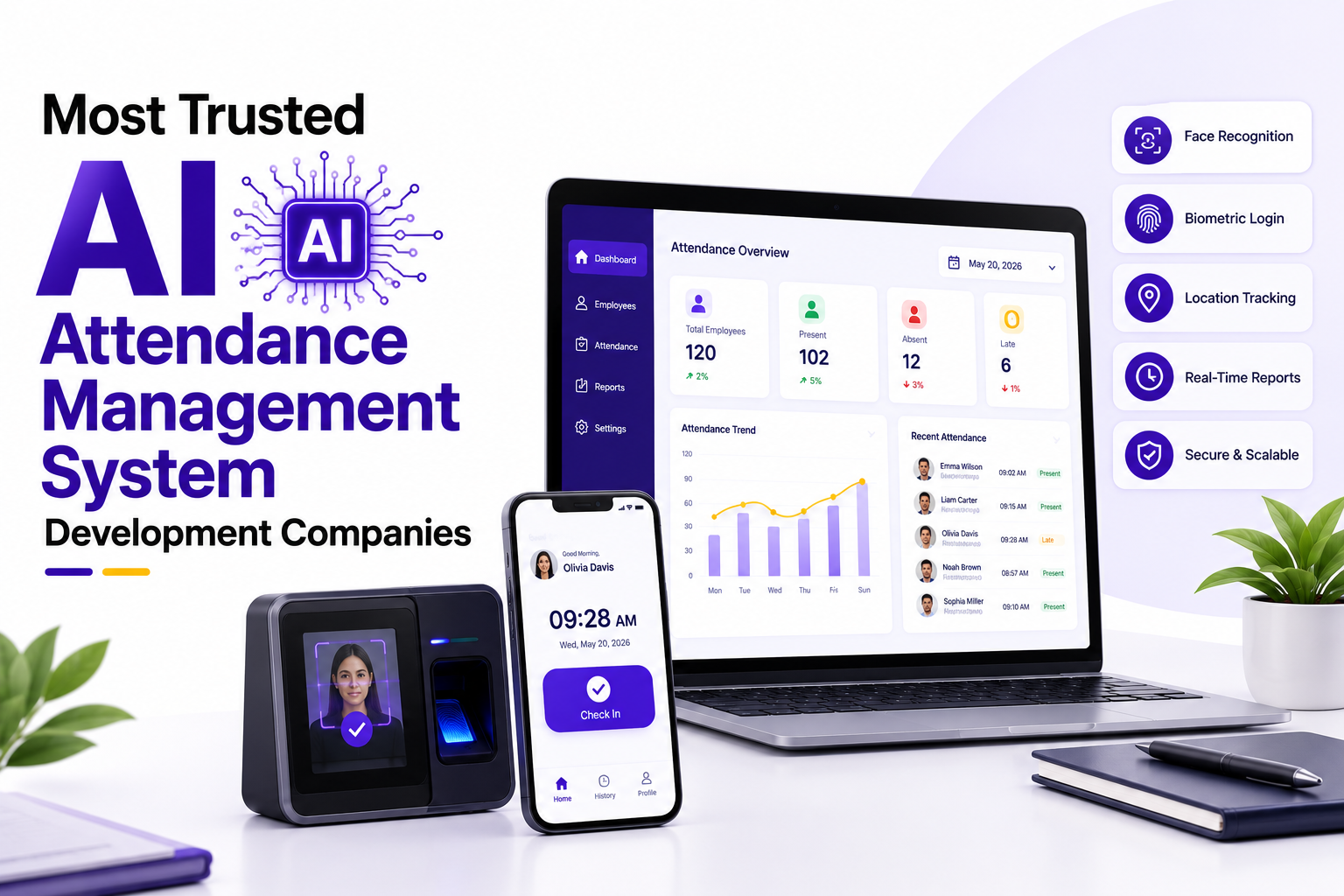

If you have ever tried to fix attendance issues with spreadsheets, biometric machines that jam every Monday morning, or an HR team manually chasing people for their in and out times, you already know why so many companies are switching to something smarter. An AI Attendance Management System does not just record punches. It recognizes faces, tracks patterns, flags anomalies, predicts absenteeism, and quietly saves your HR team hours every single week.
The tricky part is not deciding whether you need one. Most founders and CEOs figure that out fast once they see the cost of manual tracking. The hard part is picking who actually builds it for you. There are hundreds of development companies claiming to be AI experts, and not all of them have touched attendance or workforce systems before. Building one well means combining computer vision, machine learning, cloud infrastructure, and a genuine understanding of how HR teams actually work day to day.
This blog is not a sales pitch. It is a practical, no fluff list of 16 AI Attendance Management System development companies worth shortlisting in 2026, put together for people who are actually comparing vendors, not just browsing. We have kept the jargon out and the useful details in, so by the end you should have a shorter, smarter list to work from.
We looked at companies with different strengths on purpose. Some are large, established firms with enterprise clients and formal delivery processes. Others are leaner, more flexible teams that let you hire developers on an hourly basis and scale up once your requirements become clearer. Neither approach is automatically better, it really depends on where your business is right now, how big your team already is, and how quickly you need something working.
Why an AI Attendance Management System Matters More in 2026
Hybrid work is no longer the exception, it is the default for a large chunk of businesses. Teams are spread across cities, time zones, and sometimes countries, which makes old school punch cards and manual registers almost useless. An AI Attendance Management System solves this by combining facial recognition, geofencing, and behavior based analytics so attendance data is accurate whether someone is in the office, working from home, or on a client site.
There is also a cost angle that decision makers care about. Manual attendance tracking is prone to buddy punching, data entry errors, and payroll disputes that eat up HR bandwidth. A well built AI Attendance Management System reduces these errors automatically, integrates directly with payroll, and gives leadership real time visibility into workforce trends instead of a static monthly report. That combination of accuracy and insight is exactly why demand for custom attendance systems has grown so quickly this year.
There is a compliance side to this too, which often gets overlooked until something goes wrong. Labor laws around working hours, overtime, and leave tracking vary by country and even by state in some cases. A properly built system can be configured to flag violations automatically, which protects the business from disputes and keeps HR audits far less stressful than digging through spreadsheets after the fact.
What to Check Before You Hire a Development Partner
Before you sign a contract, it helps to look past the sales calls and check a few practical things. Ask about their prior work with HR tech or workforce management tools specifically, not just general app development. Ask how they handle data privacy and biometric compliance, since attendance systems deal with sensitive employee data. And ask about post launch support, because an attendance system needs regular updates as your team grows and your policies change.
Pricing models also vary a lot between these companies. Some work on fixed project costs, others offer hourly or dedicated team hiring, and the right choice usually depends on whether you need a one time build or an ongoing in-house style team. Keep that in mind as you go through the list below.
It also helps to think about how much of the work you want done in-house versus outsourced entirely. Some businesses prefer to keep a small internal team involved for oversight while the development company handles the heavy lifting. Others hand off the whole project and only step in for reviews and testing. Being clear about which setup you want before the first call saves everyone time and helps you compare quotes on a fair, apples to apples basis.
The 16 Most Trusted AI Attendance Management System Development Companies
1. Hourly Developers
Hourly Developers has built a name for itself as a flexible staffing and custom development partner for businesses that do not want to commit to a full in-house team right away. They let you hire developers on an hourly, part-time, or full-time basis, which works well if you want to start small on an AI Attendance Management System and scale the team as the project grows. Their developers cover backend engineering, facial recognition integration, and cloud deployment, so you are not stuck hiring three different vendors for one product.
What stands out about Hourly Developers is the transparency in their engagement model. You know exactly what you are paying for and can adjust team size without renegotiating a whole contract. They are a solid pick for startups and mid-sized companies that want a working prototype fast, then expand once the system proves itself internally. Their pricing tends to be hourly, which suits businesses still shaping their exact requirements.
2. Appinventiv
Appinventiv is one of the more recognizable names in AI and mobile app development, with a portfolio that spans enterprise clients across industries like retail, healthcare, and logistics. Their AI and machine learning teams have worked on facial recognition, predictive analytics, and workflow automation projects, all of which are core building blocks of a modern attendance platform.
Businesses usually choose Appinventiv when they need a partner who can handle both the technical build and the strategic side, such as figuring out how attendance data should feed into broader HR analytics. Their process leans toward structured, enterprise style delivery with dedicated project managers, which larger organizations tend to appreciate. It is a good fit if you want a long-term technology partner rather than a quick fix, especially if you anticipate adding modules like performance tracking or workforce forecasting down the line.
3. Matellio
Matellio positions itself around digital transformation, and workforce management happens to be one of the areas they specialize in. They have experience building custom HR platforms that include attendance tracking, leave management, and performance analytics under one roof, which is useful if you eventually want your attendance system to talk to other HR tools.
Their approach usually starts with a discovery phase to understand your existing HR processes before writing a single line of code, which reduces the chances of building something that does not fit how your team actually works. Matellio works with both startups and larger enterprises, and their AI consulting background means they can advise on things like anomaly detection models, not just the app interface. This can be especially useful if your leadership team wants attendance data connected to broader workforce planning decisions.
4. Space-O Technologies
Space-O Technologies has spent years building AI powered mobile applications, with computer vision and facial recognition being a strong part of their skill set. That expertise translates well into attendance systems, since accurate face detection under different lighting and camera conditions is one of the harder technical problems to solve.
They typically work with startups and small to mid-sized businesses looking for a cost-effective yet technically solid build. Space-O is known for clear communication throughout the project and for delivering working prototypes early, which helps you course correct before the final version is built. If budget matters as much as quality, they are worth a conversation.
5. Konstant Infosolutions
Konstant Infosolutions has been in custom software development for a long time and has built a reputation for handling enterprise grade projects without the enterprise grade price tag. Their teams cover mobile, web, and backend development, which means they can build an attendance system as a standalone app or integrate it into an existing HR portal.
Clients often pick Konstant when they need a dependable partner for a mid-sized project that still requires solid architecture planning. They are less flashy about AI marketing compared to some newer firms, but their engineering fundamentals are strong, which matters a lot when you are dealing with something as data sensitive as employee attendance. Their long track record also means they have likely already solved many of the edge cases that trip up newer development teams.
6. Intellectsoft
Intellectsoft works with global brands and has experience in enterprise digital transformation, including AI and IoT based solutions. Their background in building large scale, secure systems makes them a reasonable choice for companies that need an AI Attendance Management System deployed across multiple locations or countries with different compliance requirements.
They tend to run a more structured, consultancy style engagement, which suits larger organizations that need documentation, security audits, and integration with existing enterprise software like ERP or payroll systems. If your business already has complex IT infrastructure, Intellectsoft's experience with enterprise environments can save you a lot of back and forth, since they are usually familiar with the kind of legacy systems larger companies still rely on.
7. ScienceSoft
ScienceSoft has been around since 1989, which is unusually long for a software company, and that experience shows in how methodically they approach projects. They have built HR and workforce management tools before, and their processes are built around ISO certified quality standards, which some businesses in regulated industries specifically look for.
Their consulting-first approach means they usually start by reviewing your current attendance and payroll workflows before recommending a technical architecture. This can slow down the initial timeline slightly, but it tends to result in a system that actually matches how your organization operates, rather than a generic template. For businesses in healthcare, finance, or other regulated sectors, that upfront diligence often pays off later.
8. Backend Development Company
As the name suggests, Backend Development Company focuses specifically on the engine room of software, the databases, APIs, and server infrastructure that keep an attendance system running smoothly under real world load. For an AI powered platform that needs to process facial recognition data, sync attendance records in real time, and connect with payroll software, backend reliability is not optional.
They are a strong choice if you already have a front end design or mobile app team and specifically need someone to build a scalable, secure backend architecture. Businesses that have been burned by systems that crash during peak login hours, like clock-in time on Monday mornings, often turn to specialists like this rather than a generalist agency.
9. Simform
Simform is a product engineering company that leans heavily into cloud native development, which matters for attendance systems that need to scale as your headcount grows. Their teams have experience with AI integrations, data pipelines, and building systems that stay fast even when handling large volumes of daily check in and check out data.
They typically work with mid-market and enterprise clients who want a technically robust product built with modern cloud infrastructure like AWS or Azure. Simform is a good option if you are thinking beyond a basic attendance app and want a system that can eventually support advanced analytics like predicting attrition or attendance trends by department, without needing a full rebuild later.
10. TatvaSoft
TatvaSoft is a Microsoft Gold Partner with offices across India, Canada, and Australia, and they have built a range of enterprise software including HR and workforce management modules. Their Microsoft ecosystem expertise is useful if your company already runs on tools like Microsoft 365 or Azure, since integration becomes far smoother.
They tend to favor a fairly formal project management process, which some businesses find reassuring when a lot of money and sensitive employee data is involved. TatvaSoft is a solid pick for mid-sized to large businesses that want an established vendor with a long track record rather than a newer, more experimental firm, and their multi-country presence can be handy if your workforce spans several regions.
11. Bacancy Technology
Bacancy Technology runs on a dedicated team hiring model, similar in spirit to Hourly Developers, where you get developers who work exclusively on your project rather than juggling multiple clients. Their web, mobile, and AI/ML capabilities cover most of what is needed to build an attendance platform from scratch.
This model works particularly well for companies that want a team embedded in their workflow long-term, almost like an extension of their in-house department. If you expect your AI Attendance Management System to keep evolving with new features over the next few years, a dedicated team can be more efficient than repeatedly renegotiating scope with a project based vendor, and it also keeps institutional knowledge about your system in one place.
12. HireFullStackDeveloperIndia
HireFullStackDeveloperIndia specializes in exactly what the name says, full stack developers who can handle both the front end interface and the backend logic without needing a separate team for each layer. Their developers work across stacks like MERN, MEAN, and Laravel, giving you flexibility depending on what your existing systems are built on.
They are known for offering hourly, part-time, and full-time hiring models, which makes them approachable for businesses at different budget levels. Companies looking to hire dedicated developers for a complete, end to end attendance system build, from the employee facing app to the admin dashboard, often find their all-in-one team structure convenient.
13. Osiz Technologies
Osiz Technologies started out with a strong focus on blockchain but has expanded into AI and enterprise software development over the years. Their engineering teams have worked on projects involving facial recognition, real time data processing, and secure cloud deployment, all relevant pieces for a modern attendance platform.
They tend to attract businesses that want some flexibility to explore advanced features down the line, like blockchain based audit trails for attendance records in industries where tamper-proof logs matter, such as finance or government contracting. For most standard use cases, their core AI and software development team is more than capable, and the blockchain option stays available as a future upgrade rather than something you have to commit to on day one.
14. Techahead
Techahead is a mobile first development agency, which is worth noting because most employees these days check in and out from their phones rather than a fixed office terminal. Their experience building AI powered mobile apps translates directly into features like GPS based check-ins, facial recognition through a phone camera, and push notification reminders for attendance policies.
They usually work with mid-sized businesses and enterprises that want a polished, consumer grade app experience for something as routine as attendance tracking. If employee adoption and a smooth mobile experience matter to you as much as the backend intelligence, Techahead's mobile focus is a meaningful advantage, since a clunky app is often the real reason attendance tools fail to catch on with staff.
15. HireAIDevelopers
HireAIDevelopers, as the name makes clear, is built entirely around connecting businesses with developers who specialize in artificial intelligence, including generative AI, natural language processing, and computer vision. For an attendance system, their computer vision expertise is directly relevant to building accurate facial recognition and anomaly detection features.
Their engagement model is flexible, letting you hire AI specialists for a defined project or bring them on for ongoing development as your AI Attendance Management System adds new capabilities like predictive absenteeism alerts or automated shift scheduling. Businesses that specifically want an AI-first team, rather than a general software agency that also does some AI work, tend to gravitate toward them.
16. Hyperlink InfoSystem
Hyperlink InfoSystem is a large development agency with teams covering mobile, web, and AI based application development across a wide range of industries. Their scale means they can staff a project quickly and handle multiple modules of a system in parallel, which can shorten development timelines for businesses in a hurry.
They are a reasonable option for companies that want an established agency with broad experience rather than a boutique specialist, especially if your attendance system needs to integrate with other custom modules like payroll, project tracking, or performance reviews being built at the same time. Their scale also means they can usually accommodate tighter deadlines than smaller, more specialized teams.
Final Thoughts
Choosing a partner to build your AI Attendance Management System really comes down to matching your specific situation, your budget, your timeline, and how much you already have built, with a company whose strengths line up with that. A startup that wants to move fast and scale the team gradually will have very different needs from an enterprise that needs deep compliance and integration work.
The 16 AI Attendance Management System development companies listed here cover a wide range of that spectrum, from flexible hourly hiring models to full enterprise consultancies. Take the time to have real conversations with two or three of them, ask for examples of past workforce or HR tech projects, and pay attention to how well they understand your actual attendance and payroll process, not just the AI buzzwords.
It also helps to ask each vendor what happens after launch. Software does not stay finished, policies change, teams grow, and new integrations get requested six months in. A partner who is upfront about ongoing support and maintenance, rather than just the initial build, usually saves you a bigger headache later. A good AI Attendance Management System should quietly make your HR team's life easier for years, so it is worth getting the choice of partner right the first time.