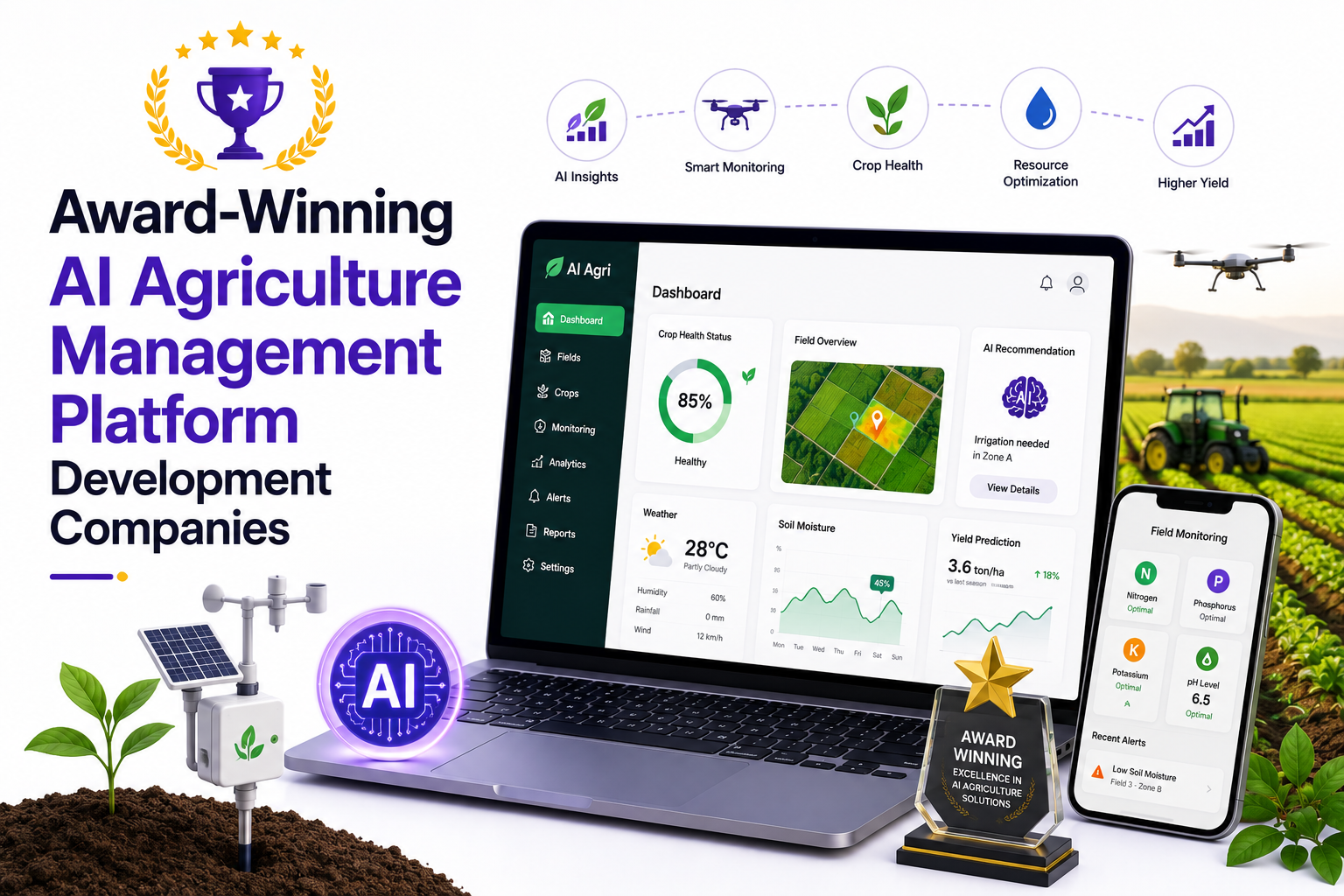

Farming used to run on instinct, experience, and a bit of luck with the weather. That is changing fast. Walk into any large farm or agribusiness office in 2026 and you will find dashboards showing soil moisture levels, drone footage of crop health, and predictions about next week's yield, all generated by software rather than guesswork. This shift has created real demand for a reliable AI Agriculture Management Platform, and with that demand comes a crowded field of development companies claiming to be the best at building one. If you are a founder or decision-maker trying to figure out who actually deserves your budget, this guide breaks down what these platforms actually do, why they matter right now, what they should include, what they cost to build, and which development companies are worth a serious conversation.
What makes this space tricky to navigate is that agriculture technology is not quite the same as building a generic SaaS product. Anyone evaluating vendors is really comparing technical capability against practical, on-the-ground reliability, because a platform that looks impressive in a sales demo but falls apart the moment the internet drops in a rural field is not worth the investment. This guide is written with that reality in mind, so instead of generic praise for every company on the list, you will find specifics on what each one actually does well and roughly what it costs to bring them on board.
What Is an AI Agriculture Management Platform?
An AI Agriculture Management Platform is essentially a software system that uses artificial intelligence to help farmers, cooperatives, and agribusinesses manage everything from planting schedules to harvest logistics. Instead of relying purely on manual record keeping or spreadsheets, the platform pulls in data from sensors, satellite imagery, weather services, and equipment, then uses machine learning to turn that raw data into practical recommendations. Think of it as a control center that tells you when to irrigate, which fields are showing early signs of disease, and how much of a crop you can realistically expect to harvest this season. Most platforms today are built as a combination of a web dashboard for managers and a mobile app for field workers, connected through cloud infrastructure that keeps everything synced in real time.
The term covers a fairly wide range of products in practice. Some platforms are narrow and focused, built specifically for one crop type or one part of the operation, such as irrigation scheduling alone. Others are broad, end-to-end systems meant to run an entire agribusiness, tracking everything from seed procurement to final sale. Neither approach is automatically better, and the right scope really comes down to what problem the business is trying to solve first, and how much budget and internal capacity exists to manage a larger rollout.
Why This Is Trending in 2026
A few things have come together at once to push this trend forward. First, sensor hardware and drones have become far cheaper than they were even five years ago, so collecting field data is no longer limited to large commercial farms. Second, climate volatility has made traditional farming methods riskier, and businesses want data backed decisions rather than gut calls, especially when a single bad season can wipe out months of margin. Third, government subsidies and private investment in agri-tech have picked up significantly across regions like North America, Europe, India, and parts of Africa, which has made funding for new platforms easier to secure. Finally, labor shortages in agriculture have pushed farms toward automation and remote monitoring simply because there are not enough hands to walk every field every day. Put together, these factors explain why an AI Agriculture Management Platform has gone from a nice-to-have experiment to something serious agribusinesses are actively budgeting for.
How It Helps Farmers and Agribusinesses
The practical benefits tend to show up in a few clear areas. Yield prediction models help businesses plan storage, logistics, and sales contracts months in advance instead of scrambling after harvest. Early disease and pest detection, often powered by computer vision on drone or camera footage, can catch problems while they are still small and treatable. Irrigation and resource management tools cut down on water and fertilizer waste, which saves money and also matters for sustainability reporting that many buyers now require. Supply chain and inventory features give managers visibility into what is happening across multiple farms or warehouses from a single screen, which is especially useful for larger operations. And because most of this runs through a mobile app, even field staff without much technical background can log observations, get alerts, and follow recommendations without needing to be trained on complicated software.
There is also a financial planning angle that often gets overlooked. When a business has a reasonably accurate picture of expected yield weeks or months ahead of harvest, it becomes much easier to negotiate contracts, secure financing, and plan labor needs around peak periods. Insurance and compliance reporting also get simpler, since the platform can generate the kind of historical data that lenders, insurers, and auditors increasingly expect to see, rather than relying on paper records that are easy to lose or dispute.
What Features to Include
Not every platform needs every feature, but a well-rounded AI Agriculture Management Platform generally includes the following:
• Real-time weather and soil data integration from IoT sensors and third-party weather APIs
• Satellite or drone imagery analysis for crop health monitoring
• AI-driven yield prediction and harvest planning tools
• Automated pest and disease detection using computer vision
• Smart irrigation scheduling based on soil moisture and weather forecasts
• Inventory and supply chain tracking across multiple farms or warehouses
• Farmer facing mobile app with offline support for low connectivity areas
• Role-based dashboards for managers, agronomists, and field workers
• Reporting and analytics for compliance, sustainability, and financial planning
• Integration with existing farm equipment and third-party marketplaces
Getting this feature list right at the planning stage saves a lot of rework later, which is one reason it is worth spending real time with a development partner on discovery before any code gets written. It is also worth resisting the temptation to build every one of these features in the first version. Most successful platforms start with two or three core capabilities that solve an immediate, painful problem, prove their value with real users in the field, and then expand the feature set based on actual feedback rather than assumptions made in a boardroom.
Cost to Build an AI Agriculture Management Platform
Cost is usually the first question on every decision-maker's mind, and the honest answer is that it depends heavily on scope. A basic version with a farmer facing app, simple dashboard, and a few core features like weather integration and task management can run anywhere from $15,000 to $40,000. A mid-range platform that adds AI-driven analytics, drone or satellite imagery processing, and multi-farm support typically falls between $40,000 and $90,000. A full enterprise grade AI Agriculture Management Platform, complete with custom machine learning models, IoT hardware integration, offline mobile support, and advanced reporting, can go anywhere from $90,000 to well over $200,000 depending on how many data sources and third-party integrations are involved. Beyond the initial build, most businesses should also budget for ongoing cloud hosting, model retraining, and maintenance, which usually adds up to 15 to 20 percent of the original build cost per year.
A few specific factors tend to push the number up or down more than anything else. The number of external data integrations matters a lot, since connecting to five different weather providers, satellite imagery vendors, and hardware sensor brands takes considerably more engineering time than connecting to one. The complexity of the AI models also plays a big role, because a simple rule-based alert system costs far less to build and maintain than a custom-trained computer vision model for disease detection. Team location is another factor worth understanding upfront, since development companies based in North America or Western Europe generally charge more per hour than teams based in South Asia or Eastern Europe, though the gap in output quality has narrowed considerably over the past few years as remote collaboration tools have matured. It is worth asking any shortlisted company for a rough breakdown of these cost drivers before signing anything, since it makes it much easier to compare quotes that otherwise look wildly different on the surface.
How to Choose the Right Development Partner
Before jumping into the list, it helps to know what actually separates a good agri-tech partner from an average one. Ask each company for examples of projects where they handled messy, incomplete, or inconsistent data, since that is the norm in agriculture rather than the exception. Find out whether their team has genuinely worked with IoT hardware or satellite imagery providers before, or whether they are learning on your project. Pricing matters too, but the cheapest hourly rate rarely produces the cheapest total cost, especially if it leads to rework later. Finally, pay attention to communication style during the sales process itself, because that is usually a fair preview of what working together will actually feel like once the contract is signed.
Top 20 AI Agriculture Management Platform Development Companies in 2026
Here is a rundown of 20 development companies worth shortlisting, along with what they are generally known for and roughly what their developers charge per hour. Rates shift depending on team seniority, region, and project complexity, so treat these as a starting point for your own conversations rather than fixed pricing.
1. Hourly Developers
Hourly Developers has built a strong reputation as a go-to partner for businesses that want flexible, on-demand access to skilled engineers without the overhead of full-time hiring. Their team works across AI, IoT, and cloud technologies, which makes them a solid fit for building a custom AI Agriculture Management Platform from the ground up. Clients like their transparent hourly billing model and the ability to scale the team up or down as the project evolves.
Approximate Hourly Developer Cost: $20 to $40 per hour
2. Backend Development Company
As the name suggests, this company specializes in the backend architecture that powers data heavy platforms, which happens to be exactly what agri-tech projects need. They handle everything from database design to API integration and cloud infrastructure, making sure the platform can process sensor data, weather feeds, and satellite imagery without slowing down.
Approximate Hourly Developer Cost: $25 to $45 per hour
3. Techugo
Techugo is known for its mobile-first approach and has delivered apps across several industries including healthcare and logistics. Their agriculture focused work usually centers on farmer facing mobile apps that pair with a central dashboard, giving both field staff and managers real-time updates.
Approximate Hourly Developer Cost: $25 to $50 per hour
4. HireFullStackDeveloperIndia
This company is built around a simple promise, giving businesses access to experienced full stack developers at competitive Indian market rates. Their teams handle frontend dashboards, backend logic, and third-party integrations such as GPS tracking and weather APIs, all under one roof, which keeps communication simple for the client.
Approximate Hourly Developer Cost: $18 to $35 per hour
5. Konstant Infosolutions
With over two decades in custom software development, Konstant brings a mature, process-driven approach to agri-tech projects. They are often chosen by mid-size agribusinesses that want a structured development lifecycle, detailed documentation, and predictable timelines. Their account management style also tends to suit clients who prefer regular status calls and formal milestone sign-offs over a more informal, fast-and-loose working style.
Approximate Hourly Developer Cost: $25 to $45 per hour
6. Chetu
Chetu operates with a large bench of specialized developers, which means they can assemble a team with very specific skills such as computer vision for crop monitoring or machine learning for yield prediction fairly quickly. They tend to work well with clients who already have a detailed technical specification ready.
Approximate Hourly Developer Cost: $30 to $55 per hour
7. HireAIDevelopers
HireAIDevelopers focuses specifically on machine learning and artificial intelligence talent, which makes them a natural choice when the AI components of the platform, like disease detection or predictive analytics, are the top priority. They typically pair AI specialists with a smaller support team for the surrounding application.
Approximate Hourly Developer Cost: $25 to $50 per hour
8. Debut Infotech
Debut Infotech has diversified into blockchain, AI, and IoT solutions over the past few years, and their agriculture projects often combine sensor data with smart contracts for supply chain transparency. They are a reasonable pick for businesses that want traceability built into the platform from day one.
Approximate Hourly Developer Cost: $25 to $45 per hour
9. Oyelabs
Oyelabs is a smaller, founder-led studio that tends to work closely with startups and early-stage agri-tech companies. Their strength lies in quick prototyping, so if the goal is to validate an idea before a full build, they are worth a conversation.
Approximate Hourly Developer Cost: $20 to $40 per hour
10. Matellio
Matellio positions itself as a digital transformation partner rather than just a coding shop, and they usually start engagements with a discovery workshop to map out the platform requirements before writing any code. This suits decision-makers who want a clear roadmap before committing budget.
Approximate Hourly Developer Cost: $25 to $50 per hour
11. Intelivita
Intelivita has a track record in IoT integration, which is a core requirement for any serious agriculture platform since soil sensors, drones, and weather stations all need to feed data into the system reliably. Their teams are comfortable working with hardware vendors as well as software, and they often help clients choose the right sensor and connectivity setup before development even begins, which can save costly rework once the platform is live.
Approximate Hourly Developer Cost: $25 to $45 per hour
12. Biz4Group
Biz4Group runs a dedicated AI and machine learning division, and they have published several case studies around predictive analytics in agriculture, covering things like irrigation scheduling and pest forecasting. They are often shortlisted by companies that want AI to be the centerpiece of the product rather than an add-on feature bolted onto a standard dashboard, and their team is generally comfortable discussing model accuracy and data requirements in detail during early scoping calls.
Approximate Hourly Developer Cost: $25 to $45 per hour
13. SoluLab
SoluLab combines blockchain, AI, and mobile development under one roof, and their agri-tech portfolio leans toward supply chain and farm-to-table traceability apps. They work with clients across the US, UK, and Middle East, so time zone coverage is generally good.
Approximate Hourly Developer Cost: $25 to $50 per hour
14. Zignuts Technolab
Zignuts is a mid-size development company that has quietly built a name in custom SaaS platforms, including a few agriculture management dashboards for cooperative farming groups. Their pricing tends to be friendlier for startups working with a tighter budget.
Approximate Hourly Developer Cost: $18 to $35 per hour
15. Codewave
Codewave puts a strong emphasis on design thinking, which shows in the usability of the platforms they build. For an agriculture platform that will be used by farmers with varying levels of tech comfort, this focus on intuitive interfaces can make a real difference in adoption.
Approximate Hourly Developer Cost: $25 to $45 per hour
16. Space-O Technologies
Space-O has been around for over a decade and has worked on a wide range of on-demand and SaaS platforms. Their agriculture related work usually involves farm management apps that combine task scheduling, inventory tracking, and basic analytics.
Approximate Hourly Developer Cost: $20 to $40 per hour
17. Hyperlink InfoSystem
Hyperlink InfoSystem runs a large in-house team and is known for handling both mobile apps and web dashboards in parallel, which can shorten overall delivery time. They have delivered projects across agriculture, logistics, and retail sectors.
Approximate Hourly Developer Cost: $20 to $40 per hour
18. Appventurez
Appventurez specializes in building scalable mobile and web applications, and their agri-tech clients often come to them for farmer facing apps that need to work reliably even with patchy rural internet connectivity, which is a real and often overlooked challenge in this space.
Approximate Hourly Developer Cost: $25 to $45 per hour
19. Suffescom Solutions
Suffescom has broad experience across blockchain, AI, and Web3, and while agriculture is not their only focus, they have delivered a handful of projects involving crop monitoring and marketplace platforms connecting farmers directly with buyers.
Approximate Hourly Developer Cost: $20 to $40 per hour
20. TechAhead
TechAhead has a long history in mobile app development and has more recently expanded into AI powered solutions, including a few precision farming apps built for clients in North America and Europe. They are a reliable option for companies that want an established partner with a global client base.
Approximate Hourly Developer Cost: $30 to $55 per hour
Final Thoughts
Picking the right partner for an AI Agriculture Management Platform is less about finding the company with the flashiest portfolio and more about finding one that actually understands the messy, unpredictable nature of farming data. Weather does not follow a schedule, rural internet is not always reliable, and every farm has its own quirks that a generic template will not solve. The companies on this list each bring something different to the table, whether that is deep AI expertise, IoT hardware experience, or simply a pricing model that fits your budget. The smartest move is to shortlist two or three, ask each one detailed questions about how they would handle your specific use case, and pay close attention to how well they listen before they start pitching solutions. Get that part right, and the rest of the build tends to follow.
2026 is shaping up to be the year this technology moves from early adopter territory into the mainstream of how mid-size and large farming operations run day to day. Businesses that start the conversation with a development partner now, rather than waiting until competitors have already gained a data advantage, will have more room to experiment, adjust, and get the platform right before it becomes a competitive necessity rather than a competitive edge.