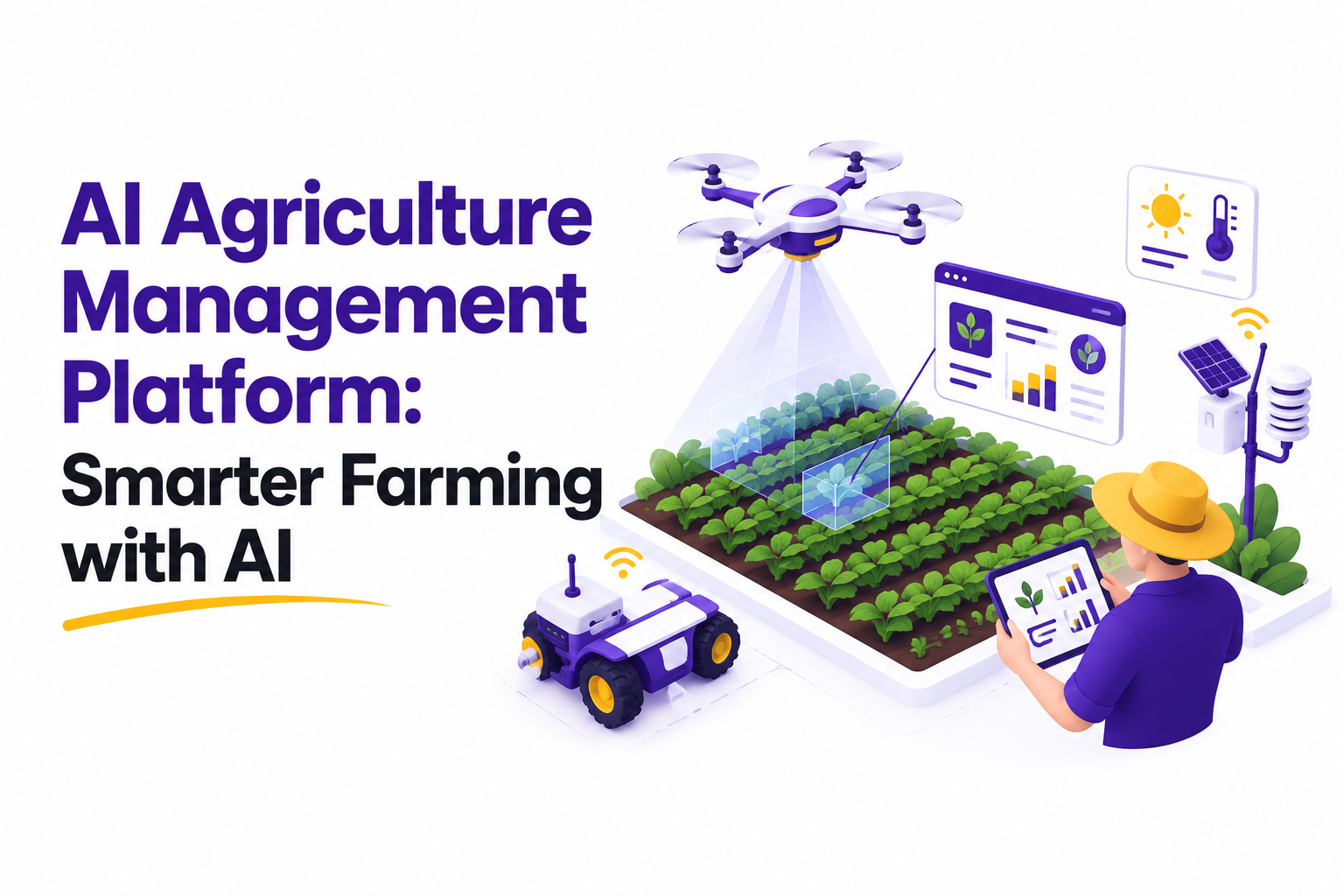

Farming decisions used to run almost entirely on experience built up over years in the field. In 2026, that experience is getting real backup. An AI agriculture management platform now works alongside soil sensors, drones, and weather stations, turning raw farm data into decisions a grower can act on before sunrise.
This is not about replacing a farmer's judgment. It is about giving that judgment sharper information, faster, so fewer decisions come down to guesswork or wait until damage is already visible in the field.
The gap between farms that use this technology well and farms that do not is starting to show up in the numbers, not just in conference talks. Tighter margins and unpredictable weather have made data driven decisions less of a nice extra and more of a working requirement.
Here is what these platforms actually do, what they typically cost, and how to tell a serious solution from a flashy one before committing a season and a budget to it.
What Is an AI Agriculture Management Platform, Really?
At its core, an AI agriculture management platform is software that pulls data from every corner of a farm operation and uses machine learning to turn that data into recommendations. Instead of checking five different apps for weather, soil moisture, and equipment status, a farm manager gets one dashboard that already knows what matters most that day.
It is worth separating this from basic record keeping software. A spreadsheet or a simple tracking app can store what happened last week. An AI driven system goes further, comparing current field conditions against years of historical patterns and flagging what is likely to happen next if nothing changes. That forward looking piece is the real difference.
• Pulls data from sensors, satellites, drones, and machinery into a single dashboard
• Uses predictive models to forecast yield, pest pressure, and irrigation needs
• Sends alerts before a small problem becomes an expensive one
• Learns from every season and sharpens its recommendations over time
• Connects with existing farm equipment instead of forcing a full hardware replacement
Traditional Farm Management vs AI-Powered Farm Management
The difference shows up less in any single feature and more in how fast a farm can react once a problem starts.
None of this means traditional methods were wrong. They were built for a slower pace of decision making. The problem is that weather, pest pressure, and input prices no longer move at that pace, and farms that wait for visible symptoms are almost always paying for damage that already happened.
Why Farms Are Turning to AI Farming Software in 2026
Adoption is still early but moving fast. Recent industry surveys found that around 14 percent of farmers are already using some form of AI on their operation, with roughly a quarter of that group applying it specifically to yield prediction and agronomic decisions. That number is expected to climb over the next few years as more mid size operations get access to affordable AI farming software.
The economics matter too. Analysts tracking the farm management software market put its value near 4 billion dollars in 2026, with projections pushing past 6 billion dollars by 2030. Growth like that does not happen unless the return on investment is real for the farms paying for it.
There is also a generational piece to this. Younger operators stepping into family farms tend to be comfortable adopting software early, and they are often the ones pushing a multi generation operation to modernize its record keeping and decision process in the first place.
• Tighter margins mean every input dollar has to work harder
• Labor shortages make automated monitoring more valuable, not less
• Climate variability is pushing farms to react faster than manual methods allow
• Buyers and regulators increasingly want proof of sustainable practices, and platforms make that documentation easier
• Equipment financing is increasingly bundled with software access, lowering the barrier to trying it
Core Features Worth Comparing
Not every platform needs every feature. Use this as a checklist against your own priorities rather than a wish list.
It helps to think about features in terms of the decisions they support rather than how impressive they sound in a demo. A platform with twenty features that nobody on the farm ends up using is worth less than one with five features that get opened every single week, day after day, throughout the season.
How an AI Agriculture Management Platform Works, Step by Step
Underneath the dashboard, most platforms follow a similar process, even if the interface looks different from one vendor to the next.
1. Data collection: Sensors, drones, satellite imagery, and machinery feed continuous data into the platform throughout the growing season.
2. Data cleaning and integration: The system standardizes data from different sources so it can be compared and analyzed together, rather than sitting in separate silos.
3. Pattern analysis: Machine learning models compare current conditions against historical patterns from the same field and similar farms nearby, looking for early warning signs.
4. Recommendation generation: The platform turns analysis into specific, actionable guidance, such as when to irrigate or where to scout for pests first, ranked by urgency.
5. Feedback loop: Outcomes from each season feed back into the model, so predictions get sharper the longer the platform stays in use on that specific farm.
Benefits That Go Beyond the Obvious
The headline benefits of higher yield and lower input cost get most of the attention, but several of the more valuable gains show up in places farm managers do not always expect at first.
• Lower input costs through targeted rather than blanket application
• Fewer surprises at harvest thanks to earlier, more accurate forecasting
• Better labor planning, since the platform flags exactly where attention is needed
• Stronger compliance documentation for buyers and certification programs
• A searchable history of every field, useful when leasing, selling, or transferring land
• Easier onboarding for new staff, since field history and recommendations live in one place instead of one person's head
In short: None of these benefits require a farm to go fully automated overnight. Most operations start with one or two use cases and expand from there once the results are visible and the team trusts the data.
Common Challenges and How to Solve Them
Every new system creates friction at first. Most of it is predictable and manageable if it is planned for ahead of time.
Most of these obstacles are not technical, they are organizational. A platform succeeds or fails based on whether the people using it every day trust what it is telling them, and that trust is built through a slow rollout, not a rushed one.
Choosing the Right AI Agriculture Management Platform Development Companies
Picking a platform is really picking a long term partner. AI agriculture management platform development companies vary widely in how they approach agronomy, data ownership, and ongoing support, so it pays to look past the sales pitch before signing anything.
Some vendors specialize in a single crop type or region and know its quirks in detail. Others build broader, general purpose platforms that work across many operations but require more customization to fit a specific farm. Neither approach is automatically better, but it is worth knowing which one you are evaluating before comparing prices.
Team size and funding stability are also worth a closer look than most buyers give them. A small, well funded team with a clear roadmap can often outpace a larger vendor spread thin across too many product lines, especially when it comes to responding quickly during a critical growing window.
• Ask how the platform handles data ownership. Farm data should belong to the farm, not get locked into a vendor's ecosystem
• Ask for references from farms with a similar crop mix and region
• Check whether the platform integrates with equipment already on hand
• Confirm what support looks like during planting and harvest, when problems cannot wait
• Understand how pricing scales as acreage or feature use grows
• Find out how often the underlying models are retrained and with whose data
AI Agriculture Management Platform Options by Farm Type
The right feature set looks different depending on what a farm actually produces.
A platform built primarily for row crops will not necessarily translate well to an orchard or a livestock operation, even if the marketing language sounds similar. It is worth asking a vendor directly how many of their current customers operate in the same category as your farm.
Data Security and Ownership: What to Watch For
Farm data is valuable, and not just to the farm producing it. Buyers, insurers, and even competitors can find uses for detailed field level data, which is exactly why ownership terms deserve as much attention as feature lists.
Before signing a contract, get clear answers on who can access the data, whether it is shared with third parties, and what happens to it if the farm ends the relationship with the vendor. A platform that cannot answer these questions clearly is worth a second look before committing.
• Confirm data is encrypted both in transit and at rest
• Check whether aggregated or anonymized farm data is sold to third parties
• Get an explicit data export process in writing, not just a verbal promise
• Ask what happens to stored data after a contract ends
Getting Your Team on Board: Training and Adoption
Even the best platform is only as useful as the people willing to open it every day. Farm crews, especially longtime staff, often have decades of field experience that no dashboard can replace, and rolling out new software without acknowledging that tends to backfire. The teams that see the smoothest adoption usually treat the platform as a second opinion rather than a replacement for the person who has walked that field for twenty years.
A gradual rollout beats an all at once switch almost every time. Picking one crew member as the point person for the platform, letting them get comfortable with it on a single field, and then having them train the rest of the team tends to build more genuine trust than a top down mandate from management. That trust matters more than any feature list, since a tool nobody opens is worth nothing regardless of how sophisticated the underlying model is.
• Assign one person as the platform champion during the first season
• Run the new system alongside existing methods for at least one full cycle before retiring the old process
• Set a recurring fifteen minute check in to review alerts and recommendations as a team
• Celebrate specific wins publicly, like a pest outbreak caught early, to build confidence in the tool
Integrating With Existing Farm Systems
Very few farms are starting from a blank slate. Most already run some combination of accounting software, equipment telematics, and maybe a basic weather app, and a new platform has to fit into that existing stack rather than replace all of it overnight.
The strongest integrations tend to happen through open APIs and standard file formats, which let a new AI agriculture management platform pull in historical data instead of forcing a farm to start its record keeping over from zero. Ask any vendor directly which systems they already integrate with, since a long list of partner logos on a website does not always mean a smooth, working connection in practice.
• Confirm compatibility with your current equipment telematics before signing
• Check whether historical yield and input data can be imported directly
• Ask if the platform supports standard agronomic file formats for future flexibility
• Test the integration with a small data set before committing farm wide
AI and Sustainability: The Compliance Angle
Sustainability reporting used to be a side project handled once a year for a single buyer or certification body. In 2026, it is becoming a continuous requirement, with more processors, retailers, and lenders asking for documented proof of practices like reduced input use, water conservation, and soil health management.
This is one area where an AI driven platform genuinely saves time rather than just adding another dashboard to check. Because the system is already tracking input application, water use, and field activity, generating a sustainability report becomes a matter of pulling existing records instead of reconstructing a season from memory and scattered receipts.
• Automated tracking of input application reduces manual reporting time
• Water use data supports conservation program applications and rebates
• Soil health trends over multiple seasons strengthen regenerative certification claims
• Exportable reports save time during buyer or lender audits
What Does It Actually Cost?
Pricing varies by acreage, feature depth, and whether the build is custom or subscription based. Most AI farming software today is priced per acre or by feature tier rather than as a flat fee.
Custom built platforms designed around one specific operation typically cost more upfront, often landing somewhere between $15,000 and $75,000 for initial development, depending on scope. Subscription based platforms spread that cost out over time but may limit how much customization is possible.
Hidden costs are worth budgeting for separately. Sensor hardware, connectivity upgrades, staff training time, and data migration from an old system rarely appear in the headline subscription price, but they add up quickly during the first year.
Build vs Buy: Custom Development or an Off the Shelf Platform
This decision comes up early in almost every evaluation, and there is no universally right answer. An off the shelf platform is faster to deploy and cheaper upfront, and it benefits from improvements made across every other farm using the same system. The tradeoff is less flexibility to match a very specific operation or an unusual crop mix.
A custom build, on the other hand, can be shaped exactly around one farm's workflow, existing equipment, and reporting needs. That flexibility comes at a real cost, both in upfront development spend and in the time it takes to get the system working reliably across a full season.
Most mid size operations start with an off the shelf platform and only move toward custom development once they have a clear, specific gap that a general purpose tool cannot fill. That sequence tends to be far less expensive than starting with a custom build before knowing exactly what is needed.
• Off the shelf platforms suit farms wanting to get started quickly with proven features
• Custom builds suit operations with unusual crops, workflows, or reporting requirements
• A hybrid approach, an off the shelf core with custom integrations, is increasingly common
• Whichever path is chosen, confirm ongoing maintenance and update responsibilities in writing
Measuring ROI: What to Track After Adoption
The only way to know whether a platform is paying for itself is to track the right numbers from day one.
What AI Catches That a Weekly Walkthrough Often Misses
A weekly field walkthrough is still one of the most valuable habits a grower can keep, but it only captures a snapshot. A pest population can double between visits, and a drainage issue can quietly stress a section of a field for days before it becomes visible from the truck window.
Consider a mid size row crop operation running a few hundred acres. Soil moisture sensors flag a section drying out faster than the rest of the field, days before the crop shows any visible stress. That early flag gives a manager time to adjust irrigation before yield is actually affected, instead of discovering the damage at harvest when nothing can be done about it.
The same pattern shows up with pest pressure. Imagery analysis can spot the early signature of an infestation from canopy color changes long before it is visible to the eye on the ground, giving a narrow window to spot treat a few acres instead of the whole field.
In short: None of this replaces walking the field. It just means the walkthrough starts with a shortlist of exactly where to look first, instead of covering every acre at the same pace.
Where This Is Headed: 2026 and Beyond
The next phase looks less like dashboards and more like autonomous action. Industry analysts describe this shift as moving from AI as decision support toward AI that can act directly, adjusting irrigation or guiding equipment without someone approving every single step.
That shift will not happen everywhere at once. Large operations with the capital to invest in autonomous equipment will move first, while mid size and smaller farms will likely keep using AI mainly as a decision support layer for several more years.
• Autonomous field equipment that adjusts its own behavior in real time
• Deeper integration between farm software and supply chain or buyer systems
• Growing use of AI for carbon tracking and regenerative practice verification
• More open data standards, making it easier to switch platforms without starting from zero
In short: The technology is moving fast, but the fundamentals of a good platform stay the same. Reliable data, clear recommendations, and support that shows up when it is needed most.
Conclusion
An AI agriculture management platform is not a shortcut around good farming. It is a way to see problems earlier, use inputs more precisely, and spend less time reacting to surprises after the fact.
The farms getting the most value in 2026 are not necessarily the ones with the most sensors. They are the ones that picked a platform matched to their actual decisions, then gave it a full season to prove itself before expanding further.
The technology will keep evolving, and next year's version will inevitably do more than this year's. That is not a reason to wait. A platform adopted today starts building a season by season dataset that only becomes more valuable the longer it runs, and farms that wait for the perfect version end up starting that data history years behind everyone else.
Start small, measure the results, and let the data make the case for what comes next on your operation.