
The last few years have transformed how businesses build digital products. Web applications are no longer simple interfaces—they’ve become intelligent platforms that learn from user behaviour, process massive datasets, generate predictions, automate decisions, and integrate AI-driven features. As we move into 2026, this shift toward intelligence, automation, and real-time data processing is accelerating even faster.
To meet this new era of digital expectations, companies worldwide prefer to hire Python developers because Python has become the strongest foundation for building scalable, data-rich, AI-powered web applications.
Whether you are creating an AI-driven SaaS platform, an analytical dashboard, a predictive business tool, or a personalized user experience system, Python stands out as the most reliable, future-ready, and business-friendly language.
Why 2026 Marks a Turning Point for Python in Web Development
The technological landscape in 2026 looks different from what we saw even a few years ago. Organizations now demand:
- Continuous data analysis
- Predictive intelligence
- Machine Learning inside web applications
- Real-time dashboards
- AI chat interfaces
- Automated decision-making
- Faster development & deployment cycles
Python aligns perfectly with these needs because of three major reasons:
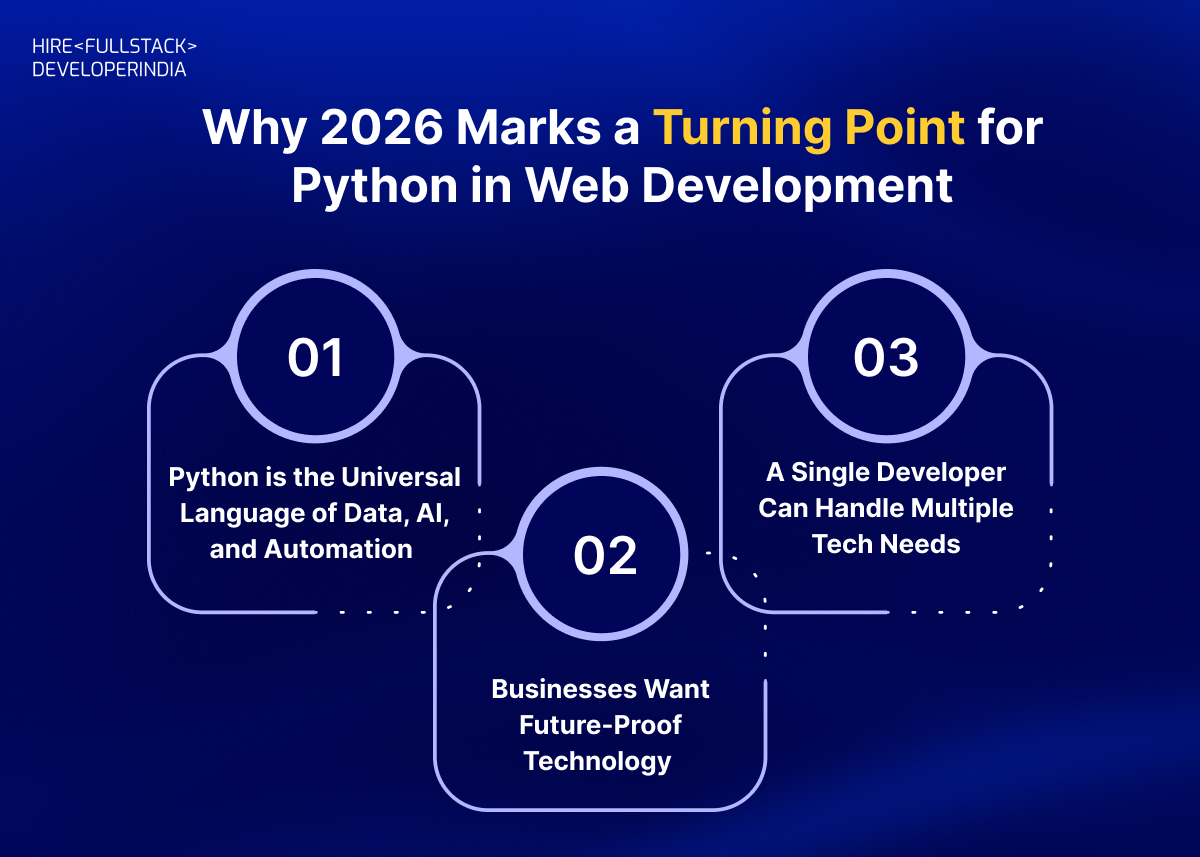
1.1 Python is the Universal Language of Data, AI, and Automation
Unlike JavaScript, PHP, or Ruby, Python is rooted deeply in the data ecosystem. It powers:
- AI and ML models
- Automation workflows
- Big Data pipelines
- Deep learning systems
- Predictive analytics engines
- Cloud deployments
- Web backends
This all-in-one capability makes Python the most strategic choice for modern web applications in 2026.
1.2 Businesses Want Future-Proof Technology
Companies are investing heavily in AI/ML. Python is the native language behind:
- ChatGPT and LLMs
- OpenAI APIs
- TensorFlow, PyTorch
- Scikit-learn
- HuggingFace
- Data visualization tools
When businesses choose Python Web Development 2026, they ensure their platforms stay compatible with upcoming AI innovations for many years.
1.3 A Single Developer Can Handle Multiple Tech Needs
Python developers can manage:
- Data analytics
- Machine learning model integration
- Backend development
- Web API creation
- Automation
- Cloud deployment
- DevOps tasks
This makes hiring Python developers extremely cost-effective, where skill efficiency matters more than ever.
Why Python Developers Are Essential for Data-Driven Web Applications in 2026
Python continues to be one of the most powerful languages for building data-driven web applications, especially as businesses enter an era of advanced AI, automation, and real-time analytics. In 2026, companies need applications that do more than show data — they need systems that interpret, predict, and automate decisions. This is exactly where skilled Python developers stand out.
1. Python Connects Web Apps Seamlessly With AI & Data Pipelines
Almost every modern web application needs AI features like predictions, personalization, fraud detection, and automated decisions.
Python developers make this possible because the language integrates naturally with:
- Machine learning libraries: TensorFlow, PyTorch, Scikit-learn
- Big Data tools: Spark, Hadoop, Dask
- Data visualization: Plotly, Matplotlib, Seaborn
Why it matters:
Python developers can build a single application where data flows smoothly from database → AI model → user interface.
2. Faster Development With Powerful Web Frameworks
Python has matured web frameworks that reduce development time while increasing reliability.
- Django – Best for large, scalable, security-heavy applications
- Flask / FastAPI – Best for microservices, APIs, and AI-powered apps
- Streamlit – Perfect for internal dashboards and data apps
Outcome:
Python developers build applications faster while keeping them clean, secure, and easy to extend.
3. Perfect Fit for Real-Time Analytics
Businesses in 2026 depend on quick decision-making — from customer behavior tracking to inventory forecasting.
Python is widely used for:
- Real-time dashboards
- Predictive analytics
- Automated reporting
- Data-heavy backend services
Python developers help companies turn raw numbers into meaningful insights that appear instantly inside web apps.
4. Python Is the Backbone of AI-Powered Web Applications
AI-driven features are now standard:
- Chatbots and assistants
- Recommendation engines
- Fraud and risk detection
- Smart search systems
- Image/text analysis
Python developers can effortlessly connect these AI models to web applications, making the end product smarter and more efficient.
5. Scalability & Cloud Adoption Are Easier With Python
Cloud platforms like AWS, Azure, and Google Cloud offer strong Python support.
Python developers can build applications that:
- Scale automatically
- Process large amounts of data
- Integrate with cloud-native tools
- Support containerization (Docker, Kubernetes)
This ensures the app stays fast even when user traffic grows.
6. Python Is Future-Ready for 2026 and Beyond
Python’s ecosystem is expanding every year with better support for:
- Advanced AI
- Automation
- Edge computing
- API-first applications
- Security and performance optimization
Hiring Python developers ensures your web application remains relevant and upgradeable for years. Hiring Python developers is no longer optional for companies that rely on data. Their ability to combine AI, analytics, and modern web technologies makes them essential for building applications that are intelligent, scalable, and ready for the future.
Why Python Is the Ideal Foundation for Data-Driven Web Applications
Data-driven web applications do far more than display information. They interpret patterns, analyze user behavior, and trigger automated actions. Python has become the strongest foundation for this shift because it combines simplicity, analytical power, and deep AI ecosystem support. Here’s a clear breakdown.
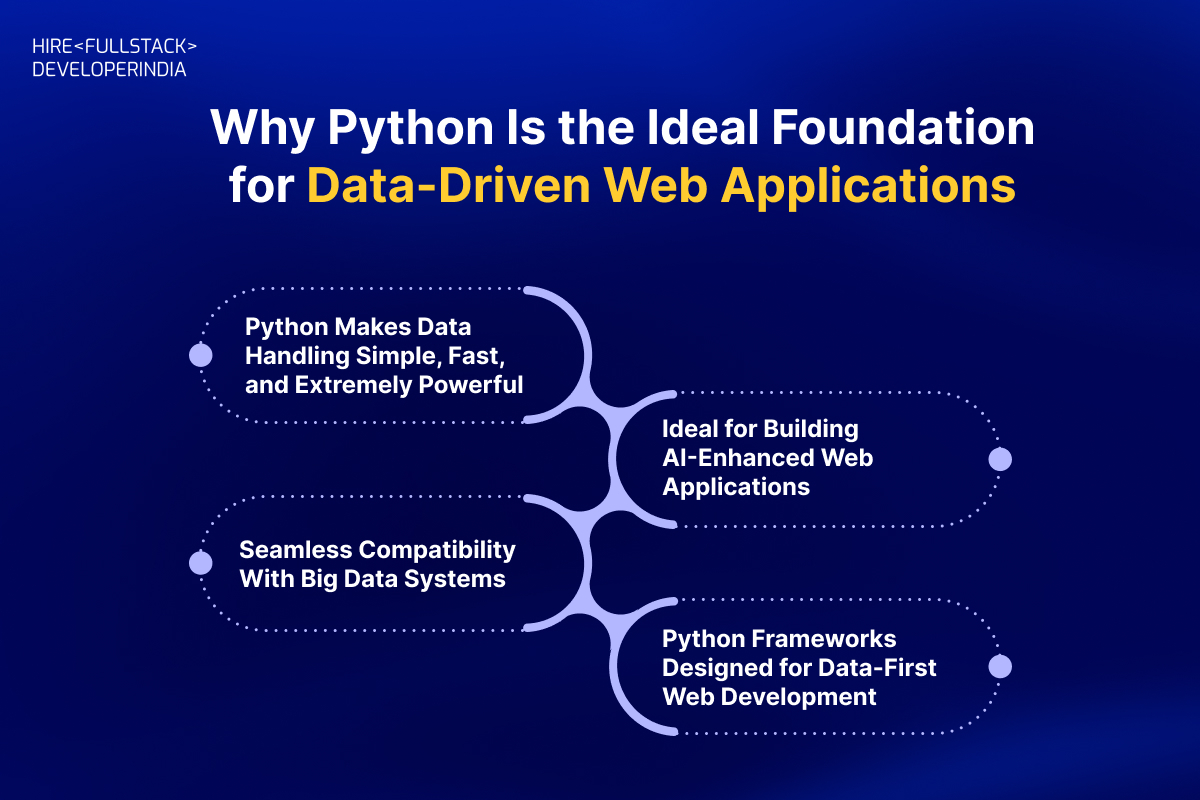
2.1 Python Makes Data Handling Simple, Fast, and Extremely Powerful
Python gives developers access to some of the world’s most advanced data-processing tools. These libraries make it easy to clean, analyze, and transform data inside web applications.
Core libraries used in 2026:
- Pandas – data cleaning, manipulation, and reporting
- NumPy – fast mathematical and numerical operations
- Dask – distributed processing for large datasets
- Polars (2026 standout) – lightning-fast analytics for performance-heavy apps
This enables applications to:
- Clean and organize user data
- Identify patterns and generate insights
- Track trends in real time
- Build personalization engines
- Automate intelligent decisions
- Run statistical and predictive models
In simple words: Python converts raw data into useful intelligence that businesses can act on instantly.
2.2 Ideal for Building AI-Enhanced Web Applications
Companies hire Python developers primarily because Python integrates seamlessly with modern AI technologies. Developers can embed smart features directly into web applications using popular frameworks such as:
- TensorFlow
- PyTorch
- Scikit-learn
- HuggingFace Transformers
- LangChain
- OpenAI API tools
These enable applications to include:
- Smart recommendations
- AI chatbots and conversational tools
- Behaviour prediction models
- Fraud and anomaly detection
- Automated insights and summaries
- Natural Language Processing (NLP)
- Image and voice recognition
This is why sectors like SaaS, HR Tech, EdTech, fintech, retail, and healthcare rely heavily on Python developers —they can build web apps that think, learn, and adapt.
2.3 Seamless Compatibility With Big Data Systems
Modern data-driven web applications depend on large and fast-moving datasets. Python integrates exceptionally well with Big Data infrastructure, allowing developers to manage data from multiple sources effortlessly.
Common 2026 Big Data integrations include:
- Apache Spark
- Hadoop
- Snowflake
- Google BigQuery
- Amazon Redshift
- Kafka
- Airflow
- Azure Data Lake
This makes it possible to build systems that:
- Process millions of records efficiently
- Handle real-time event streams
- Run automated ETL and data pipelines
- Deliver instant dashboards and analytics
- Power high-speed backend engines
No other language offers such smooth and widespread Big Data compatibility, making Python the backbone of large-scale data systems.
2.4 Python Frameworks Designed for Data-First Web Development
Python provides a rich ecosystem of frameworks that match different types of data-driven workflows. Each one serves a unique purpose:
- Django
A complete, enterprise-grade framework known for strong security, built-in admin panel, ORM, caching, and authentication.
Best for: Large, complex systems that need reliability and structure. - Flask
A lightweight and highly flexible framework ideal for custom architectures and microservices.
Best for: APIs, modular apps, and small-to-medium data services. - FastAPI
The fastest-growing framework in 2026, designed for performance-heavy and AI-centric applications.
Best for:
- ML/AI model deployment
- High-performance APIs
- Real-time systems
- Async operations
Dash & Streamlit
Special frameworks for creating data-first interfaces.
Best for:
- Dashboards
- BI tools
- Reporting systems
- Machine learning model apps
Together, these frameworks let developers build web apps that are fast, scalable, and deeply integrated with analytics and AI—a must for modern data-driven systems.
How Python Developers Build Intelligent Web Applications in 2026
Python developers play a critical role in building smart, automated, and data-powered web applications. In 2026, their responsibilities go far beyond simple backend coding—they design systems that learn, adapt, and make real-time decisions. Here’s how they do it.
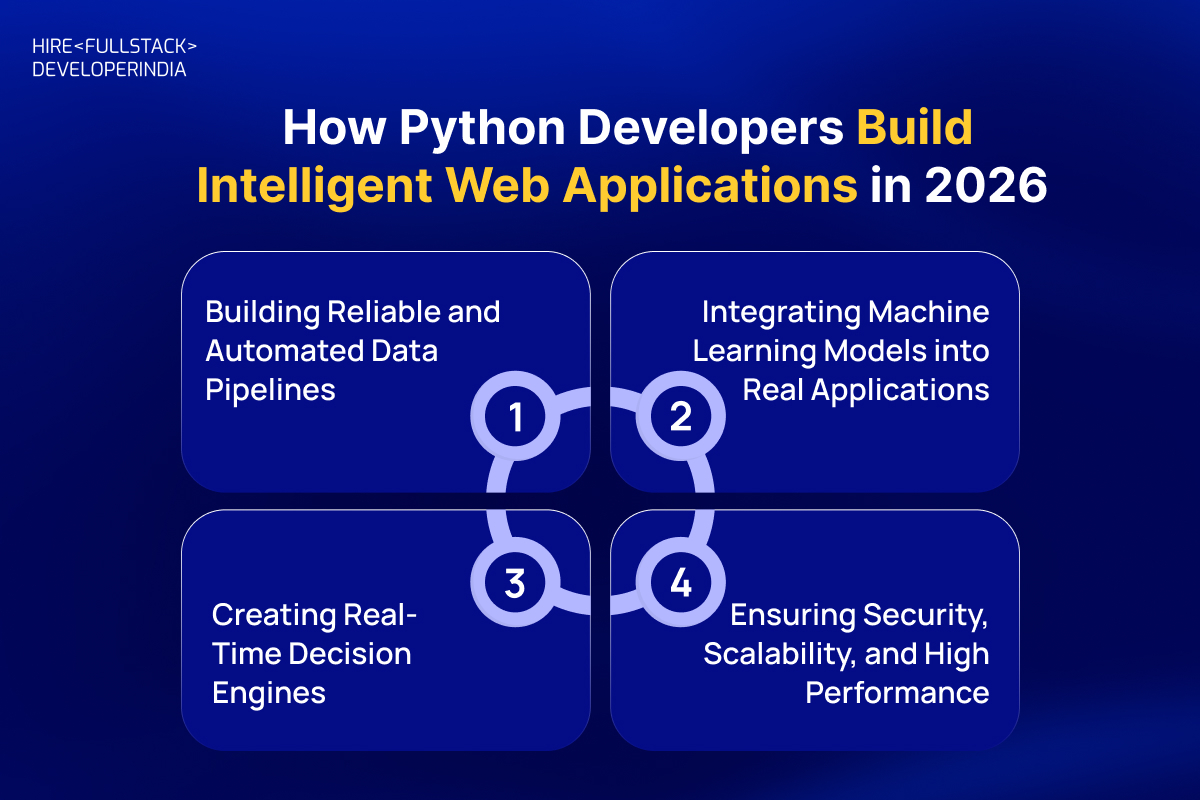
3.1 Building Reliable and Automated Data Pipelines
For any data-driven web application, clean, accurate, and real-time data is the foundation. Python developers build automated pipelines that ensure data flows smoothly from multiple sources into your application.
A modern pipeline must deliver data that is:
- Clean
- Reliable
- Well-structured
- Timely
- Accurate
Python developers use powerful tools such as Pandas, Airflow, Spark, and Dask to create these pipelines.
Common data sources in 2026 include:
- APIs
- Internal and external databases
- IoT devices
- Third-party platforms
- User activity logs
- CRMs and ERPs
- SaaS tools
These pipelines run automatically, ensuring your application always receives the freshest and most reliable data—without manual effort.
3.2 Integrating Machine Learning Models into Real Applications
In 2026, ML integration is one of the main reasons companies hire Python developers. They take machine learning models and convert them into usable, scalable features inside web apps.
Python developers handle tasks like:
- Training and fine-tuning ML models
- Building prediction APIs
- Connecting these models to front-end interfaces
- Monitoring performance and drift
- Automating retraining cycles
This enables businesses to add intelligent features such as:
- Demand forecasting
- Smart recommendation engines
- Personalized learning paths (EdTech)
- Patient risk prediction (HealthTech)
- Intelligent search, sorting, and filtering
- AI-generated content and insights
Because Python excels at both machine learning development and web deployment, it becomes essential for long-term digital transformation.
3.3 Creating Real-Time Decision Engines
Users today expect immediate responses—whether they’re checking inventory, tracking delivery, or getting security alerts. Python developers build real-time decision systems using tools like:
- FastAPI – high-speed API responses
- Redis – in-memory caching for instant data
- Kafka – real-time streaming
- Async programming – high concurrency
These technologies power features such as:
- Live analytics dashboards
- Real-time fraud or anomaly alerts
- Instant recommendation updates
- Activity and behavior tracking
- Logistics and delivery monitoring
- Predictive notifications
This gives businesses the ability to respond to user actions within milliseconds, creating a smooth and intelligent user experience.
3.4 Ensuring Security, Scalability, and High Performance
Beyond AI and analytics, Python developers also ensure that the application is secure, stable, and scalable. Modern Python frameworks like Django, FastAPI, and Flask come with built-in mechanisms for:
- User authentication
- Role-based permissions
- Data encryption
- HTTPS configuration
- Input validation
- SQL & NoSQL injection prevention
These capabilities make Python a strong choice for industries where security and reliability are non-negotiable, including:
- FinTech
- HealthTech
- EdTech
- E-commerce & Retail
- Logistics & Supply Chain
- SaaS platforms
In 2026, as cyber threats grow and applications scale globally, Python developers help businesses maintain a secure and high-performing digital environment.
Why You Should Hire Python Developers in 2026
In 2026, Python developers are considered some of the most valuable tech professionals. Their ability to work across AI, data, backend, automation, and cloud makes them essential for building modern digital platforms. Here’s why hiring Python developers is a strategic advantage for any business.
4.1 They Support Both AI and Web Development (One Developer, Multiple Skills)
Unlike many other specialists, Python developers can work across multiple layers of technology. This means companies don’t need separate hires for backend development, data processing, and AI integration.
A single Python developer can manage:
- Backend logic and server-side development
- Data engineering and ETL workflows
- Machine learning model integration
- API design and development
- Dashboard and analytics UI creation
- Automation scripts and task schedulers
- Model deployment and monitoring
This multi-disciplinary skillset dramatically reduces development cost, speeds up releases, and ensures all components of your system work smoothly together.
4.2 Python Developers Speed Up Development Cycles
Python’s biggest advantage is its readability and simple syntax. This makes development faster at every stage of the project lifecycle.
Python enables teams to:
- Build MVPs in weeks instead of months
- Validate product ideas quickly
- Add or modify features with minimal complexity
- Fix bugs in clean, easy-to-read code
- Iterate continuously without slowing down
In 2026, where rapid innovation is a competitive advantage, Python developers help businesses stay one step ahead. This is especially beneficial for startups, SaaS companies, and enterprise innovation labs.
4.3 They Help You Build Future-Ready, AI-Driven Platforms
The digital landscape of 2026 is defined by:
- AI automation
- Machine learning workflows
- Hyper-personalization
- Predictive intelligence
- Real-time decision systems
- Data-driven insights
Python developers ensure your platform is compatible with these technologies—not just today, but for future upgrades as well.
They help businesses:
- Build applications that learn from user behavior
- Integrate LLMs and advanced AI models
- Deploy predictive engines
- Automate operations
- Create scalable data architectures
In short, hiring Python developers means your web application will not become outdated as new AI capabilities emerge.
4.4 Python Developers Fit Into Any Modern Tech Stack
Python plays well with virtually every major technology used in 2026. This makes Python developers highly adaptable in cross-functional teams.
They integrate easily with:
- Frontend frameworks: React, Next.js, Vue, Angular
- Mobile apps: Flutter, React Native
- Cloud platforms: AWS, Azure, Google Cloud
- Databases: PostgreSQL, MySQL, MongoDB, Redis
- API architectures: REST, GraphQL, WebSockets
- Microservices and containerized systems: Docker, Kubernetes
This compatibility ensures your platform can grow, scale, and evolve easily without running into technology limitations.
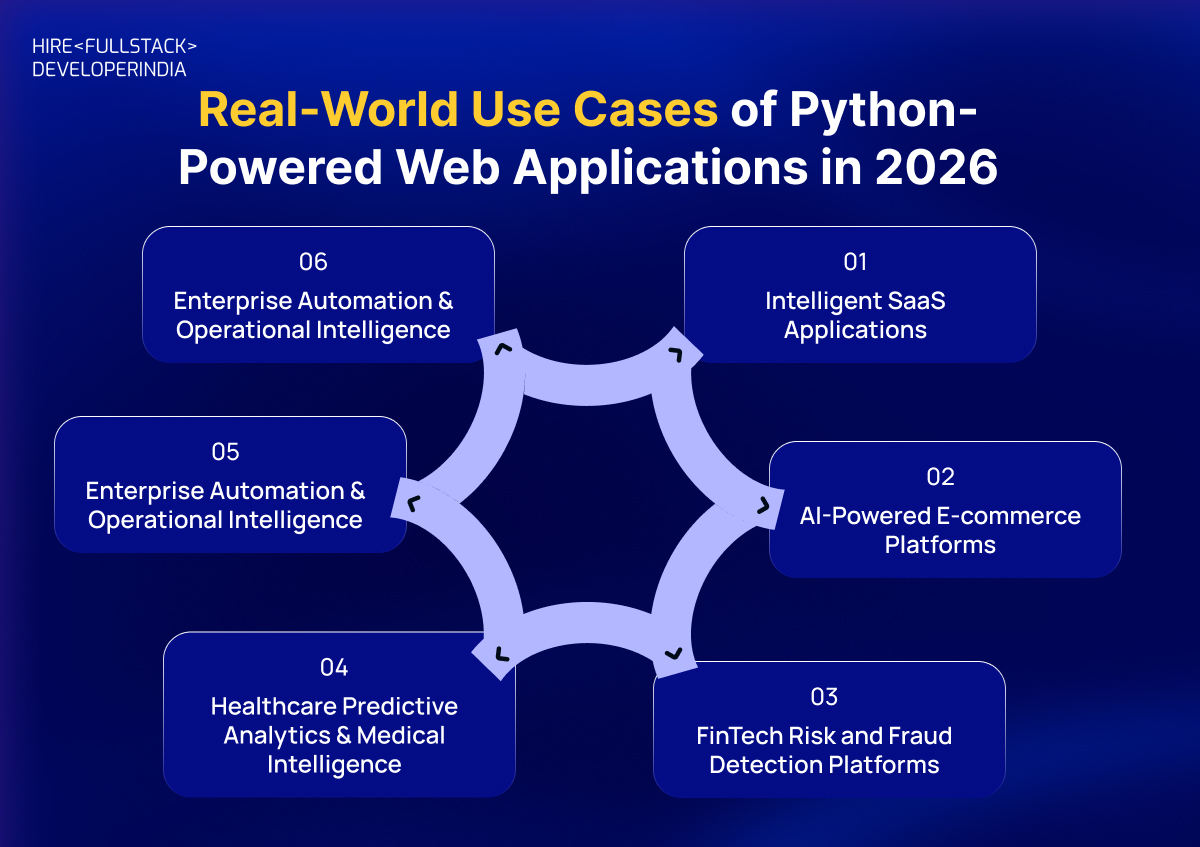
Real-World Use Cases of Python-Powered Web Applications in 2026
Python is not just a popular programming language—it’s the backbone of intelligent digital platforms in almost every industry. In 2026, organizations are relying on Python to build applications that think, analyze, and automate. Below are the most impactful real-world use cases.
5.1 Intelligent SaaS Applications
Modern SaaS products are expected to deliver insights, automation, and personalized experiences. Python enables all of this through its strong analytics and AI ecosystem.
Common Python-powered SaaS features include:
- CRM scoring systems that analyze customer potential
- User suggestion engines that predict user interests
- Interactive analytics dashboards for business insights
- Automated reporting tools that summarize data instantly
- Churn prediction models to identify users at risk
- Workflow automation engines for routine tasks
SaaS companies prefer Python because it helps them launch smarter features quickly and continuously upgrade their platform with AI innovations.
5.2 AI-Powered E-commerce Platforms
E-commerce in 2026 is driven by hyper-personalization. Python helps brands deliver the right product, price, and experience to the right customer at the right time.
Python enables:
- Product recommendation engines (similar to Amazon)
- Dynamic pricing models that adjust prices based on demand
- AI-driven search systems with intent-based results
- Customer segmentation and behavioral clustering
- Inventory prediction for warehouses and logistics
- Sentiment analysis on reviews and customer chats
This allows e-commerce businesses to increase conversions, reduce returns, and deliver a more personalized shopping experience.
5.3 FinTech Risk and Fraud Detection Platforms
Security is at the heart of every financial application. Python’s strength in data analysis and machine learning makes it perfect for building intelligent FinTech systems.
Python powers:
- Fraud detection engines that identify suspicious activity
- Real-time transaction monitoring
- Credit scoring and risk evaluation models
- KYC automation and identity verification
- AML (Anti-Money Laundering) pattern recognition
Because these systems need to process millions of data points instantly, Python is the preferred language for FinTech applications.
5.4 Healthcare Predictive Analytics & Medical Intelligence
Healthcare systems are shifting toward preventive and personalized care. Python enables medical platforms to analyze large datasets and generate actionable health insights.
Python helps build:
- Disease prediction models (diabetes, heart disease, etc.)
- Patient risk scoring systems
- Health monitoring dashboards
- AI-powered radiology and diagnostic tools
- Medical record summarization systems
- Drug recommendation and dosage prediction engines
Python developers help healthcare companies improve patient outcomes with smarter, data-driven decision-making.
5.5 Education & Talent Management Platforms
EdTech and HRTech platforms use Python to understand learner behavior and employee performance. This leads to more efficient training, hiring, and career development.
Python powers:
- AI tutors that personalize learning
- Performance prediction models for exams and skills
- Content recommendation engines for learners
- Automated career path suggestions
- Resume screening & talent scoring tools
- Employee retention prediction
These intelligent systems make learning more engaging and hiring more efficient.
5.6 Enterprise Automation & Operational Intelligence
Large enterprises rely on Python to automate processes, reduce manual effort, and improve efficiency across departments.
Python helps build:
- End-to-end workflow automation tools
- Process optimization systems
- Demand and supply forecasting engines
- Operational dashboards
- Automated decision-making workflows
- Robotic Process Automation (RPA) using Python scripts
This helps businesses save time, reduce errors, and operate with real-time intelligence.
Across all these industries, one thing remains clear:
Python developers are essential because Python is the only language that seamlessly connects AI, analytics, automation, and web development.
This unique compatibility makes Python-powered applications the smartest choice for 2026 and beyond.
The Future of Python in Web Development Beyond 2026
Python’s popularity will continue to grow because:
- AI will dominate almost every digital platform
- Data will become bigger and more complex
- Web apps will need instant intelligence
- Automation will be fully mainstream
- Predictive analysis will be the new standard
Python is the only language that aligns deeply with all these future trends.
Conclusion: Python Developers Are the Core of Data-Driven Digital Transformation in 2026
In 2026, every modern business needs platforms that are smart, fast, secure, and powered by real-time data. Python developers make this possible by combining AI expertise, data engineering skills, and strong web development capabilities.
If your business wants an application that is:
- AI-ready
- Scalable
- Data-driven
- Analytics-focused
- Cloud-compatible
- Future-proof
-then hire Python developers is no longer optional. It’s essential.
Python’s ecosystem brings together everything—from machine learning and Big Data to automation and backend development—making it the most reliable foundation for next-generation applications. Python developers don’t just build websites—they build intelligent systems that drive the digital future.