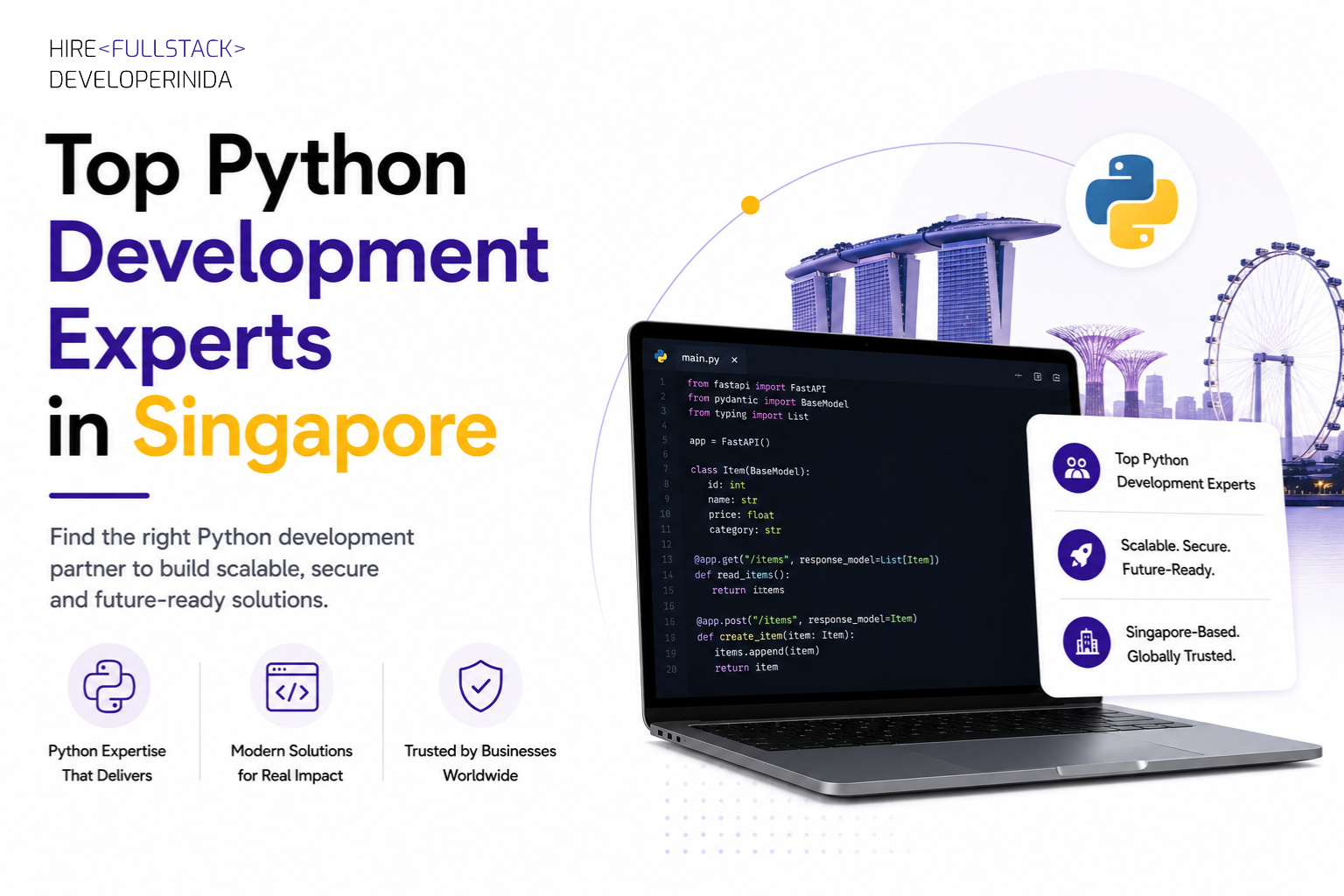

Top Python Development Experts in Singapore: What Nobody Tells You Before You Sign the Contract
Let's be honest. You've probably already Googled this topic three or four times. You've read lists, clicked through a few websites, and still feel like something's missing. The blogs you found were helpful to a point, but they all started to sound the same after a while. Company X has a talented team. Company Y delivers on time. Company Z has great reviews. And then? You're back to square one, still not sure who to actually trust with your product.
This guide is different. It's written for founders, CEOs, and decision-makers who are past the "what is Python" stage and are now deep in the research process, comparing real options, trying to figure out who is genuinely good and who is just good at marketing. We'll cover 10 companies worth your attention, but more importantly, we'll give you the honest context around costs, hiring decisions, red flags, and factors that most blogs skip entirely.
Singapore's tech ecosystem has matured significantly by 2026. The country has become a serious hub for AI development, fintech infrastructure, and enterprise automation. Python, being the backbone of all three, is now in higher demand than ever. And that demand has reshaped the market in ways that directly affect your budget and your decisions.
Why Singapore and Why Python in 2026
Singapore is not just a financial hub anymore. It has quietly built one of the most capable tech talent pools in Southeast Asia. Government programs like the Smart Nation initiative and continued investment in digital infrastructure have made the city-state a natural home for serious software development. If you're building something that requires robust backend systems, machine learning capabilities, or data-heavy platforms, Singapore gives you access to world-class talent within a stable, English-speaking, legally reliable environment.
Python specifically has become the language of choice for three categories of work that are booming right now: AI and machine learning applications, data analytics platforms, and backend API development. In 2026, nearly 70 percent of AI-related development projects globally use Python as the primary language. That number tells you something important: when you're hiring a Python Development Company Singapore , you're not just looking for a coding shop. You're looking for a team that understands modern infrastructure, data systems, and potentially AI integration.
The other thing worth understanding is that Singapore-based companies increasingly work across time zones, serving clients in Europe, the US, and the Middle East. This means their processes, communication standards, and delivery models are built for international collaboration. That's a practical advantage for any founder who isn't based in Singapore but wants a team that operates like a professional partner, not just a vendor.
The Real Cost Conversation Nobody Has With You Upfront
Most articles that mention cost do it in a vague, unhelpful way. "Pricing varies by project scope" tells you nothing. So let's be specific.
Hiring a local Singapore-based developer directly (full-time) will cost you anywhere between SGD 7,000 and SGD 15,000 per month for a mid-to-senior Python developer. That's before CPF contributions, benefits, and the time cost of recruiting. If you're building a team of five, you're looking at operational costs that can easily exceed SGD 600,000 annually.
A development company, by contrast, typically charges on a project or retainer model. For a mid-complexity web or data platform, expect project quotes in the range of SGD 30,000 to SGD 120,000 depending on scope, timelines, and the specific company's pricing structure. Some companies offer dedicated team models where you're essentially renting a team of three to five developers for a fixed monthly fee, which can range from SGD 15,000 to SGD 45,000 per month.
Here's the part most blogs miss: the real cost isn't always in the sticker price. It's in revision cycles, unclear requirements, poor documentation, and lack of post-launch support. A cheaper company that requires five rounds of rework will cost you more than a slightly pricier firm that gets it right in two. Always ask prospective companies about their QA process, how they handle scope changes, and what post-launch support looks like. That conversation reveals more than any pricing table.
Also worth noting: companies that operate hybrid models, with some senior talent in Singapore and a delivery team in India or Eastern Europe, are often able to offer more competitive rates without sacrificing leadership quality. This is a legitimate model that several top firms use, and it works well as long as the Singapore-side team has strong project ownership.
10 Python Development Companies Worth Your Time in 2026
This isn't a sponsored list. These companies have been selected based on their technical reputation, client engagement quality, team capabilities, and relevance to modern Python development use cases.
1. Backend Development Company
Backend Development Company is a Python Development Company Singapore has built a strong reputation for doing exactly what the name implies: serious, scalable backend work. Their Python expertise spans Django and FastAPI frameworks, and they've developed a notable track record in building high-performance APIs for fintech and logistics platforms. What sets them apart is their engineering-first culture. They don't just deliver code; they deliver architecture decisions with documentation that your internal team can actually work with after handover.
Key strengths: API development, microservices architecture, database optimization, fintech and logistics industry experience. They follow a transparent project management process and provide regular build reports.
2. Deloitte Digital (Singapore)
Deloitte Digital brings enterprise-grade consulting combined with actual technical delivery capacity. Their Python practice in Singapore is primarily focused on data engineering, enterprise analytics, and automation of internal business processes. If you're a large organization looking to modernize legacy systems or build data pipelines at scale, Deloitte Digital has the experience and the risk management frameworks to handle the complexity.
Key strengths: Enterprise transformation, data engineering, compliance-heavy environments, cross-functional team management. Best suited for mid to large enterprises rather than startups.
3. HireFullStackDeveloperIndia
The name might suggest otherwise, but HireFullStackDeveloperIndia has a strong presence serving Singapore-based clients and operates on a hybrid engagement model that gives you access to full-stack Python expertise at significantly more competitive rates. Their model is particularly interesting for startups and growth-stage companies that need the output of a senior team without the cost of a fully Singapore-based studio.
Key strengths: Full-stack Python development, React and Django integration, cost-efficient team scaling, startup-friendly engagement structures. Strong client communication practices and a dedicated project manager for each engagement.
4. HireAIDevelopers
As the name clearly states, HireAIDevelopers focuses specifically on AI and machine learning development, and Python is central to everything they build. In 2026, with AI integration becoming a baseline expectation rather than a differentiator, this company is particularly relevant for founders who want to embed intelligence into their products without building an in-house AI team from scratch.
Key strengths: LLM integration, custom model development, Python-based ML pipelines, NLP applications, and AI product development from prototype to production. They have a portfolio that covers healthcare, ecommerce, and SaaS applications.
5. Accenture Singapore
Accenture's Singapore operations have a dedicated technology services division with deep Python capabilities, particularly around cloud migration, data transformation, and AI integration for enterprise clients. They work extensively with AWS and Google Cloud environments, and their Python teams are often embedded within larger digital transformation programs.
Key strengths: Cloud-native development, enterprise AI deployment, large-scale digital transformation, hybrid team management. More suitable for organizations running complex programs rather than single product builds.
6. DataEximIT
DataEximIT brings a data-first philosophy to Python development, which makes them an interesting choice for businesses where the product is built around data flows, reporting, or analytics. They work with clients in the supply chain, manufacturing, and retail sectors, building platforms that don't just display data but actually help businesses make decisions based on it.
Key strengths: Data-driven application development, Python for ETL pipelines, business intelligence integration, custom dashboard development, and ERP-adjacent systems. Their team is experienced in Pandas, NumPy, and visualization libraries. They also support post-deployment training for client teams.
7. Endava Singapore
Endava is a globally recognized technology services company with a growing Singapore footprint. Their Python practice is strong in the financial services and payments space, which is directly relevant to Singapore's position as a fintech hub. They bring a structured delivery methodology and work well with clients who need both strategic guidance and hands-on development.
Key strengths: Fintech application development, payment processing systems, API-first architectures, agile delivery at scale. Endava tends to work best with mid to large clients who have defined product roadmaps.
8. WebClues Infotech
WebClues Infotech is one of those companies that has consistently shown up in conversations about reliable offshore and hybrid development partnerships. They offer Python development services covering web applications, API development, and automation, and have built up a reasonable portfolio of Singapore-based client work over the years.
Key strengths: Python web application development using Django and Flask, third-party API integrations, ecommerce backends, and mobile app backend services. WebClues Infotech is particularly noted for their responsive client management and detailed project scoping process, which reduces the chance of budget surprises mid-project.
9. ThoughtWorks Singapore
ThoughtWorks is known globally for its engineering culture, and the Singapore office is no different. They are one of the few companies on this list that prioritizes engineering practices as much as output. Their teams work in a heavily collaborative, test-driven development environment, which means the code they deliver tends to be cleaner and more maintainable than what you'd get from a typical project shop.
Key strengths: Software craftsmanship, Python microservices, continuous integration and deployment pipelines, digital platform modernization. ThoughtWorks works best with clients who value long-term code quality and are open to agile collaboration processes.
10. Publicis Sapient Singapore
Publicis Sapient brings together technology delivery and business strategy in a way that's useful for companies going through significant digital change. Their Python practice is focused on digital experience platforms and data-driven customer engagement systems. They have a strong design and UX team that works alongside the engineering team, making them a good fit for companies where product experience and technical performance need to be developed together.
Key strengths: Digital experience platforms, customer data platforms, Python backend for content-heavy applications, enterprise retail and consumer brand work. Their engagement model is best suited for companies with defined transformation budgets.
Decision-Making Tips That Actually Change the Outcome
Here are the things most shortlisting guides don't bother telling you, because they either assume you already know or they're trying to keep things simple. You deserve the full picture.
Ask to see their Python version and framework history on past projects. A company that is still defaulting to Django 3.x for new projects in 2026 may not be keeping up with the ecosystem. Django 5.x and FastAPI have significantly changed what's possible in terms of performance and async capabilities. You want a team that's actively evolving.
Understand the team structure before you sign anything. You should know exactly how many senior developers will be on your project, and whether the person who pitches to you is the same person leading the build. It's surprisingly common for a company to send their most experienced person to the sales conversation and then assign junior developers to the actual work.
Test how they handle ambiguity. Give them a slightly vague requirement in your initial conversations and see how they respond. A good development partner will ask clarifying questions, challenge assumptions, and help you think through edge cases. A less experienced team will just nod and say they can build it.
Request references from clients with similar project types. A company that has done great SaaS work may not have the same track record in data-heavy applications. Match their portfolio to your actual needs, not just to the size and prestige of their past clients.
Clarify intellectual property terms before day one. This sounds obvious, but many founders discover mid-project that their contract has ambiguous language around code ownership. Make sure your contract clearly states that all developed code, documentation, and associated assets belong to you upon final payment.
What's Changing in Python Development in 2026
The Python ecosystem is evolving faster than it has in years. Here's what is actually shaping projects and talent requirements in 2026.
FastAPI has largely overtaken Flask for new API projects. It offers automatic documentation generation, native async support, and significantly better performance for high-traffic applications. Any Python team worth hiring in 2026 should be fluent in FastAPI.
AI integration is now a standard expectation, not a specialty. Clients are increasingly asking development companies to integrate LLM capabilities, vector search, and intelligent automation into products that would previously have been purely transactional. Python teams that don't have this capability are already falling behind.
Python type hints and static analysis tools have gone mainstream. Teams that write typed Python code with tools like mypy or Pyright produce significantly more maintainable codebases. This matters if you plan to hand the code to an internal team or bring in other developers later.
Cloud-native Python deployment has become a baseline skill. Knowing how to write Python is only part of the picture. Understanding containerization, serverless functions, and cloud orchestration is now expected of any team working on production-level applications.
Hidden Factors That Determine Whether Your Project Succeeds
Beyond the technical capabilities, there are organizational and process factors that often determine project success more than the quality of the code itself.
Knowledge transfer practices. The best development companies in Singapore have formal handover processes. They document system architecture, write developer guides, and often offer transition support to help your team get up to speed. Companies that skip this step create expensive dependency situations where you constantly need to go back to them for changes.
Security practices embedded in the development workflow. With Singapore's PDPA and increasing regulatory scrutiny on data handling, the development team you choose should have a clear approach to security. Ask specifically about how they handle data encryption, secrets management, and vulnerability scanning in their standard workflow.
Communication frequency and format. Some teams prefer weekly sprints with formal check-ins. Others run async-first workflows. Neither is inherently better, but mismatches between your communication expectations and a company's default rhythm create friction that slows projects down. Establish this clearly before the project starts.
So, Where Does This Leave You?
You came here looking for a list, and you're leaving with something more useful than that. You now know that the right Python development partner in Singapore isn't determined by which company has the prettiest website or the most impressive client logo on their homepage. It's determined by how well their delivery model fits your specific product needs, how transparent they are about cost and process, and whether they have the maturity to handle ambiguity without burning through your budget.
The 10 companies listed here represent a genuine range. Some are built for enterprise complexity. Some are ideal for startups moving fast on limited runway. Some specialize in AI. Others in data. The key is matching the company's natural strengths to the problems you actually need solved, not the problems they want to solve.
Singapore's Python development scene in 2026 is competitive and capable. The talent is real. The processes have matured. The costs are transparent if you ask the right questions. You're now better equipped to do exactly that.
Take two or three names from this list, reach out with a brief project summary, and watch how they respond. That first interaction tells you more than any review platform ever will.