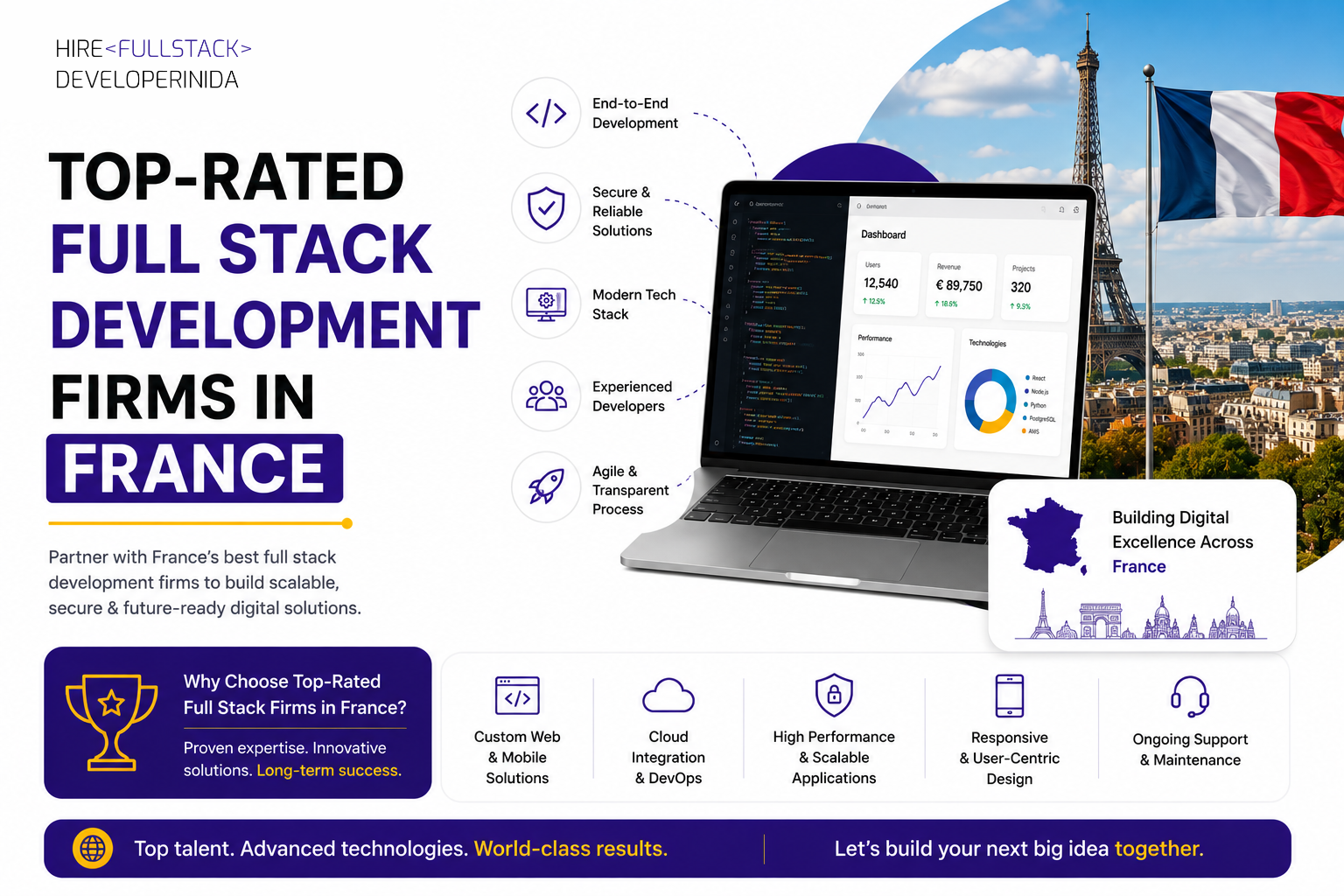

France has one of the most active technology ecosystems in Europe. With a software development market that continues to expand and a growing pool of specialized engineering talent concentrated in Paris and other major cities, the country has attracted considerable investment in digital product development across every major industry.
Choosing the right full stack development company or hire Full Stack Developers in France is a decision with real consequences. The partner you select will shape your product architecture, your time to market, the quality of your codebase, and ultimately the experience your users and customers have. Getting this choice wrong costs time, money, and momentum in ways that are difficult to recover from quickly.
This guide covers 20 of the top full stack development companies in France and those actively serving French clients in 2026. Some are established Parisian agencies with decades of delivery history. Others are globally distributed teams that combine offshore cost efficiency with genuine technical depth. The goal is to give you enough information to confidently shortlist companies and make an informed hiring decision without needing another resource.
Why Businesses Are Investing in Full Stack Development in 2026
Full stack development has moved from a hiring preference to a strategic priority. Several forces are driving this shift simultaneously.
- Digital Transformation Is No Longer Optional
Companies that deferred modernization programs during previous economic cycles are now accelerating them, often under board level pressure to compete on digital capability. Full stack development firms provide the end to end capability to rebuild legacy platforms without requiring businesses to assemble separate frontend and backend teams and manage the coordination overhead between them. - AI Is Now a Development Expectation
AI adoption is reshaping how software is built and how fast delivery is expected to move. Businesses now expect development partners to integrate AI powered software development capabilities into their products, from recommendation engines and intelligent search to automated workflows and predictive analytics. Full stack teams with genuine AI experience can deliver these integrations without requiring additional specialists or separate contracts. - Faster Product Cycles Demand End to End Teams
Startup founders and product managers are under pressure to release early, gather real user feedback, and iterate quickly. Full stack web development teams that own both frontend and backend adapt faster when priorities shift mid sprint than siloed teams that require alignment across separate functional groups before any change can be implemented. - Cost Efficiency Drives Offshore and Hybrid Models
Engaging a dedicated development team with full stack capability typically costs significantly less than assembling equivalent expertise internally, particularly when factoring in recruitment timelines, retention costs, and management overhead. The growth of offshore development teams and hybrid models has made it possible for businesses to access senior technical talent at a fraction of in house costs without sacrificing quality. - Enterprise Modernization Is Sustaining Demand
Large organizations are replacing legacy systems with cloud native architecture, microservices, and modern APIs at a pace that was uncommon five years ago. Enterprise software development firms with experience in full stack modernization are well positioned to manage these transitions from end to end, providing a single accountable partner for programs that previously required multiple contractors.
How We Selected the Best Full Stack Development Companies in France
Selecting 20 companies for this guide required looking beyond website portfolios and marketing copy. The evaluation process considered years of active experience and delivery track record, the depth and currency of technical expertise across the full stack, verified client reviews on platforms such as Clutch and G2, demonstrated industry specialization, breadth of the maintained technology stack, development methodology and agile maturity, post launch support practices, communication standards and time zone adaptability, and evidence of recent innovation in project work.
Companies were selected to represent a deliberate range of sizes, pricing models, and geographic bases, reflecting the diversity of businesses that rely on this type of guide. Both established French agencies and globally distributed offshore teams are included, because the right choice genuinely depends on your specific situation, budget, and product requirements.
Top 20 Full Stack Development Companies in France
The following companies represent the strongest options available for businesses seeking full stack development services in France in 2026. Each profile includes a data table, overview, key services, technology stack, industries served, reasons to choose, and the business types each company is best suited to serve.
1. Theodo
Theodo is a Paris based digital product agency founded in 2009, built around agile development and lean engineering principles. The company works with growth stage startups and enterprise innovation teams across France, the UK, and the US. Development teams are structured around cross functional squads, meaning engineers own features from conception through deployment rather than working on isolated layers. Theodo has particular strength in React and Node.js projects and has delivered platforms for clients across fintech, ecommerce, and media.
Key Services
• Full stack web development
• Mobile development (React Native)
• Cloud infrastructure and DevOps
• API design and integration
• Product consulting
• Software modernization
Technology Stack
React, Next.js, Node.js, Python, Django, React Native, AWS, PostgreSQL, Docker, Kubernetes
Industries Served
Fintech, ecommerce, media, healthcare, logistics
Why Choose This Company
Theodo is known for delivery velocity without sacrificing code quality. Their internal engineering culture emphasizes software craftsmanship, producing maintainable codebases that do not accumulate technical debt quickly. They also invest heavily in developer training, so teams stay technically current. If speed and code standards both matter to your organization, Theodo brings a rare combination of both.
Best For
Growth stage startups, scale ups requiring rapid product iteration, enterprise innovation labs building new digital products
2. HireFullStackDeveloperIndia
HireFullStackDeveloperIndia operates as a dedicated offshore development partner for businesses across Europe and North America. The company specializes in assembling full stack development teams that integrate directly with client workflows, adapting to client time zones where required. With over a decade of delivery experience, their model suits businesses that need consistent, scalable engineering capacity without the overhead of growing an internal team. Projects span web platforms, SaaS applications, mobile apps, and complex API ecosystems.
Key Services
• Full stack web development
• SaaS platform development
• API development and integration
• Mobile app development
• UI/UX design
• Dedicated development teams
Technology Stack
React, Angular, Vue.js, Node.js, Python, Laravel, PHP, Flutter, AWS, MongoDB, MySQL
Industries Served
Healthcare, ecommerce, fintech, logistics, education, real estate
Why Choose This Company
The company's core value is flexibility. Clients can scale teams up or down based on project phase, and the offshore pricing model makes it viable for businesses that cannot justify European agency rates for every component of their development roadmap. Communication processes are structured around daily standups, project management tools, and weekly reporting, so visibility remains high even across time zones.
Best For
Startups and SMEs seeking cost efficient dedicated teams, product companies scaling engineering capacity, SaaS businesses needing ongoing development support
3. Zenika
Zenika was founded in Paris in 2006 and has since expanded to offices across multiple French cities. The company combines software delivery with technical training and knowledge sharing, making it a distinctive choice for organizations that want to build internal capability while also completing a project. Zenika engineers are particularly recognized for their expertise in Java based backend systems and modern frontend frameworks. The firm has a strong presence in enterprise digital transformation programs and contributes actively to open source communities.
Key Services
• Full stack web development
• Technical consulting and architecture
• DevOps and cloud migration
• Software modernization
• Developer training programs
• Agile transformation support
Technology Stack
Java, Spring Boot, React, Angular, Node.js, Kubernetes, Docker, Azure, Google Cloud, PostgreSQL
Industries Served
Banking, insurance, retail, manufacturing, public sector
Why Choose This Company
Zenika's combination of development delivery and knowledge transfer is unusual at this scale. If your organization wants to reduce dependency on external vendors over time, their embedded training model supports building internal technical capability alongside project delivery rather than creating ongoing dependency. This is particularly relevant for enterprises that want to eventually own their development capacity.
Best For
Enterprises undergoing digital transformation, organizations wanting technical upskilling alongside development delivery, companies transitioning toward internal engineering teams
4. Backend Development Company
Backend Development Company serves clients across Europe and beyond as a specialist software engineering partner with particular depth in server side architecture, API design, and cloud based system development. Despite the name, the company delivers complete full stack solutions, with frontend teams capable in React and Vue.js working alongside their core backend engineering practice. The firm operates on both project based and dedicated team models, providing flexible engagement structures that suit short term product builds and long running platform development programs alike.
Key Services
• Backend development and system architecture
• API development and integration
• Full stack web development
• Cloud solutions and infrastructure
• Database architecture and optimization
• DevOps implementation
Technology Stack
Node.js, Python, Django, Java, Spring, React, Vue.js, PostgreSQL, MySQL, AWS, Azure, Docker
Industries Served
Fintech, logistics, ecommerce, healthcare, SaaS
Why Choose This Company
Their engineering focus on performance, scalability, and system reliability makes them well suited for products that expect significant traffic growth or require complex integrations with third party services and payment systems. Backend Development Company consistently delivers architectures that handle business growth without requiring expensive platform rewrites as user volumes increase.
Best For
SaaS businesses needing scalable backend infrastructure, enterprises requiring complex API ecosystems, API first product teams building multi platform applications
5. Ekino
Ekino is a Paris based digital engineering firm founded in 2010, now part of the Havas Group, which brings additional creative and strategic resources under the same roof. The company delivers web applications, mobile platforms, and connected experiences for brands seeking both technical quality and strong user experience. Ekino engineers work across React, Vue.js, and Node.js and the firm has a strong track record in delivering high traffic platforms for media companies and luxury brands. Their position within Havas gives them access to brand strategy and digital marketing capabilities that pure engineering firms cannot offer.
Key Services
• Full stack web development
• Mobile application development
• Ecommerce platform development
• UX design and prototyping
• API integration
• CMS development and headless architecture
Technology Stack
React, Vue.js, Node.js, PHP, Symfony, Magento, AWS, Docker, GraphQL
Industries Served
Media, luxury retail, ecommerce, fashion, publishing, entertainment
Why Choose This Company
The Havas Group connection provides access to digital strategy, brand, and marketing capabilities in the same relationship. For businesses building consumer facing digital products that need both engineering depth and audience engagement thinking, Ekino provides an integrated approach that avoids the coordination friction of managing separate agency and development relationships.
Best For
Consumer brands and luxury sector organizations, ecommerce businesses seeking integrated digital strategy and development, media companies building high traffic content platform.
6. HireAIDevelopers
HireAIDevelopers brings together full stack engineering and artificial intelligence development in a model designed for companies building AI powered products or integrating machine learning into existing systems. The company assembles development teams with hands-on experience in LLM integration, natural language processing, computer vision, and predictive analytics alongside conventional web and mobile development capabilities. Clients typically engage HireAIDevelopers when their product roadmap requires both a reliable development team and domain level AI expertise, avoiding the need to source these capabilities separately.
Key Services
• AI powered software development
• Full stack web and mobile development
• Machine learning model integration
• LLM and generative AI API integration
• Data pipeline development
• Cloud AI deployment and scaling
Technology Stack
Python, TensorFlow, PyTorch, OpenAI APIs, React, Node.js, FastAPI, AWS SageMaker, Google Cloud AI, PostgreSQL
Industries Served
Healthcare AI, fintech, ecommerce personalization, logistics optimization, legal tech, HR tech
Why Choose This Company
Rather than treating AI as a feature added at the end of a project, HireAIDevelopers structures builds with AI architecture considerations from the design phase. This produces platforms where AI capabilities are deeply integrated rather than superficially bolted on, which matters considerably for performance, cost efficiency, and long term product maintainability.
Best For
AI startup founders building intelligent products, enterprises adding AI capabilities to existing platforms, product teams developing ML driven features and workflows
7. Octo Technology
Octo Technology is one of France's most established independent consulting and engineering firms, founded in 1998 with a reputation built on technical excellence and thought leadership. The company is particularly well known in enterprise circles for its work on software architecture, data platforms, and cloud migration programs. Octo Technology consultants regularly contribute to French and European technology conferences, and the firm's technical publications carry genuine authority within the French developer community. Their development teams work on complex, high stakes programs for large financial institutions, public organizations, and industrial groups.
Key Services
• Software architecture and consulting
• Full stack development
• Data platform development
• Cloud migration programs
• DevSecOps implementation
• Technical coaching and agile transformation
Technology Stack
Java, Python, React, Angular, Node.js, Kafka, Kubernetes, AWS, Azure, Google Cloud, Terraform
Industries Served
Banking, insurance, public sector, telecommunications, aerospace, energy
Why Choose This Company
Octo Technology operates at the intersection of architecture and delivery, making them particularly valuable when a project involves significant technical complexity, legacy system integration, or strict compliance requirements. Their reputation for intellectual rigor translates into documentation and architectural decision records of notably high quality, which matters when platforms need to be maintained and evolved by internal teams long after initial delivery.
Best For
Large enterprises with complex architecture requirements, regulated industries such as banking and insurance, organizations running legacy modernization programs at scale
8. DataEximIT
DataEximIT combines full stack software development with data engineering and business intelligence capabilities, positioning the company as a strong choice when digital products need to generate, process, or visualize data as a core function. The firm serves clients in Europe, the US, and the Middle East with teams spanning frontend development, backend systems, and data infrastructure. Project engagements range from custom web and mobile applications to complete data driven platforms where product functionality and analytics are tightly integrated from the outset.
Key Services
• Full stack web and mobile development
• Data engineering and pipeline development
• Business intelligence and reporting
• Cloud integration
• API development
• UI/UX design and prototyping
Technology Stack
React, Angular, Node.js, Python, Django, MySQL, PostgreSQL, Tableau, Power BI, AWS, Azure
Industries Served
Retail, logistics, healthcare, manufacturing, fintech, education
Why Choose This Company
DataEximIT's dual capability in product development and data architecture means companies do not need to manage separate vendors for application development and data infrastructure. For products where analytics, reporting dashboards, or data pipelines are central to the user experience, this integrated approach reduces both cost and the coordination overhead that comes with managing multiple specialist contractors.
Best For
Data driven businesses building analytics first platforms, enterprises needing integrated application and BI development, ecommerce companies requiring inventory and sales intelligence.
9. Ippon Technologies
Ippon Technologies is a French software engineering consultancy founded in 2002 with offices in Paris and international presence in the US and Australia. The company is particularly recognized for its depth in Java and JHipster based architectures, cloud native application development, and data engineering with Apache Spark and similar tools. Ippon engineers have contributed significantly to open source communities, and their technical blog carries genuine authority among French developers. Enterprise clients across banking, insurance, and retail engage Ippon for projects where architectural quality and long term maintainability are primary requirements.
Key Services
• Full stack development
• Java and Spring Boot development
• Cloud native application architecture
• Data engineering and Apache Spark
• API design and microservices
• DevOps implementation
Technology Stack
Java, Spring Boot, JHipster, React, Angular, Node.js, Apache Spark, AWS, Azure, Kubernetes, PostgreSQL
Industries Served
Banking, insurance, retail, media, logistics
Why Choose This Company
Ippon's open source credentials and consistent technical publishing give clients confidence that teams work at the frontier of their discipline rather than applying outdated patterns. Their structured consulting methodology means projects come with clear documentation of architectural decisions, which matters considerably for long term platform management, particularly when internal teams will need to maintain and extend the system independently.
Best For
Enterprises in finance and retail with Java based platform requirements, organizations building cloud native microservices, data engineering programs requiring Apache Spark expertise
10. WebClues Infotech
WebClues Infotech delivers full stack web and mobile development services to clients across Europe, the US, and the Middle East, with a proven track record spanning over a decade. The company covers the complete product development lifecycle from initial wireframes and UX design through development, testing, and deployment. Teams are organized around technology specializations while maintaining the ability to deliver complete end to end builds. WebClues Infotech has delivered products for hundreds of clients ranging from early stage startups to midsize enterprises across a wide range of sectors.
Key Services
• Full stack web development
• Mobile app development (iOS and Android)
• Ecommerce platform development
• UI/UX design
• Quality assurance and testing
• Post launch maintenance and support
Technology Stack
React, Angular, Vue.js, Node.js, Laravel, PHP, Flutter, React Native, Swift, Kotlin, AWS, Firebase
Industries Served
Healthcare, retail, ecommerce, education, real estate, fintech, travel
Why Choose This Company
WebClues Infotech covers a wide range of technology stacks within a single engagement, reducing the risk of platform incompatibilities and the coordination burden of managing multiple vendors. Their pricing model suits businesses that need professional development quality without European agency rates. Their end to end service from design through post launch support means clients have a single point of contact for the entire product lifecycle.
Best For
Startups and SMEs, ecommerce businesses, product companies requiring mobile and web development in parallel at accessible price points
11. Devoteam
Devoteam is a French born technology consulting group founded in 1995, now operating across more than 25 countries with over 10,000 professionals. The company focuses primarily on cloud transformation, cybersecurity, and data strategy, with full stack development capabilities embedded within client programs. Devoteam has deep partnerships with Google Cloud, AWS, and Microsoft Azure, meaning their engineering teams carry cloud platform certifications and hands-on deployment experience across all three major providers. Enterprise clients across telecommunications, energy, and financial services rely on Devoteam for multi year digital transformation programs.
Key Services
• Cloud transformation programs
• Full stack development
• Cybersecurity and compliance
• Data strategy and analytics
• DevSecOps implementation
• AI and automation integration
Technology Stack
Python, Java, Node.js, React, Angular, Terraform, Kubernetes, Google Cloud, AWS, Azure, Datadog
Industries Served
Telecommunications, energy, banking, insurance, public sector, manufacturing
Why Choose This Company
Devoteam's scale and multi cloud expertise make them suitable for enterprise programs that involve migrating complex infrastructure to cloud environments while simultaneously developing new digital products. Their position as a certified partner across all three major cloud platforms provides clients with genuine flexibility rather than vendor lock in, which matters considerably for organizations that want to maintain optionality in their infrastructure decisions.
Best For
Large enterprises undertaking multi year cloud migration programs, regulated industries requiring cybersecurity integration throughout development, organizations needing multi cloud architecture
12. SFEIR
SFEIR is a Paris based technology consultancy founded in 2007, recognized as one of France's leading Google Cloud partners and known for its deep expertise in Angular, Java, and cloud native development. The firm employs over 600 engineers and consultants and works primarily with mid to large enterprises on platform modernization and digital product programs. SFEIR's investment in internal technical communities, conference sponsorships, and speaker programs has helped the company attract and retain strong engineering talent, which benefits clients who receive teams actively engaged with the broader developer community rather than working in isolation.
Key Services
• Full stack development
• Google Cloud architecture and migration
• Angular and Java development
• Data engineering and BigQuery
• API platform development
• DevOps and CI/CD
Technology Stack
Angular, React, Java, Spring Boot, Node.js, Python, Google Cloud Platform, BigQuery, Kubernetes, Docker
Industries Served
Retail, banking, logistics, media, insurance, public sector
Why Choose This Company
SFEIR's Google Cloud Partnership is at a level that relatively few firms in France achieve, which translates directly into access to specialized support resources, early feature access, and GCP migration credits for clients building on that infrastructure. For organizations committed to or evaluating Google Cloud, this relationship provides tangible technical and commercial advantages that independent consultancies cannot replicate.
Best For
Enterprises building on Google Cloud infrastructure, Angular focused product teams, organizations modernizing large Java based systems
13. Smile Open Source Solutions
Smile is one of France's largest open source software companies, founded in 1997 with offices across France and several other European countries. The company has built its entire practice around contributing to and integrating open source platforms, including Symfony, Odoo, Magento, Drupal, and PrestaShop, while maintaining full stack web development capabilities for custom application builds. Smile's team of 1,800+ professionals includes certified developers across multiple open source ecosystems, making them a strong choice for organizations that want to avoid proprietary software costs while maintaining professional engineering quality.
Key Services
• Open source platform development
• Full stack web development
• Ecommerce development (Magento, PrestaShop)
• ERP integration with Odoo
• CMS development (Drupal, WordPress)
• API development and cloud deployment
Technology Stack
PHP, Symfony, Magento, PrestaShop, Drupal, React, Vue.js, Python, Odoo, AWS, Docker
Industries Served
Retail, ecommerce, manufacturing, public sector, media, non profit
Why Choose This Company
Smile's depth in open source ecosystems is genuinely rare at their scale. Organizations that prefer to avoid expensive proprietary software licenses, or that want to build on proven open source foundations rather than bespoke codebases, benefit from their extensive certifications and community relationships. Their 25+ years of open source development mean they understand these platforms at a depth that most generalist agencies do not.
Best For
Ecommerce businesses building on established open source platforms, public sector organizations, enterprises seeking open source ERP and CMS solutions with strong vendor support
14. Sopra Steria
Sopra Steria is one of Europe's largest IT consulting and services firms, founded in France and employing over 50,000 professionals globally. The company delivers enterprise software development, digital transformation programs, and managed IT services across virtually every major industry. For full stack development specifically, Sopra Steria engages through dedicated delivery teams that operate within the firm's established project governance frameworks, providing the risk management and escalation processes that large enterprise programs require. The company has significant government and defense sector experience in France and across Europe.
Key Services
• Enterprise application development
• Full stack development
• Digital transformation programs
• Cloud migration and managed services
• ERP and CRM integration
• Cybersecurity services
Technology Stack
Java, .NET, C#, React, Angular, Python, SAP, Salesforce, Azure, AWS, Oracle
Industries Served
Banking, insurance, defense, healthcare, transport, public sector, aerospace
Why Choose This Company
For large organizations with complex governance requirements, extensive compliance obligations, or programs spanning multiple years and dozens of stakeholders, Sopra Steria provides the organizational infrastructure to manage scale safely. Their experience in regulated industries such as defense and financial services means they understand compliance and documentation requirements at a level that smaller firms rarely match.
Best For
Large enterprises and government bodies, programs requiring French market expertise combined with global delivery capacity, heavily regulated industries including defense and finance
15. Arolla
Arolla is a Paris based software engineering consultancy founded in 2010, with a reputation built on software craftsmanship, clean code practices, and technical excellence. The company is smaller and more focused than generalist consulting firms, working primarily with companies where engineering quality is a genuine competitive advantage rather than a cost center. Arolla consultants are visible in the French developer community through conference talks, open source contributions, and technical writing. Their teams have particular strength in domain driven design and test driven development, which produces codebases that age well.
Key Services
• Full stack development
• Software architecture and design
• Domain driven design consulting
• Test driven development
• Technical coaching and code review
• API and microservices development
Technology Stack
Java, Kotlin, Scala, React, TypeScript, Node.js, Docker, Kubernetes, AWS, PostgreSQL
Industries Served
Fintech, insurance, logistics, media, telecommunications
Why Choose This Company
Arolla is the right choice when code quality and long term maintainability are non negotiable. If previous development projects delivered functionality quickly but left behind significant technical debt, Arolla's methodology of comprehensive test coverage, clean architecture, and ongoing refactoring produces codebases that remain manageable as product complexity grows and team composition changes over time.
Best For
Technology driven companies where code quality is a strategic priority, fintech and insurance businesses building complex domain logic, organizations recovering from technical debt heavy previous builds
How to Choose the Right Full Stack Development Company
Whether you want to hire full stack developers in France locally or engage an offshore team serving the French market, making the final decision well requires assessing several dimensions that are not visible in portfolio presentations.
- Assess Technical Expertise Against Your Specific Requirements
A company that excels in React and Node.js may not be the right fit if your product requires deep Java expertise or complex data pipeline development. Map your technical requirements to each company's demonstrated stack rather than accepting general claims of full stack capability. - Evaluate Communication and Project Transparency
The quality of communication before a contract is signed usually predicts the quality of communication during delivery. Assess how promptly teams respond, how clearly they explain technical concepts to non technical stakeholders, and what project management tools they use to give clients visibility into progress. - Align Budget with the Right Engagement Model
Hourly rates and project based pricing have different risk profiles. Hourly models suit evolving projects where scope is likely to change. Fixed price models work better when requirements are clearly defined. Understand which model a company prefers and whether it aligns with how your project is likely to develop. - Consider Scalability and Team Growth
If your product is expected to grow, your development partner needs to be able to scale the team alongside it. Ask how quickly additional developers can be added to a project, whether skill gaps can be filled within the same organization, and what the process is for ramping up or down based on the development phase. - Verify Security and Compliance Practices
For products handling personal data, payment information, or health records, security practices are not optional. Ask about GDPR compliant architecture, penetration testing processes, secure code review practices, and how the company handles vulnerability disclosure. Full stack development services France based companies should have clear GDPR processes by default. - Look for Genuine Agile Methodology
Most companies describe themselves as agile. What that means in practice varies considerably. Ask specifically about sprint length, how requirements are refined during delivery, what happens when sprint goals are not met, and how often working software is demonstrated to stakeholders. The specifics reveal the reality of their process. - Check AI and Emerging Technology Capabilities
In 2026, AI powered software development capability is increasingly relevant even for products that are not AI native. Ask how teams approach LLM integration, whether they have experience with agentic AI workflows, and how they use AI tools in their own development process to improve delivery speed. - Confirm Maintenance and Post Launch Support
Development does not end at launch. Ask what post launch support looks like, what the SLA terms are for critical issues, whether the same team that built the product supports it, and how knowledge transfer is handled if the engagement ends. These terms are often negotiated separately and are frequently overlooked until they matter.
Questions to Ask Before Hiring a Full Stack Development Company
Use these questions during discovery calls and proposal reviews to separate genuine capability from surface level presentation.
1. Can you share three case studies from projects similar to mine in scope and industry?
2. Who specifically will work on my project, and what are their experience levels?
3. What does your sprint process look like, and how often will I see working software?
4. How do you handle scope changes mid project, and what does the change request process involve?
5. Who owns the source code and intellectual property at the end of the engagement?
6. What does your code documentation and handover process look like?
7. How do you approach security testing and vulnerability management during development?
8. What is your team's experience with GDPR compliant architecture for European clients?
9. What project management tools do you use, and how will I maintain visibility into progress?
10. What does post launch support look like, and what are the SLA terms for critical issues?
Latest Full Stack Development Trends in 2026
Knowing what is happening in full stack development right now will help you ask smarter questions when you speak to potential partners. It also helps you spot quickly whether a company is keeping up or falling behind.
- AI Assisted Development Is Changing Speed Expectations
A few years ago, developers wrote every line of code manually. Today, most good development teams use AI tools like GitHub Copilot, Cursor, or Amazon CodeWhisperer to write code faster, catch bugs earlier, and generate test cases automatically.
This matters for you as a client because a team that uses these tools well can deliver the same feature in days rather than weeks. The quality does not drop. In fact, it often improves because developers spend more time reviewing logic and less time on repetitive typing.
When speaking to a potential partner, ask them directly: which AI tools does your team use daily, and how have they changed your delivery speed? If they cannot answer this clearly, that tells you something. - Generative AI and LLM Integration
You have probably used ChatGPT, Claude, or Google Gemini yourself. The same technology is now being built directly into software products across every industry.
For example, a legal firm might add a feature that lets users ask questions about a contract in plain language and get a clear answer instantly. An ecommerce platform might use it to write product descriptions automatically. A healthcare app might use it to summarise patient notes for doctors.
Development teams that know how to connect products to APIs from OpenAI, Anthropic, or Google AI are now considered a standard requirement, not a specialist skill. If your product roadmap includes anything involving text, documents, or conversation, make sure your development partner has done this before. - Agentic AI in Software Products
This is newer and worth understanding at a basic level. Regular AI gives you an answer when you ask a question. Agentic AI takes actions on your behalf, step by step, to complete a goal.
Think of it this way. A regular AI chatbot tells you how to book a flight. An agentic AI actually searches for flights, compares prices, picks the best option based on your preferences, and books it, all without you doing anything beyond giving the initial instruction.
Products built with agentic AI need a different kind of backend architecture to manage what the AI is doing at each step, check whether it went wrong, and correct it if needed. This is a genuinely new area and not every development team has experience with it yet. If it is relevant to your product, ask for specific examples of agentic builds the team has delivered. - Cloud Native Applications and Serverless Architecture
In simple terms, a cloud native application is built specifically to live and run on cloud platforms like AWS, Google Cloud, or Azure. It is not an old system that has been moved to the cloud. It is designed from day one to take advantage of what the cloud offers.
One part of this is serverless architecture. Rather than running a server that is switched on all the time, serverless systems only activate when there is something to do. A good example is an image processing tool that only runs when a user uploads a photo. The rest of the time it costs nothing and uses no resources.
For most new products in 2026, cloud native and serverless approaches are the default starting point rather than a premium option. They are cheaper to run, easier to scale, and faster to update. - Microservices and API First Design
Older software was often built as one large block. If something broke or needed changing, the whole system was affected. Microservices break the product into smaller, independent services that each handle one job.
A practical example is an ecommerce platform. The payment system, the inventory tracker, the recommendation engine, and the user account system can all run as separate services. If the payment provider changes, only the payment service needs to be updated. Everything else keeps working.
API first design goes alongside this. Before any code is written, the team agrees on how the different parts of the system will talk to each other. This makes it much easier to add new features later, connect to third party tools, or build a mobile app that shares the same backend as the web version.
This is standard practice among the best full stack development firms in France and globally. If a company still builds everything as one large block, that is worth questioning. - DevSecOps as Standard Practice
Security used to be checked at the end of a project, just before launch. That approach created problems because fixing security issues late is expensive and sometimes means rebuilding parts of the product.
DevSecOps means security checks happen throughout the entire development process, not just at the end. Every time a developer writes new code and pushes it, automated tools scan it for known vulnerabilities. If something risky is found, it is flagged immediately rather than discovered months later.
For any product handling personal data, payment information, or health records, this is not optional. It is what your development partner should be doing as a matter of course. Ask them where in their process security testing happens, and what tools they use to automate it. - Progressive Web Apps and Headless Architecture
A Progressive Web App, or PWA, is a website that behaves like a mobile app. Users can save it to their home screen, use it offline, and receive push notifications, all without downloading anything from an app store. Companies like Starbucks, Pinterest, and Twitter have used PWAs to reach users who would not bother downloading a full app.
Headless architecture is related but slightly different. It means the part of the system that users see (the frontend) is completely separated from the part that manages content and data (the backend). A good example is a retail brand that wants to show the same product catalogue on its website, its mobile app, and in store screens. With a headless setup, the content is stored in one place and delivered to all three without needing to update each separately.
Both approaches are increasingly common in full stack web development projects where businesses need to reach users across multiple devices and channels without rebuilding the product each time.
Benefits of Hiring a Full Stack Development Company
Working with a full stack development partner rather than assembling a team of specialists through separate contracts provides several tangible advantages.
• Single point of accountability across frontend and backend development removes the communication gaps that cause delays between separate teams.
• Faster time to market through parallel development across the full stack rather than sequential handoffs between frontend and backend contractors.
• More coherent technical decisions across the entire system, because teams working across all layers understand the full implications of architectural choices.
• Lower coordination overhead compared to managing separate vendors for UI, backend, database, and infrastructure work.
• Cost efficiency through shared context and reduced handoff cycles, which is particularly significant in projects where requirements evolve during development.
• Access to a wider range of technologies through one commercial relationship, simplifying procurement and legal review.
• Easier scaling of development capacity as the product grows, since the partner already understands the architecture and domain.
Common Mistakes Businesses Make When Hiring
These are the most frequent errors that lead to failed partnerships or disappointing outcomes.
• Choosing the lowest hourly rate without evaluating code quality signals such as open source contributions, technical writing, or client references that speak to output standard.
• Failing to clarify IP ownership before signing. If the contract does not explicitly assign source code ownership to your organization, you may not own what was built for you.
• Selecting a company without speaking directly to previous clients. A portfolio shows finished products but reveals nothing about what the working relationship was actually like.
• Underestimating communication and cultural fit. Technical capability matters considerably, but a team that communicates poorly will consistently underdeliver regardless of their skill level.
• Not specifying post launch support requirements upfront. These terms are frequently left to a separate conversation and are the source of significant disputes when critical issues arise after going live.
• Treating the development brief as fixed rather than collaborative. The most productive partnerships treat the brief as a starting point and expect the development team to challenge assumptions and improve requirements during discovery.
• Not allocating internal time for reviews, approvals, and feedback. Development timelines slip most frequently because of delays on the client side, not the development side.
• Ignoring timezone realities when working with offshore teams. A six hour time difference that leaves only two hours of daily overlap creates compounding coordination delays that affect every sprint.
Conclusion
The full stack development market serving France in 2026 is genuinely diverse. You can work with a specialist studio in Paris that has spent fifteen years refining its engineering culture and client collaboration model, or engage a globally distributed team that delivers comparable technical quality at a fraction of the cost. Neither option is inherently superior. The right partner depends on your product's complexity, your timeline, your budget, and how much involvement you want to have in the development process.
Use this guide as the starting point for a shortlist of four or five companies. Request discovery calls with each one, ask the questions outlined in this article, and pay close attention to how teams communicate before any contract is signed. That pre contract conversation quality is almost always a reliable predictor of how the collaboration will actually function over time.
Every company on this list has demonstrated consistent delivery across real projects. Your task is to identify which one fits your specific product requirements, budget constraints, and working preferences. Make that match well, and you will have a development partner that contributes to your product's success rather than just completing a contract.