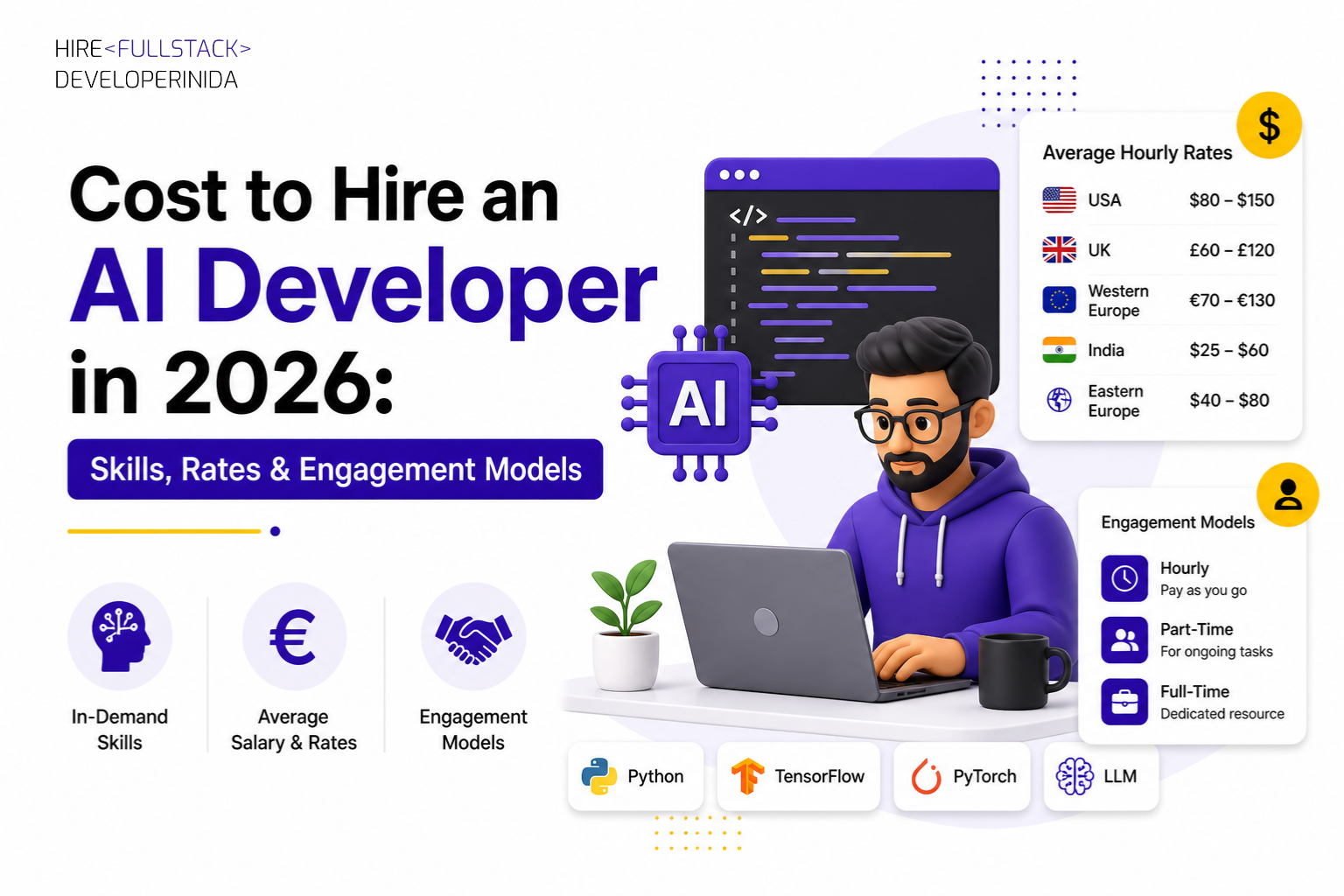

Let's be honest. If you run a food delivery business and someone told you to add AI to your platform, your first question was probably: how much is this going to cost me?
That is a completely fair question. And the problem is, most answers you find online are either outdated, too vague, or just plain confusing. They throw around numbers like "$50 to $500 per hour" and call it a day.
So let's actually break this down in a way that makes sense. Whether you are thinking about smarter delivery routing, AI-powered customer support chatbots, predictive demand forecasting, or a fully automated order management system, this guide will help you understand exactly what you are getting into and what it will cost you in 2026. If you have been searching for hire AI developer cost 2026 information that actually makes sense for a food delivery business, you have landed in the right place.
Stop Asking How Much. Start Asking What Kind of AI Do You Need?
Here is something most people miss when they start looking for AI developers. The title says AI developer, but two people with that exact same title can cost completely different amounts, do completely different work, and deliver completely different results.
Why? Because AI is not one thing. It is a whole family of technologies, and each type needs different skills. In the food delivery world specifically, there are four main types of AI you might want to build:
- Generative AI: Think of tools like ChatGPT. If you want a smart virtual assistant that can handle customer complaints, suggest meals based on preferences, or even auto-write promotional messages for your app, this is generative AI. It creates content, conversations, and responses.
- Predictive AI: This is the kind that looks at your past order data and tells you: "Hey, on rainy Friday nights, orders from this zone spike by 40%." It helps with demand forecasting, rider availability planning, and stock management for restaurant partners.
- Automation AI: Imagine your operations team spending hours manually assigning delivery zones, updating restaurant menus, or processing refund requests. Automation AI handles all of that without a human touching it. It connects tools, triggers workflows, and keeps things moving.
- Embedded AI: This is AI that lives quietly inside your existing app or platform, making it smarter over time. Personalized restaurant recommendations when a user opens your app, smart reorder suggestions, or dynamic pricing during peak hours, that is embedded AI in action.
The reason this matters for cost? Each type needs a different kind of developer. Someone who is great at building predictive models may have zero experience with LLM-based chatbots. Someone brilliant at automation workflows may not know how to fine-tune a recommendation engine.
So, before you even look at hourly rates, get clear on what type of AI your food delivery business actually needs.
The 2026 Cost Spectrum: From Freelancer to Full AI Team
Okay, now we can talk numbers. Before we get into numbers, understanding what shapes hire AI developer cost 2026 will save you from budgeting surprises down the road. But let's do this properly with context, because just throwing figures at you helps nobody.
- Freelancers
If you are experimenting with a small feature, like adding a basic chatbot to handle FAQs or testing a simple recommendation widget, a freelancer is often the most affordable starting point.
- Junior to mid-level freelancers: $25 to $60 per hour
- Experienced AI freelancers: $60 to $120 per hour
- Monthly cost for one freelancer working full-time: roughly $4,000 to $18,000
This works well when you have a defined, small scope. It gets risky when the scope is unclear or the project grows. - Mid-Level AI Developers
These are developers who have worked on a few real AI products, not just tutorials. They can build working models, integrate APIs, and deploy something your users can actually use.
- Hourly rate: $50 to $120
- Monthly cost: $7,000 to $18,000
For a food delivery business adding AI features to an existing app, this tier is usually the sweet spot for quality without overspending. - Senior AI Engineers
These folks have seen the full lifecycle of AI products, from building to scaling to fixing in production. They think about performance, cost efficiency, and long-term maintainability.
- Hourly rate: $120 to $250 or more
- Monthly cost: $18,000 to $40,000 or more
You will need someone at this level if you are building complex, high-stakes systems like real-time fraud detection, dynamic surge pricing algorithms, or large-scale recommendation engines.
Why Did AI Talent Get So Expensive After 2023?
When generative AI exploded into the mainstream after late 2022, demand for AI talent skyrocketed almost overnight. Every company suddenly needed AI engineers, but the supply had not caught up. Two years later in 2026, demand is still very high, and truly skilled AI engineers remain a rare commodity. That is why rates went up and have stayed up.
AI Roles Have Fragmented. You Are Probably Not Hiring Just One Person
Here is a reality check. In 2026, saying you need an AI developer is a bit like saying you need a kitchen staff for your restaurant without specifying whether you need a chef, a sous chef, a prep cook, or a dishwasher. Modern AI projects in food delivery usually need a combination of these roles:
- Machine Learning Engineer: Builds and trains the models. If you want your app to predict which restaurant a user is most likely to order from, this person creates that prediction engine.
- Data Scientist: Analyzes your delivery data, finds patterns, and tells the ML engineer what to actually build. Without clean, understood data, the best ML engineer in the world cannot help you.
- LLM Engineer: Specializes in large language models like GPT or Claude. If you want a smart conversational bot that can understand complex user requests, handle complaints naturally, or generate personalized dish descriptions, you need this person.
- MLOps Engineer: Keeps everything running in production. AI models degrade over time as user behavior changes. This person makes sure your models are retrained, monitored, and performing well on an ongoing basis.
- AI Product Engineer: Sits between the product team and the technical AI team. Translates business problems into AI solutions and makes sure what gets built actually solves the right problem.
For a medium-scale food delivery AI project, you might realistically need 2 to 4 of these roles, even if some are part-time or contracted. That significantly affects your total budget.
Table 1: AI Roles and Skills Breakdown
What Skills Actually Matter in 2026
This section matters because a lot of people get sold on buzzwords. Someone says they know AI and shows you a few ChatGPT prompts. That does not make them an AI engineer.
Core Technical Skills You Should Actually Check For
• Python: The main programming language for almost all AI development
• TensorFlow and PyTorch: The frameworks used to build and train machine learning models
• LangChain and LlamaIndex: Tools that help connect large language models to your actual data, databases, and business logic
• OpenAI, Anthropic, and open-source model APIs: Experience working with modern AI APIs
Newer Skills That Are Critical in 2026
• Production-grade prompt engineering: Not just writing clever prompts, but designing prompts that work reliably at scale for thousands of users
• RAG pipelines (Retrieval-Augmented Generation): This is how you connect an AI model to your own data, like your menu database, order history, or support tickets, without expensive fine-tuning
• Model fine-tuning: Adjusting a base AI model on your specific data to improve accuracy for your use case
• AI safety and hallucination control: Making sure your AI does not give users wrong information about delivery times, prices, or allergies, something that could seriously damage your brand
• Inference cost optimization: Running AI at scale is expensive. Engineers who know how to reduce cost per API call can save you thousands of dollars per month
Here is the honest truth: knowing how to use ChatGPT is not the same as being an AI engineer. It is like saying you can drive a car so you can build one. Ask for proof of real projects, not just familiarity with tools.
Geography Still Plays a Role, But Less Than Before
Location used to be one of the biggest cost drivers in hiring. In 2026, it is still a factor, but the rise of remote-first hiring has made the global talent market much more competitive and accessible.
Hourly Rates by Region
• United States and Canada: $100 to $250 per hour
• Western Europe: $70 to $150 per hour
• Eastern Europe: $40 to $100 per hour
• India: $25 to $80 per hour
• Southeast Asia and Latin America: $30 to $70 per hour
For food delivery businesses, working with Indian or Eastern European AI developers has become very common and often produces excellent results, especially for backend AI work like recommendation engines, data pipelines, and chatbot development.
The real shift in 2026 is this: skill matters more than location. A brilliant AI engineer from Bangalore who has built real production systems is worth more than a mediocre developer from San Francisco who has only done tutorials. The smartest companies are hiring globally based on skill, not zip codes.
Table 2: AI Developer Rates by Level and Region (2026)
Engagement Models Decoded: What Actually Works and When
This is one of the most important decisions you will make, and it goes way beyond just cost. How you engage your AI developer affects how fast you move, how much control you have, and how well the work gets done.
- Freelancers
Best for food delivery businesses that are experimenting. Want to test a simple chatbot? Build a quick demand forecasting prototype? A freelancer can get you there fast and affordably.
- Works best for: MVPs, small features, experiments
- Budget range: $3,000 to $15,000 for a defined deliverable
- Risk: Hard to manage if scope creeps or the project grows - In-House AI Hires
When AI is core to how your food delivery business competes, owning that talent makes sense. If your competitive edge is your routing algorithm or your recommendation engine, you want those engineers on your team full-time.
- Works best for: Long-term product building, proprietary systems
- Budget range: $80,000 to $300,000 per year depending on role and location
- Risk: Slower to hire, requires management bandwidth - AI Agencies
Agencies bring a full team with defined processes. They cost more per hour, but they move fast and come with project management built in. Great for food delivery companies that need results quickly without hiring a whole team.
- Works best for: Faster execution with less management overhead
- Budget range: $25,000 to $150,000 per project
- Risk: Less control, higher cost - Dedicated AI Teams
This is like having your own AI team but without the overhead of employment. You get a fixed group of engineers who work exclusively on your project, often managed by the agency or outsourcing partner.
- Works best for: Scaling phase when you need output volume and consistency
- Budget range: $15,000 to $50,000 per month
- Risk: Requires clear communication and strong internal product leadership
A simple decision framework: If the budget is tight and speed is flexible, go freelancer. If speed matters most and budget is available, go to an agency. If you are building something strategic long-term, invest in in-house or dedicated teams.
Table 3: Engagement Models Compared
The Hidden Costs Nobody Tells You About
This is the part that surprises most food delivery business owners. You think you are budgeting for developer cost, but the developer is actually just a fraction of what you will spend.
- Data Collection and Cleaning
Your AI is only as good as your data. If your order history is messy, incomplete, or inconsistently formatted, a data scientist will spend weeks just cleaning it before anyone can build anything. Budget $5,000 to $20,000 just for data preparation on a mid-size project. - Model Training and Compute Costs
Training AI models requires significant computing power, especially for anything custom. Cloud computing costs during training can range from a few hundred dollars for small models to tens of thousands for larger, custom-trained systems. - Cloud Infrastructure
Running AI in production on platforms like AWS, Azure, or Google Cloud is an ongoing cost. A recommendation engine processing real-time requests for a food delivery app can easily cost $500 to $5,000 per month in infrastructure depending on scale. - API Usage Costs
If your AI product relies on calling OpenAI or Anthropic APIs, those costs add up fast at scale. A customer support chatbot handling 50,000 messages per month could cost $500 to $2,000 per month just in API calls. - Ongoing Monitoring and Retraining
AI models drift over time. User behavior changes, new restaurants join your platform, seasonal trends shift. You will need to budget for regular model evaluation and retraining. This is often an ongoing $2,000 to $8,000 per month cost that people completely forget when planning their budget.
Here is the key insight: in most AI projects, the developer cost is only 40 to 60 percent of the total cost. When you are planning your budget, always multiply your developer cost estimate by 1.5 to 2x to get closer to your real total.
How Generative AI Changed Hiring Forever Between 2023 and 2026
The AI hiring market in 2026 looks very different from what it was in 2022. The rise of generative AI triggered a massive shift in how companies think about AI talent, including food delivery companies.
Before generative AI, most AI projects required deep specialization. You needed someone who had spent years on a very specific type of model. Now, with powerful pre-trained models available via API, a skilled generalist with good product thinking and fast experimentation skills can often deliver more business value than a narrow specialist.
Companies in the food delivery space are now hiring for three qualities above all others: the ability to clearly define problems, strong product instinct for what will actually improve the user experience, and the ability to prototype fast and test ideas quickly before investing in full builds.
This shift has also made hiring cycles shorter. You no longer need to wait six months to find a perfect deep learning specialist. A strong AI generalist who can integrate LLMs, build pipelines, and ship working products in weeks is often the better hire for most food delivery businesses in 2026.
Build vs Hire vs Outsource: The 2026 Decision Matrix
One of the most practical things you can do before spending anything is to decide which path actually makes sense for your situation.
When to Hire Full-Time
• AI is a core competitive differentiator for your platform
• You are building proprietary systems you do not want external parties to access
• You have consistent, long-term AI work for 12 months or more
• You can afford the time to recruit, which often takes 3 to 6 months for senior AI roles
When to Work with Freelancers
• You are validating an AI idea before committing to a full build
• You have a clearly defined, small-to-medium scope project
• You need speed over long-term continuity
• Budget is limited and you need to start small
When to Partner with an AI Agency
• You need a complete team delivered quickly
• Your internal team does not have AI expertise to manage freelancers effectively
• You are a startup or enterprise that needs an AI feature shipped in 3 to 6 months
• You are willing to pay a premium for less management overhead
Real scenarios in food delivery: A startup validating whether an AI chatbot reduces support tickets should start with a freelancer. A growing platform adding personalized restaurant recommendations to their app might work well with an agency. An enterprise delivery company building a proprietary routing and demand prediction system should invest in in-house talent.
Timeline vs Cost: Why Faster AI Development Costs More
Speed is expensive in AI development, even more so than in traditional software. This is something food delivery businesses need to understand clearly, because when you are racing to launch before a competitor, you might be tempted to push for faster delivery without realizing what that costs.
A rapid prototype of an AI feature might take 4 to 8 weeks and cost $15,000 to $40,000. A production-ready version of that same feature, one that is reliable, scalable, and properly tested, might take 3 to 6 months and cost $60,000 to $150,000. The jump in cost and time comes from the work that users never see: handling edge cases, testing for accuracy, ensuring the model does not make embarrassing mistakes at scale, setting up proper monitoring, and building infrastructure that does not fall over when order volumes spike.
In food delivery specifically, this trade-off is serious. A recommendation engine that works great 90 percent of the time but suggests a closed restaurant or a dish that a user is allergic to the other 10 percent can actually cause real harm. Moving fast is fine for prototypes, but production AI in a consumer-facing product needs to be built responsibly.
Cost Optimization Strategies That Actually Work in 2026
You do not have to spend hundreds of thousands of dollars to get meaningful AI into your food delivery platform. Here are strategies that genuinely work.
• Use pre-trained models instead of building from scratch: OpenAI, Anthropic, Google, and open-source alternatives like Meta Llama have incredibly powerful base models. Building on top of them is almost always faster and cheaper than training from zero.
• Start with APIs before custom models: Before investing in a custom recommendation model, test whether an off-the-shelf API can solve 80 percent of your problem. It often can, at a fraction of the cost.
• Build RAG pipelines instead of fine-tuning when possible: Retrieval-Augmented Generation lets you connect an AI model to your own data without expensive retraining. For most food delivery use cases like connecting a chatbot to your menu database or order history, RAG is faster, cheaper, and often just as good as fine-tuning.
• Hire hybrid teams with a mix of seniority levels: You do not need your entire AI team to be senior engineers. One senior AI architect guiding two or three mid-level engineers is often more cost-effective and just as productive as a team of all seniors.
• Define scope tightly before hiring: The single biggest cost driver in AI projects is scope creep. Every time the requirements change after development has started, you are essentially paying to redo work. Get ruthlessly clear on what you are building before you hire anyone.
Real World Cost Scenarios for Food Delivery Businesses
Let us make this really concrete with examples that are directly relevant to your world.
- AI Chatbot for Customer Support
You want a smart bot that handles order tracking questions, refund requests, and delivery complaints without involving a human agent for routine issues.
- Scope: Integration with OpenAI or Anthropic API, connection to your order management system, basic conversation flows
- Timeline: 6 to 12 weeks
- Estimated cost: $5,000 to $25,000 depending on complexity and who you hire
- Ongoing API costs: $300 to $1,500 per month based on message volume - AI-Powered Recommendation Engine
Your app learns what each user tends to order and serves them personalized restaurant and dish suggestions when they open the app.
- Scope: Data pipeline, collaborative filtering or LLM-based recommendation model, front-end integration
- Timeline: 3 to 5 months
- Estimated cost: $30,000 to $80,000
- Ongoing costs: $500 to $3,000 per month for infrastructure and model maintenance - Full AI Demand Forecasting and Route Optimization System
A complete system that predicts order volumes by zone and time window, automatically adjusts rider deployment, and optimizes delivery routes in real time.
- Scope: Predictive models, real-time data processing, maps integration, operational dashboards
- Timeline: 6 to 12 months
- Estimated cost: $100,000 to $300,000 and above
- Ongoing costs: $2,000 to $10,000 per month
These ranges are not meant to scare you. They are meant to help you plan realistically so you are not shocked three months into a project.
The Biggest AI Hiring Mistakes in 2026
Learning from what others have gotten wrong is just as valuable as learning what to do right.
- Hiring before defining the use case: Bringing an AI engineer on board and then figuring out what to build is one of the most expensive mistakes a business can make. Spend the time upfront to define the problem clearly.
- Overpaying for hype skills: Someone who attended an AI bootcamp and knows the buzzwords is not worth senior engineer rates. Ask for real project examples and check their actual deployments.
- Ignoring data readiness: Many food delivery companies discover their data is a mess only after hiring an expensive AI team. Audit your data before you hire. Do you have clean, labeled, accessible order history? Do you have enough of it?
- Expecting plug and play AI: AI is not software you install and forget. It needs ongoing care, monitoring, and improvement. If you treat it like a one-time purchase, you will be disappointed.
- Underestimating the total cost: As covered earlier, developer rates are just part of the picture. Missing the infrastructure, API, and maintenance costs in your budget can derail a project midway through.
The Smart Hiring Framework: Your Final Takeaway
Instead of starting with the question how much does it cost to hire AI developer 2026, start with these three steps.
Step 1. Define the problem first: What specific business problem do you want AI to solve? For your food delivery business, is it reducing support ticket volume, increasing repeat orders, improving delivery time accuracy, or reducing food waste? Get specific.
Step 2. Choose the right engagement model: Based on your timeline, budget, and how strategic this is for your business, decide whether to go with a freelancer, agency, dedicated team, or in-house hire.
Step 3. Start small, scale smart: Do not bet everything on a massive AI build in your first project. Start with a focused experiment, prove the value, then scale investment based on what works.
Here is a realistic budget summary to guide your planning:
• Experimentation and proof of concept: $3,000 to $10,000
• Working MVP with real users: $15,000 to $50,000
• Production-ready AI feature: $40,000 to $120,000
• Full scalable AI product: $75,000 to $300,000 and above
AI is not magic, and it is not cheap. But for food delivery businesses, the right AI investment made at the right time for the right problem can genuinely change your competitive position. The key is knowing what you are buying before you spend a single dollar. Now that you have a clear picture of hire AI developer cost 2026, the smartest next step is to define your use case before you start any hiring conversation.