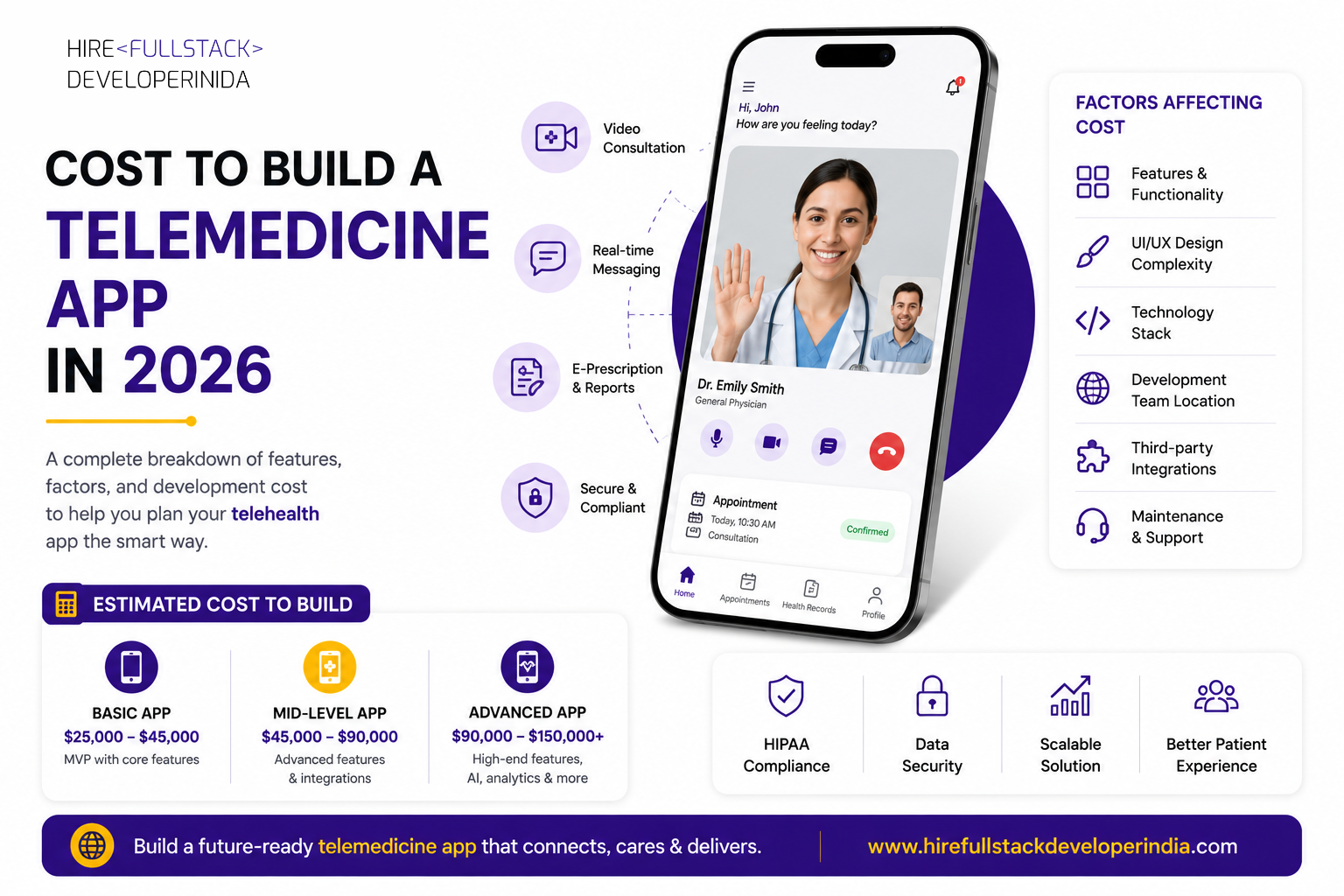

If you have been researching the cost to build a telemedicine app, you have probably noticed that most estimates online give you a number without any real context. Someone says $50,000 and another says $400,000 and you are left wondering what the difference is. The truth is, both numbers can be right. It depends entirely on what you are building, where you are building it, and what you want the app to do.
Telemedicine is no longer a backup plan for when clinics are closed. In 2026, it is a primary care channel for millions of people. Virtual consultations, remote monitoring, AI assisted diagnosis, prescription delivery, and mental health therapy are all happening through apps. Patients expect it. Insurers are covering it. Regulators are adapting to it. If you are planning to build in this space, you need a realistic picture of what it costs, why it costs that much, and where you can be smart about spending.
This guide covers everything. What a telemedicine app actually is, the sections it needs, the features that drive cost, the licenses you cannot skip, the tech stack choices, AI integration, and where your budget will realistically land depending on the type of product you want to ship.
What Is a Telemedicine App and What Does It Actually Do?
A telemedicine app is a digital platform that connects patients with healthcare providers without requiring either party to be in the same physical location. It can be a simple video call tool, a fully integrated health management system, or anything in between.
The scope of telemedicine has expanded significantly. Modern apps in 2026 are doing much more than scheduling video calls. They are managing chronic conditions, monitoring vitals through connected devices, sending prescriptions directly to pharmacies, running AI triage systems, handling insurance billing, and integrating with hospital electronic health record (EHR) systems.
Here is what a functional telemedicine app typically handles:
• Patient registration and digital onboarding with identity verification
• Appointment scheduling and calendar management for healthcare providers
• Video and audio consultations with secure, encrypted connections
• Secure messaging and file sharing between patients and doctors
• Electronic health records (EHR) storage and access
• E prescription generation and pharmacy integration
• Payment processing, insurance billing, and copay handling
• Remote patient monitoring via wearables and IoT devices
• AI powered symptom checkers and triage tools
• Notifications, reminders, and follow up tracking
Types of Telemedicine Apps and What They Cost to Build
Before talking about numbers, it helps to identify what category your product falls into. The cost to build a telemedicine app varies considerably depending on the type.
Core Sections and Modules Required in a Telemedicine App
A telemedicine app is not a single screen. It is a collection of interconnected modules, and each one contributes to the total development cost. Understanding what these modules are helps you plan your budget more accurately.
- Patient Side Module
This is the interface patients use. It includes registration, profile creation, appointment booking, consultation sessions, medical history access, prescription downloads, and payment handling. The patient module is the most visible part of the app and needs to be intuitive enough for users of all ages.
- Doctor or Provider Dashboard
Doctors need a separate, purpose built interface. This includes their calendar, patient queue, consultation room, medical note taking tools, prescription writing, and secure communication. Provider dashboards need to be fast and reliable because practitioners are using them under time pressure throughout the day.
- Admin Panel
Every telemedicine platform needs an admin backend. This is where user accounts are managed, doctors are verified and onboarded, revenue is tracked, complaints are handled, and platform settings are configured. Skipping a proper admin panel leads to operational headaches at scale.
- Consultation and Communication Module
This is the technical heart of the app. It includes the video calling infrastructure, secure chat, file sharing, and recording capabilities where permitted. This module requires integration with third party video SDKs like Twilio or Vonage, which adds licensing cost on top of development cost.
- EHR and Medical Records
Electronic health records are the backbone of any serious telemedicine platform. This module stores patient histories, lab results, imaging reports, consultation notes, and prescription records. Building a custom EHR system is expensive. Most platforms integrate with existing EHR systems like Epic or Cerner, which comes with its own integration cost.
- Payment and Billing Module
Patients pay through the app, and insurance claims need to be processed. This module handles card payments, insurance verification, copay processing, subscription plans for chronic care patients, and revenue reporting. Healthcare billing is complex because of the insurance layer, and building it properly takes significant development time.
- Notifications and Reminders
Push notifications, SMS reminders, and email alerts keep patients engaged and reduce no show rates. This module connects to notification services and handles personalized scheduling reminders, prescription refill alerts, and follow up prompts.
Key Features That Drive the Cost to Build a Telemedicine App
Features are where the budget gets spent. Here is a breakdown of the major features and what each one typically adds to your development cost.
Licensing and Compliance Costs You Cannot Skip
Telemedicine is one of the most regulated industries in software. Getting the licenses and compliance certifications wrong does not just cost money later. It can shut your product down entirely. This is an area where many founders underestimate cost at the planning stage.
- HIPAA Compliance (United States)
If you are building for the US market, your app must comply with the Health Insurance Portability and Accountability Act. HIPAA governs how patient data is stored, transmitted, and accessed. Achieving HIPAA compliance requires encrypted data storage, audit logs, role based access controls, business associate agreements with all vendors, and regular security audits. Budgeting for HIPAA compliance, including legal review and security assessment, typically adds $15,000 to $50,000 to your initial build cost, depending on your architecture.
- GDPR and Regional Data Privacy Laws
If you are operating in Europe or serving European patients, GDPR applies. Similar frameworks apply in Canada (PIPEDA), Australia (Privacy Act), and other jurisdictions. Building data privacy compliance into the app from the start is far less expensive than retrofitting it later.
- Medical Device Regulation
If your app includes any feature that qualifies as a medical device, such as diagnostic tools or monitoring systems that influence clinical decisions, you may need FDA clearance in the US or CE marking in Europe. This process can take 6 to 18 months and cost anywhere from $30,000 to $300,000 depending on the device classification.
- Telemedicine Prescribing Licenses
If your platform allows doctors to prescribe medication, the prescribing doctors need valid licenses in every state or country where they practice. Some platforms handle this by partnering with networks of licensed physicians. Others build licensing management directly into their onboarding system for providers.
- Third Party Compliance Certifications
Many enterprise healthcare clients require SOC 2 Type II certification before they will consider integrating with a new telemedicine vendor. Achieving SOC 2 certification involves a formal audit and can cost $20,000 to $60,000 the first time, plus ongoing annual audit costs.
Tech Stack Choices and Their Cost Impact
The technology decisions you make early in the project shape both your upfront build cost and your long term operating cost. Here is what the choices look like.
- Frontend and Mobile Development
You have two main paths. Native development means building separate iOS and Android apps using Swift and Kotlin respectively. This gives you the best performance and access to device hardware but costs more because you are maintaining two codebases. Cross platform development using Flutter or React Native gives you one codebase that runs on both platforms, reducing development time and cost by roughly 30 to 40 percent, with some tradeoffs in performance for complex features.
- Backend Development
The backend is where patient data lives, business logic runs, and integrations connect. Node.js, Python (Django or FastAPI), and Java are common choices for healthcare backends. Python is particularly popular in healthcare applications because of its strong ecosystem for data processing and AI integration. A well architected microservices backend for a telemedicine platform costs more to build initially but scales far better than a monolithic architecture.
- Database
Healthcare data needs both relational and non relational storage. PostgreSQL is widely used for structured patient records and transactional data. MongoDB or similar databases handle unstructured data like imaging reports. Redis is often added for caching and real time session management during consultations.
- Video Infrastructure
Building your own video calling infrastructure from scratch is expensive and risky. Most telemedicine platforms use third party video SDKs. Twilio, Daily.co, Vonage, and Zoom SDK are the leading options. These come with per minute or per participant pricing that becomes a significant operating cost at scale. For a platform running 10,000 consultation minutes per day, video infrastructure costs alone can run $3,000 to $8,000 per month.
- Cloud Hosting
AWS and Google Cloud are the preferred hosting environments for healthcare applications because both offer HIPAA eligible services with business associate agreements. Microsoft Azure is also widely used, particularly by organizations that already use Microsoft services. Hosting costs for a mid range telemedicine platform typically run $2,000 to $8,000 per month depending on traffic and data storage requirements.
AI Integration in Telemedicine Apps and What It Costs
Artificial intelligence is no longer optional in competitive telemedicine platforms. In 2026, AI has moved from a marketing differentiator to a functional necessity. Here is where AI is being built into telemedicine apps and what each capability costs to develop.
- AI Symptom Checker and Triage
An AI symptom checker asks patients a series of questions about their symptoms and uses a trained model to suggest possible conditions and recommend appropriate care levels. This ranges from basic rule based systems at the low end to genuinely intelligent triage tools trained on clinical data at the high end. A production ready AI symptom checker built on a solid clinical dataset costs $25,000 to $60,000 to develop, not including the ongoing cost of model maintenance and updates.
- Natural Language Processing for Medical Notes
AI powered transcription and summarization tools can listen to a consultation and automatically generate structured clinical notes. This saves doctors significant time and reduces documentation errors. Building this capability requires integration with medical grade NLP models. Development cost ranges from $20,000 to $50,000, depending on the level of customization and the language models you build on.
- Predictive Analytics for Chronic Care
Platforms serving patients with chronic conditions like diabetes, hypertension, or heart disease are integrating predictive models that flag patients at risk of deterioration before a crisis occurs. These systems process data from wearables, lab results, and consultation history to generate risk scores. Building meaningful predictive analytics requires clean training data, data science expertise, and infrastructure for model serving. Budget $40,000 to $100,000 for a first version of a predictive analytics module.
- AI Driven Appointment Matching
Smart scheduling systems that match patients to the right specialist based on their symptoms, location, language preference, and insurance network use recommendation algorithms under the hood. This feature reduces patient drop-off and improves outcome quality. Development cost for intelligent appointment matching runs $15,000 to $35,000.
- AI Chatbot for Patient Support
A 24/7 AI chatbot handles appointment booking, prescription refill requests, test result queries, and general health questions outside consultation hours. In 2026, most of these are built on large language model APIs with healthcare specific fine tuning. Integration and customization cost ranges from $10,000 to $30,000.
Development Team Structure and Hourly Rate Impact
Who builds your app has as much impact on cost as what you are building. Development rates vary enormously by geography, and the team structure you choose affects both speed and budget.
A typical mid range telemedicine app requires the following team over a 6 to 12-month build cycle:
• 1 to 2 Backend Developers
• 2 Frontend and Mobile Developers
• 1 UI and UX Designer
• 1 QA Engineer
• 1 Project Manager or Product Owner
• 1 DevOps Engineer
• 1 Security and Compliance Specialist (part time)
If you add AI development, you will also need at least one data scientist or ML engineer, either full time or as a specialist contractor.
Third Party Integrations and What They Add to Your Budget
Telemedicine apps do not operate in isolation. They connect to external services, and each integration adds development time and ongoing subscription cost.
These operational costs compound quickly. A telemedicine platform processing a meaningful volume of consultations can easily spend $15,000 to $40,000 per month on third party services before accounting for hosting.
Full Cost Breakdown by Development Phase
Here is how the cost to build a telemedicine app distributes across the development lifecycle:
Ongoing Operational Costs After Launch
The development cost is a one time investment. The operational costs are forever. Many founders focus entirely on what it costs to build and then get surprised by what it costs to run. Here is what you should budget for on a monthly basis once your telemedicine app is live.
• Cloud hosting and server costs: $2,000 to $10,000 per month
• Video infrastructure (per minute billing): $500 to $8,000 per month
• EHR and integration licensing: $2,000 to $20,000 per month
• Security monitoring and penetration testing: $1,000 to $4,000 per month
• Customer support tooling: $500 to $3,000 per month
• HIPAA compliance monitoring tools: $500 to $2,000 per month
• App store fees (Apple and Google): $99 to $299 per year
• Bug fixes and minor updates: $3,000 to $8,000 per month in dedicated development
Factors That Can Reduce Your Build Cost
Building smart matters as much as building well. There are a few approaches that can meaningfully reduce the cost to build a telemedicine app without compromising quality.
• Start with a minimum viable product focused on core consultation and scheduling features, then add complexity in subsequent releases
• Use cross platform frameworks like Flutter to avoid building two separate native apps
• Leverage pre built HIPAA compliant video and messaging platforms rather than building communication infrastructure from scratch
• Use existing EHR platforms via API rather than building custom health records storage
• Partner with a healthcare focused development company that already has reusable telemedicine modules, which can cut initial development time by 20 to 35 percent
• Consider white label telemedicine platforms if you are launching quickly and want to test the market before committing to a full custom build
Choosing the Right Development Partner
The difference between a telemedicine project that succeeds and one that stalls at launch almost always comes down to the development partner. Healthcare software has a specific compliance burden that general purpose agencies are not equipped to handle. You need a partner that has delivered HIPAA compliant applications before, understands HL7 and FHIR data standards for health records, has experience integrating with EHR systems, and can provide references from healthcare clients.
Beyond technical capability, communication matters a great deal. A telemedicine build is a 9 to 18-month relationship for a serious product. You want a partner who asks hard questions during scoping, surfaces risks early, and does not underquote to win the project and then overcharge to finish it.
Conclusion
The cost to build a telemedicine app in 2026 sits in a wide range because telemedicine is not one product. It is a category that spans from a simple video consultation tool to a fully integrated clinical platform with AI driven triage, remote monitoring, insurance billing, and multi specialty care management. The gap between a $40,000 build and a $400,000 build is real, and it comes down to scope, compliance requirements, AI capabilities, integration complexity, and where your development team is located.
What matters more than the exact number is building the right thing at the right stage. A well scoped MVP with a clear path to adding features beats an overengineered first version that runs out of budget before launch. Map your features to your market, get the compliance architecture right from day one, and choose a development partner who has delivered in healthcare before.
The demand for telemedicine is not slowing down. Patients are not going back to waiting rooms for every consultation, and providers have recognized that digital channels extend their reach without proportionally increasing their overhead. Getting into this market in 2026 with a quality product built on a realistic budget is a legitimate business decision. The numbers in this guide are here to help you make that decision with clarity.