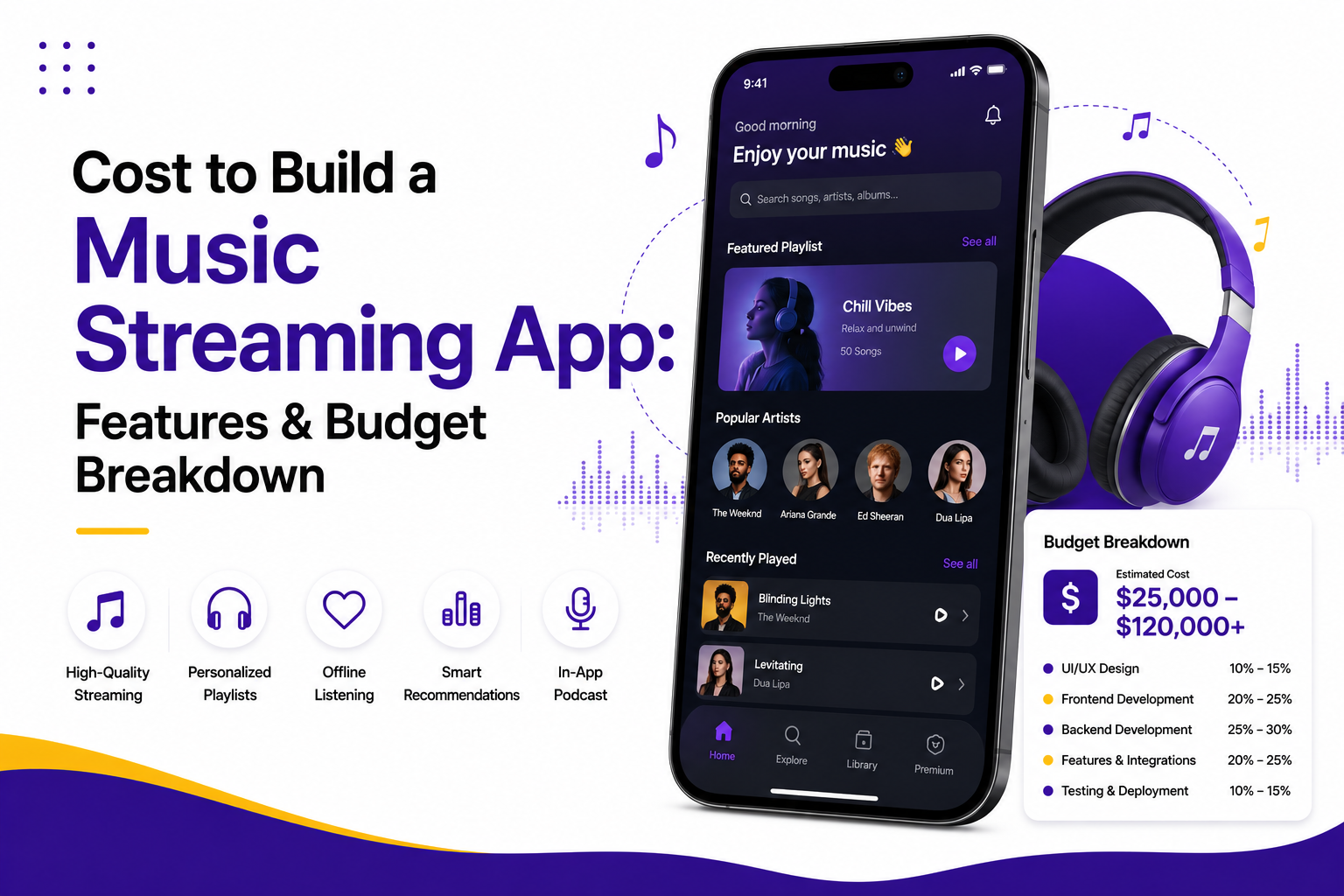

Every founder who has ever hummed along to a playlist while stuck in traffic has probably had the same passing thought. What if I built something like this myself? The idea sounds simple until you sit down with a developer and start asking about servers, licensing, and audio compression. Suddenly the conversation shifts from music to money, and that is exactly where this guide picks up.
If you are reading this, you are probably not looking for a sales pitch. You want real numbers, honest ranges, and a clear picture of what actually drives the cost to build a music streaming app in 2026. So instead of vague promises, we are going to walk through every cost driver, every feature decision, and every hidden expense that shapes a final invoice. By the end, you will know exactly what questions to ask any music streaming app development company you talk to next.
What Is a Music Streaming App?
A music streaming app is a platform that lets users listen to songs, podcasts, or audio content instantly over the internet, without needing to download every file first. Instead of buying an album and storing it on a device, users simply tap play and the app streams the audio in real time from a remote server.
Behind the simple play button sits a fairly complex system. The app pulls audio files from cloud storage, compresses them for fast delivery, and uses a content delivery network to reduce buffering. Recommendation engines study listening habits and suggest new tracks, while licensing systems make sure artists and labels get paid for every play.
Spotify, Apple Music, YouTube Music, Amazon Music, and SoundCloud are the names most people recognize, and each one has carved out a slightly different niche. Spotify leans on personalization, Apple Music focuses on catalog depth and integration with its hardware, and SoundCloud built its identity around independent artists and unreleased tracks. Understanding these differences matters because it shapes how much you will eventually spend on your own platform.
Why Build a Music Streaming App in 2026?
The global appetite for audio content keeps growing, and it is not limited to mainstream music anymore. Podcasts, regional language tracks, indie artists, and niche genres are all finding dedicated audiences who feel underserved by the big platforms. That gap is exactly where new founders find their opening.
From a business standpoint, streaming apps generate revenue through several channels at once, including subscriptions, advertising, and premium features, which makes the model attractive to investors. A well built platform also creates a direct relationship with listeners, something record labels and radio stations never fully achieved.
Growth potential is another reason founders keep entering this space. Emerging markets in Southeast Asia, Africa, and Latin America are still relatively underserved by global players, and a platform tailored to local languages, payment methods, and music tastes can grow quickly. None of this changes the fact that you need a realistic budget before writing a single line of code, which is why understanding music app development cost early on saves founders from painful surprises later.
There is also a strategic angle worth considering. Owning your own platform means owning the relationship with your listeners and the data that comes with it, rather than renting an audience through someone else's app. That kind of long term control is often what convinces founders to commit to the upfront investment in the first place, even when a cheaper shortcut might look tempting at first glance.
Types of Music Streaming Apps
Not every streaming app is built the same way, and the type you choose has a direct effect on your final budget.
- On demand streaming apps let users pick any song or album and play it whenever they want, similar to Spotify or Apple Music. These require large catalogs and strong licensing agreements.
- Internet radio apps stream curated or algorithm driven channels where users cannot choose the exact song, similar to traditional radio but delivered online.
- Podcast platforms focus on spoken word content, episodic structure, and features like show subscriptions and episode downloads.
- Audio sharing apps let independent creators upload their own tracks or voice notes, building a community around user generated audio.
- Hybrid platforms combine two or more of the above, offering music, podcasts, and live audio in a single app, which naturally increases development complexity and cost.
Before you approach a developer, it genuinely helps to decide which of these categories your idea fits into. A simple on demand player will always cost less than a hybrid platform that also supports podcasts, live radio, and creator uploads. Being clear about this from day one prevents the scope from quietly expanding halfway through the project, which is one of the most common reasons budgets run over in the first place.
Essential Features Every Music Streaming App Needs
Every feature you add has a direct line item attached to it, so it helps to know what each one actually does before your development team starts building.
- User registration and login: including email, phone number, and social login options for a smoother signup experience.
- Music library management: a searchable, well organized catalog that can handle millions of tracks without slowing down.
- Search and filters: so users can find songs by artist, genre, mood, or even lyrics within seconds.
- Playlist creation: allowing users to build, edit, and share their own playlists with friends or followers.
- Recommendation engine: which studies listening patterns and suggests new tracks the user is likely to enjoy.
- Offline downloads: so subscribers can save songs locally and listen without an active internet connection.
- Audio player controls: covering play, pause, skip, shuffle, repeat, and variable playback speed.
- Subscription management: handling free trials, premium tiers, renewals, and cancellations smoothly.
- Push notifications: for new releases, playlist updates, and personalized listening reminders.
- Social sharing: letting users post what they are listening to on other platforms or within the app itself.
- Ratings and reviews: so the community can flag quality issues or highlight tracks worth hearing.
None of these features exist in isolation. A recommendation engine only works well if your search and library management are solid, and offline downloads only feel useful if your subscription management is handled correctly behind the scenes. This is why experienced teams map out feature dependencies early, rather than pricing each one as a standalone item.
Admin Panel, User Panel, and Artist Panel
Admin Panel
The admin panel is the control room of the entire platform, and while users never see it, the business cannot function without it.
- Content upload and moderation tools
- User account management and support ticket handlin
- Revenue and subscription analytics dashboards
- Licensing and royalty tracking
- Push notification and campaign scheduling
User Panel
This is the side of the app your listeners interact with every day, and it needs to feel effortless.
- Personal profile and listening history
- Playlist and library management
- Subscription and billing settings
- Offline downloads and device management
Artist or Creator Panel
If your platform supports independent artists or podcasters, a dedicated dashboard becomes essential.
- Track and episode upload tools
- Performance analytics, including plays, listener location, and engagement
- Payout and royalty statements
- Direct fan interaction and comment moderation
Detailed Cost Breakdown by Development Stage
This is usually the part founders care about the most, so let us break the music streaming app development cost down stage by stage. These figures are approximate estimates in USD, and actual pricing will vary based on your specific requirements, chosen tech stack, and the development partner you hire.
Add these stages together and a mid range project typically lands between $35,000 and $120,000, though highly complex platforms with advanced AI or global licensing can go well beyond that. This range is precisely why so many founders ask how much does it cost to build a music streaming app before committing to a full scope document, and it is a fair question to raise with any vendor you shortlist.
Feature Wise Development Cost
Not all features carry the same price tag. Here is a rough sense of how individual features contribute to your overall budget.
Third Party Services and Recurring Costs
Beyond the core build, several ongoing services keep your app running smoothly, and these often surprise first time founders because they continue long after launch.
None of these numbers are fixed, and they scale directly with your user base, so a platform with a hundred thousand active listeners will pay considerably more than one with a few thousand.
Factors That Affect Music Streaming App Development Cost
Once you understand the base numbers, it helps to know why two apps that sound similar can end up with wildly different price tags. The following factors have the biggest influence on music streaming app development cost.
- App complexity: a simple audio player costs far less than a platform with live streaming, social features, and offline sync.
- Number of features: every additional feature adds design, development, and testing hours.
- Platform choice: building for Android, iOS, and web simultaneously costs more than launching on a single platform first.
- Native versus cross platform development: native apps perform better but require separate codebases, while cross platform frameworks save money at a small performance trade off.
- Custom UI/UX: a fully custom design with animations and branding costs more than using pre built templates.
- Scalability requirements: architecture built to handle millions of users from day one costs more upfront but avoids expensive rebuilds later.
- Security requirements: encryption, secure payment handling, and fraud prevention all add development time.
- Third party integrations: each licensing API, payment gateway, or analytics tool adds both setup cost and ongoing fees.
- Streaming quality: high fidelity audio streaming demands more bandwidth and smarter compression, which increases both development and hosting costs.
- AI implementation: personalization and smart recommendations require data science expertise that adds to the overall budget.
AI Powered Features and Their Impact on Cost
Artificial intelligence is no longer a luxury add on for music apps. It has become the feature that keeps users coming back, and it directly shapes the final music app development cost.
- Personalized recommendations: using listening history to suggest songs a user is likely to enjoy.
- Smart playlists: automatically generated playlists based on mood, activity, or time of day.
- Voice search: letting users find songs by simply speaking instead of typing.
- AI chatbot support: handling common customer queries without human intervention.
- Mood based suggestions: analyzing tone and tempo to match music with how the listener is feeling.
- Predictive analytics: helping the business forecast churn, popular genres, and peak usage times.
- Content moderation: automatically flagging copyrighted or inappropriate uploads on user generated platforms.
- AI generated playlists: creating entirely new playlist concepts based on trending patterns across the platform.
Adding a solid AI recommendation engine alone can increase the budget by $5,000 to $20,000, depending on how sophisticated the model needs to be, but most founders find the return on user retention makes it worthwhile.
Monetization Strategies for Music Streaming Apps
A streaming app is only as valuable as the revenue model behind it, and most successful platforms combine more than one approach.
- Subscription plans: recurring monthly or annual fees for ad free, premium access.
- Advertisements: audio or banner ads shown to free tier users between tracks.
- Premium memberships: tiered plans offering higher audio quality, offline downloads, or exclusive content.
- In app purchases: one time purchases like exclusive albums or early access releases.
- Sponsored content: brands paying to feature curated playlists or promoted artists.
- Affiliate partnerships: earning commission by linking to concert tickets or merchandise.
- Merchandise sales: letting artists sell branded merchandise directly through the app.
- Live events: ticketed virtual concerts or listening parties hosted within the platform.
Most platforms do not rely on a single revenue stream for very long. Spotify, for instance, built its early growth on a free ad supported tier before premium subscriptions became the dominant source of revenue. Planning for this kind of shift from the beginning, even if you launch with just one model, makes it far easier to add new monetization layers later without redesigning your entire billing system.
Development Phases Explained
- Discovery: understanding your business goals, target audience, and competitors before any design work begins.
- Planning: defining the technical roadmap, timeline, and resource allocation.
- Design: creating wireframes and polished visual designs that match your brand.
- Development: building the actual frontend, backend, and database layers.
- Testing: checking for bugs, performance issues, and security gaps across devices.
- Deployment: publishing the app to app stores and setting up production servers.
- Post launch maintenance: ongoing updates, bug fixes, and feature additions based on user feedback.
Development Team Composition
Behind every polished app is a team of specialists, and knowing their roles helps you understand where your budget actually goes.
Building In House Versus Hiring a Development Company
Once you understand the roles involved, the next decision is whether to hire each specialist individually or work with an established music streaming app development company that already has a team in place. Building an in house team gives you direct control over daily priorities, but it also means covering salaries, benefits, office space, and recruitment time, all before a single feature ships.
Working with an outside development partner usually works out cheaper in the early stages, because you are paying for output rather than maintaining a full time payroll. A seasoned music streaming app development company also brings pre-built components, prior experience with music licensing integrations, and a faster path through common technical roadblocks that a brand new in house team would need to solve from scratch.
The right choice really depends on your long term plans. Founders who intend to keep evolving the product for years often start with an outsourced team and gradually bring key roles in house once the platform has proven itself in the market.
Development Cost by Geographic Location
Where your development team is based has a significant effect on your final invoice, sometimes more than the features themselves.
This is exactly why many founders based in the US, UK, or Australia partner with an experienced music streaming app development company in India or Eastern Europe, since it lowers the overall cost to build a music streaming app without compromising on quality, as long as communication and project management are handled well.
Licensing and Legal Costs
Music licensing is one of the most misunderstood expenses in this entire process, and skipping it is simply not an option.
- Music licensing agreements: negotiated with record labels, distributors, or performance rights organizations, often running into thousands of dollars depending on catalog size.
- Copyright compliance: ensuring every track uploaded or streamed has proper permissions.
- Privacy law compliance: covering how user data is stored, processed, and shared.
- Terms and conditions drafting: legal documentation protecting both the business and its users.
- App store and Google Play fees: typically a one time developer account fee plus a percentage cut of in app purchases.
- GDPR and regional compliance: additional legal review needed if you plan to operate in Europe or other regulated markets.
Competitor Comparison: Spotify, Apple Music, YouTube Music, Amazon Music, and SoundCloud
Studying established players helps you decide where your own platform can carve out an advantage.
Additional Features to Help You Stand Out
If you want your platform to feel different from the giants, a few thoughtful additions can go a long way.
- Collaborative playlists: letting multiple users add and edit songs on the same playlist in real time.
- Lyrics synced playback: showing scrolling lyrics that match the exact moment in the song.
- Mood based discovery: letting users browse music by feeling rather than genre alone.
- Creator monetization dashboard: giving independent artists clear, transparent payout tracking.
- Local language and regional content hubs: surfacing music that mainstream platforms often overlook.
Hidden Costs Founders Often Overlook
Budgets rarely blow up because of the features everyone planned for. They blow up because of the ones nobody expected.
- Scope changes: adding features mid project almost always costs more than planning for them from the start
- Server upgrades: as your user base grows, your hosting plan needs to grow with it.
- Third party API price changes: licensing or analytics providers can revise their pricing at any time.
- Ongoing maintenance: operating systems and devices update constantly, and your app needs to keep up.
- Security updates: new vulnerabilities are discovered regularly, and patching them is not optional.
- Feature enhancements: user feedback after launch often points to features you had not originally planned.
- Customer support costs: as your user base grows, so does the volume of support tickets.
- Marketing expenses: a great app with no marketing budget rarely finds its audience.
- Legal expenses: licensing renewals and compliance reviews are recurring, not one time costs.
A good rule of thumb is to set aside an additional 15 to 20 percent of your total budget purely as a buffer for these kinds of surprises. Founders who skip this step often find themselves negotiating rushed, expensive fixes later, simply because there was no room left in the plan to absorb anything unplanned.
How to Reduce Music Streaming App Development Costs
- Start with a minimum viable product instead of building every feature on day one.
- Choose cross platform development if native performance is not a strict requirement.
- Partner with an experienced music streaming app development company that already has reusable components, since this reduces build time significantly.
- Negotiate music licensing deals early, before your user base grows and your leverage shrinks.
- Use cloud hosting plans that scale with usage instead of paying for capacity you do not need yet.
- Prioritize core features first and add AI powered personalization once you have real user data to work with.
Final Thoughts
There is no single number that answers the question everyone eventually asks, which is how much does it cost to build a music streaming app. The honest answer depends on your feature list, your target platforms, your chosen tech partner, and how quickly you want to scale. What we can tell you with confidence is that founders who plan their budget stage by stage, account for hidden costs, and choose the right music streaming app development company almost always end up building something they are proud of, without the mid project panic that comes from underestimating the numbers.
If you are still comparing quotes and trying to make sense of wildly different estimates, that is a normal part of the process. Use the ranges in this guide as your starting point, ask detailed questions about what each quote actually includes, and remember that the cheapest option rarely turns out to be the most cost effective one in the long run.