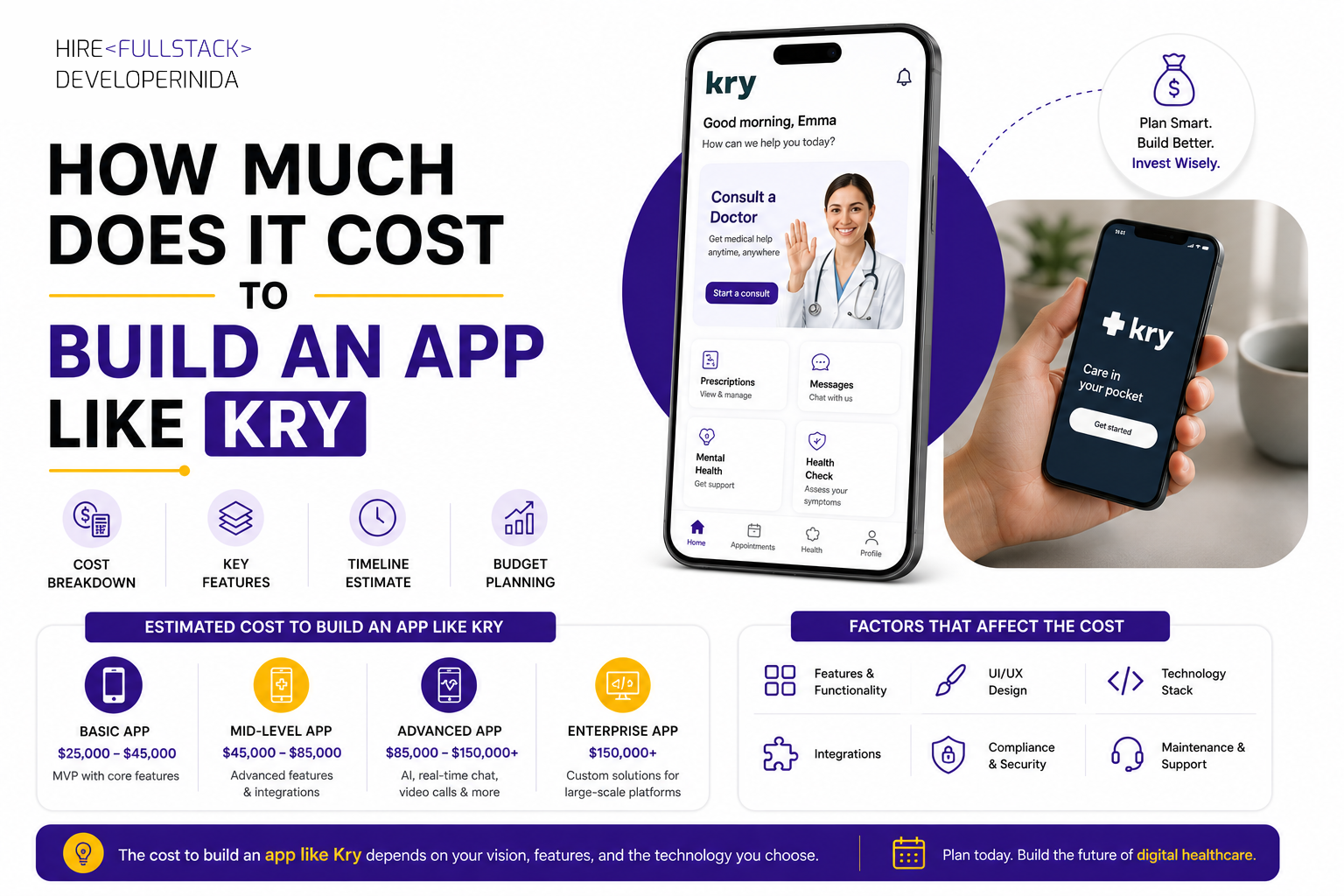

Healthcare is one of the last industries to go fully digital. But apps like Kry are changing that fast. Kry is a Swedish digital health platform that lets patients book video consultations with licensed doctors, get prescriptions, access mental health support, and manage their health records, all from a smartphone. No waiting rooms. No appointment queues that stretch three weeks out. Just open the app and see a doctor.
The platform launched in Sweden in 2015 and has since expanded across Europe. By 2026, Kry operates in Sweden, Norway, Germany, France, and the United Kingdom, handling millions of consultations and serving both individual patients and enterprise clients through its B2B arm. Its success pushed investors to back it with over $500 million in funding, placing it firmly among Europe's top digital health unicorns.
If you are a founder or product decision-maker exploring the cost to build an app like Kry, this guide gives you what you actually need to know. Not vague estimates. Not filler content about how telehealth is growing. Real numbers, real cost drivers, and an honest look at what it takes to bring a medical app like this to market in 2026.
What Is Kry and What Does It Actually Do?
Kry is a telemedicine platform built for the European healthcare market. At its core, it connects patients with qualified healthcare professionals through video calls, making the process as simple as ordering food online. But underneath that simple interface is a fairly complex healthcare system.
The app handles appointment scheduling, real-time video consultations, digital prescriptions sent directly to pharmacies, sick leave certificates issued on the spot, and follow-up care coordination. For mental health, Kry offers therapy sessions with licensed psychologists and counselors. It also integrates with national health systems in its operating markets, which means doctors on the platform work within the local regulatory framework rather than outside it.
What makes Kry particularly interesting for founders and product teams is how it balances two very different demands. On one side, it has to be dead simple for patients, most of whom just want a quick consultation without friction. On the other side, it has to be medically rigorous, secure, and compliant with healthcare data laws across multiple European jurisdictions. Getting that balance right is where most of the development cost, effort, and time actually goes.
Core Features Required to Build an App Like Kry
Before looking at costs, you need to understand what you are actually building. A telemedicine app like Kry is not a single product. It is a platform that serves at least three distinct user types: patients, healthcare providers, and administrative staff. Each group needs its own interface, and all three need to work together in real time.
Patient-Facing Features
- User registration and identity verification with medical-grade authentication
- Symptom checker and triage module to help patients identify urgency level
- Doctor search with filters for specialty, language, availability, and ratings
- Appointment booking with calendar sync and automated reminders
- High-definition, low-latency video consultation with secure end-to-end encryption
- In-app messaging and chat for pre-consultation and follow-up communication
- Digital prescription generation and direct pharmacy integration
- Sick leave and referral certificate issuance
- Personal health record access and consultation history
- Payment processing with insurance claim support
- Push notifications and health reminders
Doctor and Provider-Facing Features
- Secure provider onboarding with license verification and credential management
- Patient queue management and consultation scheduling dashboard
- Electronic health record (EHR) access and note-taking during consultations
- Prescription writing tools with medication database integration
- Consultation summary generation with AI-assisted clinical note drafting
- Earnings tracker and payout management
- Continuing medical education and compliance tracking
Admin and Platform Features
- CMS for managing content, providers, and regionn
- Analytics dashboard for consultation volumes, wait times, and revenue metrics
- Compliance management for GDPR, medical licensing, and regional health regulations
- Fraud and abuse detection engine
- Multi-language and multi-currency support for international markets
- Third-party integrations with pharmacy networks, insurance providers, and national health system.
Sections and Modules You Need to Build
An app like Kry is typically broken into six primary product modules, each of which requires separate scoping and development effort.
Each of these modules needs to be individually tested, security-audited, and integrated. The complexity multiplies when you add multi-market support, because regulatory requirements, payment systems, and health record standards vary by country.
What Licensing and Compliance Do You Need?
This is where most founders get a nasty surprise. Building the app is one challenge. Getting it legally cleared to operate as a healthcare platform is an entirely separate one. Regulatory compliance is not optional and it is not cheap.
Healthcare Regulatory Licenses
- Medical device software classification: In the EU, a telemedicine app that aids in clinical decision-making may be classified as a Class IIa or Class IIb medical device under MDR 2017/745. This requires conformity assessment, clinical evaluation, and CE marking.
- Telehealth operating license: Several European countries require the platform itself to hold a healthcare facility license or registration with the national health authority before it can offer consultations.
- Pharmacy integration approval: Sending digital prescriptions directly to pharmacies requires bilateral agreements and regulatory sign-off in each country where this feature operates.
Data Protection and Privacy
- GDPR compliance (EU): All health data is special category data under GDPR, requiring explicit patient consent, data processing agreements with every third-party vendor, a Data Protection Officer appointment, and documented Data Protection Impact Assessments.
- NHS Digital Standards (UK): If you plan to operate in the United Kingdom, you will need to meet NHS Digital's Data Security and Protection Toolkit standards.
- Local health data residency rules: Some countries require patient health data to be stored within national borders, which affects your infrastructure design significantly.
Provider Credentialing Requirements
- Doctors on the platform must hold valid licenses in each country where they consult patients. Building a credential verification and license management system is not optional.
- Malpractice insurance documentation per provider per jurisdiction.
Compliance-related costs across legal counsel, certification bodies, and ongoing audits can realistically add $80,000 to $200,000+ to your project budget before you launch, depending on which markets you target first.
AI Integration in a Kry-Like App
AI is now a foundational layer in digital health platforms, not a premium add-on. By 2026, platforms that compete with Kry use AI across multiple touchpoints, and your product roadmap needs to account for this if you want to build something competitive.
- Symptom Checker and Triage Engine
This is typically the first AI feature users encounter. Patients describe their symptoms in natural language or answer structured questions, and the AI model assesses urgency, suggests the appropriate care pathway, and routes them to the right type of provider. Building this from scratch using a fine-tuned LLM on clinical data costs significantly more than licensing an existing medically validated symptom checker API. - AI-Assisted Clinical Note Drafting
During video consultations, AI transcribes the conversation and generates a draft clinical summary that the doctor can review and sign off on. This alone saves providers 5 to 10 minutes per consultation. The technology uses medical-grade speech-to-text combined with a clinical NLP layer to structure notes in the right format for EHR entry. Building this requires integration with models like Google MedPaLM 2, specialized clinical NLP APIs, or custom-trained models. - Prescription Validation AI
Before a prescription is issued, an AI layer cross-checks for drug interactions, dosage appropriateness relative to patient age and weight, and contraindications flagged in the patient's medical history. This is a safety-critical feature that requires validated clinical datasets and significant testing before deployment. - Mental Health Assessment Tools
For the mental health vertical, AI can analyze patient-reported outcome measures (PHQ-9, GAD-7 questionnaires) and flag deteriorating mental health scores across sessions, prompting care teams to intervene. This requires both the AI model and a care coordination workflow built around it. - Intelligent Scheduling and Wait Time Optimization
AI-driven scheduling systems analyze consultation demand patterns by time of day, specialty, and region, then adjust provider availability displays and booking windows dynamically to minimize patient wait times while maximizing provider utilization.
The cost to implement a full AI layer as described above ranges from $60,000 to $180,000 depending on whether you are using existing APIs and SDKs or building proprietary models. Most startups in 2026 wisely start with best-in-class third-party clinical AI APIs and build proprietary models over time as they accumulate proprietary patient data.
Technology Stack for Building a Kry-Like App
Technology stack choices have a direct impact on development speed and cost. React Native or Flutter for mobile development, for example, lets one team build for both iOS and Android rather than two separate native teams, which can reduce mobile development costs by 30 to 40 percent.
Cost to Build an App Like Kry: Full Breakdown
Here is where founders need to pay close attention. The cost to build an app like Kry is not a single number. It is the sum of many different expenditure categories, and many of them are recurring, not one-time.
1. Discovery and Product Definition
Before a single line of code is written, you need product discovery: defining user journeys, clinical workflows, feature sets per market, and the compliance architecture. This phase typically takes 6 to 10 weeks and costs $15,000 to $35,000. Skipping it is the single most common reason healthcare app projects go massively over budget.
2. UI/UX Design
Healthcare apps have to meet accessibility standards and earn patient trust through design. A dedicated UX research phase, wireframing, prototype testing, and final visual design across patient and provider interfaces typically costs $20,000 to $50,000. For a full-featured platform targeting multiple markets, budget toward the upper end.
3. Mobile App Development (iOS and Android)
With React Native or Flutter, building the patient-facing mobile app covering registration, booking, video consultations, messaging, health records, and payment takes approximately 2,000 to 3,500 development hours. At a blended hourly rate of $40 to $80 for a quality offshore team or $100 to $180 for a Western European or North American team, this comes out to:
• Offshore team (India, Eastern Europe): $80,000 to $180,000
• Mid-market team: $150,000 to $280,000
• Premium Western team: $280,000 to $500,000+
4. Web Portal for Doctors and Admin
The provider web portal and admin dashboard are equally important and often underestimated. Expect 800 to 1,500 hours of development work here, adding $35,000 to $120,000 to the project cost depending on team rates and feature complexity.
5. Backend API and Database Architecture
The backend is where the most architectural complexity lives. Building a scalable, HIPAA/GDPR-compliant API layer with proper data encryption, audit logging, role-based access control, and EHR integration hooks typically requires 1,200 to 2,000 hours. Budget $50,000 to $160,000 for this component.
6. Video Infrastructure
You are not building video technology from scratch. You will use a vendor like Twilio Video or Daily.co. Integration and customization costs run $10,000 to $25,000. After launch, video infrastructure costs shift to a usage-based model. Twilio Video, for instance, charges approximately $0.004 per participant-minute for group rooms. At scale, this becomes a meaningful line item.
7. AI Integration
As covered in the AI section above, budget $60,000 to $180,000 for initial AI feature implementation. This is a wide range because it depends heavily on whether you use pre-built clinical AI APIs (faster and cheaper to integrate) or build custom models on your own clinical data (more expensive, more differentiated).
8. Compliance and Security
Security audits, penetration testing, GDPR compliance framework setup, and preparing documentation for any medical device certification combine to cost $30,000 to $80,000 upfront. Add another $20,000 to $60,000 per year for ongoing compliance maintenance, annual security audits, and regulatory monitoring as your operating markets evolve.
9. QA Testing and Clinical Validation
Healthcare apps require more rigorous QA than consumer apps. Clinical workflow testing, edge case handling in medical scenarios, performance testing under load, and accessibility compliance testing add $25,000 to $60,000 to the project.
10. Healthcare Licensing and Legal
Legal counsel for healthcare regulations, medical device classification assessment, GDPR legal framework setup, provider agreement drafting, and licensing fees collectively run $40,000 to $150,000 before launch, depending on market scope.
11. Third-Party Integrations
Pharmacy network integrations, insurance verification APIs, national health record system connectors, and electronic prescription networks all require custom integration work. Budget $20,000 to $60,000 for initial integration development, with ongoing API licensing costs on top.
12. Post-Launch Infrastructure and Maintenance
AWS or GCP hosting for a healthcare platform with proper redundancy, EU data residency compliance, and backup systems runs $3,000 to $12,000 per month once you have active users. Add ongoing development resources for bug fixes, feature updates, and OS compatibility maintenance at $15,000 to $40,000 per month for a small dedicated team.
Pulling it all together, here is an honest total cost summary for building an MVP versus a full-featured platform:
These figures represent development costs only, using an experienced offshore or nearshore team. Building with a premium Western European or US-based agency would typically add 60 to 120 percent to these figures. Infrastructure, licensing, and ongoing operational costs are additional.
Hidden Costs Most Founders Do Not Budget For
Every experienced digital health founder will tell you the same thing: the number that surprised them most was not the development cost. It was everything else.
• Provider acquisition and credentialing operations: You need staff and systems to verify, onboard, and manage hundreds or thousands of licensed healthcare professionals. This is an operational cost that starts before launch and never stops.
• Clinical governance and medical advisory board: Running a platform where healthcare decisions are made requires medical oversight. A part-time medical director and advisory board costs $50,000 to $150,000 per year.
• Patient acquisition and marketing: Healthcare apps have unusually high customer acquisition costs because of trust barriers. Budget $100 to $300 per acquired active patient in paid channels, especially early on.
• Insurance and indemnity coverage: Platform liability insurance for medical consultations is expensive and varies by market. Expect $30,000 to $100,000 per year depending on consultation volumes and geographies.
• Feature localization: Translating the app is relatively cheap. Truly localizing it for each healthcare market, including adapting clinical workflows to local practice norms, prescription systems, and referral pathways, is expensive and time-consuming.
Realistic Development Timeline
A realistic MVP timeline from project kickoff to first patient consultation sits between 12 and 18 months for a well-funded team. Founders who expect to launch in 6 months typically either scope down to something that is not yet a viable healthcare product or underestimate the compliance and testing requirements significantly.
Build From Scratch vs. Use a White-Label Telemedicine Platform
Before committing to a full custom build, it is worth understanding the build versus buy decision clearly. Several white-label telemedicine platforms exist in 2026, including Doxy.me, Zocdoc, Meditab, and various EU-focused platforms that offer pre-built compliant infrastructure.
White-label platforms can get you to market in 3 to 6 months for $30,000 to $80,000 in setup fees plus licensing of $3,000 to $15,000 per month. The downside is limited customization, dependency on the vendor's roadmap, and difficulty differentiating your product from competitors using the same base platform.
Custom builds take longer and cost more upfront but give you full ownership of the product, the data architecture, the AI capabilities, and the user experience. For a platform intended to compete seriously with Kry, a custom build is almost always the right strategic choice. For a market test or regional MVP, a white-label solution may be the faster and leaner starting point.
Revenue Models and Path to ROI
Understanding the cost to build an app like Kry is only useful if you also understand how these platforms make money. Kry operates on a combination of revenue streams that, taken together, make the unit economics work at scale.
• Direct-to-consumer consultations: Patients pay per consultation. In Europe, fees typically range from €25 to €75 per video appointment depending on specialty and market.
• B2B employer health packages: Kry sells corporate wellness packages to employers who offer teleconsultation as an employee benefit. This is a high-margin, predictable revenue stream that also drives user volume.
• Insurance reimbursement: In markets where private health insurance or national health systems reimburse telemedicine consultations, the platform bills the insurer rather than the patient directly.
• Subscription models: Monthly or annual subscriptions giving patients a set number of consultations or unlimited access within defined parameters.
• Pharmacy referral revenue: When a prescription is digitally issued through the platform and fulfilled via a partner pharmacy, there is a referral or data fee arrangement.
At scale, platforms like Kry target a contribution margin of 30 to 45 percent per consultation after provider payment, platform costs, and support. Getting to that margin requires significant patient volume, efficient provider utilization, and strong insurance reimbursement rates, none of which happen in year one.
Final Thoughts
The cost to build an app like Kry is substantial, but it is not abstract. It is a direct function of the features you build, the markets you target, the team you hire, and how seriously you take compliance from day one. Founders who treat compliance as a post-launch problem almost always face a rebuild. Founders who treat AI as a nice-to-have find themselves behind competitors who used it as a core differentiator.
The most important cost decision you will make is not between vendors. It is whether you invest in doing this properly from the beginning. A well-built digital health platform that earns patient trust and passes regulatory scrutiny has enormous commercial value. A shortcut version that skips the hard parts tends to create expensive problems at exactly the wrong moment, usually right when you are trying to raise your next funding round or close a major B2B contract.
If you are at the stage of evaluating development partners and understanding your build roadmap, the numbers in this guide give you a realistic starting point. The specifics will depend on your target markets, the MVP scope you agree on with your development team, and the timeline you are working toward. But at least now you know what you are actually working with.