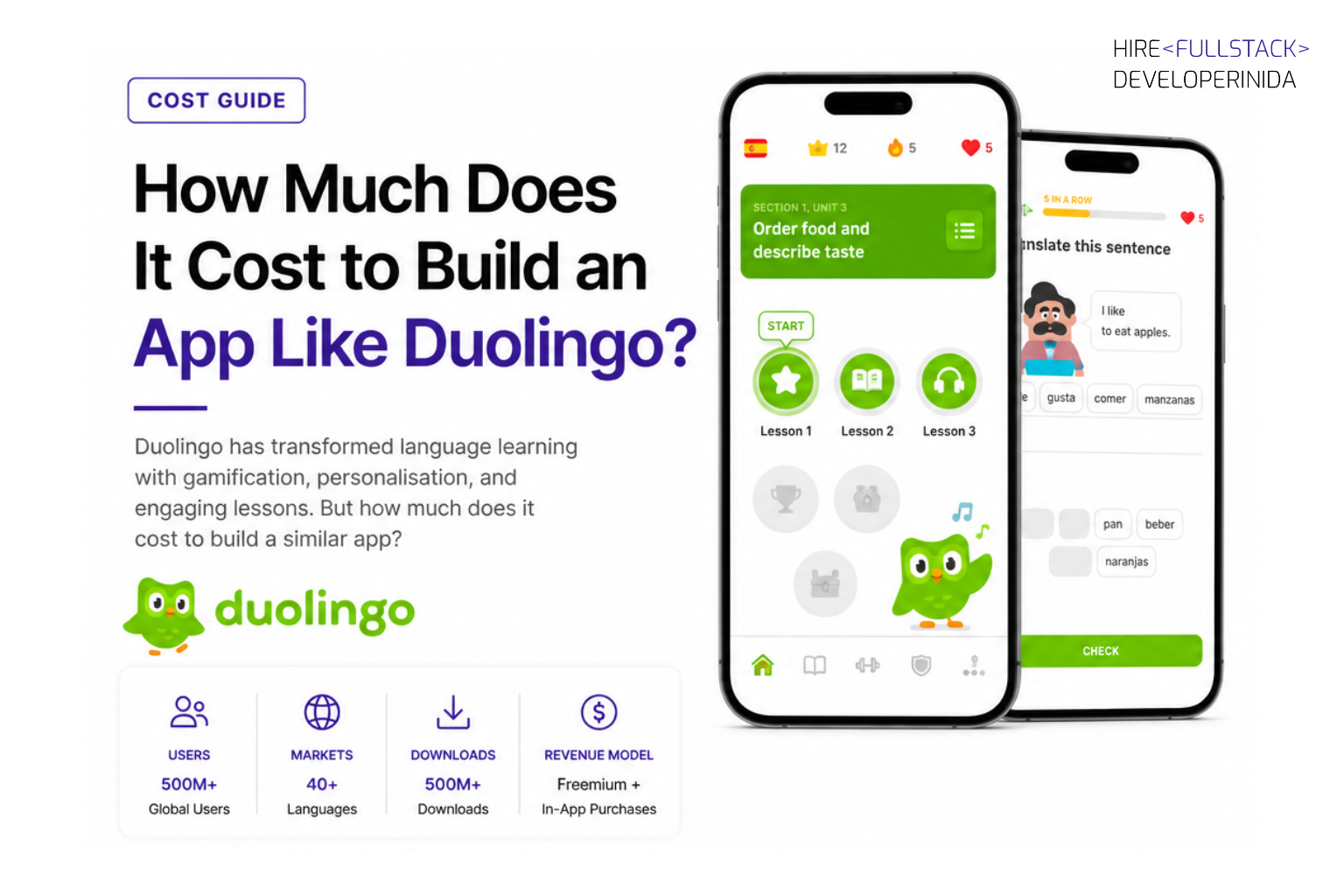

Let's be real. When most people hear "Duolingo", two things come to mind: that weirdly threatening green owl and the fact that over 600 million people have downloaded the app. That's not just a win for language learning. That's proof that mobile education, done right, is an absolutely massive market.
So it makes total sense that founders, startup teams, and even established edtech companies are asking the same question in 2026: what does it actually cost to build a language learning app like Duolingo?
The answer is not a single number. It depends on the features you want, the team you hire, the technology you choose, and how polished you want the final product to be. But in this blog, we are going to walk through every piece of that puzzle, so by the end you have a real, grounded understanding of the cost to build language learning app like Duolingo.
Why Language Learning Apps Are Still a Hot Investment in 2026
The global language learning market crossed USD 115 billion in 2025 and is only growing. Generative AI has changed how people interact with language tutors. Real time conversation practice with AI, adaptive learning paths, voice recognition for pronunciation, and gamification mechanics are no longer nice to have features. They are what users expect.
Duolingo itself reported over 37 million daily active users in early 2025. That number reflects something important: people are not just downloading language apps, they are actually using them every single day. That kind of retention is rare in mobile apps and it is largely thanks to smart product design.
If you are planning to build in this space in 2026, you are entering a competitive but very much alive market. The key is knowing what to build, what it will cost, and how to make smart investments from day one.
What Makes Duolingo So Expensive to Build?
Before we talk numbers, it helps to understand what you are actually paying for when you build something like Duolingo. It is not just an app with some lessons in it. It is a full learning platform with layers of technology and design working together.
- Gamification at the Core
Duolingo made language learning addictive by borrowing mechanics from mobile games. Streaks, XP points, leaderboards, daily goals, badges, and in app rewards keep users coming back. Building these systems from scratch requires careful product thinking and solid backend development. Getting gamification right takes time and iteration. - AI Powered Adaptive Learning
The app does not give every user the same lessons in the same order. It tracks mistakes, adjusts difficulty, and personalizes what you see n ext. In 2026, most serious language apps use machine learning for this. Building that layer is technically complex and adds to your overall cost to build language learning app. - Voice Recognition and Pronunciation
One of Duolingo's most powerful features is the speaking exercises. Users pronounce words and the app gives instant feedback. This requires speech to text APIs and sometimes custom trained models for accuracy across multiple languages. It is one of the more technically challenging and expensive features to get right. - Content Creation Infrastructure
Every course in Duolingo has hundreds of lessons with text, audio, images, and exercises. Building the tools for content creators to build and manage that content is an entire project in itself. Your CMS and admin panel will need to support multi language content at scale. - Offline Mode and Performance
Users expect the app to work without an internet connection. Offline functionality requires smart caching, local storage management, and careful sync logic when the user comes back online. It sounds simple but it adds meaningful development time.
Core Features and Their Individual Costs
Let us break this down feature by feature. These are rough estimates based on average development rates in 2026 across different regions and seniority levels.
These numbers add up quickly. And that is just the feature level cost. There are also infrastructure, third party services, and ongoing maintenance costs to factor in.
Total Cost Estimates by App Complexity
Not every founder needs to build a Duolingo clone on day one. The cost to build a language learning app varies drastically based on how much you are building. Here is a clearer picture across three tiers.
- MVP Version
An MVP for a language learning app would include basic user auth, a fixed set of lessons for one language, a simple progress tracker, and maybe a basic gamification element like streaks. This is enough to test your core concept and gather user feedback.
Estimated cost: $30,000 to $70,000
Timeline: 3 to 5 months - Mid Level App
This includes multiple languages, adaptive learning, voice practice, gamification with leaderboards, push notifications, and a subscription model. Think of this as a solid consumer product that can compete in the market.
Estimated cost: $100,000 to $200,000
Timeline: 7 to 12 months - Full Scale Duolingo Level App
This is the full package. AI powered personalization, multiple languages, social features, live tutor matching, premium subscription tiers, a robust CMS, and analytics dashboards for both users and admins.
Estimated cost: $300,000 to $700,000 and beyond
Timeline: 14 to 24 months
Duolingo itself has reportedly spent hundreds of millions on product development since its founding. The current version you see on your phone is the result of over a decade of iteration. You do not need to match that from day one, but knowing the ceiling helps you plan.
How Does Your Tech Stack Affect the Cost?
The technology choices you make early on will directly impact your budget, your team size, and your long term maintenance costs. Here are the main decisions you need to think through.
- Native vs Cross Platform Development
Building separate native apps for iOS and Android means you hire two development teams or the same team builds everything twice. Cross platform frameworks like Flutter or React Native let you write most of your code once and deploy to both platforms. In 2026, Flutter has matured significantly and is a popular choice for edtech startups looking to reduce costs without sacrificing quality.
Native development gives you more control over performance and device specific features but it roughly doubles your frontend development costs. Cross platform typically saves 20 to 40 percent on initial build time. - Backend Infrastructure
Your backend will handle user authentication, lesson data, progress tracking, voice uploads, AI model calls, and push notifications. A well architected backend on AWS, Google Cloud, or Azure using Node.js or Python can scale to millions of users. Going serverless from the start can reduce operational costs significantly. - AI and Voice APIs
You have two options here. Use third party APIs from providers like Google Cloud Speech, Microsoft Azure Cognitive Services, or OpenAI for voice and NLP features. Or train and host your own models. Third party APIs are faster to integrate and cheaper upfront. Custom models give you more control and accuracy but require data, ML engineers, and ongoing infrastructure costs.
For most startups in 2026, starting with third party AI APIs and evolving toward custom models as you scale is the smarter path. - Team Structure and Hiring Costs
Who you hire and where they are located will be one of the biggest cost drivers. Here is what a typical team looks like for a language learning app build.
- Project Manager or Product Owner
- 2 to 3 Mobile App Developers (iOS, Android, or Flutter)
- 1 to 2 Backend Developers
- 1 UI/UX Designer
- 1 AI/ML Engineer (for adaptive learning and voice features)
- 1 QA Engineer
- Content Specialists and Linguists (for actual language content)
Hourly rates vary significantly by region. Developers in North America typically charge $100 to $200 per hour. Eastern European and Latin American developers average $40 to $80 per hour. South and Southeast Asian teams average $20 to $50 per hour. Many companies in 2026 build hybrid teams, with a local product lead and a distributed development team, to balance quality and cost.
Hidden Costs That Most People Forget
When people estimate the cost to build language learning app, they usually focus on development hours. But there are several other real costs that sneak up on you.
- Content Production
Duolingo courses have thousands of exercises, audio recordings by native speakers, and visual assets. If you are building for even 3 languages, content production can cost anywhere from $20,000 to $100,000 depending on quality and depth. Native speaker voice recording, translation review, and illustration work all add up. - App Store Fees and Compliance
Apple charges $99 per year for developer enrollment and takes a 15 to 30 percent cut on in app purchases. Google Play charges a one time $25 fee with similar revenue sharing. You also need to comply with GDPR, COPPA if your audience includes minors, and App Store content guidelines. - Ongoing Maintenance
Once your app launches, it does not maintain itself. Bug fixes, OS updates, new device compatibility, and feature improvements require a dedicated team. Budget at least 15 to 20 percent of your initial development cost per year for maintenance. - Marketing and User Acquisition
A great app that nobody downloads is just a hobby project. Language learning is a crowded space. Whether you invest in ASO, paid social ads, creator partnerships, or content marketing, budget for this from day one. Many founders allocate as much as 30 to 40 percent of their total launch budget toward marketing.
How to Build Smarter and Spend Less
You do not have to spend $500,000 to enter the language learning market. Here are a few strategies that smart founders are using in 2026 to build competitively without burning through their runway.
- Start with one language and one target audience. Depth beats breadth at the MVP stage.
- Use no code tools for your admin panel and CMS before building custom. Tools like Retool or Airtable can handle content management early on.
- Partner with an established development agency that specializes in edtech. The domain knowledge they bring reduces trial and error significantly.
- License existing language content or partner with universities and language schools instead of creating everything from scratch.
- Use AI conversation tools as a force multiplier. An AI tutor can replace expensive live tutor booking infrastructure for your first version.
What to Expect After Launch
Building the app is actually just the beginning. The apps that compete with Duolingo are not one time builds. They are living products with constant iteration.
After launch, your team will spend time on A/B testing new lesson formats, improving voice recognition accuracy, adding new languages, testing monetization models, and responding to user feedback. Most successful edtech products in 2026 release meaningful updates every two to four weeks.
This ongoing investment is what separates the apps that stick from the ones that get downloaded once and forgotten. Factor this into your total budget picture from the start.
Final Thoughts: Is It Worth Building?
The cost to build language learning app at Duolingo scale is significant. There is no getting around that. But the market opportunity is equally significant and the technology available in 2026 makes it more accessible than ever to build something genuinely powerful.
If you start smart, with a focused MVP, the right team, and a clear monetization strategy, you can enter this market for far less than you might expect and still build something that users love.
The question is not really whether you can afford to build it. The question is whether you have a product that gives users a reason to open the app every single day. Get that right, and the investment pays for itself.