
eBay announced in February 2026 that it would acquire Depop from Etsy for approximately 1.2 billion dollars. That single transaction tells you more about the resale market than any trend report could. A platform built around secondhand clothes, run largely by Gen Z sellers photographing their own outfits, just became valuable enough for one of ecommerce's oldest names to buy outright.
That changes the conversation for any founder who has been quietly wondering whether a Depop style marketplace is worth building in 2026. It is not a hypothetical anymore. The category has real acquirers, real revenue, and real competition from Vinted, Poshmark, and Mercari, all fighting for the same Gen Z and millennial buyers who now treat secondhand shopping as a default, not a backup.
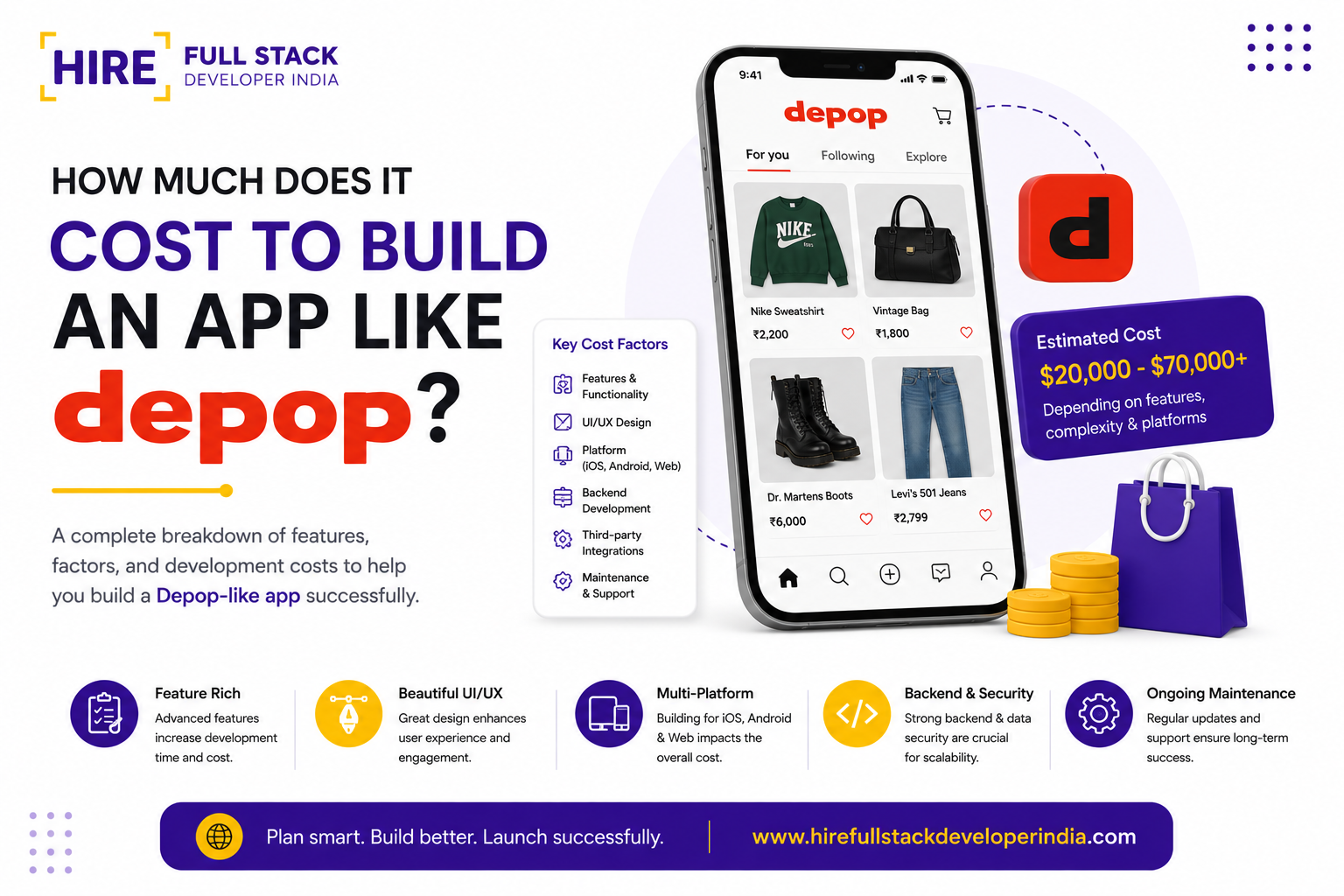
What this guide will not do is throw around vague phrases like “it depends” and leave you to figure out the rest. The cost to build an app like Depop ranges from around 25,000 dollars for a barebones MVP to over 250,000 dollars for an enterprise grade platform with AI driven recommendations, fraud detection, and global payment rails. The real number for your business depends on a specific set of decisions: which features you launch with, which you can delay, where your development team sits, and how much you are willing to spend on the parts of the app users never see but always notice when they break.
This guide breaks down the cost to build an app like Depop stage by stage, from the first wireframe to the first year of server bills, so you can budget with actual numbers instead of a guess pulled from a sales call.
What Is Depop?
Depop is a peer to peer marketplace app where individuals buy and sell secondhand, vintage, and handmade fashion. It combines the visual feed of a social app with the listing and checkout mechanics of a marketplace, which is why it is often described as Instagram for shopping.
Business Model
Depop earns revenue primarily through a seller fee charged on completed sales, supplemented by a paid Depop Plus subscription tier and promoted listing placements. There is no fee to browse or list items, which keeps the barrier to entry low for new sellers.
How the Platform Works
- Sellers create listings with photos, descriptions, pricing, and category tags.
- Buyers discover items through a personalized feed, search, hashtags, and following sellers directly.
- Transactions happen in app, with integrated payment processing and shipping label generation.
- A rating and review system builds trust between strangers transacting peer to peer.
User Journey by Role
- Buyers: browse the feed, search by keyword or hashtag, save items to a wishlist, message sellers with questions, and check out using a stored payment method.
- Sellers: upload listings, manage inventory and pricing, respond to buyer messages, ship orders, and track sales performance through basic analytics.
- Admins: moderate listings and user reports, manage disputes, enforce platform policies, and monitor overall marketplace health.
Why Are Apps Like Depop Popular in 2026?
Several consumer and economic trends are converging to make resale marketplace apps one of the strongest categories in mobile commerce right now.
- Sustainable fashion demand: buyers increasingly view secondhand purchases as a way to reduce fashion waste, and resale platforms make that choice convenient rather than effortful.
- Circular economy momentum: brands and retailers are launching their own resale arms, which signals that circularity is becoming standard business practice, not a niche movement.
- Gen Z shopping behavior: younger shoppers now plan to spend nearly half of their apparel budget on secondhand goods, treating resale as a primary channel rather than a fallback.
- Social commerce growth: shopping feeds that look and feel like social media increase time spent in app and make discovery feel less like searching and more like scrolling.
- Mobile first behavior: the vast majority of resale transactions now happen through a phone app rather than a desktop browser, which raises the bar for mobile UX quality.
- Economic pressure: weaker consumer sentiment and tariff driven price increases on new goods are pushing budget conscious shoppers toward resale across age groups, not just among younger buyers.
Together, these forces explain why investors and acquirers are paying close attention to this category, and why the cost to build an app like Depop is a question more founders are asking seriously rather than casually.
Top Competitors of Depop
Before building a Depop style app, it helps to understand how the existing players differentiate themselves. Each of these platforms made deliberate product and monetization choices that shaped both their growth and their cost structure.
The biggest strategic difference across this list is fee structure. Vinted's decision to charge buyers instead of sellers removed a major point of friction for first time sellers, while Depop's lower commission compared to many rivals has been a consistent draw for its seller base. These are product decisions, not just pricing decisions, and they directly affect how your own app's backend and payment logic need to be built.
Essential Features Required in an App Like Depop
Every Depop style marketplace needs five core modules. Each one carries a different level of development complexity, which directly affects both timeline and cost.
User Panel
- Registration and login with email and phone verification
- Social login through Google and Apple ID
- User profile setup with bio, profile photo, and follower system
Purpose: this module establishes identity and trust before any transaction happens. Development complexity: low to moderate, since most of this can be built on standard authentication libraries.
Seller Panel
- Product listing creation with multiple photo uploads
- Inventory management and bulk editing tools
- Basic sales analytics and performance tracking
Purpose: this is where sellers manage their storefront. Development complexity: moderate, with image handling and analytics dashboards adding the most engineering time.
Buyer Panel
- Product browsing through a personalized feed
- Search with filters for category, size, price, and condition
- Wishlist and saved items
- Checkout flow with saved payment methods
Purpose: this module drives discovery and conversion. Development complexity: moderate to high, since feed personalization and search relevance require careful backend design.
Messaging Module
- Real time chat between buyers and sellers
- Push notifications for messages, offers, and order updates
Purpose: enables negotiation and trust building pre purchase. Development complexity: moderate, particularly for real time delivery at scale.
Payment Module
- Integrated payment gateway supporting cards and digital wallets
- In app wallet for seller earnings
- Refund and dispute handling logic
Purpose: this module is the financial backbone of the marketplace. Development complexity: high, due to compliance requirements and the need for airtight error handling around money.
Admin Panel
- User account management and suspension tools
- Product moderation queue for flagged listings
- Reporting tools for disputes and policy violations
- Platform wide analytics dashboard
Purpose: keeps the marketplace safe and gives the business visibility into platform health. Development complexity: moderate, though it grows in complexity as user volume increases.
Advanced Features That Can Increase App Engagement
Once the core marketplace is functional, these features are what separate a generic listings app from something that genuinely competes with Depop on engagement and retention.
None of these are required for an MVP. They are growth levers to add once you have validated that people actually want to buy and sell on your platform.
Step by Step Development Process
Building an app like Depop follows a fairly standard product development sequence, but each phase carries its own cost and timeline depending on how much customization you need.
Team Composition Required
The size and seniority of the team you assemble has the single biggest influence on your total cost. A lean MVP team might combine several of these roles into two or three people, while an enterprise build typically staffs each role separately.
Detailed Cost Breakdown
Here is how a typical budget breaks down across every major component of the build. These ranges assume a mid market development team and a feature set comparable to Depop's core functionality, before factoring in heavy AI investment or enterprise scale infrastructure.
Total cost for a fully featured app, combining every row above at the middle of each range, typically lands between 65,000 and 130,000 dollars. Enterprise builds with deeper AI integration and custom infrastructure can exceed 250,000 dollars.
Factors That Affect Depop App Development Cost
Two companies can request what sounds like the same app and end up with completely different invoices. These are the variables that explain why.
- Feature complexity: a basic listing and checkout flow costs far less than a feed driven, AI personalized marketplace with real time chat and dispute resolution tools.
- Platform selection: building for iOS and Android separately costs more than a single cross platform codebase, though native apps often perform better at scale.
- Team location: development rates vary significantly by region, with North American and Western European teams typically charging two to four times more per hour than teams in South Asia or Eastern Europe.
- Development methodology: agile development with iterative releases tends to cost more upfront than a fixed scope waterfall build, but reduces the risk of building the wrong thing.
- AI integration: every AI feature you add, from recommendations to fraud detection, adds both development cost and ongoing model hosting or API costs.
- Security requirements: marketplaces handling payment data face stricter compliance obligations than simple content apps, which adds both development and audit costs.
- Scalability: an app built to handle 10,000 users costs less to build than one architected from day one to handle 10 million, even if the features look identical.
- Third party integrations: each payment gateway, shipping API, or identity verification service you integrate adds both setup cost and ongoing per transaction fees.
Hidden Costs Businesses Often Miss
The development quote is rarely the full story. These ongoing costs are what catch founders off guard in year one, often adding 15 to 25 percent of the original build cost annually.
Monetization Strategies
Depop and its competitors prove there is more than one viable way to make a resale marketplace profitable. Most successful platforms combine two or three of the following.
- Commission model: a percentage fee charged on each completed sale, typically ranging from 5 to 20 percent depending on the platform.
- Listing fees: a flat fee charged per item listed, which works better for higher value categories than for casual fashion resale.
- Premium memberships: a subscription tier offering sellers lower fees, better placement, or advanced analytics, similar to Depop Plus.
- Advertising: brands or top sellers pay to promote their listings or storefront within the app.
- Featured products: sellers pay a small fee to have specific listings boosted in search results or the home feed.
- Brand collaborations: partnerships with fashion brands for exclusive drops or co branded campaigns, which also drive user acquisition.
- Transaction fees: a separate fee charged to either the buyer or seller specifically for payment processing and buyer protection.
How Long Does It Take to Build an App Like Depop?
Timeline scales with scope in a fairly predictable way. A founder testing a niche resale idea moves much faster than a team building for global scale from day one.
MVP vs Full Product Cost Comparison
Most founders should not start by building the full product. An MVP exists to test a specific hypothesis, that people in your chosen niche will actually list and buy items, before you commit a larger budget to features that may not matter to your specific audience.
How AI Is Transforming Marketplace Apps
AI has moved from a nice to have feature to a competitive necessity in resale marketplaces. Industry analysis now points to AI powered intake, automation, and improved logistics as central to making resale platforms profitable rather than just popular.
- AI powered recommendations: personalized feeds keep users browsing longer and increase the odds they find something they want to buy, directly improving conversion rates.
- Automated moderation: AI can flag policy violating or counterfeit listings faster than a human review team, reducing both cost and response time.
- Fraud prevention: machine learning models can detect suspicious account behavior and payment patterns before they result in a chargeback or scam.
- Customer support automation: AI chat assistants can resolve common buyer and seller questions without human intervention, reducing support headcount needs.
- Predictive analytics: sellers benefit from AI suggested pricing and demand forecasting, which increases their success on the platform and their loyalty to it.
Implementation costs for a full AI suite typically range from 30,000 to 70,000 dollars depending on whether you build custom models or integrate existing AI APIs. The business benefit is measurable in retention and conversion, which is why most platforms treat this as a phase two investment after the core marketplace is validated.
Final Cost Summary
Pulling every section together, here is the cost to build an app like Depop at each stage of ambition.
Conclusion: What Should Your Budget Actually Look Like?
The eBay Depop deal did not happen because resale apps are trendy. It happened because one of them built a business model that worked: low seller fees, high engagement, and a product experience built for how people actually browse on their phones. That is the real lesson for anyone budgeting a Depop style build in 2026. The cost to build an app like Depop is not really about hitting a number. It is about deciding which 20 percent of the platform creates 80 percent of the reason someone opens it every day, and funding that part properly while keeping the rest lean.
A realistic MVP will run 25,000 to 45,000 dollars and prove whether people in your specific niche will actually list and buy. A fully featured app with AI search, fraud detection, and a polished seller experience moves into the 80,000 to 150,000 dollar range. Enterprise grade platforms built for scale, with custom recommendation engines and multi region infrastructure, push past 250,000 dollars. None of these numbers include the bill that comes after launch, and that is the mistake most first time founders make. Hosting, compliance, payment processing fees, and ongoing maintenance will cost 15 to 25 percent of your original build, every single year, for as long as the app exists.
If there is one strategic call to make before writing a single line of code, it is this: decide whether you are building a fashion resale niche or a general marketplace, because that single decision will move your cost estimate by tens of thousands of dollars in either direction. Get that right, build lean, and let real user behavior tell you what to build next.