
The global language learning app market crossed $21 billion in 2024 and is projected to reach over $41 billion by 2030. That trajectory is not slowing down. If anything, 2026 is one of the most competitive and most opportunity rich windows for entrepreneurs to enter this space.
Babbel sits among the most trusted names in language learning, with over 10 million active subscribers and a product that blends structured curriculum with bite sized lessons. It is not an accident. The app is the result of deliberate product decisions, years of refinement, and a technology backbone built to support millions of concurrent learners across 13 languages.
If you are a founder, product team, or investor exploring what it actually takes to build an app like Babbel, this guide gives you a complete picture from the first line of design to launch day infrastructure. No vague estimates. No filler. Just the full development roadmap and cost breakdown you need to make a real decision.
What Is Babbel and How It Works?
Babbel is a subscription based language learning platform available on iOS, Android, and web. Unlike flashcard heavy apps or passive listening tools, Babbel uses a structured, dialogue first approach. Lessons are built around real world conversations — not just vocabulary drills.
Here is how a typical user flow works:
A new user selects their native language and the language they want to learn. They then set a daily goal — usually 10 to 15 minutes per day. The app places them into a curriculum designed around thematic units: travel, business, everyday conversation. Each unit contains a series of short lessons that blend reading, listening, speaking, and writing exercises. A speech recognition engine evaluates pronunciation in real time. At the end of each lesson, a review session reinforces what was just learned using spaced repetition logic.
The backend tracks progress across devices, syncs lesson state in real time, and serves personalized content based on a learner's performance history. The product feels simple from the outside. The engineering underneath it is not.
Key Features of a Babbel Like App
User Panel Features
- Onboarding flow with language selection, proficiency test, and daily goal setting
- Structured course curriculum organized by level and theme
- Interactive lessons with reading, writing, listening, and speaking exercises
- Real time speech recognition and pronunciation feedback
- Spaced repetition review system for vocabulary retention
- Offline mode for downloaded lessons
- Progress tracking with streak counters and XP style milestones
- Multi device sync with cross platform lesson continuity
- Push notifications for daily learning reminders
- In app dictionary and grammar reference
- Community features such as leaderboards and peer challenges
- Podcast and audio story modules for intermediate learners
Admin Panel Features
- Content management system for course and lesson creation
- User analytics dashboard covering retention, completion, and churn
- Subscription and billing management with revenue reporting
- A/B testing tools for lesson formats and UI variations
- Localization management for multilanguage content updates
- Push notification scheduling and campaign management
- Customer support ticket routing and resolution tools
- Role based access for content editors, QA reviewers, and administrators
Optional Advanced Features
- AI powered adaptive learning paths that adjust to individual learner pace
- Generative AI conversation partner for open ended speaking practice
- Live tutoring module with certified teacher bookin
- AR enabled vocabulary learning using camera based object recognition
- Emotional tone analysis during speaking exercises
- Multi accent recognition engine for regional speech patterns
Benefits of Building a Similar App
Business Benefits
- Recurring subscription revenue model with predictable monthly income
- High retention potential through gamification and habit forming design
- Low marginal cost per additional user once content library is built
- Scalable to new languages without rebuilding the core product
- Multiple monetization channels including B2B enterprise licensing
- Strong SEO and app store discoverability in a well defined category
User Benefits
- Self paced learning that fits into busy daily schedule
- Immediate pronunciation feedback without a human teacher
- Consistent progress tracking that motivates continued learning
- Accessible on any device, online or offline
- More affordable than traditional language classes or tutors
Market Opportunity
The global eLearning market is expected to hit $457 billion by 2026, with language learning apps taking a meaningful share. Corporate demand is rising fast — companies with international operations increasingly pay for employee language training through platform subscriptions. The B2B segment alone represents a major revenue layer that most consumer focused competitors underestimate. Additionally, the integration of generative AI into language practice is resetting user expectations, creating a product gap that new entrants can fill before incumbents fully adapt.
Development Process
Phase 1: Discovery and Planning
Before writing a single line of code, the planning phase defines the product's direction. This includes market research to validate your language pair focus, competitive analysis against Babbel and its direct competitors, user persona development, and feature prioritization for the MVP. A Product Requirements Document is the output of this phase — it translates business goals into technical specifications. Budget allocation, team composition, and timeline milestones are finalized here. A typical planning phase for a product of this complexity takes 3 to 5 weeks. A key deliverable of the planning phase that many teams skip is a content strategy document. Your app development timeline and your content production timeline need to run in parallel — the best built app in the world cannot launch without a curriculum. Decide during planning whether you will build content in house, license it from a third party, or partner with certified language educators. The answer directly affects your cost structure and your launch readiness date.
Phase 2: UI/UX Design
UI/UX design for a language learning app is not cosmetic work — it directly affects learning outcomes. Designers create user flows, wireframes, and interactive prototypes before any development begins. The design system must account for accessibility (screen readers, text sizing, contrast ratios), multilanguage content rendering (right to left scripts, CJK character spacing), and the micro interaction feedback loops that keep learners engaged. Usability testing with real target users should happen before development locks the interface. Design phase duration: 4 to 6 weeks.
Phase 3: Frontend Development
Frontend development covers the learner facing interfaces across iOS, Android, and web. For a Babbel like product, React Native or Flutter are the practical choices for mobile — both allow a shared codebase while maintaining near native performance. The web platform uses React.js or Next.js. Front-end engineers build the lesson UI, speech recognition integration layer, progress visualization components, and offline sync logic. This is typically the longest development phase: 12 to 20 weeks depending on feature scope.
Phase 4: Backend Development
The backend handles everything the user does not see — authentication, lesson delivery, progress tracking, speech processing results, subscription billing, and content management. Node.js with Express or a Python based framework like FastAPI are common choices. The backend must be designed for horizontal scale from day one; language learning apps experience sharp traffic spikes during morning commute windows and evening study sessions. API design, database schema, and microservices boundaries are critical decisions made here. Backend development runs 10 to 16 weeks. A common mistake at this stage is building the subscription billing system too simply. Stripe and Braintree both offer powerful subscription management APIs, but the integration needs to handle trial periods, plan upgrades and downgrades, failed payment retries, and country specific tax compliance. Treating billing as a minor integration rather than a first class system leads to revenue leakage and customer support overhead that costs more to fix than it would have cost to build correctly upfront.
Phase 5: QA and Testing
Quality assurance for a language learning app spans functional testing, performance testing, speech recognition accuracy testing, and localization testing. Automated test suites cover regression across platform versions. Manual testers verify lesson logic, audio playback, and offline behavior. Load testing simulates concurrent user spikes. A dedicated QA phase of 4 to 6 weeks prevents post launch defects that damage early ratings — critical for app store discoverability.
Phase 6: Deployment
Deployment covers app store submissions, backend infrastructure provisioning, CDN configuration for audio and media assets, and post launch monitoring setup. CI/CD pipelines automate future releases. Apple App Store and Google Play Store review processes each take 2 to 7 days. A phased rollout — releasing to 10% of users before full launch — catches production issues before they affect your full user base. Deployment phase: 2 to 3 weeks.
Tech Stack Required
Panels Required in the App
- Learner App (User Panel)
The learner facing mobile and web applications is the core product. It handles onboarding, daily lessons, speech exercises, review sessions, progress tracking, subscription management, and community features. This is the panel that drives retention and revenue. - Admin Panel
The admin panel is where your team manages the product from the inside. Content editors upload and update lessons. Marketing manages notifications and campaigns. Finance monitors subscription metrics and revenue. Engineering monitors system health. A well built admin panel is what makes the product operationally scalable without adding headcount. - Content Partner Portal
For apps that license curriculum from educational publishers or certified language schools, a partner portal allows third party content creators to upload, preview, and submit lessons for review. This is optional at MVP stage but becomes valuable at scale — it lets you expand your language and level offerings without hiring an in-house curriculum team for every new language pair.
Monetization Strategies
- Subscription Model
Subscriptions are the primary revenue model for apps like Babbel. Monthly plans typically price between $13 to $18 per month. Annual plans — offered at a steep discount — drive better LTV and are where most revenue actually comes from. Babbel's annual plan has historically sold for $83 to $99 per year. Family plan tiers (2 to 4 members) open an additional pricing layer. A freemium tier with one free lesson per course keeps acquisition costs low by letting users experience value before hitting the paywall. - B2B and Enterprise Licensing
Enterprise licensing is underutilized by most language app startups but represents a high margin revenue stream. Companies pay per seat subscriptions for employee access — often at $5 to $15 per user per month at volume. Education institutions are a related channel: universities and language schools license platforms for student use. Both segments require a separate sales motion and admin feature set, but they significantly improve revenue predictability. To unlock the B2B market effectively, your platform needs SSO integration (SAML or OAuth), a manager dashboard that shows aggregate team progress, and the ability to assign specific language courses to employee cohorts. Invoice billing rather than credit card checkout is also expected by enterprise procurement teams. These features can be built as a second phase after your consumer product is stable, but planning for them in your initial database schema and user model avoids costly refactoring later. - Ad Supported Free Tier
An ad supported free tier can monetize users who do not convert to paid plans. Banner and interstitial ads carry low CPM rates in education apps, but rewarded video ads — where users watch an ad to unlock additional daily lessons — perform meaningfully better. Ad revenue alone will not sustain the business, but it extends monetization reach across your non paying user base. - In App Purchases and Content Packs
One time purchases for premium content packs, specialized vocabulary modules, or access to the AI conversation partner can generate meaningful revenue outside the subscription model. Users who prefer not to commit to recurring billing are often willing to pay for discrete, high value content items. This model also works well for corporate gift cards and gifted subscriptions.
Cost to Build an App Like Babbel Breakdown
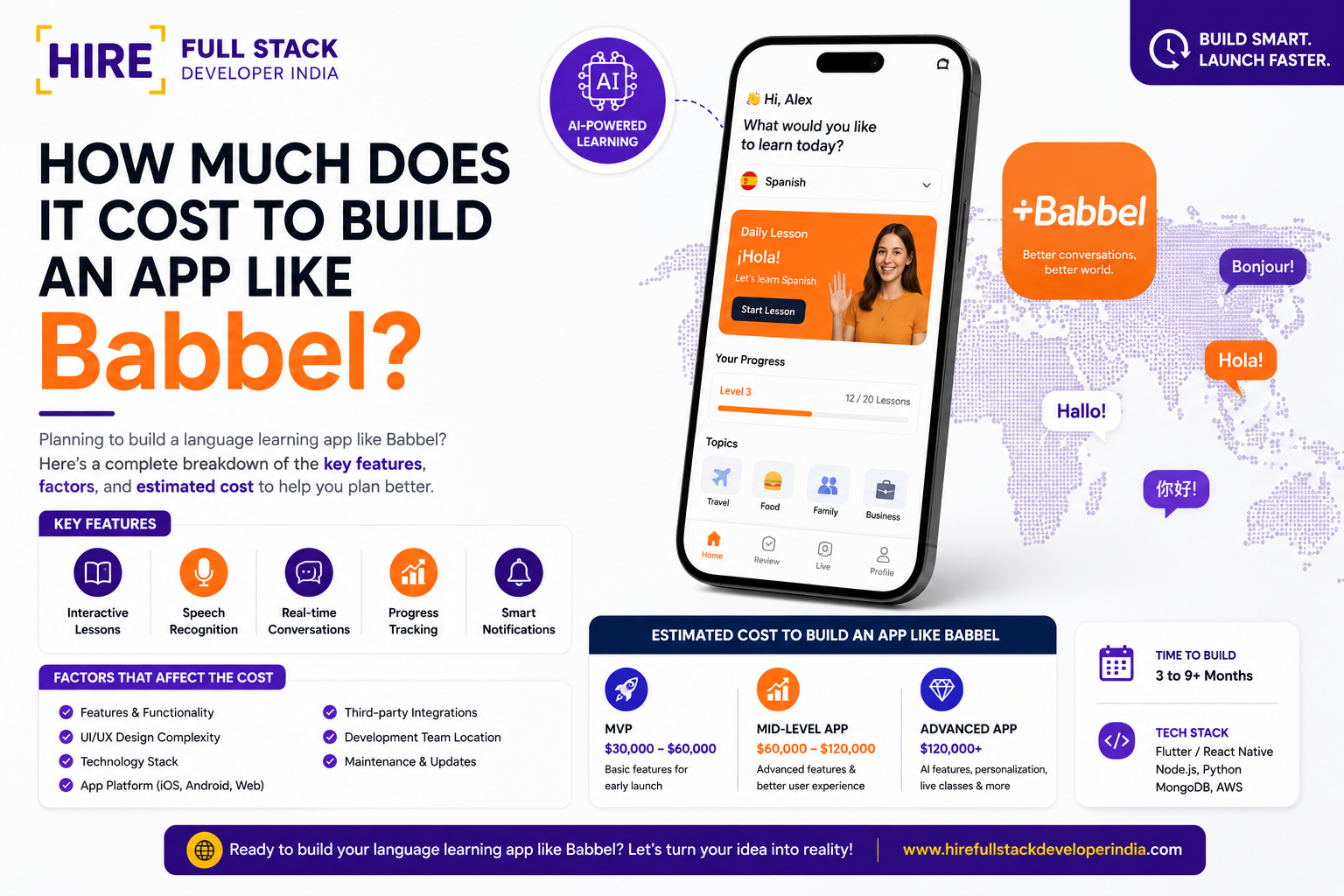
Estimated Total: MVP: $55,000 to $100,000 | Full Scale: $120,000 to $220,000
Ranges reflect offshore development team rates. US or Western Europe based teams typically cost 2 to 3 times more.
Development Timeline
Challenges in Building a Language Learning App
Technical Challenges
• Speech recognition accuracy varies significantly across accents, microphone quality, and background noise. Building a robust fallback experience when recognition fails is as important as the recognition itself.
• Offline functionality requires careful sync architecture. Lesson state, progress data, and downloaded content must merge cleanly when a user comes back online after an extended offline session.
• Spaced repetition algorithms require substantial data to personalize effectively. Early stage apps with limited user history must rely on general models until user specific data accumulates.
• Multilanguage content rendering — particularly for right to left scripts like Arabic or Hebrew, or tonal languages like Mandarin — requires frontend work that most teams underestimate.
• Scaling audio content delivery globally without latency requires a well configured CDN and media optimization pipeline. A single audio asset may need to load within 200ms for the lesson experience to feel fluid.
Business Challenges
• Content production is expensive and slow. Building a curriculum for a single language pair at beginner through advanced levels can require 300 to 500 hours of content creation before the product feels complete.
• User retention in language learning is historically poor. Most apps see 90 day retention rates below 10%. Designing habit loops that outlast the initial motivation spike is a core product problem, not a marketing one.
• App store competition for language learning is intense. Duolingo's brand dominance means you are not just competing on features — you are competing for mental real estate. Niche positioning (professional language, specific regional dialects, industry specific vocabulary) is often more effective than building a direct competitor.
Future Scope of Language Learning Apps
Language learning apps are moving from passive instruction to active practice environments. The next competitive frontier includes AI conversation partners that simulate real dialogues, live tutoring marketplaces integrated directly into the learning flow, and AR overlays that label real world objects in the target language.
The integration of large language models into language learning creates a genuine product shift. Where earlier apps could only evaluate whether a user typed the right word, LLM powered platforms can now hold open ended conversations, correct grammar in context, explain idiomatic usage, and adapt their vocabulary level in real time. This moves the product from a content delivery platform to an intelligent practice partner — a meaningfully different value proposition for learners at intermediate and advanced levels.
From a business perspective, the B2B market is expanding faster than consumer. Corporate training budgets increasingly include language learning as a line item, and companies want platforms that integrate with their existing HR and LMS infrastructure. Building SCORM compliance and SSO integration into your roadmap early positions your product for enterprise contracts. Multi seat billing dashboards, usage reporting per employee, and manager level visibility into team progress are features that enterprise buyers expect before signing. These are relatively low effort additions to build but dramatically expand the buyer pool.
Expansion by language pair is a natural growth lever. Building the platform architecture to support new languages without engineering rework multiplies the product's market reach without rebuilding the core. An app that launches with Spanish and French can add Mandarin, Japanese, or Arabic with content production investment but no additional infrastructure work, if the original architecture supports it.
Wearable and ambient learning represent an emerging channel. Vocabulary review through smartwatch prompts, audio immersion through ambient speakers, and context aware learning that surfaces vocabulary based on a user's location or calendar are product directions that move language learning out of dedicated study sessions and into the fabric of daily life. Early movers in this space will capture a distinct segment of learners who do not have time for structured daily sessions.
In the end,
Building an app like Babbel in 2026 is not a simple project, but it is a well defined one. When evaluating the Cost to Build an App Like Babbel, businesses must look beyond development expenses and consider content creation, user engagement strategies, and long term scalability. What separates successful launches from failed ones is not the concept but execution quality, content depth, and the decision to build with a team that understands both the technical and product dimensions of language learning platforms.
One of the most important decisions you will make before development begins is where to focus. A language learning app that tries to cover every language, level, and learning style from day one typically delivers a mediocre experience across all of them. The products that build loyal user bases tend to do one thing extremely well, whether that is conversational Spanish for working professionals, business Japanese for cross border teams, or industry vocabulary for healthcare workers. Tight focus at launch allows your content team to go deep rather than wide and gives your marketing team a clear audience to acquire.
The technology investment is substantial but structured. Speech recognition, spaced repetition, and subscription billing are well solved problems in 2026. You are integrating proven tools rather than building everything from scratch. The engineering risk lies in how well those pieces connect, how your backend handles concurrent load during peak learning windows, and how cleanly your content management system allows your curriculum team to update lessons without engineering involvement.
The Cost to Build an App Like Babbel can vary significantly depending on the number of supported languages, the complexity of speech recognition capabilities, AI powered learning features, and the depth of curriculum content. A basic MVP focused on a single language will require a considerably lower investment than a multilingual platform with adaptive learning and real time conversational practice.
Total investment in the $80,000 to $150,000 range gets you a production ready MVP with real speech recognition, structured curriculum delivery, and subscription billing. Full scale development with adaptive learning, AI conversation practice, advanced analytics, and enterprise features typically sits in the $150,000 to $220,000 range.