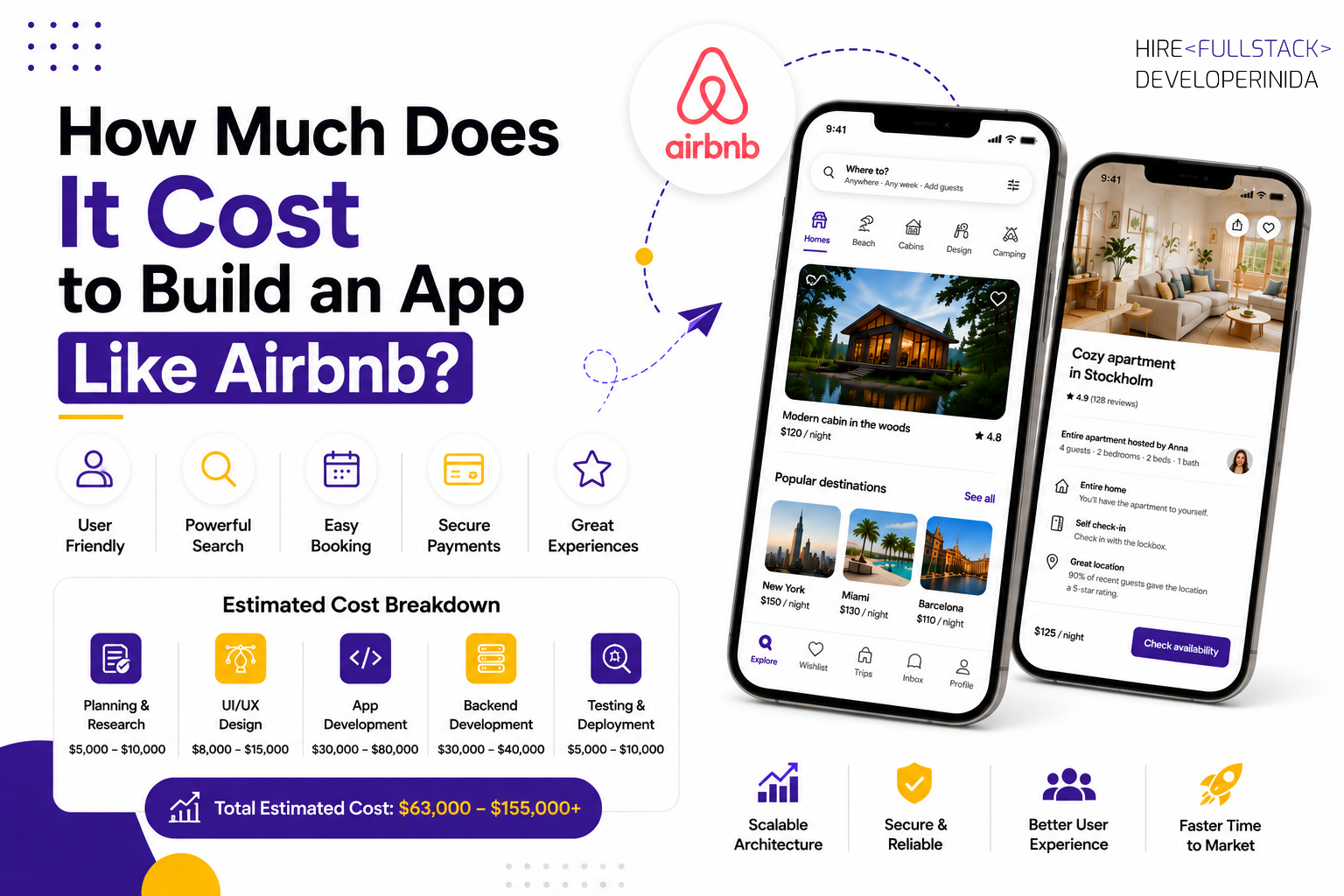

Every few years, a platform redefines how people think about travel, accommodation, or shared resources. Airbnb was one of those platforms. What started as an air mattress on a living room floor became a business valued at over $70 billion. And now, thousands of founders want a piece of that model.
But here is the part that most blogs conveniently skip: building an app like Airbnb is not a single project. It is three interconnected products running simultaneously. A guest-facing app. A host management platform. And a backend admin system that keeps everything honest. Each one of those has its own complexity, its own integrations, and its own team requirements.
If you have been searching for the cost to build an app like Airbnb and landing on vague answers like "$50,000 to $500,000," you are not getting the full picture. This guide will change that. We will walk through every cost layer that actually matters in 2026, including the ones most vendors will not mention until the invoice arrives.
Understanding Airbnb's Business Model Before Estimating Costs
Most founders make the mistake of jumping straight to feature lists and technology stacks before they truly understand what Airbnb is doing at a business level. That is a costly mistake, sometimes literally. The business model determines the features. The features determine the architecture. And the architecture is what your development partner ultimately bills you for.
So before any numbers enter the conversation, let us understand what kind of product you are actually trying to build.
Marketplace Architecture Explained
Airbnb is not one app. It is three separate user experiences running on top of a shared backend. Each one has its own interface, its own set of actions, and its own logic. The moment you understand this, the development cost stops feeling surprising.
- Guests are the demand side of the marketplace. They search, filter, compare, book, pay, and review. Their experience needs to be fast, visual, and frictionless because they are making purchasing decisions. Every extra second of load time or extra tap in the booking flow costs you conversions. The guest app is typically the most design-intensive part of the platform.
- Hosts are the supply side. They list properties, upload photos, set pricing rules, manage booking calendars, handle guest communication, and track their earnings. The host experience needs to be powerful without being complicated. A host managing five properties across two cities needs a dashboard that gives them control without requiring a manual. If onboarding a new property takes more than 20 minutes, your retention will suffer. The host app is typically the most logic-intensive part of the platform.
- Administrators are the invisible side. They are your internal team operating the platform, which means they are verifying property listings, approving host accounts, flagging suspicious activity, managing commissions, resolving disputes, and monitoring platform health through analytics. This panel does not face the public, but it directly determines how trustworthy and reliable your platform feels to everyone who does use it. Skimping on the admin panel is one of the most common and most expensive mistakes a marketplace founder can make.
Here is why this three-sided structure matters for your budget: every feature you build likely has to work across all three panels. A booking modification, for example, triggers a change in the guest's itinerary, an update in the host's calendar, a recalculation of fees in the payment system, and a logged event in the admin panel. That is four touchpoints from a single user action. Multiply that logic across dozens of features and you start to see why marketplace development costs more than a standard app.
Revenue Streams
Understanding how Airbnb makes money is not just an interesting context. It is a blueprint for what you need to build. Each revenue stream requires its own feature logic, and some of them are considerably more complex to implement than they appear.
- Booking commissions are the primary revenue engine. Airbnb charges guests a service fee of roughly 14 to 16 percent on top of the listing price. Implementing this requires a flexible fee calculation engine that applies the right percentage at checkout, handles edge cases like partial bookings or cancellations, and adjusts correctly when hosts offer discounts or promotions. Getting this right under real-world conditions, including currency differences and regional tax rules, is not trivial.
- Host service fees come in at around 3 percent of the booking subtotal, deducted from the host payout. Platforms that use a split-fee model (charging both sides) need their payment logic to split, route, and reconcile funds accurately on every transaction. This is a meaningful piece of backend development.
- Premium listings work like a native advertising layer, where hosts pay to appear at the top of search results or receive a featured badge. Building this requires a listing prioritization engine, a separate billing workflow for hosts, and safeguards to ensure paid visibility does not make the platform feel untrustworthy to guests.
- Experiences and activities are a separate product line within the Airbnb ecosystem. Hosts offer guided tours, cooking classes, and local experiences that guests can book independently of a property stay. Adding this to your platform essentially means building a second marketplace within the first one, with its own listing format, scheduling logic, and cancellation policies. This is worth planning for early even if you do not launch it on day one.
- Insurance partnerships represent a more mature monetization layer. Airbnb's AirCover program and its partnerships with insurance providers generate revenue through embedded coverage products. Implementing insurance integrations requires API connections with third-party providers, policy display logic, and claims workflow support. Budget for this in a later phase unless insurance is central to your differentiation
Why Business Model Directly Impacts Development Cost
This is the insight most cost guides skip entirely: two platforms can look nearly identical on the surface and cost completely different amounts to build because their revenue models require fundamentally different technical infrastructure.
Consider a platform that charges a flat subscription to hosts versus one that takes a percentage commission per booking. The subscription model needs a billing system, plan management, upgrade and downgrade logic, and a trial period workflow. The commission model needs a real-time fee calculator, escrow-style payment holding, automated split payouts, and a reconciliation engine. These are different systems with different complexities, even though both platforms look like a property rental app to the average user.
If you plan to offer dynamic pricing, you need data infrastructure to support it. If you want to run promotions and discount codes, you need a promotions engine. If your model includes a host loyalty tier (like Superhost), you need an ongoing scoring system that evaluates and recalculates status automatically. Every monetization decision downstream creates a development requirement upstream.
The practical implication is this: when you sit down with a development partner for the first time, the first conversation should not be about screens and features. It should be about how your platform makes money and who does what on each side of the marketplace. The clearer you are on your business model before development begins, the fewer expensive mid-project changes you will face later.
What Type of App Are You Actually Building?
Not all rental marketplaces are created equal, and the type of platform you want to build will dramatically affect your budget. Here is how cost varies by niche.
Luxury villa platforms cost more because the guest experience demands richer media, concierge-style support flows, and curated onboarding. Boat or RV rentals involve logistics-heavy features like delivery coordination, insurance verification, and geo-based availability that differ from traditional property rentals.
Core Features and Their Development Costs
Guest App Features
Host App Features
Admin Panel Features
Advanced Features Most Cost Guides Completely Ignore
This is where most blogs stop. But if you are serious about building a competitive platform in 2026, the following features are no longer optional extras. They are the table stakes for user retention and investor credibility.
- Dynamic Pricing Engine
Airbnb's Smart Pricing adjusts listing prices in real time based on demand, local events, seasonality, and competitor rates. Building a custom version of this involves demand forecasting algorithms, integration with external data feeds, and rule-based overrides for hosts. The cost to develop a basic version starts at around $15,000 to $30,000. A fully AI-trained dynamic pricing engine can push that to $50,000 or more.
- Trust and Safety Infrastructure
This is one of the most underestimated cost centers in rental marketplace development. Identity verification, document scanning, background check API integrations, and fraud detection logic together form a trust layer that guests and hosts both depend on. Cutting corners here creates liability. Budget between $18,000 and $40,000 for a robust trust and safety system.
- AI-Powered Search and Recommendations
In 2026, guests do not just type "apartment in Barcelona." They expect the platform to know that they prefer walkable neighborhoods, quiet properties, and fast WiFi based on their past searches and bookings. Building a behavioral recommendation engine adds $20,000 to $45,000 to your development budget, but it significantly improves conversion rates and repeat bookings.
- Smart Customer Support
AI chatbots that handle booking modifications, refund requests, and host inquiries in multiple languages have become expected. Training and deploying a support automation layer with escalation paths costs between $10,000 and $25,000 depending on language support and integration complexity.
Airbnb App Development Cost by Development Stage
Cost Breakdown by Platform
- iOS App Development
A native iOS app built in Swift offers superior performance and a polished user experience. For a rental marketplace, expect to budget between $35,000 and $70,000 for the guest-facing iOS app alone. Add another $20,000 to $40,000 for the host app. - Android App Development
Android development costs are roughly comparable to iOS when built natively in Kotlin, sometimes slightly higher due to fragmentation testing across devices. Budget $35,000 to $72,000 for the guest app and $22,000 to $42,000 for the host app. - Cross-Platform Development
Using React Native or Flutter allows a single codebase for both iOS and Android. This can reduce initial development costs by 30 to 40 percent compared to building both natively. However, for complex features like real-time messaging or custom camera workflows, native modules may still be required, partially eroding those savings. - Progressive Web App
A PWA gives you a web-based experience that works on mobile browsers without requiring an app store download. For early-stage startups validating the market in a single city, a PWA can reduce your initial budget by 35 to 45 percent. The trade-off is limited access to device features and lower discoverability through app stores.
Hidden Costs Most Founders Do Not See Coming
This section is the one that separates well-prepared founders from the ones who run out of runway six months after launch.
The payment processing fees alone can become a significant cost driver at scale. A platform processing $1 million per month in bookings is paying approximately $29,000 to $30,000 per month in Stripe fees before any other overhead. This is not a reason to avoid building, but it is absolutely a reason to model your unit economics before you write a single line of code.
How AI Is Actively Increasing Development Budgets in 2026
Two years ago, AI features were nice-to-have add-ons. In 2026, investors and users both expect them. Here is what that actually costs.
An important note on AI costs: model training and API consumption grow with your user base. A fraud detection system that costs $1,500 per month at 5,000 users could cost $12,000 per month at 100,000 users. Budget for this scaling behavior early.
Real Cost Estimates Based on Product Stage
A. MVP Airbnb Clone
An MVP includes user registration, basic property listing, search, booking, and payment processing. No AI, no advanced trust layer, no dynamic pricing.
B. Startup-Ready Product
Adds in-app messaging, reviews, push notifications, host dashboard analytics, and basic reporting.
C. Enterprise-Level Platform
Full AI recommendations, dynamic pricing, fraud detection, multilingual support, compliance modules, and scalable infrastructure.
Team Structure and Its Impact on Cost
For most founders, a dedicated development company offers the best balance of cost, accountability, and output quality. You get a managed team with defined processes, without the overhead of hiring, HR, and benefits that come with building in-house.
Cost Comparison by Development Region
The conversation about the development region should be less about hourly rate and more about value per dollar. A $30 per hour team that takes twice as long and produces half the quality is not cheaper. India-based development firms, when properly vetted, routinely deliver enterprise-grade products at 40 to 60 percent of Western market rates, which is why they remain the most popular choice for international tech startups
Infrastructure Costs at Different User Volumes
This is one of the most valuable sections in this guide and one almost no other blog covers in detail.
Architecture decisions made at the MVP stage have enormous long-term cost implications. Choosing a monolithic architecture to save time early often results in expensive re-architecture at 50,000 to 100,000 users. Microservices cost more upfront but scale linearly and predictably.
Build from Scratch vs Clone Script vs White-Label
Clone scripts are tempting but dangerous at scale. They carry significant technical debt, are difficult to customize beyond surface-level UI changes, and often use outdated security practices. For a product you intend to raise funding for or sell to investors, building from scratch is almost always the right decision.
Cost Optimization Strategies for Startups
Being smart about your budget does not mean cutting quality. It means sequencing your spending correctly.
• Launch with a single city or region to reduce infrastructure and compliance complexity
• Use cross-platform development for the first version to cut mobile costs by 30 to 40 percent
• Integrate third-party APIs for verification, messaging, and maps rather than building custom versions
• Delay AI personalization features until you have enough user data to train them effectively
• Automate manual operations like property verification and host onboarding after you understand the workflow, not before
• Use a staged rollout approach: release to beta users first, resolve edge cases, then scale
Future Trends That Will Affect Development Costs
Planning for 2026 means accounting for where the market is heading in the next two to three years.
• Voice-based booking through smart speakers and mobile assistants will require conversational UI development, adding $15,000 to $35,000 to your roadmap
• Blockchain-based identity verification is gaining traction for high-trust marketplaces, with integration costs starting at $20,000
• AR and VR property tours are moving from luxury features to expected features in the premium rental segment, with development costs ranging from $25,000 to $80,000 per property type
• Smart property management integrations (smart locks, IoT sensors, automated check-in systems) are becoming standard in new listings, requiring dedicated API layers
Is Building an Airbnb-Like App Worth the Investment?
The vacation rental market exceeded $100 billion globally in 2024 and continues to grow at a compound annual rate of roughly 10 percent. The opportunity is real. But so is the execution risk.
The question is not whether the market supports another rental marketplace. It does, particularly in underserved niches and regions. The real question is whether your team has the product clarity, the technical partner, and the financial runway to reach product-market fit before the money runs out.
The founders who succeed in this space are not the ones who built the cheapest version fastest. They are the ones who understood exactly what they were building, chose the right development partner, and made smart decisions about what to build first and what to defer.
Conclusion
Here is the honest summary. A well-built MVP will cost you between $40,000 and $75,000. A startup-ready product with messaging, reviews, and analytics will run between $90,000 and $160,000. An enterprise-level platform with AI features, compliance modules, and scalable architecture will require $200,000 to $500,000 or more.
The real cost to build an app like Airbnb is not just the development invoice. It is the sum of infrastructure, integrations, compliance, hidden operational costs, and the ongoing investment in keeping your platform competitive. The founders who account for all of these upfront are the ones who build sustainable businesses.
If you are evaluating development partners right now, the right question to ask is not just what they charge. It is whether they have built platforms of similar complexity, whether they understand your business model, and whether they will still be accountable six months after your launch.
That last question tends to answer itself fairly quickly.