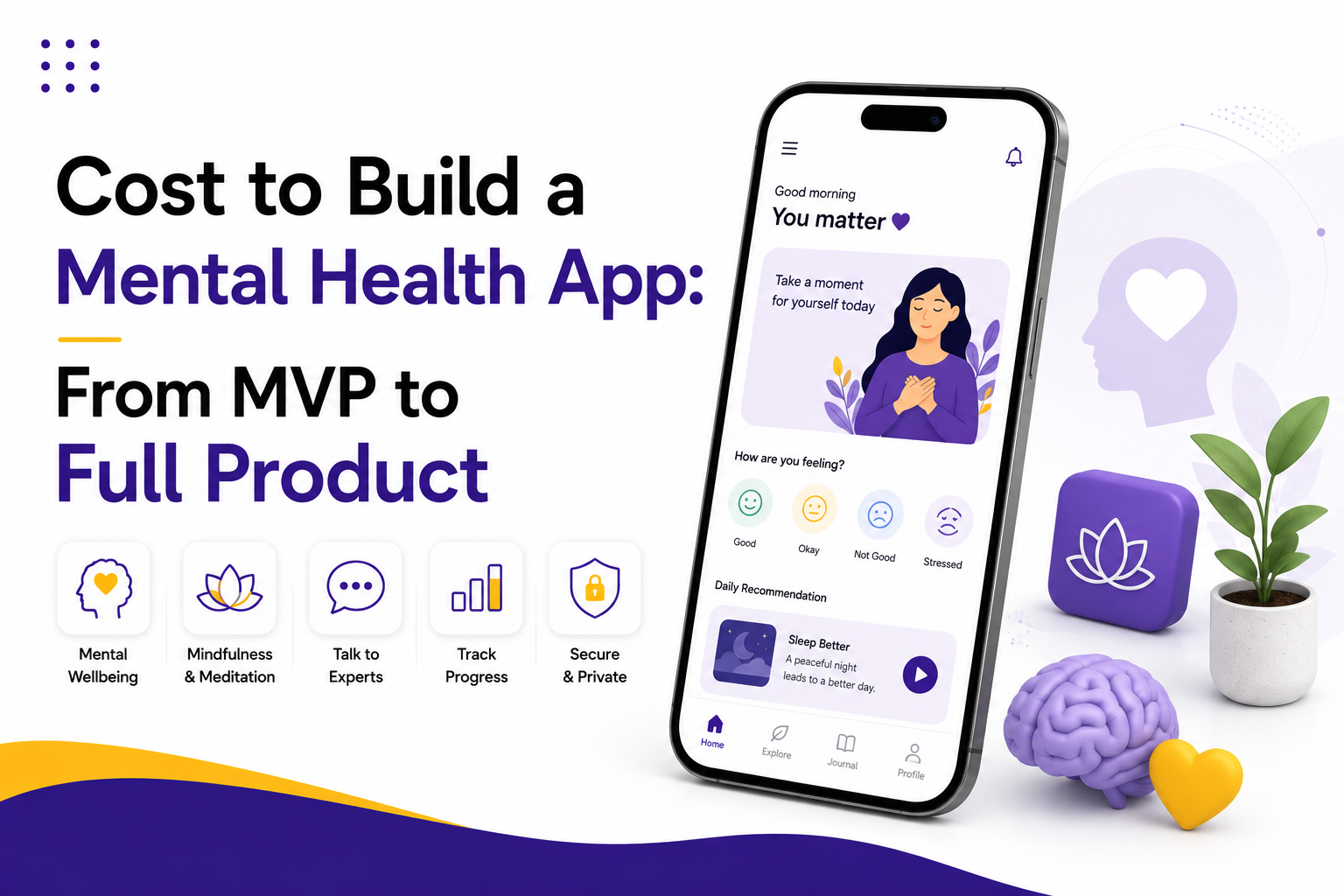

Mental health app downloads crossed 500 million globally in 2025, and the market is on track to hit $17.5 billion by 2030. Founders are paying attention. So are investors. But here is the question that actually matters before you commit to building one: how much does it cost, and what are you really paying for?
The answer is not a single number. The cost to build a mental health app depends on what you want the product to do, who you hire to build it, how fast you need to move, and how seriously you take compliance from day one. Someone who cuts corners on HIPAA in year one often spends twice as much fixing it in year two.
This guide covers everything. What a mental health app actually is, what sections and features it needs, what compliance licenses you have to get, how AI changes the cost equation, and what a realistic budget looks like from a lightweight MVP all the way to a fully loaded product. No vague ranges. No padding. Just a clear breakdown you can actually use to plan.
What Is a Mental Health App and What Does It Do?
A mental health app is a digital platform that helps users manage their psychological and emotional wellbeing. It can serve individuals dealing with anxiety, depression, PTSD, or stress. It can support therapists and counselors in managing their client relationships. It can serve enterprises offering employee assistance programs. Or it can do all three.
There are four broad categories of mental health apps:
- Self Guided Wellness Apps
Think Calm or Headspace. These offer guided meditations, breathing exercises, mood journaling, sleep content, and cognitive behavioral therapy (CBT) exercises. No clinician in the loop. These are the most affordable to build and the least regulated. - Therapist Marketplace Apps
Think BetterHelp or Talkspace. These connect users with licensed therapists for text, audio, or video sessions. They require robust therapist verification workflows, scheduling engines, and secure messaging infrastructure. - Condition Specific Apps
Apps targeting a single condition like OCD, eating disorders, or substance recovery. These often partner with clinical institutions and require a higher standard of evidence for their interventions. - Enterprise Mental Health Platforms
B2B products sold to employers or insurers that offer mental health support to employees as a benefit. These come with SSO integrations, admin dashboards, utilization reporting, and contractual SLA requirements.
Most founders start with category one or two, build an MVP, and expand from there. The features you choose within those categories drive the majority of your cost.
Core Sections and Features Your App Needs
Here is a practical breakdown of every section a mental health app typically requires, along with what each one involves at a development level.
- User Onboarding and Profile Setup
The first screen a user sees sets the tone for their entire experience. Good onboarding for a mental health app is not just registration. It includes a mental health intake assessment, goal setting, preference configuration, and notification opt in. You need a secure account creation flow with email or phone verification, optional social sign in, and a well designed user profile that stores sensitive information securely. For apps targeting therapist matching, onboarding also pulls initial data that feeds a matching algorithm. - Mood and Symptom Tracking
This is the core feature of most mental health apps. Users log how they feel daily or multiple times a day. You need an intuitive logging interface, a history view with charts and trends, custom mood labels, optional journaling fields linked to mood entries, and reminder notifications. For clinical apps, symptom tracking may use standardized tools like PHQ-9 for depression or GAD-7 for anxiety, and the output feeds into therapist dashboards. - Content Library
A curated library of therapeutic content: guided meditations, breathing exercises, psychoeducation articles, CBT worksheets, and video sessions with licensed therapists or psychologists. This section requires a content management system (CMS) on the backend, a search and filter interface, progress tracking per content piece, and offline access capability for premium users. The cost here is split between content creation (which can be significant) and the engineering to serve and manage it. - Therapist and Coach Matching
For marketplace style apps, the matching engine is a major feature. Users answer questions about their needs, preferences, and history. The algorithm (or sometimes a manual team) presents therapist matches. Once matched, users can view therapist profiles, read bios, check availability, and book sessions. This requires a therapist facing onboarding and verification system, credential validation, calendar integrations, and a client and therapist relationship management layer. - Video, Audio, and Text Sessions
Real time communication is non negotiable for therapy apps. Building it requires HIPAA compliant video infrastructure (you cannot just embed Zoom), end to end encrypted messaging, asynchronous messaging for text based therapy plans, session recording and transcription for clinical review, and call quality monitoring. Vendors like Twilio, Daily.co, or Vonage provide SDKs that reduce build time but still require significant configuration for compliance. - Progress Tracking and Goals
A goals module helps users set and track personal mental health goals over time. This might include weekly check ins, milestone badges, streaks, and personalized recommendations based on progress. The UX here significantly affects user retention, so investment in good design pays off. - Notifications and Reminders
Behavioral triggers are a key part of mental health app efficacy. Push notifications, in app nudges, SMS reminders, and email sequences all require a notification pipeline, user preference management, and time zone handling. For clinical apps, crisis detection logic can trigger escalation alerts. - Payments and Subscriptions
Subscription billing for consumer apps, or session based billing for therapy marketplaces. You need Stripe or Braintree integration, plan management, free trial logic, refund handling, receipt generation, and an admin panel for finance teams. For B2B apps, invoicing and contract management replace the standard checkout flow. - Admin Dashboard
Every mental health app needs a backend admin panel. At minimum, this covers user management, content publishing, flagging and moderation, basic analytics, and support ticket access. For clinical apps, the admin layer expands into compliance audit logs, therapist management, session oversight, and reporting tools for enterprise clients.
Compliance, Licensing, and Legal Requirements
This is where founders underestimate costs the most. Regulatory compliance is not optional for mental health apps. Getting it wrong does not just cost money. It ends companies.
- HIPAA Compliance (USA)
If your app stores or transmits any protected health information (PHI), you are covered by HIPAA. This means you need technical safeguards (encryption at rest and in transit, access controls, audit logs), administrative safeguards (workforce training, documented policies), and signed Business Associate Agreements (BAAs) with every vendor who touches PHI. Your cloud provider, database vendor, messaging service, video SDK, and analytics tool all need BAAs if they handle health data.
AWS, Google Cloud, and Azure all offer BAA eligible plans, but configuration matters. A HIPAA compliance audit from a qualified consultant typically costs $15,000 to $40,000. Ongoing compliance maintenance adds $5,000 to $15,000 per year. - FDA Regulation
If your app makes diagnostic or treatment claims (for example, "this app treats depression"), the FDA may classify it as a Software as a Medical Device (SaMD). Apps that only provide wellness information or general coping tools typically fall outside FDA purview. But if your app uses AI to detect a condition or recommend a clinical intervention, you may need a 510(k) clearance. That process typically costs $50,000 to $200,000 and takes 6 to 18 months. Most early stage founders structure their product to stay outside this definition. - GDPR and International Privacy Laws
If you have users in the EU, GDPR applies. You need explicit consent for data collection, a right to erasure mechanism, data portability, and a documented data processing register. Similar laws apply in Canada (PIPEDA), Australia (Privacy Act), and India (DPDP Act 2023). Legal counsel for privacy policy and terms of service drafting: $5,000 to $20,000 depending on jurisdiction scope. - Telehealth Licensing
If your app facilitates therapy sessions, you may need telehealth operating licenses in each state or country where you operate. In the US, therapists must be licensed in the state where the patient is located. Your platform needs to enforce this. The legal and operational cost of managing multi state therapist licensing varies but adds meaningful overhead to a marketplace model. - App Store Medical Category Rules
Apple and Google both have specific requirements for apps in the health and medical categories. Both require privacy nutrition labels, accurate health data declarations, and compliance with their health data policies. Violations result in app rejection or removal. Budget for legal review before your first app store submission. - AI Integration and What It Costs
AI has moved from a differentiator to a baseline expectation in mental health apps. Here is what founders are actually building in 2026, and what each capability costs.
AI Powered Mood Analysis
Using natural language processing to analyze journal entries or free text inputs and surface emotional patterns. Powered by models like GPT-4o, Claude 3.5, or fine tuned open source models. You pay per token for API usage, plus engineering time to build the analysis pipeline, and UX time to surface the insights meaningfully. Monthly API costs for a product with 10,000 active users running daily journal analysis: roughly $2,000 to $8,000 depending on input volume and model choice.
- AI Chatbot and Conversational Support
An AI companion that can respond to user messages with empathetic, evidence based responses. This is not therapy and must be labeled as such. Building a safe, effective chatbot requires prompt engineering, safety guardrails, crisis detection logic, escalation pathways to human support, and extensive red teaming. Development cost: $30,000 to $80,000 to build responsibly. Cutting corners here is a liability risk. - Crisis Detection and Escalation
Machine learning models trained to detect crisis signals in user inputs (references to self harm, suicidal ideation, acute distress) and trigger appropriate responses: an in app safety plan, a human escalation queue, or emergency contact prompts. This is technically and ethically complex. You need mental health professionals involved in the design, a clinical review process for the model outputs, and rigorous testing. This feature alone can add $40,000 to $100,000 to your development budget but is worth it from a safety and liability standpoint. - Therapist Matching Algorithm
A matching engine that considers user preferences, therapist specializations, availability, communication style, and historical match quality. Early versions use rules based logic. More sophisticated versions use collaborative filtering or reinforcement learning. Cost range: $20,000 to $60,000 for a well built matching system. - Personalization Engine
Recommendations for content, exercises, and therapists based on user behavior and progress data. Requires a data pipeline, a recommendation model, and real time serving infrastructure. Cost: $25,000 to $70,000 depending on sophistication. - AI Session Summaries and Notes
For therapy marketplace apps, AI that summarizes session transcripts and auto populates therapist notes. This requires transcription (via Whisper or Deepgram), summarization (via LLM), and HIPAA compliant handling of the transcript data. Reduces therapist admin time significantly and is becoming a strong selling point for marketplace platforms.
Tech Stack and Third Party Tools
The technology choices you make affect cost, speed, scalability, and compliance. Here is what a production grade mental health app typically uses in 2026.
Development Team and What Each Role Costs
Here is the team you need and typical hourly rate ranges depending on where you hire.
Most funded startups hire a blended team: a product lead or CTO in house, and development outsourced to an agency or distributed team to control costs without sacrificing quality.
Team Composition: Who You Need and When
The team you assemble changes significantly depending on what stage you are building at. Hiring too many people too early is one of the fastest ways to burn a budget before you have a validated product. Here is how team composition typically looks across three stages.
MVP Stage Team (3 to 5 Months)
Growth Stage Team (Post MVP, Scaling Features)
Full Product Stage Team (Enterprise Ready Platform)
App Development Phases and Cost Per Phase
Understanding the cost to build a mental health app becomes clearer when you break the work into distinct phases. Every phase has a defined output, a team involved, and a realistic budget range. Rushing any phase typically creates debt you pay back later at higher cost.
Phase 1: Discovery and Planning
Duration: 2 to 4 weeks. This is where the product is defined before a single line of code is written. The output of this phase is a clear product specification, a technical architecture document, a compliance strategy, and a prioritized feature list for the MVP. Skipping this phase is the single most common reason mental health app projects go over budget.
Phase 2: UI/UX Design
Duration: 3 to 6 weeks. A mental health app lives or dies by its design. Users in distress have low tolerance for confusing navigation or cluttered screens. This phase produces high fidelity mockups for every screen, a design system, accessibility review, and a clickable prototype for stakeholder sign off before development begins.
Phase 3: Backend and Infrastructure Development
Duration: 6 to 12 weeks. The backend is the engine of your app. This phase builds the API layer, database schema, authentication system, HIPAA compliant data storage, third party integrations (video SDK, payment gateway, notification service), and the DevOps infrastructure that hosts it all. For clinical apps, this is also when the audit logging and access control systems are built.
Phase 4: Frontend and Mobile Development
Duration: 8 to 14 weeks. This phase builds what users actually interact with: the mobile apps (iOS and Android), the web portal if applicable, and the admin frontend. Each screen from the design phase gets coded, connected to the backend APIs, and tested for responsiveness and performance. For cross platform builds using React Native or Flutter, iOS and Android are developed in parallel.
Phase 5: AI Feature Development
Duration: 4 to 10 weeks (runs partially in parallel with Phase 4 for larger builds). This phase builds and integrates whatever AI capabilities are in scope: mood analysis, chatbot, crisis detection, personalization engine, or session summaries. Each feature requires model selection, API integration, prompt engineering, safety testing, and clinical review of outputs before going live.
Most MVP builds include only one or two AI features. The full range above applies to a mature platform building multiple AI capabilities simultaneously.
Phase 6: Quality Assurance and Security Testing
Duration: 3 to 5 weeks. For a mental health app, QA is not just about finding bugs. It includes functional testing of every user flow, performance testing under load, security testing for data exposure vulnerabilities, penetration testing of the API layer, and HIPAA technical safeguard validation. This phase often uncovers compliance gaps that need resolution before the compliance audit in Phase 7.
Phase 7: Compliance Audit, Legal, and Launch Preparation
Duration: 3 to 6 weeks. This is the final gate before going live. It includes the formal HIPAA compliance audit, BAA execution with all vendors, privacy policy and terms of service finalization, app store submission and review, and a soft launch plan. For apps targeting clinical workflows, this phase also includes clinical advisory review of all AI outputs and crisis protocols.
Total Development Cost Summary by Phase
An MVP build typically covers Phases 1 through 4 plus Phase 6 and Phase 7, with limited AI work in Phase 5. A full product build runs all seven phases with a significantly expanded Phase 5.
MVP vs. Full Product Cost Breakdow
MVP: 3 to 5 Months Build Time
An MVP for a mental health app is not a rough prototype. It is a functional, compliant, safe product that delivers core value to real users. For a self guided wellness MVP, this means: user onboarding and assessment, mood tracking with journaling, a basic content library with 10 to 20 pieces of content, push notifications, subscription billing, and an admin dashboard.
For a therapy marketplace MVP (matching, video sessions, messaging, and therapist profiles), add $40,000 to $80,000 on top of the above.
Full Product: 8 to 18 Month Build Time
A fully featured mental health platform includes everything in the MVP plus AI features, advanced analytics, enterprise admin tools, therapist marketplace, multi platform support, and integration with EHR systems or employer SSO.
These are build costs. They do not include ongoing operational costs, which typically run $8,000 to $30,000 per month for a live product with real users, covering cloud infrastructure, third party APIs, support staff, and maintenance.
Hidden Costs Most Founders Miss
- Content Moderation and Safety Monitoring
Mental health platforms attract vulnerable users. You need human moderators reviewing flagged content, a crisis response protocol, and relationships with crisis services. This is an ongoing operational cost that most founders do not budget for upfront. - Therapist Verification and Onboarding
For marketplace apps, verifying therapist credentials is not a one time task. It is an ongoing process requiring license verification APIs (like NPI Registry in the US), background check services, and a manual review team. Initial setup: $10,000 to $25,000. Ongoing: $2,000 to $8,000 per month depending on volume. - Insurance Reimbursement Integration
If you want therapists on your platform to accept insurance, you need to integrate with clearinghouses and billing systems. This is a multi month project costing $30,000 to $80,000 and adds significant operational complexity. Most early stage platforms defer this and focus on out of pocket pay first. - Localization and Accessibility
Launching in multiple markets requires translation of UI strings, content, and legal documents. Accessibility compliance (WCAG 2.1 AA) for users with disabilities adds design and development work. Combined budget: $10,000 to $40,000 per additional market. - App Store Fees and Distribution
Apple takes 15% to 30% of subscription revenue. Google Play takes 15% to 30%. If subscriptions are your primary revenue model, this is a meaningful cost to factor into unit economics, not just build costs.
Factors That Most Affect Your Final Cost
- Scope
Every feature you add multiplies cost. The most common mistake is building too much in the first version. AI chatbot, video sessions, a content library, mood tracking, and a therapist marketplace in V1 is a $600,000 decision minimum, not a $150,000 one. - Team Location
Building with a US based team versus an Indian or Eastern European team can change your total cost by 2x to 4x for the same scope. Quality varies within each region, so team selection matters more than geography. - Compliance Depth
An app that only handles wellness data and no PHI is far cheaper to make compliant than one that runs clinical workflows. Know which category you are building in before you start. - AI Ambition
Basic AI features (sentiment tagging, content recommendations) add $30,000 to $60,000. A full AI companion with crisis detection, personalized therapy pathways, and session intelligence adds $150,000 to $300,000 or more. - Design Quality
Mental health apps have higher than average design requirements because the users are often in distress. Poor UX is a functional problem, not just an aesthetic one. Underinvesting here shows up in retention data.
Conclusion
The cost to build a mental health app is not a number you can pull from a pricing page or a competitor's pitch deck. It is the result of about a hundred decisions: what features you build, who you trust to build them, how seriously you treat compliance from the start, and how much AI you genuinely need versus how much sounds impressive in a deck.
Founders who do this well tend to have two things in common. They build a smaller first version than they originally planned, and they treat HIPAA and user safety as architecture decisions rather than afterthoughts. The ones who skip those steps usually rebuild within 18 months, and that rebuild costs more than doing it right the first time.
If you are at the budget planning stage, the most useful thing you can do is get a detailed technical scoping session with a development team that has actually shipped mental health or healthcare apps before. Generic estimates will mislead you. Scope specific estimates will not.
The market is large, the need is real, and the business models work. The product decisions you make now determine whether your build budget gets you to market or gets you stuck.