
Business leaders in 2025 are not asking whether automation is necessary; the real question is how much of it can be powered by AI without compromising customer experience. While automation is no longer new, the way it is being shaped by AI-powered bot platforms has unlocked new possibilities. From handling routine queries to orchestrating end-to-end workflows, bots have matured into intelligent assistants that businesses can no longer overlook.
This blog explores the best AI chatbot platforms 2025 has to offer, their role in automation, and the unique features that set them apart. Instead of just naming tools, we’ll focus on fresh perspectives—where each platform fits, what problems they solve, and how businesses should think about automation in the coming years.
Why AI-Powered Bots Matter for Business Automation
Automation has always been about efficiency. But the introduction of AI-powered bots has shifted the focus toward experience-driven automation. The difference lies in how these bots can understand intent, adapt in real time, and integrate across business functions.
Here’s why they matter:
Scalability with consistency: A growing business can serve thousands of customers without diluting quality.
Human-like interactions: Natural Language Processing (NLP) ensures bots no longer sound robotic; they understand context and intent.
Operational efficiency: Tasks that once required full-time staff—appointment scheduling, product recommendations, HR FAQs—can now be managed autonomously.
Cross-functional use: Unlike early bots limited to customer service, today’s business automation tools extend to sales, IT, supply chain, and employee engagement.
In short, AI bots are not just customer-facing helpers—they are becoming the connective tissue of digital business operations.
Features to Look for in an AI-Powered Bot Platform
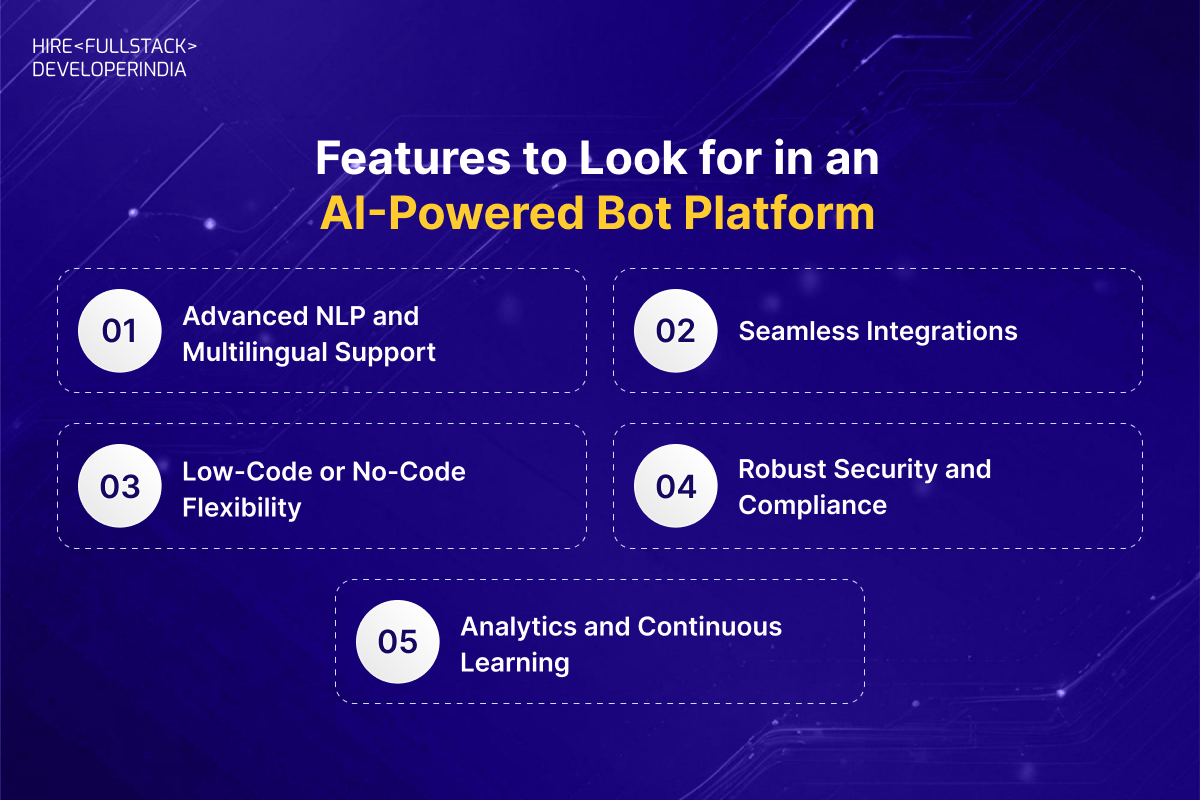
Not all bots are created equal. With so many options available, it’s important to know what differentiates a powerful platform from a generic chatbot. Some features businesses should prioritize in 2025 include:
Advanced NLP and Multilingual Support
The ability to understand complex intent, local dialects, and industry-specific jargon is crucial, especially for global businesses.
Seamless Integrations
A bot that lives in isolation has limited impact. The best AI bots for businesses integrate with CRMs, ERPs, collaboration tools like Slack or Microsoft Teams, and customer touchpoints like WhatsApp and Messenger.
Low-Code or No-Code Flexibility
Business teams need to design and adjust workflows without always relying on IT. Platforms offering drag-and-drop bot builders are gaining ground.
Robust Security and Compliance
With data privacy under scrutiny, bots must be GDPR, HIPAA, or SOC-2 compliant depending on industry.
Analytics and Continuous Learning
Beyond responding, bots should provide insights into customer behavior, bottlenecks, and opportunities for optimization.
Best AI-Powered Bot Platforms for Business Automation in 2025
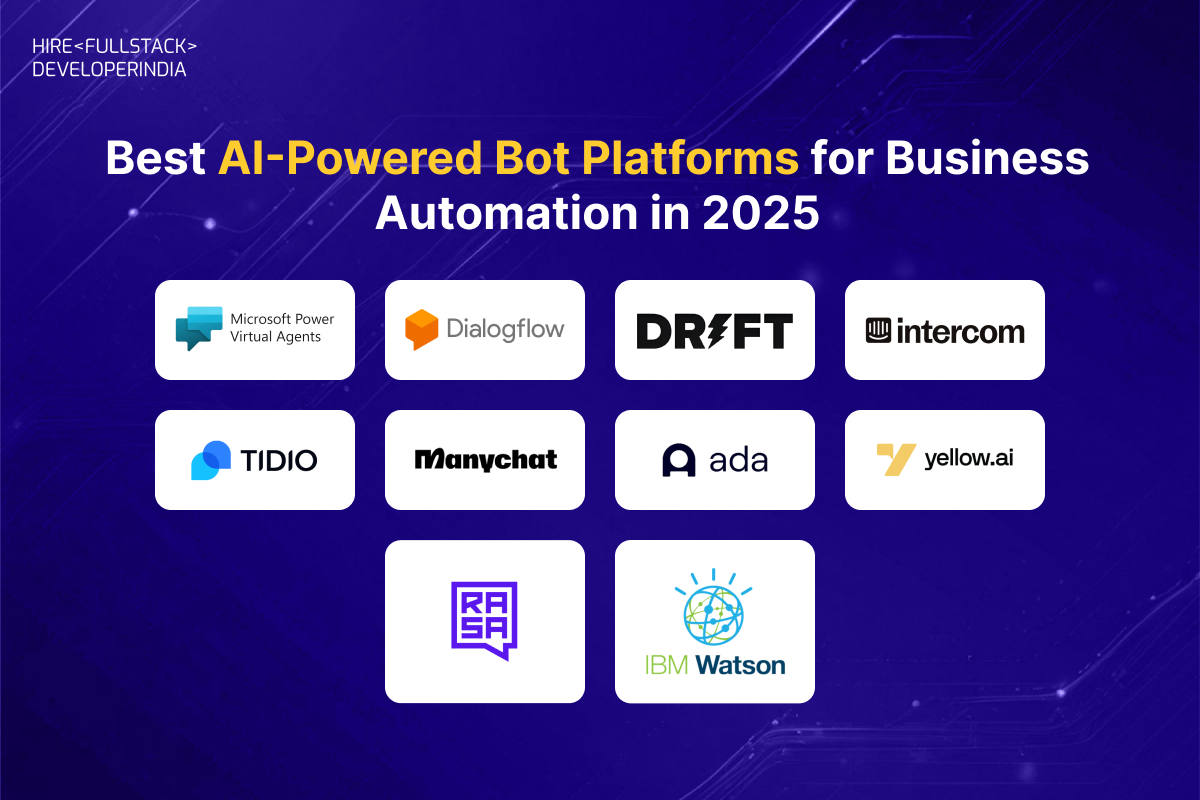
With so many AI chatbot platforms 2025 competing for attention, businesses need clarity—not just names, but how each solution fits into real-world needs. Below is a closer look at some of the best AI bots for businesses, along with their core strengths and ideal use cases.
1. Microsoft Power Virtual Agents
Microsoft’s Power Virtual Agents is an enterprise-focused bot platform that enables companies to create intelligent chatbots without heavy coding. Since it integrates seamlessly with Microsoft Teams, Dynamics 365, and Azure, it’s particularly attractive to businesses already working within Microsoft’s ecosystem.
The platform supports advanced NLP for better contextual understanding and comes with built-in analytics to measure performance. Companies can use it for customer service, employee self-service, or internal IT help desks. Its real differentiator is how it allows non-developers—like HR teams or customer service managers—to build bots quickly using a low-code interface.
Why it stands out: It combines AI-driven intelligence with Microsoft’s enterprise-grade security, making it a safe bet for businesses scaling automation across departments.
2. Google Dialogflow CX
Dialogflow CX is Google’s advanced conversational AI platform designed for more complex, multi-step interactions. Unlike simple bots that answer FAQs, Dialogflow CX can manage conversations with branching flows—ideal for industries like travel, telecom, or healthcare where interactions often involve multiple layers.
It supports over 30 languages, integrates with Google Cloud services, and comes with strong NLP capabilities thanks to Google’s AI research. One of its strengths is voice integration, which makes it suitable for businesses adopting voice-based automation alongside chat.
Why it stands out: It’s built for businesses that need intelligent, multilingual bots capable of managing intricate customer journeys across multiple channels.
3. IBM Watson Assistant
IBM Watson Assistant has been around long enough to earn credibility in enterprise AI. Known for its reliability, Watson goes beyond customer queries to integrate into workflows and enterprise applications. It allows businesses to build bots that can handle context switching—meaning they can keep track of conversations even when customers jump between topics.
What makes Watson strong is its ability to integrate with existing legacy systems—something that many AI platforms struggle with. It also places a strong emphasis on data privacy and compliance, making it suitable for heavily regulated industries.
Why it stands out: It’s built for enterprises that cannot compromise on reliability, compliance, and integration with older systems.
4. Drift
Drift isn’t trying to be everything to everyone. Instead, it focuses squarely on sales and marketing automation. The platform is designed to capture leads, qualify them, and even schedule sales meetings in real time. By analyzing visitor behavior on websites, Drift bots can engage at the right time and provide context-aware suggestions.
For example, a potential customer browsing pricing pages might get a proactive message offering help or booking a demo. This direct tie to revenue impact makes Drift more than just a support tool—it becomes a sales growth engine.
Why it stands out: It’s one of the few AI-powered bot platforms built specifically for revenue teams, not just customer support.
5. Intercom (Fin AI)
Intercom has long been known as a customer messaging platform, but its Fin AI bot has elevated its role in automation. Fin AI helps businesses scale customer support by resolving repetitive queries instantly while escalating complex cases to human agents.
Its strength lies in conversational smoothness. Fin AI doesn’t just respond—it can use knowledge bases, FAQs, and documentation to provide meaningful answers. For SaaS companies, it can handle onboarding tasks like explaining features or guiding customers through setup.
Why it stands out: It blends automation with human handoffs seamlessly, making customer experiences smooth and frustration-free.
6. Tidio
Tidio is designed for small and mid-sized businesses looking for affordable yet powerful business automation tools. It combines live chat with AI-powered chatbots, enabling businesses to engage customers across websites, Messenger, and Instagram.
What makes Tidio appealing is its simplicity. It doesn’t overwhelm users with complex features but still provides automation workflows for abandoned cart recovery, order tracking, or FAQ handling. For e-commerce stores, it can directly boost conversions while reducing support load.
Why it stands out: It’s a cost-effective option that gives SMEs enterprise-like automation without enterprise-level costs.
7. ManyChat
ManyChat has carved a niche in social media automation. It’s particularly strong on Facebook Messenger, Instagram, and WhatsApp, where businesses often engage customers in real time. ManyChat bots are easy to design and come with pre-built templates for marketing campaigns, lead generation, and customer engagement.
For businesses relying on social commerce, ManyChat acts like a 24/7 social media assistant—replying instantly, capturing leads, and nurturing them. It’s especially popular among e-commerce and digital marketing agencies.
Why it stands out: No other platform has such a strong focus on marketing-driven automation across social platforms.
8. Ada
Ada markets itself as a no-code AI chatbot platform that allows business users—not developers—to create automation workflows. It’s used widely by enterprises that want to free up IT resources while giving business units the power to innovate.
Ada’s AI continuously learns from interactions, improving over time. It supports multiple languages, omnichannel deployments, and advanced personalization. Companies use it not just for external customer service but also for internal automation—like IT troubleshooting or HR queries.
Why it stands out: Its no-code approach empowers non-technical staff to design and deploy bots, making automation accessible across the organization.
9. Rasa
Rasa is an open-source AI bot platform that gives businesses full control over customization and data ownership. Unlike SaaS-based platforms, Rasa can be hosted on-premise, ensuring higher security and compliance. Developers can design sophisticated conversational flows and tailor NLP models to specific industries.
For example, a financial services company concerned about data leaks can host Rasa internally while customizing bots for regulatory needs. While it requires more technical expertise, the flexibility it provides is unmatched.
Why it stands out: It’s ideal for organizations that prioritize data security, customization, and control over their automation systems.
10. Yellow.ai
Yellow.ai positions itself as a “total experience automation” platform, combining conversational AI with human-like interactions. It supports text, voice, and omnichannel communication, making it suitable for global enterprises with diverse customer touchpoints.
Its standout feature is hybrid automation—where bots handle routine queries and seamlessly transfer complex cases to human agents with full context. Industries from banking to retail use Yellow.ai to deliver consistent support experiences while keeping costs in check.
Why it stands out: Its balance between automation and human intervention makes it versatile across industries and customer touchpoints.
Challenges with AI Bots
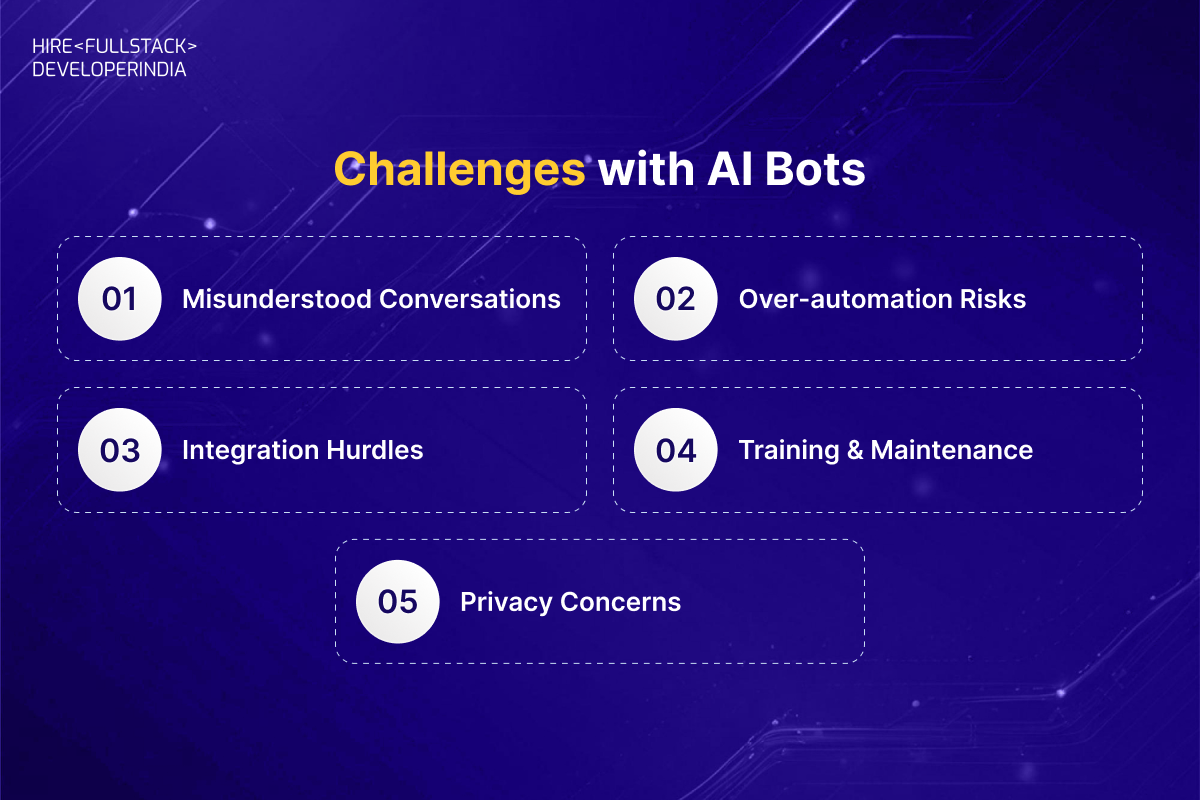
While AI-powered bots have become smarter than ever, they’re not perfect. Businesses need to be aware of a few challenges before depending on them completely:
Misunderstood Conversations: Even with advanced NLP, bots can still get confused by slang, sarcasm, or very complex queries. This sometimes leads to awkward or irrelevant responses.
Over-automation Risks: If companies push everything to bots, customers may feel frustrated when they can’t reach a human easily. Striking the right balance between automation and human support is important.
Integration Hurdles: Connecting bots with existing CRMs, ERPs, or legacy systems isn’t always smooth. It may require technical expertise and additional time.
Training & Maintenance: Bots aren’t “set-and-forget.” They need continuous training and updates to stay effective as business processes, customer needs, and products change.
Privacy Concerns: Since bots often handle sensitive customer data, businesses must ensure compliance with data security and privacy laws.
In short, bots are powerful business automation tools, but they work best when businesses understand their limits and plan for human backup, strong integration, and ongoing monitoring.
That said, these challenges aren’t roadblocks—they’re simply reminders that bots need the right setup and strategy to shine. With thoughtful training, proper integrations, and a balanced mix of human and AI support, businesses can turn these limitations into opportunities. In fact, companies that actively fine-tune their AI bots often see better customer satisfaction, smoother operations, and higher returns from their business automation tools.
Comparing Platforms: Which One Is Right for You?
Choosing from the best AI bots for businesses depends on aligning platform strengths with business priorities:
- Enterprises with existing Microsoft or Google ecosystems benefit from their native platforms.
- Regulated industries find IBM Watson or Rasa better suited.
- Startups and SMEs may find Tidio or ManyChat more accessible.
- Sales-driven companies get value from Drift or Intercom.
- Businesses seeking no-code empowerment lean toward Ada or Yellow.ai.
Instead of chasing the most advanced option, businesses should ask: Which platform fits our workflows, industry, and long-term automation strategy?
Future of AI-Powered Bots in Business Automation
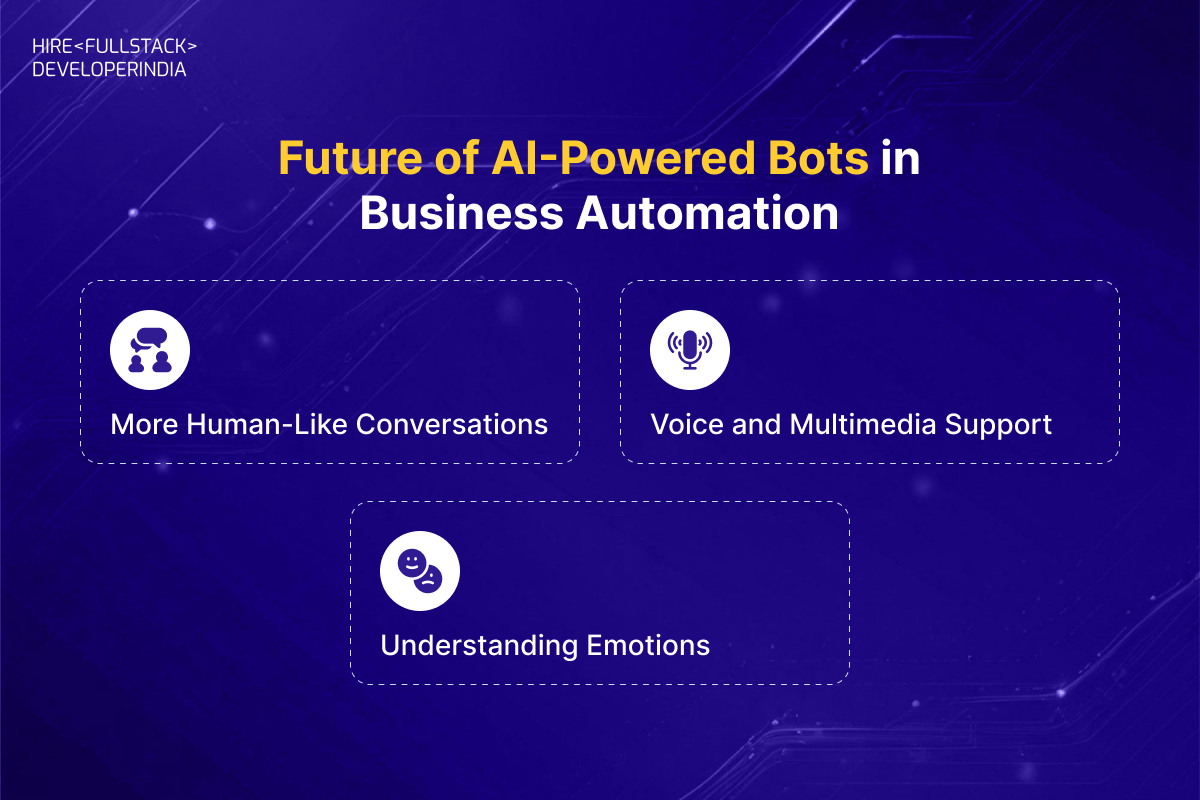
2025 is just the start of a deeper shift. The future of AI bots isn’t limited to answering questions—it’s about decision-making and prediction. Here are some trends reshaping the space:
More Human-Like Conversations: With Generative AI, bots will be able to create replies that sound natural, personal, and closer to how humans actually talk.
Voice and Multimedia Support: Bots won’t just chat in text. They’ll handle voice, images, and even videos—making interactions more interactive and flexible.
Understanding Emotions: Future bots may be able to sense whether a customer is upset, happy, or in a hurry and adjust their tone and responses to match the mood.
The real frontier is bots becoming co-pilots—helping employees and customers alike navigate complex processes without friction.
Conclusion
AI bots have moved beyond being “nice-to-have” chat widgets. In 2025, they are core business automation tools shaping efficiency, customer satisfaction, and scalability. From Microsoft’s enterprise-ready bots to Rasa’s customizable framework and Drift’s revenue-focused approach, each platform serves a unique purpose.
The key is not to pick the “most popular” tool but to identify the AI chatbot platforms 2025 that align with your size, sector, and long-term goals. Businesses that integrate bots thoughtfully will gain more than cost savings—they’ll build resilient, adaptive operations prepared for the future.