
Ask a room full of executives in 2027 whether generative AI is "worth the hype," and you'll get a different answer than you would have gotten even a year earlier. Back then it was a bet. Now it's infrastructure. Analysts at Grand View Research value the global generative AI market at roughly $161 billion in 2026, on a trajectory toward well over $1 trillion by the mid-2030s — a compound annual growth rate north of 39%. Gartner has separately projected that close to 80% of enterprises would be running generative AI inside mission-critical workflows by this point, not just pilot projects tucked away in an innovation lab.
What changed? The tools stopped being toys. A sales team can spin up hundreds of personalized outreach emails before lunch. A legal team can get a first pass on a 100-page contract in minutes instead of a weekend. A support team can resolve a ticket without a human touching it. Generative AI tools for enterprise use have moved from "nice to have" to a genuine line item in the productivity strategy — and the tools built specifically for business, not just consumer chat, are where the real ROI shows up.
This guide walks through the enterprise AI tools 2027 companies are actually adopting — the established players, the ones that quietly became essential, and what to watch out for before you commit budget.
Generative AI in the Enterprise, By the Numbers
- The enterprise-specific slice of the generative AI market was valued at roughly $2.9 billion in 2024 and was projected to reach about $5.2 billion in 2026 on its way to nearly $19.8 billion by 2030 — a CAGR above 38%, according to Grand View Research.
- Across the broader generative AI market, most major forecasts put 2026 revenue somewhere between $80 billion and $160 billion, depending on methodology, with growth rates consistently in the 30–40% CAGR range through the early 2030s.
- McKinsey-linked projections estimate generative AI could generate roughly $434 billion in yearly enterprise value by 2030, with retail and ecommerce alone expected to capture close to a third of that value.
- OpenAI held an estimated 23.6% share of the generative AI market in 2025, with the top five vendors — OpenAI, Anthropic, NVIDIA, Adobe, and Microsoft — together controlling more than half the market.
- Analysts widely expect Asia-Pacific to overtake North America as the fastest-growing regional market for enterprise generative AI around 2027, driven by large-scale industrial and enterprise adoption in China and the broader region.
- Large enterprises have moved fast on rollout scale: late-2025 deals alone saw major IT services firms commit to more than 200,000 combined Copilot licenses in a single wave of adoption.
The pattern across nearly every forecast is the same: growth isn't slowing down, and the center of gravity is shifting from single-purpose writing tools toward agentic systems that can complete entire multi-step tasks — which is exactly where most of the tools below are headed.
Why Enterprises Are Doubling Down on Generative AI in 2027
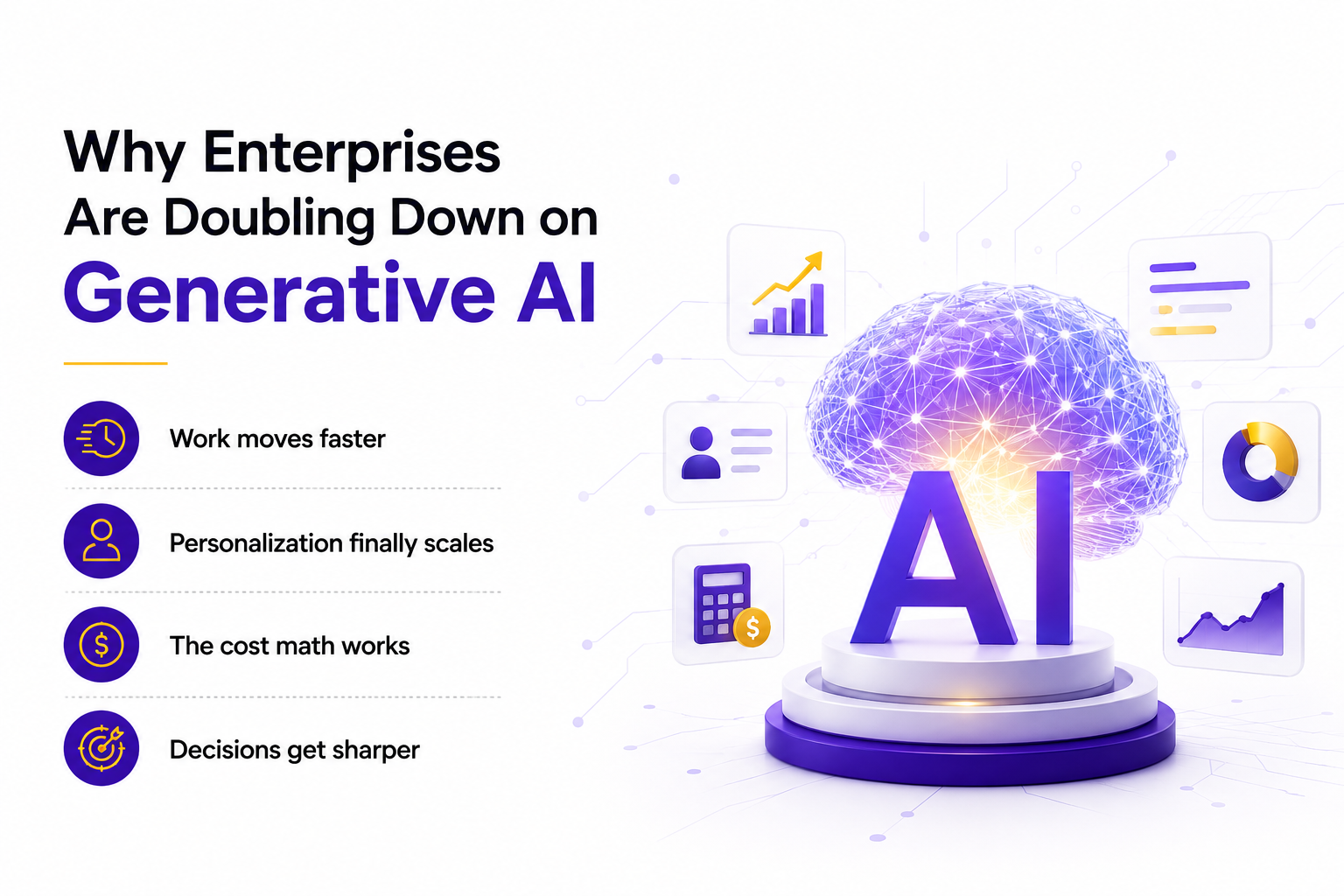
A few reasons keep showing up in every conversation with IT leaders and department heads:
Work moves faster. Drafting a report, building a campaign brief, or summarizing a meeting used to eat hours. Now it eats minutes, freeing people to focus on judgment calls instead of first drafts.
Personalization finally scales. Writing one great email is easy. Writing a thousand that each feel personal used to be impossible without a huge team. AI closes that gap.
The cost math works. Instead of adding headcount for repetitive work, teams route it through AI and reserve hiring for the parts that actually need a human.
Decisions get sharper. AI can chew through a dense report and hand back the three things that matter, which means less time reading and more time deciding.
What Makes an AI Tool Actually Enterprise-Ready
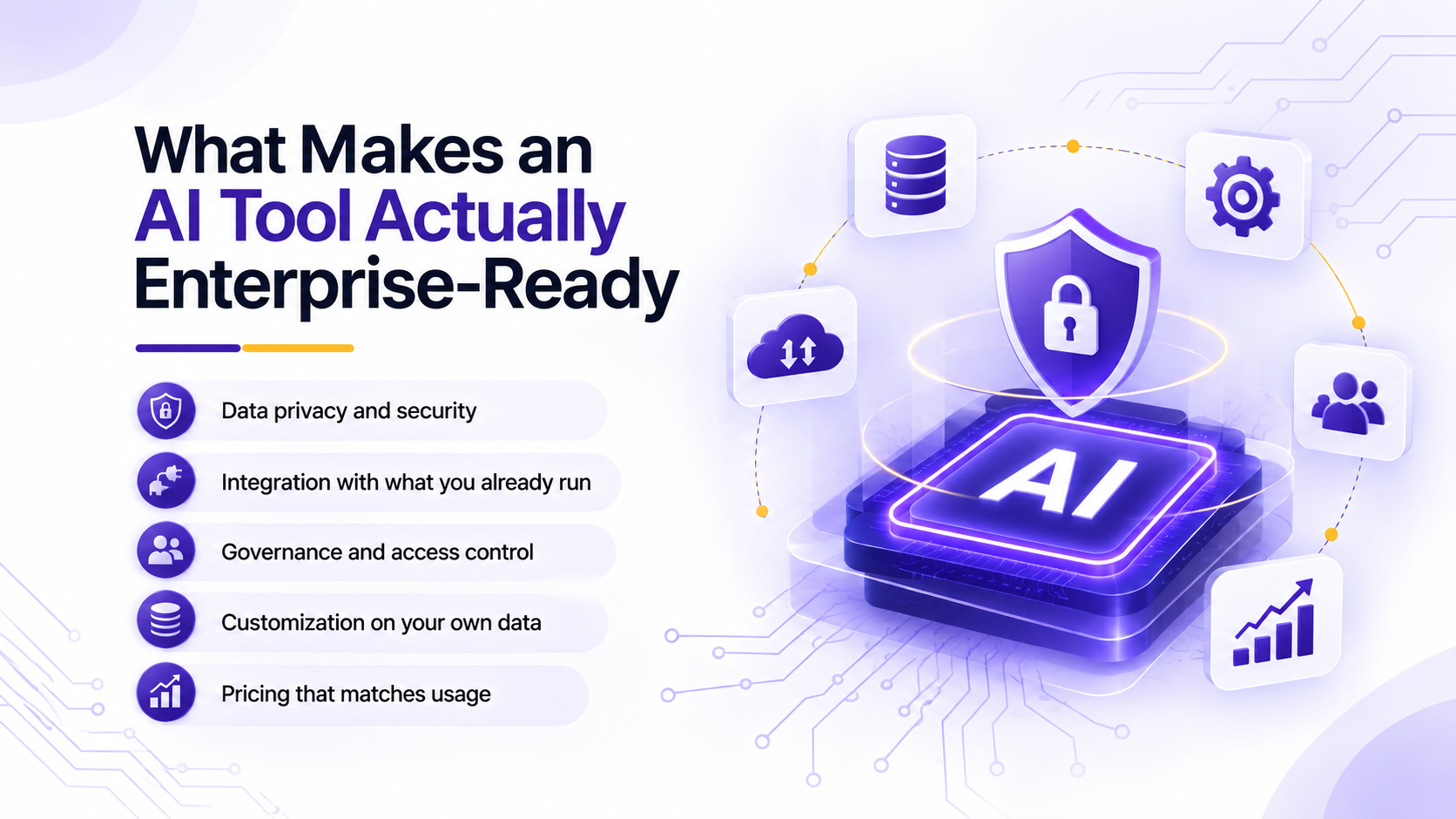
Not every AI product marketed to "teams" holds up under real enterprise scrutiny. Here's what separates the tools worth paying for from the ones that will get flagged by your security team in month one:
Data privacy and security. GDPR, HIPAA, SOC 2 — whatever applies to your industry, the tool needs to meet it, and it should not be training on your proprietary data by default.
Integration with what you already run. A tool that can't talk to your CRM, your email platform, or your internal knowledge base creates more work than it saves.
Governance and access control. Multiple users means you need role-based permissions, admin visibility, and an audit trail — not just a shared login.
Customization on your own data. Generic outputs don't cut it once you're operating at scale. The tool should be trainable on your voice, your policies, and your knowledge base.
Pricing that matches usage. Flexible or usage-based plans beat flat enterprise contracts that charge you for seats nobody touches.
The Best Generative AI Tools for Enterprise in 2027
1. ChatGPT Enterprise by OpenAI
Best for: General productivity, internal automation, customer-facing support
ChatGPT Enterprise remains one of the most widely deployed platforms for enterprise-grade generative AI, and 2027 hasn't changed that. It now runs on OpenAI's more advanced reasoning models, with expanded context windows, encryption, admin controls, and no training on your data by default. Teams use it for everything from drafting proposals to analyzing spreadsheets to summarizing transcripts — the breadth is still its biggest selling point.
Why it stands out: No hard usage caps for enterprise seats, strong data analytics for reports and spreadsheets, an admin dashboard for governance, and deep integration options across internal systems.
2. Microsoft Copilot (365, Copilot Studio, and Azure)
Best for: Office work, document creation, and building custom copilots
Copilot has quietly expanded well past "AI inside Word and Excel." Copilot Studio now lets enterprises build and govern their own custom copilots on top of company data, and it's become one of the go-to platforms for teams that want AI embedded in the tools they already use every day rather than a separate chat window to remember to open.
Why it stands out: Built directly into Microsoft 365, strong data analysis inside Excel, meeting recaps in Teams, and Azure OpenAI support for private, enterprise-controlled deployment.
3. Google Gemini for Workspace
Best for: Teams already living in Docs, Sheets, and Gmail
What used to be Duet AI is now fully folded into Gemini across Workspace. It drafts in Docs, builds formulas and analyzes trends in Sheets, and writes and prioritizes email in Gmail — with Gemini's broader reasoning improvements making the suggestions noticeably more useful than the earlier Duet-branded version. It also extends into Android and Google Cloud, which matters for enterprises standardizing on Google's stack.
Why it stands out: Fast, context-aware writing and organizing inside tools your team already uses; strong for brainstorming, content editing, and inbox management.
4. Anthropic Claude for Enterprise
Best for: Long-document analysis, coding, and use cases where accuracy and safety matter most
Claude has built its enterprise reputation on two things: very long context windows for handling dense documents like contracts and research papers, and a reputation for fewer hallucinations and more careful reasoning. That reputation has only strengthened heading into 2027 — Claude is consistently ranked among the top picks for coding and document-heavy work, and industries like legal, finance, and healthcare lean on it specifically because "close enough" isn't good enough in those fields.
Why it stands out: Handles very long documents in a single pass, strong writing quality at a lower cost than some competitors, and a track record enterprises trust for compliance-sensitive work.
5. GitHub Copilot for Business
Best for: Software development teams
GitHub Copilot is still the default code-completion assistant for a huge share of engineering teams, suggesting functions, catching bugs earlier, and speeding up onboarding for new developers. The business tier adds the privacy controls and policy management enterprises need to roll it out safely across a large engineering org.
Why it's great for businesses: Cuts time spent on boilerplate code, helps new hires ramp faster, and keeps intellectual property private at the org level.
6. Notion AI
Best for: Documentation, note-taking, and internal knowledge management
If your company runs on SOPs, wikis, and meeting notes, Notion AI turns messy internal documentation into something people actually use — generating summaries, onboarding checklists, and cleaner writing on request. It's a favorite with fast-moving teams that don't want to bolt on a separate knowledge tool.
Why it's great for businesses: Cleans up messy notes automatically, generates tasks and summaries from raw text, and strengthens internal documentation without adding new software to learn.
7. Copy.ai Workflows
Best for: Sales and marketing outreach automation
Copy.ai has moved well beyond its origins as a writing assistant. Its Workflows product is now a genuine automation platform — combine prompts, inputs, and logic to generate hundreds of personalized cold emails, LinkedIn messages, and follow-ups tailored to each recipient, without sounding like a mail merge.
Why it's great for businesses: Scales outreach without a bigger headcount, produces higher-converting copy tailored per lead, and doesn't require developer support to set up.
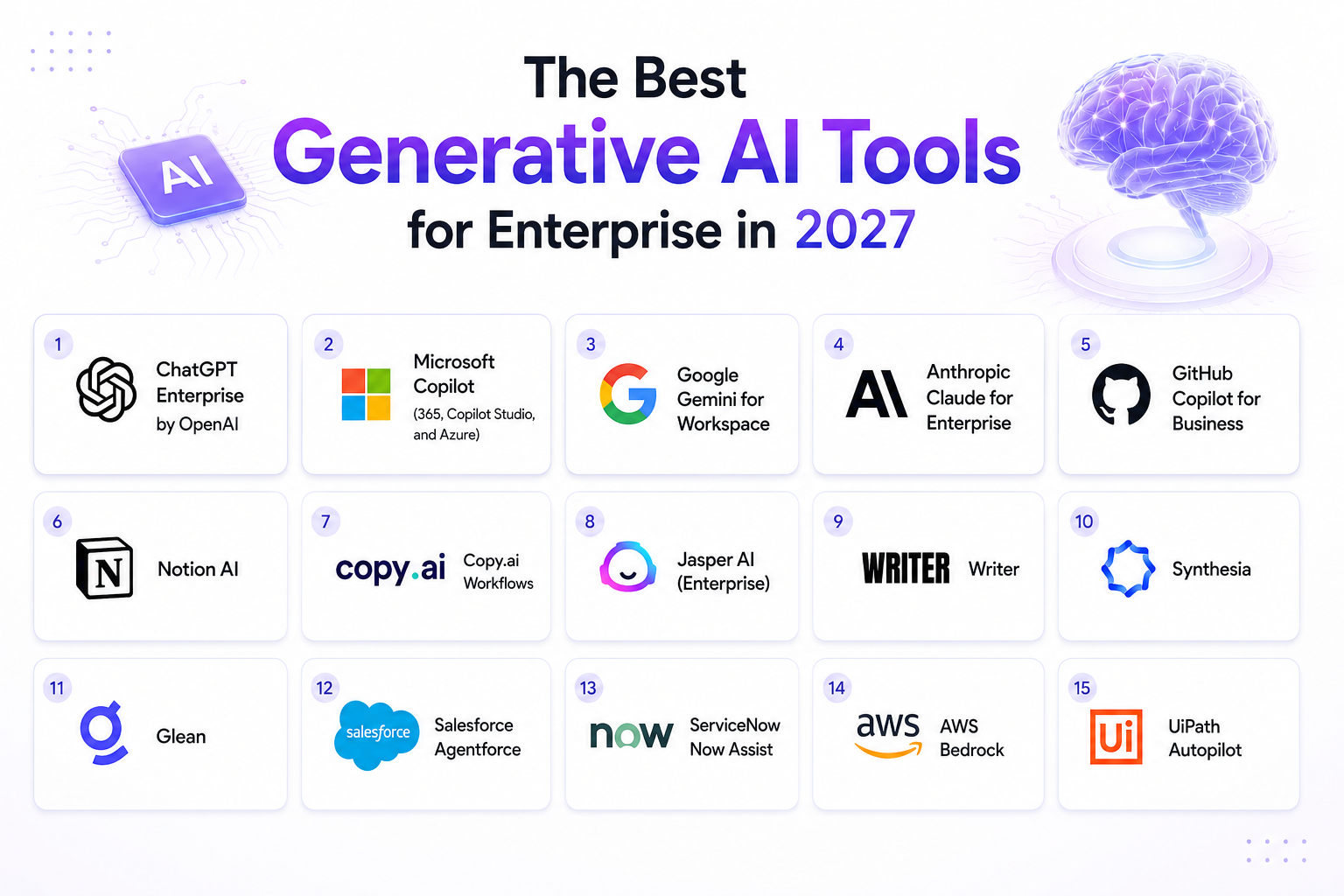
8. Jasper AI (Enterprise)
Best for: Marketing teams that need brand consistency at scale
Jasper's push over the past year has been toward becoming a full marketing execution layer rather than just a writing tool. Its Brand Voice and Style Guide features now let large marketing orgs keep hundreds of writers and campaigns on-brand automatically, and newer Studio Agents can execute multi-step marketing workflows on their own, syncing directly into tools like Asana and monday.com.
Why it stands out: Purpose-built brand voice training, agent-driven workflow execution, and collaboration tools built for large marketing teams — though the premium pricing mostly makes sense once you're producing content at real volume.
9. Writer
Best for: Regulated industries needing content governance
Writer remains the go-to platform for companies in finance, healthcare, and legal where "the AI made something up" isn't an acceptable outcome. It generates content grounded in a company's own style guides, policies, and knowledge base, with built-in guardrails that block off-brand or non-compliant output before it ever reaches a reviewer.
Why it's great for businesses: Keeps enterprise content consistent and compliant, includes approval workflows out of the box, and integrates into CRMs, CMS platforms, and helpdesks.
10. Synthesia
Best for: AI-generated video for training and internal communication
Synthesia continues to be the default choice for turning a script into a polished training or onboarding video without a camera crew. It now supports well over 100 languages and accents, which has made it a staple for global HR and L&D teams that need to localize content fast.
Why it's great for businesses: Cuts video production costs dramatically, scales training across geographies, and needs no studio or on-camera talent.
11. Glean
Best for: Enterprise search and knowledge management
Glean has become one of the fastest-growing enterprise AI platforms of the past year, and for good reason — most companies don't have a "content creation" problem, they have a "can't find anything" problem. Glean connects to your internal systems (Slack, Drive, Confluence, ticketing tools, and more) and lets employees ask questions in plain language instead of digging through five different apps. Customers include large, security-conscious organizations, and the company's valuation has climbed sharply this year on enterprise demand alone.
Why it stands out: Surfaces answers across scattered internal knowledge bases, strong for large orgs with fragmented systems, and built with enterprise-grade access controls from day one.
12. Salesforce Agentforce
Best for: CRM-native sales, service, and customer-facing automation
Agentforce builds autonomous AI agents directly into Salesforce — think agents that can resolve support cases, qualify leads, or update records without a human kicking off every step. Because it's grounded in your existing CRM data, it tends to avoid the generic, disconnected feel of bolt-on AI tools.
Why it stands out: Deep native integration with Salesforce data, strong for customer service and sales automation, and built for teams that already run their business on the platform.
13. ServiceNow Now Assist
Best for: IT service management, HR service delivery, and workflow automation
Now Assist isn't a standalone chatbot — it's woven directly into the ServiceNow platform, summarizing tickets, suggesting next actions, and automating steps inside IT, HR, and customer service workflows. For enterprises already running ServiceNow, it turns existing workflows into something noticeably faster without asking teams to adopt new software.
Why it stands out: Workflow-native rather than a separate tool, domain-tuned models for ServiceNow data, and strong for large IT and HR service teams.
14. AWS Bedrock
Best for: Enterprises that want to build custom AI applications on their own infrastructure
Bedrock gives enterprises access to multiple foundation models — including Claude, Meta's Llama, and Amazon's own models — through a single managed API, without having to manage the underlying infrastructure. It's less a finished product and more a foundation for building internal AI tools, which makes it a favorite for enterprises with dedicated engineering teams who want more control than an off-the-shelf copilot allows.
Why it stands out: Model flexibility, deep AWS ecosystem integration, and strong security posture for regulated industries already running on AWS.
15. UiPath Autopilot
Best for: Combining automation (RPA) with generative AI decision-making
UiPath built its name on robotic process automation, and Autopilot layers generative AI on top of that — turning rule-based bots into something closer to an adaptive assistant that can make judgment calls inside a workflow instead of just following a fixed script. It's a strong fit for enterprises that already have heavy automation investments and want to make them smarter rather than replace them.
Why it stands out: Combines RPA maturity with generative reasoning, strong for back-office and finance automation, and built to extend existing automation investments rather than compete with them.
Where These Tools Are Making a Difference, by Industry
Healthcare: Generating medical summaries, answering routine patient questions, translating dense reports into plain language.
Retail and ecommerce: Writing product descriptions at scale, personalizing offers, automating chat-based customer support.
Finance: Summarizing financial reports, flagging fraud patterns, auto-generating tax and compliance documentation.
Legal: Drafting contracts and legal memos, reviewing long documents faster, supporting AI-assisted legal research.
Manufacturing: Writing SOPs and technical manuals, predicting maintenance needs, drafting supplier communications.
What to Watch Out For
Data risk. Confirm — in writing — that the tool isn't storing or training on your customer or internal data. Read the actual contract, not just the marketing page.
Hallucinations. Even the best models still get things wrong sometimes. Keep a human reviewing anything that goes external or touches a real decision.
Bias in outputs. AI reflects patterns in its training data. That matters a lot in hiring, lending, and legal contexts — monitor for it deliberately, don't assume it away.
Integration headaches. Older internal systems don't always play nicely with new AI tools. Budget IT time for this; it's rarely a plug-and-play rollout.
Adoption, not access. Buying the license is the easy part. Teams need real use cases and some training, or the tool just sits there unused.
Where This Is Headed Next
The direction for 2027 and beyond is already visible:
- AI agents that complete entire tasks independently — booking meetings, processing orders, drafting full reports without step-by-step prompting
- Industry-specific models trained narrowly for a single vertical instead of general-purpose tools stretched to fit
- Multi-agent systems, where several specialized AI agents coordinate on a task the way a human team would divide up work
- Tighter AI regulation and clearer standards around transparency and accountability
- More on-device and private-cloud AI deployment for enterprises that don't want data leaving their own infrastructure
The Bottom Line
Generative AI tools for enterprise aren't a passing trend — they're now a standard part of how competitive companies operate in 2027. The tools above cover everything from general productivity and coding to knowledge management, CRM automation, and industry-specific compliance needs. The right choice isn't "the most popular one" — it's whichever tool matches your industry, your existing systems, and how your team actually works day to day. Start narrow, prove value with one team and one use case, then scale from there.