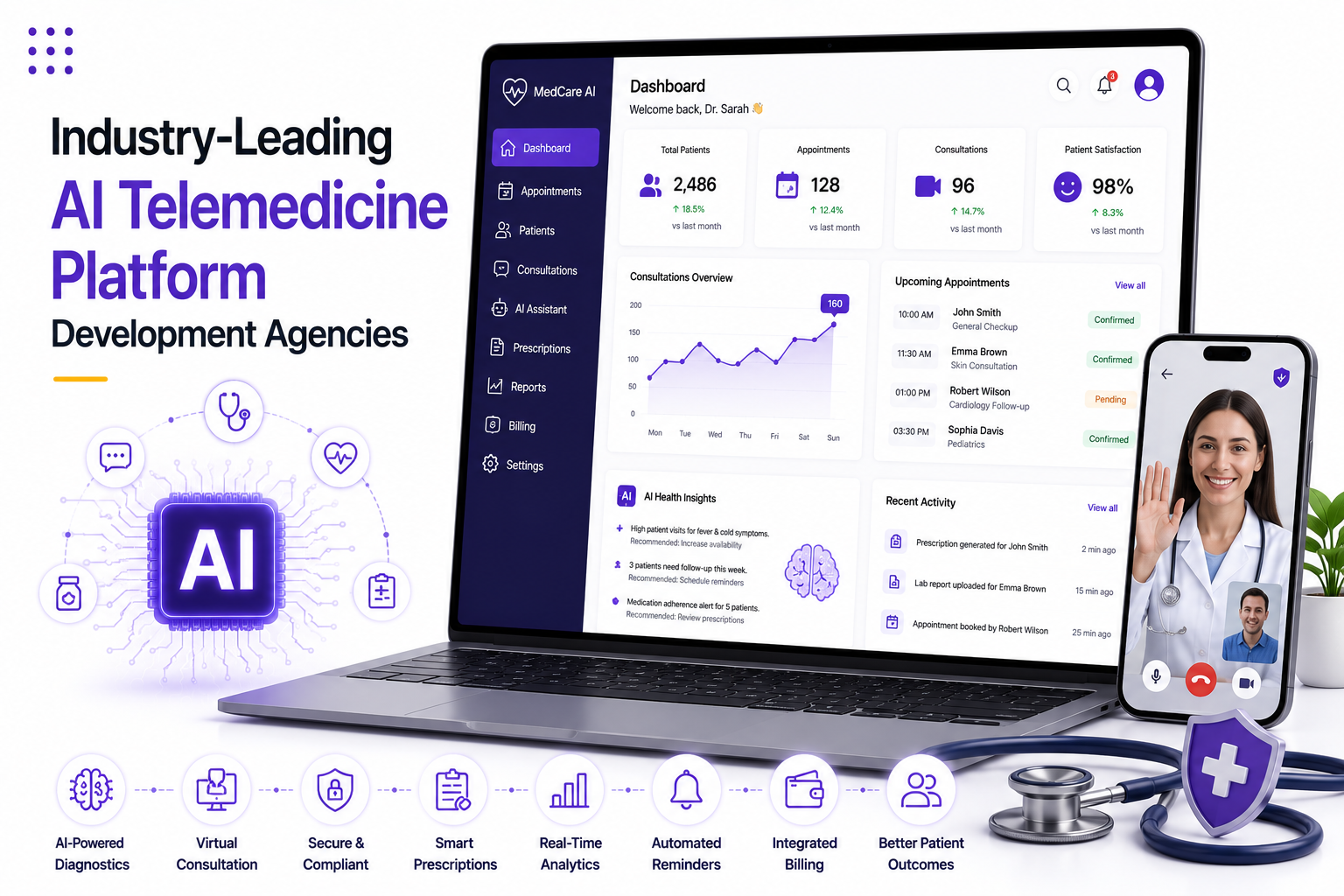

A patient opens an app at 11 p.m. because a rash will not stop spreading, and within minutes a clinician is looking at it over video instead of the patient waiting until morning for a walk in clinic. That small moment repeats itself millions of times a year now, and it only works if the software behind it can triage symptoms, route the right specialist, and keep every byte of patient data locked down at the same time. Building that kind of AI Telemedicine Platform is nothing like shipping a typical consumer app, and it is why hospital systems, digital health startups, and insurance backed care networks are all hunting for AI Telemedicine Platform Development companies who have actually done it before.
The gap between a vendor who talks about healthcare and one who has shipped inside it shows up fast once real patients and real data are involved. A team needs to understand HIPAA and GDPR from the first line of code, know how HL7 and FHIR data actually move between systems, and be able to build AI triage models that a clinician will trust enough to rely on during a busy shift. This guide walks through 15 AI Telemedicine Platform Development companies worth evaluating if you are trying to build or upgrade an AI Telemedicine Platform in 2026, along with what each one is genuinely good at.
The market backing all of this is not small either. Global telemedicine spending is projected to keep climbing well past 300 billion dollars by the end of the decade, and AI features are quickly moving from a nice to have into something buyers expect by default. That growth is pulling in a wide range of vendors, from large enterprise consultancies to smaller specialist shops, which is exactly why a clear comparison matters before you sign anything.
What to Check Before You Hire a Development Partner
Every agency on a shortlist will claim HIPAA compliance and AI capability, so the real evaluation happens one level deeper. Ask which EHR systems a team has connected to in production, whether that includes Epic, Cerner, or Athenahealth, because each behaves differently once real patient records start flowing through it. Ask how their AI triage or symptom checking models were trained, whether clinicians validated the outputs, and how the system handles a case it cannot confidently classify. A partner who answers these questions with specifics, not a service page pitch, is usually the one worth shortlisting.
Pricing and team structure matter just as much as technical depth. Some agencies work as a dedicated team embedded with your product managers, while others run a fixed scope engagement with a defined handoff date. Neither model is automatically better, but it needs to match how much ongoing product ownership you want to keep in house once the platform goes live.
15 Industry Leading AI Telemedicine Platform Development Agencies
Here are 15 agencies with real experience building AI powered telehealth software, mixed across different regions, team sizes, and specialties so you can compare options that actually fit your project.
Hourly Developers built its reputation on a simple idea. Clients should be able to scale a development team up or down as a project moves through different phases, rather than being locked into a fixed headcount for the entire build. That flexibility has made the company a popular choice for healthcare startups that need a full AI Telemedicine Platform built during an intense funding runway but do not want to carry a large permanent engineering team once the core product stabilizes.
The team has worked on video consultation systems, AI based intake and triage tools, and patient facing mobile apps that sync with clinic scheduling software. Its hourly billing model gives founders clear visibility into spend, which matters a great deal when a healthcare build has to stay within a tight seed or Series A budget. Clients also point to the team's willingness to rotate specialists in for short bursts, such as bringing in an extra AI engineer during a model tuning phase without renegotiating the entire contract.
Best for founders who want an experienced healthcare development team without committing to a long term fixed price contract before the product scope is fully settled.
Overcode has quietly become one of the more trusted names in clinical software, building everything from live video visits to remote monitoring systems and AI assisted patient intake tools. Its healthcare portfolio spans telemedicine, IVF technology, and aging care platforms, and the company backs up its claims with more than 100 completed web and mobile healthcare projects.
What sets Overcode apart is compliance breadth. The team works across HIPAA, GDPR, PIPEDA, and CCPA, and supports interoperability standards including DICOM, HL7, CCD, and FHIR, which matters enormously once a platform needs to exchange data with hospital systems that were not built with modern APIs in mind. Their documented client funding figures, which reportedly exceed a billion dollars combined, also suggest a client base that includes serious, well capitalized healthcare ventures.
Best for healthcare companies that need a technically deep partner comfortable working across multiple international compliance regimes at once.
As the name suggests, this agency lives and breathes backend infrastructure, which turns out to be exactly what a growing telehealth product needs once patient volume climbs past a few thousand daily consultations. Backend Development Company designs the API layers, database structures, and cloud deployment pipelines that keep an AI Telemedicine Platform responsive even during peak clinic hours.
Their engineers frequently step in on projects where the front end already exists but the backend cannot handle real time video load, concurrent AI inference requests, or the sheer volume of patient records a hospital network generates in a single day. They also build the queuing and caching layers that keep AI triage response times fast, and their monitoring dashboards give operations teams an early warning before a slow query turns into a dropped consultation.
Best for teams that already have a product vision and front end design but need serious backend engineering to make the platform scale reliably.
DataArt has spent more than two decades in healthcare and life sciences, which shows in how thoroughly the company handles interoperability. Its engineers work with FHIR, HL7, SMART on FHIR, DICOM, and ICD 10 standards, and build on AWS, Azure, and Google Cloud to deliver systems that hold up under an audit.
The company runs a HIPAA and GDPR aligned software development lifecycle with FDA ready documentation, and its Microsoft Gold, AWS Advanced Consulting, and Google Cloud Premium partner status gives procurement teams independent confidence in the engineering quality before a contract is even signed. Its 40 plus global locations also mean a client can usually find a delivery team working in a similar time zone.
Best for larger health systems and enterprises that need documented regulatory rigor alongside serious cloud engineering depth.
HireFullStackDeveloperIndia works well for founders who want a single team handling both the client facing app and the server side logic behind it, rather than coordinating two separate vendors. The company has built appointment scheduling systems, secure messaging features, and AI powered symptom checkers as part of broader telehealth builds.
Its full stack approach shortens the feedback loop between design decisions and technical constraints, which is useful in the early stages of a telehealth product when requirements still shift week to week. The team is comfortable working in React, Node.js, and Python stacks, alongside AI model integration through both open source and commercial APIs. Founders often mention that this reduces the back and forth that usually happens when a separate frontend and backend vendor disagree on scope.
Best for early stage healthcare startups that want one accountable team across the entire technical stack instead of managing multiple vendors.
Appinventiv covers the entire healthcare development journey, from initial consulting through custom development, modernization, and ongoing compliance management. The company reports more than 500 healthcare platforms delivered and over 450 healthcare clients served, along with more than 300 medical devices integrated across those projects.
Its healthcare deployments are backed by measurable operational numbers, including 99.9 percent uptime for critical systems and documented efficiency gains inside hospital deployments. That kind of track record matters when a hospital network is deciding whether to trust a vendor with mission critical infrastructure, since a single hour of downtime during peak clinic hours can affect thousands of scheduled consultations.
Best for large healthcare organizations that want one partner capable of handling consulting, development, and long term compliance under a single contract.
WebClues Infotech builds custom healthcare applications with a strong focus on user experience for both patients and providers, which often gets overlooked when teams focus purely on backend compliance work. Their telehealth builds typically include patient facing mobile apps, provider side dashboards, and AI driven symptom checking tools layered on top.
The company has delivered projects across multiple healthcare niches, giving its team a broad frame of reference when a new client's requirements do not fit a standard template. Their process includes dedicated design sprints before development begins, which tends to reduce costly rework once a telehealth platform reaches the testing phase. Clients in mental health and chronic care niches in particular cite the team's attention to accessibility for older or less tech comfortable patients.
Best for healthcare companies that want equal attention paid to clinical functionality and everyday usability for non technical patients.
ScienceSoft's engineers hold HL7 FHIR certification, and the company carries ISO 13485 certification for medical software development in line with FDA and EU Council requirements. That certification depth is rare among agencies of this size and gives buyers documented proof of process rather than a marketing claim.
With clients across more than 70 countries, ScienceSoft has delivered complex multi module telemedicine initiatives, including digital therapeutics for chronic conditions like Alzheimer's and atrial fibrillation, pediatric teleconsultation programs run through schools, and rehabilitation apps built for motor and cognitive recovery. Its typical MVP delivery window runs from two to six months depending on how many clinical modules a project needs at launch.
Best for organizations building regulated medical software where documented compliance and certification matter as much as the underlying engineering.
HireAIDevelopers focuses specifically on the AI layer of a telehealth product, which makes the company a strong fit for teams that already have a video and scheduling platform but need real triage intelligence built on top of it. Their work includes symptom checking models, natural language processing for clinical notes, and predictive routing that flags urgent cases before a human even reviews them.
Because the team specializes narrowly, they tend to move faster on the AI component than a generalist agency juggling the entire platform. They also help clients think through model explainability, which matters when a clinician needs to understand why an AI flagged a case as high risk before acting on it. This kind of specialist support is often brought in midway through a build once a client realizes their triage logic needs more rigor than a simple rules engine can offer.
Best for teams that already have core telehealth infrastructure and want a specialist partner to build or improve the AI triage layer.
Itransition brings more than 25 years of delivery history to healthcare projects, working with clients ranging from early stage startups to global enterprises. The company holds ISO 9001, ISO IEC 27001, and ISO IEC 15408 certifications, and its telemedicine practice covers remote care across video platforms, patient portals, remote monitoring systems, and EHR integrations layered with AI assisted clinical tools.
The company's compliance coverage spans HIPAA, CCPA, GDPR, and PIPEDA, with dedicated compliance review cycles and security architecture assessments built into their standard development process, along with documentation support for regulated products that need to satisfy hospital procurement teams. Their long operating history also means they have likely already solved integration problems that a newer agency would be encountering for the first time.
Best for large health systems that need enterprise scale delivery with the certification depth to pass rigorous procurement review.
DataEximIT works across several regulated industries, which gives its healthcare team a useful perspective on how security and compliance patterns from fintech can strengthen a telehealth build. Their work on **AI Telemedicine Platform** projects typically includes secure patient data pipelines, provider scheduling systems, and AI symptom triage integrated into a unified patient app.
The company runs dedicated QA cycles specifically for healthcare projects, testing not just functionality but also how the system behaves under concurrent video load and how gracefully it degrades if a connection drops mid consultation, which is a detail many generalist agencies overlook. Their fintech background also translates into careful handling of payment and insurance billing flows tied to virtual visits.
Best for healthcare founders who value a partner with cross industry security experience alongside dedicated healthcare delivery teams.
Binariks delivers roughly 100 projects a year and holds ISO 9001:2015 and ISO 27001:2013 certifications, which reflects a mature and repeatable delivery process. Their healthcare work spans custom telehealth platforms, remote patient monitoring, EHR integrations, and AI assisted clinical tools built on top of standard telemedicine features.
The company has built a reputation for staying involved well past launch, helping clients integrate their applications into real clinical environments where unexpected edge cases tend to surface. Their AI layer includes conversational chatbots, clinical intake automation, and data analytics that give care teams a clearer view of patient trends. Their post launch involvement model treats maintenance as a continuation of the original engagement rather than a separate line item to negotiate later.
Best for teams that want a partner who treats post launch support as part of the engagement rather than a separate future sale.
Orangesoft has spent more than 15 years developing telemedicine platforms, remote patient monitoring systems, medical device software, and mental health apps for both startups and established healthcare companies, with more than 300 web and mobile projects delivered along the way.
The company integrates advanced technologies including AI, conversational AI, IoMT, and computer vision into its healthcare builds, and its ISO aligned development process produces audit ready applications that comply with HIPAA, GDPR, FDA, MDR, and SOC 2 standards. Orangesoft also helps clients prepare regulatory submissions rather than leaving that work entirely to the client's internal team. Applications built on its platforms have reportedly reached well over 200 million users worldwide across its full portfolio.
Best for healthcare companies that want a full cycle partner comfortable handling regulatory submission support alongside the actual engineering.
TechMagic has specialized in mobile and web telemedicine app development since 2014, delivering everything from remote patient monitoring platforms to EHR integrations and patient data management systems for healthcare clients across multiple regions.
The company pays close attention to compliance from the start of a project, building HIPAA adherence and a security first architecture into the foundation of every healthcare build rather than retrofitting it later. That approach tends to save clients significant rework once a platform reaches its compliance review stage, since fixing a security gap after launch is almost always more expensive than designing around it up front.
Best for teams that want a security conscious partner experienced specifically in mobile heavy telemedicine builds.
Interexy has built more than 15 custom digital health platforms as part of a combined track record exceeding 150 successful projects overall, giving the team a wide base of experience to draw on when a new client's telehealth requirements do not fit a standard mold.
The company serves as a full service partner from initial strategy through post deployment support, and its engineers can implement essentially any core telehealth feature, whether that means video conferencing, EHR integration, or a virtual waiting room designed to reduce perceived wait times for anxious patients. Clients in clinic and hospital settings in particular value how quickly the team can add a new feature without disrupting an already live patient facing system.
Best for healthcare companies that want one partner covering the entire journey from early strategy to long term post launch support.
Budgeting for an AI Telemedicine Platform in 2026
A focused MVP with video consultations and basic scheduling usually starts around $50,000 to $100,000. A full platform with EHR integration, remote patient monitoring, AI triage, and multi role access can run from $150,000 to $400,000 or more, depending on scope and vendor rates. Agencies with lower hourly rates are not automatically the cheaper overall choice once you factor in project timeline and how much rework a less experienced team might introduce midway through the build.
Hourly rates for experienced healthcare development teams generally fall between $25 and $150 an hour depending on region and seniority, and the agencies at the higher end of that range typically bring deeper enterprise references and more mature compliance processes. It is worth weighing that tradeoff against your own internal capacity to manage a less experienced or less structured team.
Final Thoughts
Choosing a development partner for an AI Telemedicine Platform ultimately comes down to matching a vendor's proven strengths to what your specific product actually needs, rather than picking whichever agency has the longest feature list on their homepage. A startup racing toward a seed stage launch needs a very different partner than a hospital network replacing legacy infrastructure across a dozen clinics.
Whichever of the AI Telemedicine Platform Development companies you shortlist, spend real time verifying their claims. Ask for specific EHR systems they have connected to, request references from healthcare clients rather than generic case studies, and get clear on how their AI models were validated before any code gets written. The right partner will welcome those questions, because they have answered them before.