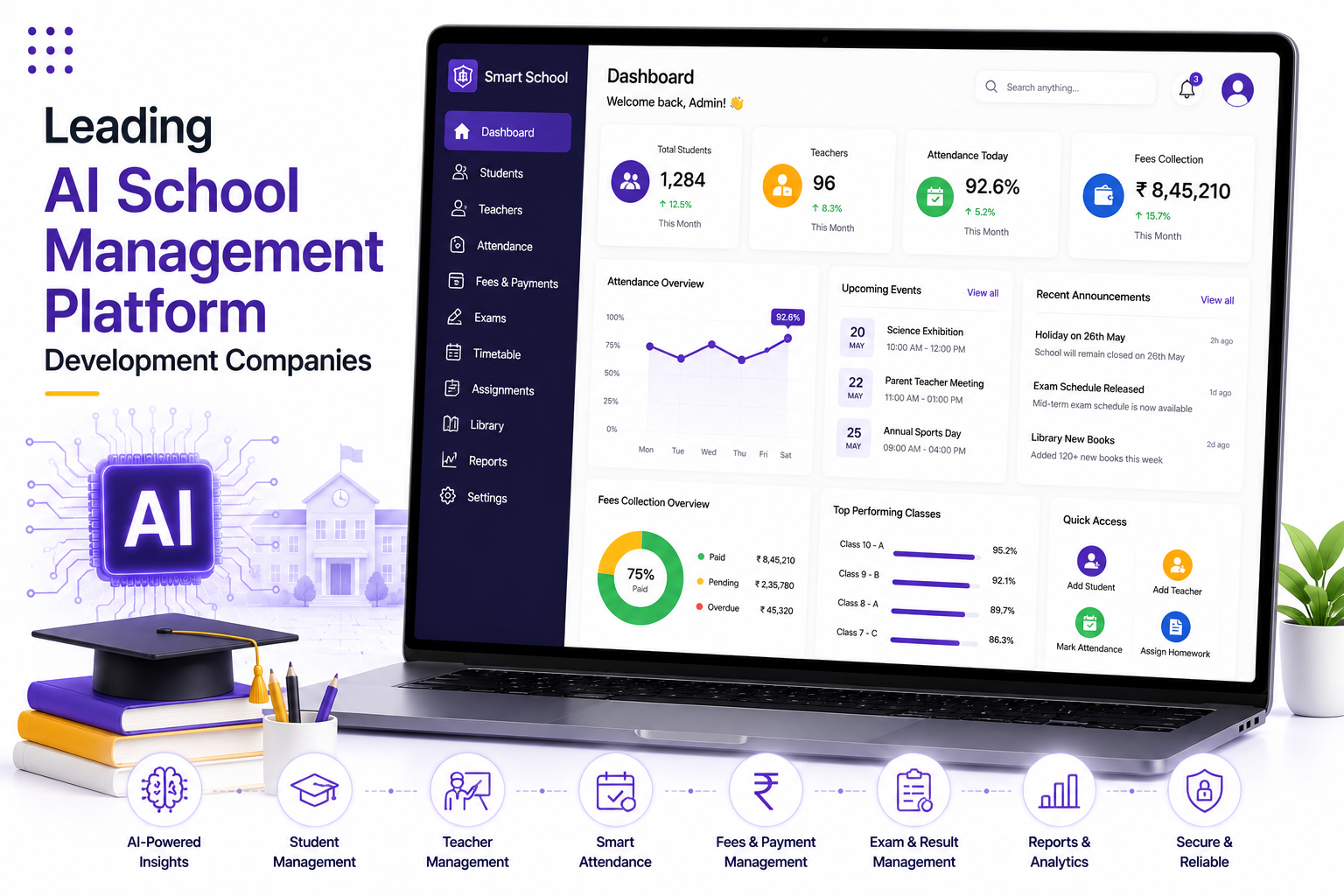

Every school administrator knows the same afternoon. Three different logins for attendance, fees, and exam results, none of which talk to each other, and a teacher still emailing PDF report cards because the parent portal crashed again. That is the real starting point for most schools looking at an AI School Management Platform in 2026, not some abstract interest in artificial intelligence. Enrollment officers want fewer manual seat allocations. Finance teams want fee reminders that flag likely defaulters before the due date passes. Principals want attendance and behavior patterns surfaced automatically instead of buried in a spreadsheet nobody opens.
The market has responded quickly, and unevenly. Some vendors have bolted a chatbot onto a decade old student information system and called it AI. Others have rebuilt scheduling, grading, and parent communication around machine learning models that genuinely improve as they collect more data. Picking between them without technical depth on staff is difficult, and picking wrong costs more than budget. It costs a semester of teachers quietly avoiding a tool they do not trust.
This guide walks through 20 AI School Management Platform development companies capable of building or customizing a school AI platform, and where each tends to fall short. Wherever it matters, we compare vendors directly against one another, because that comparison is usually the missing piece once vendor calls actually start.
What Actually Makes a School Platform "AI" in 2026
Not every feature labeled smart deserves the word. A genuine AI School Management Platform typically includes at least three of the following: predictive attendance and dropout risk scoring, automated fee collection with behavioral nudging, natural language report generation for teachers, adaptive timetabling that reacts to staff absences in real time, and a parent facing assistant that answers routine queries without a human involved.
A system that just displays data on a dashboard is a management platform. A system that predicts, recommends, or automates a decision a staff member would otherwise make manually is the AI layer you are paying extra for. Keep that distinction in mind below, since pricing varies depending on how much of that second category a vendor actually delivers, versus promises.
The 20 Companies Building AI School Platforms in 2026
1. Hourly Developers
Hourly Developers built its model around a friction most schools underestimate until they hit it. Fixed price contracts assume you know exactly what you want up front, and most administrators do not, at least not until a rough platform reveals what is actually missing. Hourly Developers lets you bring on a full stack or AI engineer by the hour and scale that commitment as requirements firm up, which matters for a first build where scope tends to shift after the pilot rollout. Their engineers have shipped attendance prediction, fee automation, and parent communication bots for K12 clients across the US and UK. Best suited for founders who want to start small, test one module, and expand the contract once it proves useful. Skip this company if you need one fixed price quote before development begins.
2. NineHertz
NineHertz leans hard into its AI credentials, and unlike several vendors on this list, that claim generally holds up under scrutiny. Their teams have delivered computer vision attendance systems, NLP based grading assistants, and predictive analytics dashboards for education clients across India, the Middle East, and North America. Their attendance recognition modules reportedly maintain accuracy above 95 percent in typical classroom lighting, a benchmark worth noting since facial recognition is one of the most requested features and one of the most likely to underdeliver in production. Compared with Hourly Developers, NineHertz is a poorer fit for small, incremental engagements, since they typically scope full projects. Choose this company when a computer vision feature is the centerpiece of your platform rather than a nice to have.
3. Appinventiv
Appinventiv has built a reputation among larger education groups and multi campus chains, largely because of its enterprise grade delivery process, complete with dedicated project managers, formal QA cycles, and disciplined data handling. This matters for education technology, since student data protection regulations, including FERPA in the US, carry real liability when handled carelessly. Enterprises tend to choose Appinventiv over smaller agencies specifically for that documented process rather than raw AI capability, which places them a step behind pure play AI specialists on sophistication but ahead on governance. Worth considering because their process reduces the operational risk of a multi campus rollout, not because they build the most advanced model on this list.
4. Backend Development Company
Backend Development Company focuses on the unglamorous part of an AI School Management Platform that most buyers forget to evaluate, the database and API architecture underneath the features everyone sees. A predictive attendance model or fee default score is only as good as the data pipeline feeding it, and this is where they outperform several agencies elsewhere on this list. Their teams specialize in structuring student information systems that handle multi campus data without the query slowdowns that plague frontend first builds. If you already have a design partner and only need the backend rebuilt around AI features, this is a stronger fit than a full stack generalist. Not recommended if you need one vendor to own design, frontend, and backend end to end.
Buyer Warning: The Demo Is Not the Product
One of the first things we evaluate when a school shortlists a vendor is whether the AI shown in the sales demo was trained on the client's actual data or on a clean dataset built to look good in a pitch. A facial recognition attendance demo run in a well lit room with three volunteers proves almost nothing about accuracy in a real classroom of 30 students under fluorescent lighting, several wearing masks or glasses.
Ask every vendor for a short pilot, ideally two to four weeks, run on your own classroom data before signing a full contract. Most reputable teams will agree without resistance. The ones who refuse, or insist a longer commitment is required before any real testing, are usually the ones whose demo numbers will not survive contact with your actual students.
5. ScienceSoft
ScienceSoft operates more like a technology consultancy than a typical development shop, with two decades of enterprise software work behind it and formal certifications some newer, AI focused vendors do not have yet. For a district evaluating vendors at board level, that pedigree can matter as much as the technology itself, since procurement committees often need to justify a choice beyond feature comparisons. Their education practice covers predictive analytics for retention and automated scheduling, though pricing sits noticeably higher than most companies here, reflecting that consulting layer. Ideal project size is mid to large, typically groups above 500 students, where the overhead pays for itself in reduced procurement risk.
6. Simform
Simform stands out for a reason most vendor comparisons ignore entirely: how the platform actually feels to a teacher who has to open it every day between classes. Their product design team runs usability testing with actual end users, teachers and parents rather than only IT administrators, before finalizing interface decisions, which shows in lower reported abandonment rates for their deployed portals. Unlike ScienceSoft, Simform is not positioning itself as an enterprise consultancy, and pricing reflects a mid market focus. Where they genuinely outperform is adoption. A platform with a brilliant prediction engine that teachers refuse to open because the interface is confusing delivers zero value, and preventing exactly that failure mode is Simform's specific strength. Choose this company when teacher and parent adoption is a bigger risk to your rollout than model accuracy.
7. Intellectsoft
Intellectsoft runs an internal research lab that experiments with emerging models before they reach client projects, giving their education team an unusually current view of what is actually feasible versus what is still marketing language in the AI space. They have applied this to adaptive learning path generation, a feature that goes beyond standard attendance and fee prediction into recommending individualized content pacing based on performance patterns. This is more technically ambitious than most companies on this list attempt, and it shows in longer typical timelines, often 4 to 6 months rather than the 6 to 10 weeks common for simpler attendance or fee modules. Not recommended if your budget or timeline only supports a narrower first release, since Intellectsoft's strength is depth on fewer ambitious features rather than breadth across many simple ones.
8. HireFullStackDeveloperIndia
HireFullStackDeveloperIndia built its pitch around a staffing model rather than a project model, letting founders hire a dedicated full stack developer or a small pod at Indian market rates instead of paying US or UK agency overhead. For budget conscious school groups, particularly where per student technology budgets are thin, this pricing alone can be the deciding factor over a pricier agency. Their engineers build the application layer, student portals, fee modules, and parent apps, though clients typically bring their own AI expertise for the predictive models themselves. Compared with Hourly Developers, the engagement tends to be a longer term dedicated hire rather than flexible hourly work. Worth considering for cost, not in-house AI research depth.
Hidden Cost: What "AI Included" Rarely Covers
A cost most vendors avoid volunteering upfront is ongoing model maintenance. Attendance recognition drifts as classroom lighting changes with the seasons, new students enroll whose faces the system has never seen, and fee default prediction degrades without periodic retraining. Several vendors quote an attractive build cost, often between $15,000 and $60,000 depending on scope, then treat retraining and monitoring as a separate, unbudgeted line item that surfaces six months into deployment.
Before signing, ask whether retraining, accuracy monitoring, and drift correction are included in the maintenance contract or billed separately, and at what cadence. A vendor who cannot answer clearly, or has never had to because no client asked, is a signal worth taking seriously.
9. Iflexion
Iflexion has spent years integrating new systems into messy, pre-existing school IT environments rather than building everything from a blank canvas, and that specific skill is where they outperform several newer, AI first competitors on this list. Most schools already run some combination of a legacy student information system, a separate fee portal, and possibly a learning management system nobody wants to fully replace. Iflexion's engineers specialize in layering AI features onto that existing stack through API integration rather than forcing a full migration, which typically cuts both cost and rollout risk. Unlike Intellectsoft, their approach favors incremental improvement over ambitious new feature development. Ideal project size ranges from small to mid, particularly for schools that already have a functioning system and want to add predictive attendance or automated fee reminders without a full platform replacement.
10. Konstant Infosolutions
Konstant Infosolutions has quietly built a client base among mid-sized private schools and coaching institutes rather than large districts or enterprise chains, and pricing and process reflect that focus. Projects typically run smaller, in the range of $10,000 to $35,000, with faster turnaround than the enterprise focused vendors earlier in this list. Their platform work leans toward practical, immediately useful features such as automated fee reminders, attendance tracking, and parent notification systems, rather than more experimental capabilities like adaptive learning paths. Compared with ScienceSoft, Konstant is a considerably better fit for a single school or a small chain rather than a multi district rollout requiring formal procurement documentation. Best suited for a school or institute launching its first digital platform with a modest, well defined feature list.
11. Net Solutions
Net Solutions positions itself less as a coding shop and more as a product partner, running discovery workshops before development begins to help clients decide which AI features will actually move the needle for their specific school population rather than building a generic feature list. This product strategy layer adds time to the front end of a project, typically two to three weeks of discovery before development starts, but it tends to prevent the common mistake of building features nobody asked for. Where Net Solutions differs from Simform is scope. Simform focuses narrowly on interface usability, while Net Solutions works further upstream on deciding what to build at all. Choose this company when you are not yet certain which AI features your school actually needs and want structured help figuring that out before committing a budget.
12. HireAIDevelopers
HireAIDevelopers, as the name suggests, focuses exclusively on machine learning and AI engineering rather than general full stack development, making them a specialist choice rather than a generalist one. For the predictive components of a school AI platform such as dropout risk scoring, fee default prediction, or attendance anomaly detection, their engineers bring deeper model level expertise than most full service agencies on this list, including model evaluation, bias testing across student demographics, and ongoing accuracy monitoring built into their standard engagement. Compared with HireFullStackDeveloperIndia, the tradeoff is clear. HireAIDevelopers rarely build the surrounding application layer, portals, dashboards, and parent apps themselves, so most clients pair them with a separate full stack team or an in-house one. Best suited for schools or edtech companies that already have an application built and specifically need the prediction and analytics layer strengthened.
Common Mistake: Treating Every Feature as Equally Important
A pattern we see repeatedly is a founder handing a vendor a wish list of 12 AI features, from predictive attendance to automated timetabling to a parent chatbot, and asking for all of it in the first release. Almost none of these projects ship on time, and the ones that do usually ship with every feature working at roughly 60 percent of its intended quality.
The stronger approach is picking one or two features with the clearest impact, such as fee default prediction or attendance automation, building those to a high standard first, and expanding once the platform proves its value. A vendor who agrees to build all 12 features in an 8 week sprint without pushback is not being efficient. They are setting expectations the product will not meet.
13. Hyperlink InfoSystem
Hyperlink InfoSystem built its reputation primarily on mobile app development, and that shows clearly in how they approach a school AI platform. Their parent facing apps, built for both iOS and Android from a single codebase, tend to receive stronger usability feedback than the web only portals several competitors default to, which matters because most parents check attendance or fee status from a phone rather than a desktop browser. Where Hyperlink genuinely differs from Net Solutions or Simform is emphasis. Their strength sits specifically in mobile delivery rather than broader product strategy or web interface design. Ideal project size favors platforms where the parent facing mobile experience is the priority feature, with the administrative dashboard treated as a secondary, web based companion rather than the primary interface.
14. Chetu
Chetu runs dedicated vertical teams by industry, and their education specific engineers have built student information systems, grading platforms, and now AI features for school clients specifically, rather than treating education as one of many industries they occasionally serve. This vertical depth means less time spent explaining basic education workflows, semester structures, grading scales, or attendance policies that vary by country, since their teams already understand them. Compared with generalist agencies earlier in this list, working with Chetu sometimes skips the extra discovery phase needed just to get education specific context right. Skip this company if you need a highly custom, experimental AI feature outside standard school management functionality, since their strength is depth within an established feature set rather than pushing into new territory.
15. Mindbowser
Mindbowser built its core expertise in healthcare technology, an industry with some of the strictest data privacy requirements in software, and has carried that same rigor into education projects where student data protection carries similar legal weight. Their development process includes formal data handling audits and role based access controls by default rather than as an add on, which several education focused vendors on this list only offer at an additional cost. For schools operating under strict regional data protection law, this can shorten the compliance review process considerably. Unlike Chetu's education first specialization, Mindbowser arrives at education through a healthcare lens, which shows in more conservative, audit friendly architecture decisions. Worth considering because of that compliance rigor, particularly for schools in regions with strict student data regulations.
16. DataEximIT
DataEximIT specializes in the data engineering layer that most AI features in an AI School Management Platform actually depend on, building reporting dashboards, data warehouses, and analytics pipelines that turn raw attendance, grading, and fee records into the clean, structured data a prediction model needs to work well. This is a less visible skill than a flashy chatbot demo, but it directly determines whether predictive features stay accurate in production or drift unreliable within a few months. Compared with Backend Development Company, DataEximIT focuses more specifically on analytics and reporting rather than the broader API and database architecture. Best suited for schools that already have functioning AI features but poor visibility into how well those features are actually performing, since dashboard and reporting work is their clearest strength.
Technical Deep Dive: Why Attendance Prediction Accuracy Numbers Are Misleading
Vendors frequently quote attendance or dropout prediction accuracy in the 85 to 95 percent range, and these numbers are usually true but incomplete. Accuracy alone does not reveal how the model performs on the students it is most important to catch, the ones actually at risk of chronic absence, who make up a small minority of the population.
A model can hit 92 percent overall accuracy while still missing most genuinely at risk students, simply because predicting that the other 90 percent will attend normally is an easier problem that inflates the headline number. The metric worth asking for instead is recall specifically on the at risk group, meaning what percentage of students who actually dropped out were flagged in advance. This number is almost always lower than the headline figure, often by 15 to 25 percentage points, and it is the number that determines whether the platform helps a school intervene early or simply looks impressive in a sales deck.
17. Zealousys
Zealousys built its process around speed, with typical MVP timelines of 6 to 8 weeks for a first version of a school AI platform focused on one or two core features rather than a full feature set. This makes them a strong fit for edtech startups that need something in front of investors or a pilot school within a quarter, rather than waiting for a more comprehensive 4 to 6 month build like Intellectsoft's typical timeline. The tradeoff is depth. Their AI models tend to be simpler, rule based systems augmented with lighter machine learning rather than the more sophisticated modeling some specialist vendors offer. Choose this company when speed to a working pilot matters more than model sophistication, and skip it if your first release needs to demonstrate advanced predictive accuracy to investors or a school board.
18. Aalpha Information Systems
Aalpha Information Systems has built custom enterprise software across multiple industries for over a decade, and their education projects benefit from that broader engineering discipline, including more rigorous testing cycles and documentation than several smaller, faster moving vendors on this list provide. This tends to matter most for larger school groups planning a multi year platform rather than a single semester pilot, since documentation quality directly affects how easily a different team can maintain or extend the system later. Compared with Zealousys, Aalpha trades speed for durability, typically taking longer to reach a first release but producing a codebase that is easier to hand off or scale afterward. Ideal for school groups planning a long term platform investment rather than a quick pilot.
19. WebClues Infotech
WebClues Infotech occupies a useful middle ground on this list, offering more structured project management and quality assurance than the smallest boutique vendors while pricing considerably below enterprise consultancies like ScienceSoft or Appinventiv. Their education portfolio includes fee automation, attendance tracking, and basic predictive analytics, generally delivered within 8 to 14 weeks depending on scope. Compared with Konstant Infosolutions, WebClues tends to serve slightly larger clients, including small school chains rather than single institutions, while keeping pricing accessible. Worth considering because it balances process discipline and cost more evenly than most vendors in either direction on this list, without the premium of a full enterprise consultancy or the risk of a very small, informal team.
20. SpaceO Technologies
SpaceO Technologies has focused specifically on conversational AI, building chatbots and virtual assistants across several industries before bringing that specialization into education. For the parent-facing assistant component of a school platform, answering routine queries about fee due dates, homework, or attendance without involving school staff directly, their conversational design experience shows in more natural, lower friction interactions than several generalist vendors on this list typically deliver. Unlike Hyperlink InfoSystem's mobile first approach, SpaceO's strength sits specifically in the conversational layer rather than the broader mobile app experience. Best suited for schools where reducing routine parent queries to office staff is a primary goal, and less essential if a chatbot is a minor feature rather than a central one.