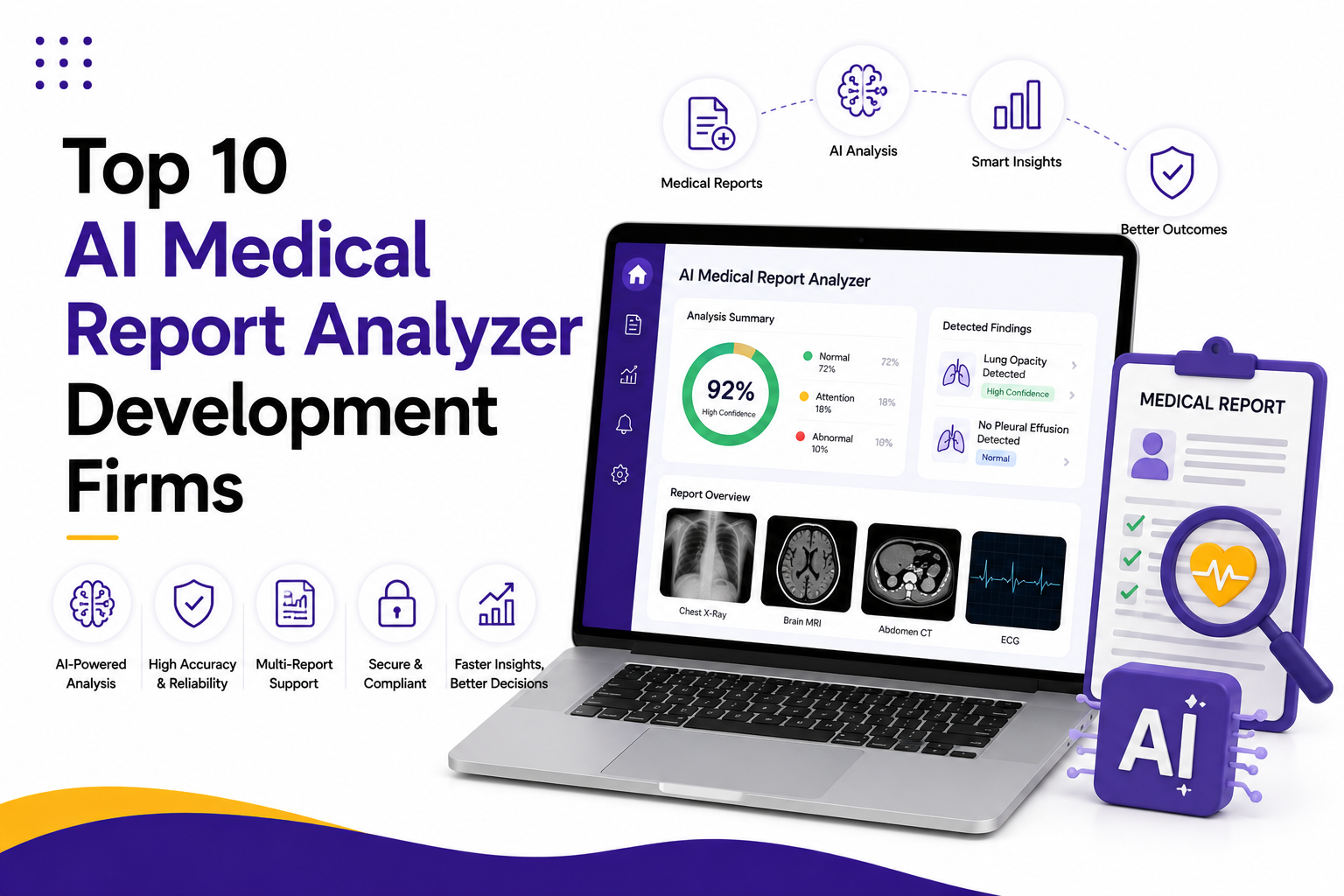

Radiologists in the US read an average of one image every three to four seconds during a busy shift, and that pace has not slowed down even as patient volumes keep climbing. Labs are drowning in scanned reports, handwritten notes, and PDFs that never talk to each other. That is the exact problem an AI Medical Report Analyzer is built to solve, and it is why hospital systems, diagnostic chains, and health tech startups are all hunting for a development partner who can build one properly.
This is not a simple software build. A tool that reads a medical report, pulls out lab values, flags abnormal findings, and hands a clinician a clean summary has to be accurate, explainable, and compliant with regulations like HIPAA and, in many cases, the EU's MDR framework. Get any one of those wrong and the tool becomes a liability instead of a time saver. So the company you choose matters as much as the idea itself.
We put together this list of 10 firms that have actual healthcare AI experience, not just a portfolio of generic apps with a medical logo slapped on top. Each profile below covers what the company is known for, how it is structured, and who it tends to work best with, so you can shortlist with confidence instead of guessing from a homepage.
One more thing worth saying upfront. The strongest firms on this list rarely lead with the word artificial intelligence in their pitch. They lead with the specific clinical problem they solve, a slow report queue, a missed abnormal value, a communication gap between departments, and then explain how the technology addresses it. That framing alone is often a useful filter when you start taking sales calls of your own.
Why Hospitals and Health Tech Companies Are Building These Tools Now
Three things changed at once. Large language models got good enough to handle messy clinical text instead of just clean, structured data. Regulators started publishing clearer guidance on how AI can be used in diagnostics, which reduced the legal fog that used to scare hospital IT departments away from these projects. And insurers began pushing providers toward faster turnaround times, which put direct pressure on report review bottlenecks.
The result is that an AI Medical Report Analyzer is no longer a research project. It is a practical tool that a mid-sized diagnostic lab or a hospital network can actually deploy this year, provided the development team understands both the machine learning side and the clinical workflow side of the problem.
There is also a talent shift worth noting. A wave of engineers who spent the last few years building general purpose large language model applications are now moving into healthcare specific roles, bringing with them a much stronger grasp of prompt design, retrieval systems, and model evaluation than the healthcare IT sector had access to even two years ago. That talent pool is exactly where the strongest development firms are pulling from right now, and it shows in the quality of the tools reaching the market this year.
None of this means the technology is plug and play. Every hospital, lab, and clinic formats its reports slightly differently, uses different abbreviations, and structures its workflow around habits built up over years. A development partner still has to spend real time learning those specifics before a model performs reliably, which is exactly why the vendor selection process below matters as much as it does.
What to Look for Before You Hire
Before you scroll through the list, it helps to know what actually separates a strong healthcare AI vendor from one that just talks a good game.
• Clinical validation experience: Ask whether the company has run its models against real patient data with a licensed clinician reviewing output, not just a synthetic test set.
• Compliance track record: HIPAA, SOC 2, and where relevant, MDR or FDA clearance history should be documented, not just mentioned in a sales call.
• Interoperability skills: The tool needs to read HL7, FHIR, and DICOM formats cleanly, and plug into whatever EHR the client already runs.
• Explainability features: Clinicians need to see why a report was flagged, not just a confidence score with no reasoning behind it.
• Post launch support model: Find out who retrains the model as clinical language and reporting formats shift over time, and whether that support is bundled into the original contract or billed separately later.
• Reference clients in your specialty: A firm that has built for radiology may struggle with pathology or lab work. Ask for a reference client whose report types closely match your own before you sign anything.
The Top 10 AI Medical Report Analyzer Development Firms
1. HireAIDevelopers
HireAIDevelopers has built a name for itself among clients who need an AI Medical Report Analyzer that can actually parse unstructured clinical text, not just structured lab exports. The team includes machine learning engineers with prior experience in radiology and pathology reporting systems, which shows in how carefully they handle edge cases like handwritten notes or scanned faxes.
What sets this firm apart is its documentation discipline. Every model version ships with a validation report showing accuracy against a clinician reviewed dataset, which makes internal compliance approval much faster for hospital clients. Pricing sits in the mid to upper range for the region, but the transparency around model performance justifies it for most buyers.
Engagements typically begin with a four week discovery sprint where the team reviews sample reports from the client's own systems before proposing an architecture, which cuts down on the guesswork that often derails healthcare AI projects in their first quarter.
Best for: Best for hospital systems and diagnostic labs that need audit ready documentation alongside the actual software build.
2. Nova Clinical Systems
Nova Clinical Systems focuses almost entirely on radiology, which is a narrower lane than most firms on this list but one they know extremely well. Their flagship product line reads imaging reports and cross references them against prior studies to flag inconsistencies a radiologist might miss during a rushed shift.
The company works mostly with mid-sized hospital networks in the US and has FDA clearance experience for two of its own products, which gives them a genuine edge when a client needs a partner who understands the regulatory submission process from the inside rather than just the development side.
Project timelines run on the longer side, often eight months for a full radiology pipeline, because the team insists on running a shadow period where the tool operates alongside human radiologists before it is trusted to flag anything on its own.
Best for: Best for radiology departments that want deep imaging expertise over general purpose medical text processing.
3. Backend Development Company
Backend Development Company is not a healthcare specialist by origin, but its engineering depth makes it a strong fit when a client already has AI models in mind and needs someone to build the infrastructure that can handle millions of reports without buckling under load. Their work on a hospital network's report ingestion pipeline in 2025 processed over 40,000 documents a day without downtime.
Where this firm shines is in the unglamorous parts of the stack, queueing systems, database sharding, and secure storage for protected health information. They typically partner with a smaller AI focused team or bring in contract data scientists for the model layer itself, so clients should expect to manage two vendors rather than one.
Their contracts are usually structured as retainers rather than fixed bids, which suits clients who expect the platform to keep growing after launch and want an engineering partner who already understands the system rather than starting a new vendor relationship from scratch every time a feature is added.
Best for: Best for founders who already have a data science plan and need rock solid backend engineering to support it at scale.
4. MedText AI Labs
MedText AI Labs built its reputation on multilingual support, which matters more than most buyers realize until they try to deploy a tool across a hospital network with patients who speak a dozen different languages. Their AI Medical Report Analyzer pipeline currently supports English, French, Spanish, and Mandarin clinical text extraction with plans to add Arabic in 2026.
The team is smaller than most competitors here, which keeps them nimble but also means longer wait times for new client onboarding during busy quarters. Clients who have worked with them describe the communication as direct and technically detailed, which suits founders who want to be closely involved in the build.
New language pairs are added roughly twice a year based on client demand, so it is worth asking directly whether a specific language is already on their roadmap rather than assuming it will be built on request within your project timeline.
Best for: Best for organizations serving multilingual patient populations that need language coverage most vendors do not offer.
5. HireFullStackDeveloperIndia
HireFullStackDeveloperIndia takes a broader product view than most firms on this list. Instead of just building the analyzer itself, they typically deliver the whole surrounding product, patient facing apps, clinician dashboards, and the AI layer that ties it together. This makes them a common choice for startups building a first product rather than hospitals adding a feature to existing infrastructure.
Their pricing model is project based rather than hourly, which founders tend to prefer because it removes the guesswork around scope creep. The tradeoff is a longer discovery phase upfront, often four to six weeks, before actual development begins.
The firm also maintains an in-house design team, which is unusual for a company this size, so clients get UI and UX work handled internally rather than outsourced to a third party design agency partway through the project.
Best for: Best for health tech startups that need a complete product built from scratch, not just an AI component added to something that already exists.
6. Cortex Diagnostics Software
Cortex Diagnostics Software has built strong relationships with European diagnostic chains, largely because of its early investment in MDR compliant development processes. Their AI Medical Report Analyzer tools are used across several pathology labs in Germany and Austria to flag abnormal lab values before a technician even opens the file.
The company runs a smaller sales team than some US competitors, so the process of getting a first quote can take longer, sometimes two to three weeks. Once engaged, though, clients report a methodical and well documented build process that pays off during regulatory review.
Because most of their client base operates under German and Austrian data protection law, they have built in data residency options that keep patient information within EU borders throughout training and deployment, which larger international clients sometimes overlook until an audit forces the issue.
Best for: Best for European diagnostic labs that need MDR compliance built in from day one rather than retrofitted later.
7. Bright Signal Health Tech
Bright Signal Health Tech is a younger firm, but it has carved out a specific niche building tools that translate dense clinical reports into plain language summaries for both physicians and patients. This is a growing demand area as more primary care practices look for ways to reduce the time doctors spend explaining lab results during appointments.
Because the team is smaller, they tend to take on fewer clients at once, which some founders like because it means more direct access to senior engineers rather than being handed off to junior staff after the sales call ends.
Pricing tends to be lower than most firms on this list, generally in the $45,000 to $80,000 range for a first version, which makes them a realistic option for smaller telehealth startups that still need genuinely clinical grade summarization rather than a generic chatbot wrapper.
Best for: Best for primary care networks and telehealth companies that want patient facing report translation alongside clinician tools.
8. DataEximIT
DataEximIT is one of the larger firms on this list, and that scale shows up in how they approach a project. Rather than a single dedicated team, clients typically get access to specialized units for data engineering, machine learning, and compliance, which can move faster on large enterprise contracts but sometimes feels less personal for smaller startups.
Their strength lies in handling the messy data integration work that many health systems underestimate, pulling records out of decades old legacy systems and normalizing them into a format an AI model can actually use. This is often the hardest part of any AI Medical Report Analyzer project and the part most vendors are least prepared for.
Clients with in-house data science teams often bring DataEximIT in specifically for the migration and pipeline work, then hand the cleaned data back to their own analysts, so the firm has learned to structure contracts around clear handoff points rather than assuming they will own the entire build end to end.
Best for: Best for large hospital networks or insurers with legacy data systems that need serious data engineering before any AI work can begin.
9. Meridian Clinical Intelligence
Meridian Clinical Intelligence takes a slightly different angle than most companies here. Instead of focusing purely on reading a single report accurately, their tools look at a patient's report history over time and flag trends that might indicate a developing condition before it becomes acute. This longitudinal approach appeals to insurers and large health networks trying to reduce long term costs.
The firm has strong ties to research hospitals in Australia and has published two peer reviewed papers validating its risk scoring models, which adds a layer of credibility that smaller vendors cannot match. Turnaround times on custom projects run slightly longer than average, generally five to seven months for a full build.
Because the models rely on years of longitudinal patient data to be genuinely useful, clients with less than two years of digitized report history sometimes need to run a shorter term pilot project first to prove out the approach before committing to a full risk scoring platform.
Best for: Best for insurers and large health systems interested in predictive, trend based analysis rather than single report processing.
10. WebClues Infotech
WebClues Infotech brings strong product design sensibilities to a space where the software is often built by engineers with little attention to how a clinician actually experiences the interface during a busy shift. Their reports on client projects consistently mention faster clinician adoption rates, which they attribute to simpler dashboards and fewer clicks required to review a flagged report.
The company works across a wide range of industries beyond healthcare, which means their AI specific bench is a bit thinner than firms that focus exclusively on medical technology. Clients who need deep clinical AI expertise sometimes bring in a specialist consultant alongside the WebClues team for the model training portion of the project.
Their standard engagement includes a usability testing phase with actual clinicians before launch, something several larger competitors treat as optional, which tends to catch workflow friction points that would otherwise only surface after the tool is already live in a busy clinic.
Best for: Best for organizations that prioritize interface design and clinician usability alongside the underlying AI functionality.
What Actually Drives the Cost and Timeline
Most projects in this space land somewhere between $45,000 and $180,000, depending on how much custom model training is required versus using a pretrained clinical language model as a base. A tool built on top of an existing foundation model with light fine tuning can launch in as little as 10 to 14 weeks. A fully custom pipeline trained on a client's own historical report data, which usually produces more accurate results for niche specialties, often takes 6 to 9 months.
Regulatory scope changes the math too. A tool meant only for internal workflow support, where a human always reviews the output before any clinical decision, faces a much lighter compliance path than one marketed as a diagnostic aid. Firms that have already been through an MDR or FDA submission, like Nova Clinical Systems and Cortex Diagnostics Software on this list, tend to price that experience into their quotes, but it can save months of back and forth later.
Ongoing costs matter just as much as the initial build, and they are the part most buyers underestimate during the sales process. Model retraining, infrastructure hosting, and support typically run 15 to 25 percent of the original build cost annually. Budgeting for that from the start prevents the awkward conversation a year in, when a team realizes the tool needs another round of investment just to stay accurate as clinical documentation habits and reporting formats continue to shift.
What Is Changing in 2026
The biggest shift this year is the move toward multimodal models that read both the report text and the underlying image or scan together, rather than treating them as separate tasks handed to separate tools. This closes a gap that used to require two systems talking to each other imperfectly.
Regulators are also moving faster than expected. Several EU markets updated MDR guidance specifically addressing generative AI output in diagnostic contexts during the first half of 2026, and US agencies have signaled similar clarifications are coming before year end. Any firm you shortlist should be able to speak to how it plans to keep pace with that regulatory movement, not just how its current model performs today.
Smaller practices are also entering the market in a way they could not a couple of years ago. Subscription based versions of these tools, priced per report or per seat rather than as a custom build, have made the technology realistic for clinics that could never justify a six figure development contract. That shift is pulling several firms on this list toward productized offerings alongside their traditional custom development work.
Final Thoughts
There is no single best firm on this list, only the best fit for what your organization actually needs. A hospital network drowning in legacy data systems has a very different problem than a startup building its first product from scratch, and the right AI Medical Report Analyzer partner looks different in each case.
What matters most is asking direct questions before you sign anything. Request a validation report, not just a demo. Ask how the team handles a wrong flag, not just a correct one. And check whether their compliance experience matches the regulatory environment you actually operate in. Get those answers first, and the rest of the decision tends to sort itself out.