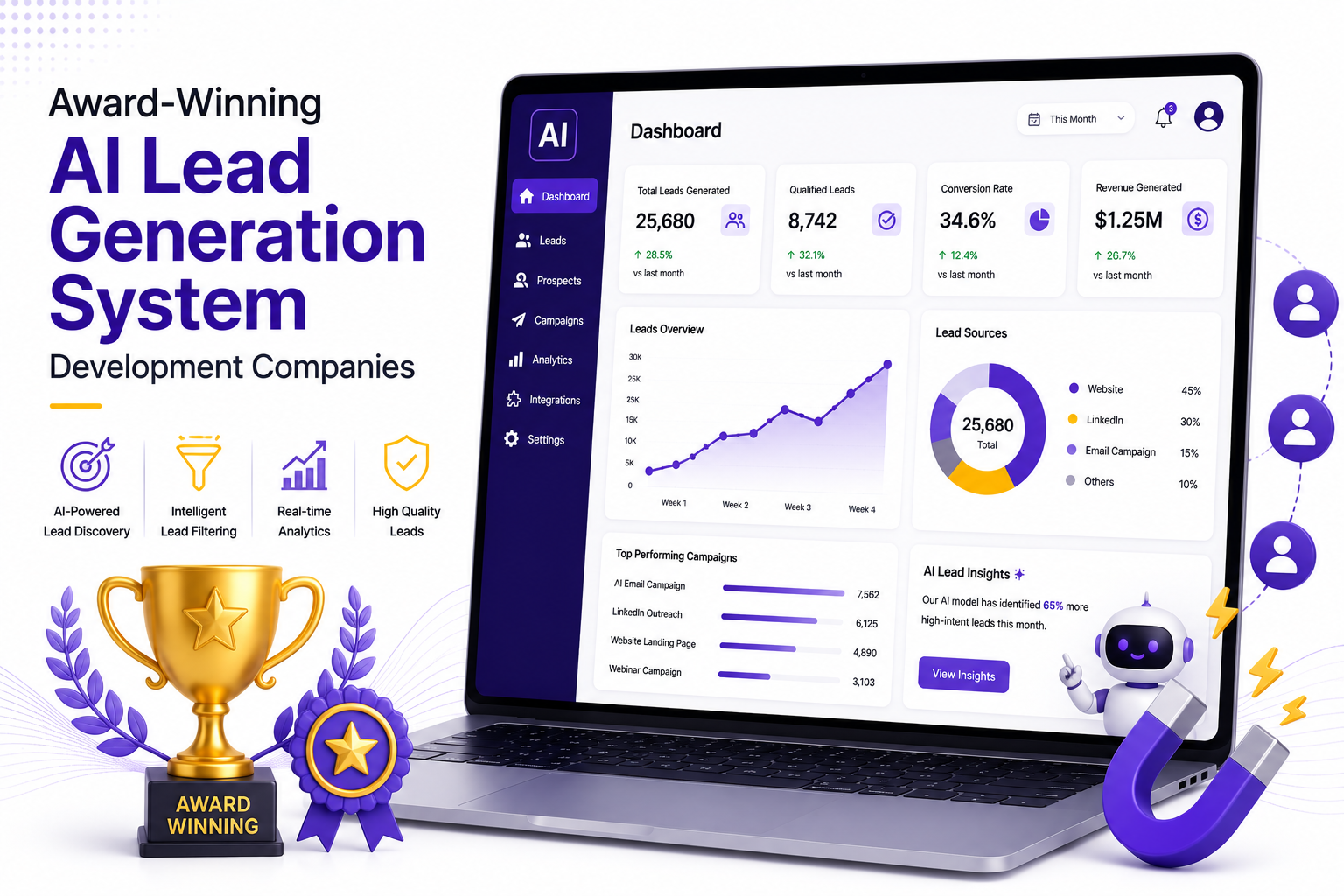

Every founder eventually runs into the same wall. Marketing brings in traffic, sales wants more qualified conversations, and the gap between the two keeps getting filled with spreadsheets, cold outreach tools that half work, and a CRM nobody trusts. That gap is exactly why an AI Lead Generation System has become one of the most searched build requests of 2026. It is not a chatbot bolted onto a website. Done properly, it is a working pipeline that scores intent, qualifies prospects, and hands sales a warm conversation instead of a cold name on a list.
The catch is that building one well takes more than a general software team. It needs people who understand intent modeling, CRM integrations, data hygiene, and the messy reality of how buyers actually behave online. That is a narrow skill set, and it shows in how uneven the market is. Some vendors will hand you a generic chatbot and call it AI. Others have shipped real systems that measurably shortened sales cycles for clients across finance, real estate, healthcare, and B2B SaaS.
This guide walks through 15 development companies worth shortlisting if you are building or upgrading an AI Lead Generation System in 2026. We have kept the technical jargon to a minimum and focused on what actually matters when you are the one signing the contract: what they build, who they build it for, and what sets them apart from the next name on your list.
One thing worth noting before diving in. Award recognition in this space rarely comes from a single glossy plaque. It tends to show up as repeat client contracts, case studies with real measurable outcomes, and reviews from other founders who went through the same hiring decision. We have weighed those signals alongside technical capability when putting this list together, rather than ranking purely on company size or marketing budget. A smaller, less known team with a handful of genuinely satisfied long term clients often deserves more attention than a large agency whose portfolio looks impressive but whose actual retention numbers tell a different story.
Why This Decision Is Bigger Than It Looks
Hiring the wrong development partner for a lead generation build does not just cost money. It costs months, because a poorly architected system tends to surface its flaws only after go live, once real prospect data starts flowing through it. A rushed integration can quietly misroute high value leads for weeks before anyone notices the pattern in the numbers.
The companies below were chosen because they have a track record of shipping systems that survive contact with real sales teams, not just demo environments. Some are large full stack studios with dedicated AI divisions. Others are smaller, more specialized teams that punch above their size on this specific use case. Both types show up on this list because founders have different needs depending on budget, timeline, and how much of the work needs to happen in house versus handed off entirely.
What a Good AI Lead Generation System Actually Needs to Do
Before comparing vendors, it helps to be clear on what this kind of system is actually supposed to accomplish, because the term gets used loosely across the industry. At a minimum, it should pull lead data from every channel a prospect might arrive through, score each one based on real signals rather than guesswork, and route the highest priority leads to a sales rep quickly enough that the prospect is still warm when the call happens.
The strongest builds also learn over time. As reps mark leads as won, lost, or unqualified, that feedback should quietly retrain the scoring model, so accuracy improves month over month instead of staying frozen at whatever the vendor delivered on day one. Keep that standard in mind while reading through the companies below, since it is the clearest way to separate a genuinely useful build from a system that only looks impressive in a sales demo. It is also worth asking any vendor how they would measure success six months after launch, not just at the moment the system goes live, since that answer tends to reveal how much thought has actually gone into the long term picture.
15 Award Winning AI Lead Generation System Development Companies
1. Hourly Developers
Hourly Developers has built a reputation around flexible, hourly and dedicated hiring models that let founders scale an AI build up or down without long contracts. For lead generation projects specifically, they typically assemble a small pod of a machine learning engineer, a backend developer, and a CRM integration specialist, which keeps communication simple and costs predictable. Clients tend to pick them when they already have a rough product spec and want a team that can start within days rather than weeks. Their transparent hourly billing and detailed weekly reporting make them a comfortable choice for founders who have been burned before by fixed bid contracts that ballooned in scope. They work across HubSpot, Salesforce, and Zoho integrations, and most of their lead scoring work is built on interpretable models rather than black box systems, which matters when a sales team needs to trust and explain why a lead was prioritized. Pricing typically runs on a monthly hourly bucket rather than a flat project fee, so costs scale directly with how much iteration the sales team asks for after launch. Founders who value being able to add or pull back developer hours month to month, without renegotiating a contract, tend to find this model easier to work with than a rigid fixed scope agreement.
2. Markovate
Markovate has carved out a name in applied AI product development, and their lead generation work usually centers on predictive lead scoring models trained on a client's own historical CRM data rather than generic third party datasets. That distinction matters because a model trained on your actual closed deals tends to outperform a one size fits all tool. They are a good fit for B2B companies with a decent volume of historical sales data already sitting in a CRM, since that data becomes the training foundation for the system. Their teams lean heavily on Python and cloud native machine learning pipelines, and they are comfortable working alongside an internal data or marketing team rather than only working in isolation. Engagements usually begin with a short data audit phase, where they assess how usable the client's existing CRM records actually are before committing to a timeline, which tends to prevent surprises later. Their pricing sits toward the higher end for this category, reflecting the deeper data science work involved, but clients with strong historical data often see the investment pay back through noticeably better lead prioritization within the first two quarters.
3. Backend Development Company
As the name suggests, this firm's strength sits in the plumbing that most AI lead generation vendors gloss over: the backend infrastructure that actually moves data between your website forms, ad platforms, CRM, and outreach tools without dropping records or duplicating contacts. Founders who have already tried a lightweight no code lead scoring tool and hit its limits often move to this company next, because they specialize in custom API architecture and event driven pipelines that scale past what plug and play tools can handle. They are less focused on flashy dashboards and more focused on making sure the underlying data pipeline is reliable, which pays off once lead volume grows past a few hundred per month. Their engagement typically starts with an architecture review of the client's existing tools, mapping out where data is currently getting lost or duplicated before any new development begins. Companies that have grown quickly and bolted on multiple marketing tools over time tend to benefit most from this approach, since untangling that existing mess often matters more than the AI model itself.
4. ScienceSoft
ScienceSoft is one of the more established names on this list, with decades of enterprise software delivery behind their newer AI practice. Their lead generation builds tend to suit mid size and larger companies that need the system to integrate with existing enterprise software such as SAP, Oracle, or a legacy CRM that smaller vendors would rather avoid touching. They bring formal documentation, structured project management, and a slower but thorough delivery process that larger organizations tend to prefer. If your company already has compliance requirements around data handling, their experience with regulated industries like healthcare and finance is a genuine advantage rather than a marketing line. Projects typically run on a fixed milestone structure with formal sign off at each stage, which appeals to procurement teams that need predictable budgeting more than rapid iteration. Smaller startups sometimes find their process heavier than necessary, but for a company with 200 or more employees and existing IT governance, that structure is usually a feature rather than a drawback.
5. HireFullStackDeveloperIndia
This company built its brand on giving founders direct access to experienced full stack talent at competitive rates, and their AI lead generation offering follows the same model. Instead of a packaged product, they assign a dedicated developer or small team who works as an extension of your own staff, often on a monthly retainer rather than a fixed project fee. This suits startups that want ongoing iteration on their lead scoring logic as their sales process evolves, rather than a one time build that gets frozen after launch. Their developers commonly work with Node.js and Python backends paired with React front ends for internal sales dashboards, and communication happens directly with the assigned developer rather than through layers of account managers. Because the pricing model is based on developer time rather than a packaged product, founders retain full ownership of the scoring logic and can request changes to qualification criteria as their ideal customer profile shifts, without waiting on a formal change request process.
6. Appinventiv
Appinventiv runs one of the larger dedicated AI and machine learning divisions among mid size development firms, and their lead generation projects often bundle in natural language processing for analyzing inbound email and chat conversations alongside the scoring model itself. That combination appeals to companies whose leads arrive through multiple unstructured channels rather than a single clean form fill. They have delivered projects across retail, healthcare, and logistics, and tend to bring a broader product strategy conversation into the engagement rather than jumping straight into development, which can add time upfront but often prevents costly rework later. Their teams are large enough to run parallel work streams, so a lead generation build can move alongside a related mobile app or customer portal project without waiting for one to finish before starting the next, which suits founders juggling several priorities at once.
7. DataEximIT
DataEximIT positions itself around data engineering first, AI second, which shows in how their lead generation systems are architected. Before any scoring model gets built, their teams typically spend real time cleaning and structuring the client's existing lead and CRM data, since a scoring model trained on messy or duplicated records will underperform no matter how sophisticated the algorithm is. This makes them a strong fit for companies that suspect their data hygiene is part of the problem, not just their lack of automation. They also offer ongoing model retraining as a service, which keeps scoring accuracy from drifting as market conditions and buyer behavior shift over a year or two. Their pricing typically includes this retraining as a recurring line item rather than a one off project cost, which some founders initially resist but usually come to appreciate once they see how quickly a static scoring model can go stale. Companies migrating off multiple disconnected spreadsheets or an outdated CRM tend to be their strongest fit.
8. OpenXcell
OpenXcell has a broad portfolio spanning mobile, web, and AI development, and their lead generation builds often include a custom internal dashboard alongside the scoring engine itself, giving sales teams a single place to see prioritized leads instead of digging through a CRM. They tend to work well with companies that want a visible, demoable product for internal stakeholders rather than a purely backend system running quietly behind existing tools. Their pricing sits in the mid range for this category, and they offer both fixed price and time and materials contracts depending on how firm the project scope already is. Sales leaders who want a visual, presentable tool to show investors or leadership, rather than a purely invisible backend process, tend to gravitate toward this dashboard first approach, and OpenXcell's design team is generally strong enough to make that dashboard genuinely usable day to day rather than a one time demo piece.
9. HireAIDevelopers
HireAIDevelopers, as the name signals, focuses specifically on artificial intelligence talent and projects rather than general software development, which shows in the depth of their lead scoring and predictive modeling work. Their teams commonly bring experience with more advanced modeling techniques, including ensemble methods and lightweight neural networks for lead prioritization, for companies whose lead volume and complexity justify moving past simpler rule based scoring. They are a strong option for founders who already understand the technical tradeoffs and want a team fluent in the same language, rather than one that needs the concepts explained from scratch. Because their staff skews toward specialists rather than generalists, project timelines can move faster once requirements are locked, though founders should expect a more technical discovery conversation upfront compared to a full stack generalist agency.
10. Konstant Infosolutions
Konstant Infosolutions has built a long standing presence in custom software development, and their AI lead generation work tends to appeal to small and mid size businesses that want a capable team without enterprise level pricing. Their process is straightforward, with clear milestone based delivery and a preference for well tested, proven technology stacks over experimental ones. That conservative approach suits founders who care more about reliability and predictable delivery timelines than being on the absolute cutting edge of AI research, which is a reasonable priority for a company depending on its first automated lead pipeline actually working. Their support does not end at launch either, and ongoing maintenance packages are usually offered at a modest monthly rate, which matters for founders who do not have an in house technical team to keep the system running smoothly after the initial build wraps up.
11. WebClues Infotech
WebClues Infotech offers a fairly complete package for founders who want the lead generation system, the marketing website, and any client facing portals built by a single vendor rather than coordinating between separate teams. Their AI practice sits alongside a larger web and app development business, which means the lead scoring logic tends to be built with an eye toward how it will surface inside a broader digital product rather than as a standalone tool. They are commonly chosen by companies in real estate, ecommerce, and local services, industries where lead volume is high but each individual lead needs fast, accurate qualification. Their combined service model also means fewer handoffs between vendors when something needs adjusting after launch, since the same team that built the scoring logic also maintains the website or app it lives inside, which shortens the time it takes to fix issues compared to coordinating across two separate agencies.
12. Matellio
Matellio's AI division has done considerable work in predictive analytics, and their lead generation systems often incorporate behavioral scoring based on website activity, such as page visits, time on site, and repeat visits, layered on top of standard demographic and firmographic data. This gives sales teams a fuller picture of intent rather than relying on form submissions alone. They typically work on a discovery phase first, mapping out the client's actual sales funnel before writing any code, which adds a few weeks upfront but tends to produce a system that matches how the sales team actually operates rather than a generic template. Their pricing structure usually separates the discovery phase as its own billed engagement, which lets founders evaluate the fit of the team before committing to the larger development contract that follows.
13. Simform
Simform has built a strong reputation in cloud native application development, and their lead generation systems are typically built to scale on AWS or Azure infrastructure from day one, which matters for companies expecting rapid lead volume growth. They favor a modular architecture that lets clients add new data sources or scoring criteria later without a full system rebuild. Their engagement model tends to suit venture backed startups that need the system to hold up under a sudden spike in traffic following a funding announcement or product launch, rather than a slow, steady lead flow. Their DevOps expertise also means the system tends to come with solid monitoring and alerting built in from the start, so a sales team is more likely to hear about a data pipeline issue before it silently affects lead scoring for days.
14. Intellectsoft
Intellectsoft brings enterprise grade delivery discipline to AI projects, including formal QA cycles and detailed technical documentation, which some founders value once a system needs to be handed off to an internal team for long term maintenance. Their lead generation builds often include integration with marketing automation platforms like Marketo or Pardot in addition to standard CRM connections, which suits B2B companies running more complex, multi touch nurture campaigns rather than a simple single form intake process. Larger organizations with dedicated IT security teams tend to appreciate the amount of documentation Intellectsoft produces along the way, since it makes internal audits and future handoffs considerably smoother than working with a smaller shop that skips formal write ups.
15. Techahead
Techahead rounds out this list with a practical, product first approach, building lead generation systems as part of a broader digital product rather than a bolted on feature. Their teams frequently pair the AI scoring component with a redesigned lead capture experience on the client's website or app, on the reasoning that a smarter backend does little good if the front end is still losing leads to a clunky form. They work across a range of industries and tend to keep timelines tight, usually delivering an initial working version within 8 to 10 weeks depending on integration complexity. Founders who are still refining their ideal customer profile alongside the technical build often appreciate this pairing, since front end and backend changes can happen in the same sprint rather than waiting on a separate vendor to update the capture form after a scoring rule changes.
Final Thoughts
None of these 15 companies are interchangeable, even though they are solving the same basic problem. The right choice depends less on who has the most impressive case studies and more on where your business actually is right now. A company with three years of clean CRM data needs a very different starting point than one still relying on spreadsheets and gut instinct. Budget matters too, and so does how much you want to manage in house versus hand off completely.
What ties every strong AI Lead Generation System build together, regardless of which vendor delivers it, is a clear eyed look at your existing data and sales process before a single line of code gets written. The companies on this list that consistently produce results are the ones willing to slow down at the start to understand how leads actually move through your funnel today. Skip that step, and even the most technically impressive model will end up prioritizing the wrong prospects.
Take the time to have a real conversation with two or three of these teams before committing. Ask to see how they handled a client with a data situation similar to yours, and pay attention to whether they ask you good questions in return. That exchange usually tells you more about how the project will go than any portfolio ever will.
It is also worth asking each vendor directly what happens after launch. A working model on day one is only half the story, since buyer behavior shifts, new channels get added, and last year's scoring rules can quietly stop matching this year's reality. The teams that build in retraining and ongoing support from the start tend to be the ones whose systems are still delivering accurate, trusted leads a year later, long after the initial excitement of launch day has worn off. Whichever company ends up on your shortlist, that single question about long term maintenance is usually the fastest way to separate a partner from a vendor.