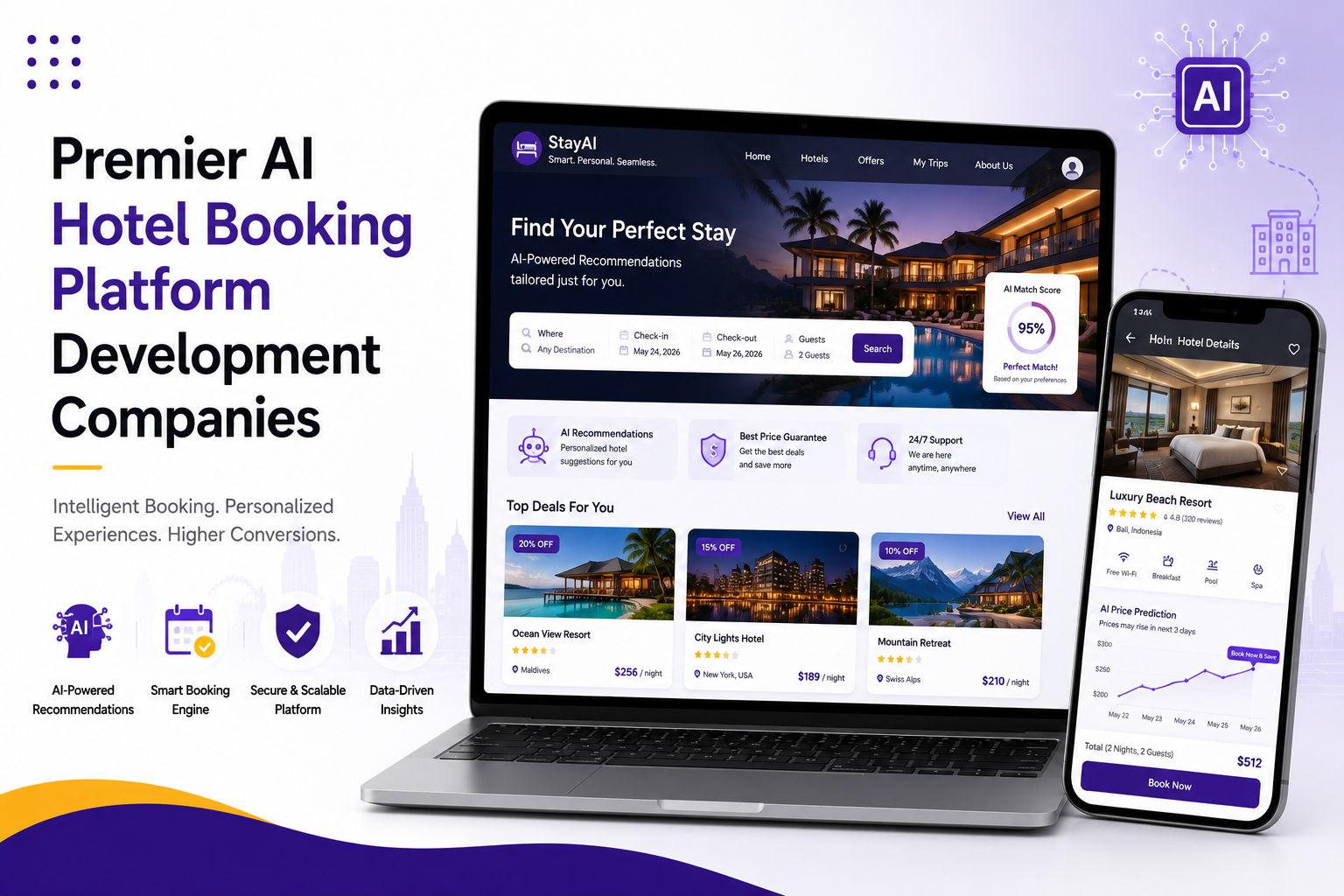

Somewhere between the fifth demo call and the tenth pitch deck, most hotel and travel founders start asking the same question: who can actually build this thing without needing to be managed like a junior hire? If you are reading this, you have probably moved past wondering whether an AI Hotel Booking Platform is worth building. You already know guests expect instant, personalized recommendations, pricing that adjusts in real time, and a booking flow that feels less like filling out a form and more like chatting with a well-informed travel agent.
What you are really trying to figure out now is who gets to build it, and that is a harder question than it sounds. Search for an AI Hotel Booking Platform development company and you will find hundreds of agencies claiming the exact same three things: AI expertise, hospitality experience, and a proven track record. Most of that language is copied from one website to the next, with very few companies explaining what they actually build or how working with them feels once the contract is signed.
This blog skips the sales pitch. It is a practical shortlist of 20 companies worth researching if you are serious about building an AI hotel booking platform in 2026, along with what each one generally focuses on, so you can walk into your first call already knowing the right questions to ask.
Why 2026 Is a Different Kind of Year for Hotel Booking Technology
Hotel booking software has quietly gone through three or four generations in the last decade, but 2026 feels like a genuine turning point. Guests now expect an AI Hotel Booking Platform to understand context, not just keywords. A search like "quiet hotel near the conference center with a late checkout" should return a short, relevant list, not a generic results page. Behind the scenes, dynamic pricing engines react to demand shifts within minutes instead of overnight batch jobs, and conversational AI concierges now handle a growing share of pre-booking questions that used to tie up a front desk phone line.
None of this is optional anymore for hotel groups competing with OTAs that have already invested heavily in AI. The gap between a booking platform that simply lists rooms and one that actively helps a guest choose the right room is exactly where the development company you choose will make or break the outcome.
What Actually Matters When Comparing These Companies
Before jumping into the list, it helps to know what separates a genuinely capable partner from a well-designed website. A few things worth checking during your own research include prior hospitality or travel domain experience, comfort working with large language models and recommendation engines rather than treating AI as a buzzword, the ability to integrate with existing property management systems and OTA channels, and a clear post-launch support plan. Pricing transparency matters too. A company that avoids giving even a rough range on your first call is usually one to be cautious about.
With that in mind, here are 20 companies worth putting on your shortlist for an AI Hotel Booking Platform build in 2026.
20 Companies to Consider for Your AI Hotel Booking Platform
1. Appinventiv
- Location: India, with offices across the US and UK
- Core Focus: Enterprise-grade AI and mobile app development
- Best For: Hotel groups that need a full-scale, multi-platform booking ecosystem
Appinventiv is widely recognized for combining AI, machine learning, and cloud engineering into large hospitality and travel projects. They tend to work with mid-size to enterprise clients who need a booking platform that ties together mobile apps, web portals, and backend systems in one coordinated build.
2. HireAIDevelopers
- Location: India, serving clients globally
- Core Focus: Dedicated AI and machine learning developer teams
- Best For: Founders who want to hire specialized AI talent without building an in-house team
As the name suggests, HireAIDevelopers focuses specifically on staffing and building AI-first products. For hotel and travel businesses, this usually means recommendation engines, chatbot concierges, and predictive pricing models built by developers who work on AI systems every day, not as a side skill.
3. Chetu
- Location: United States, with global delivery centers
- Core Focus: Custom software development across travel and hospitality
- Best For: Businesses that need deep integrations with existing PMS or booking engines
Chetu has a long history in custom software for niche industries, and travel technology is one of their stronger verticals. They are often chosen for projects that involve connecting a new booking system to legacy hotel management software that is not always easy to work with.
4. Simform
- Location: United States and India
- Core Focus: Product engineering, cloud, and AI/ML solutions
- Best For: Startups and scale-ups that want a lean, product-first build approach
Simform is known for a product engineering mindset rather than a pure outsourcing model. Teams here typically get involved early in planning, which suits founders who are still shaping their platform roadmap and want a partner who questions assumptions instead of just executing tickets.
5. Backend Development Company
- Location: India, with remote delivery worldwide
- Core Focus: Backend architecture, APIs, and scalable server-side systems
- Best For: Projects where booking logic, pricing engines, and data pipelines matter more than the front end
This team specializes in the part of the platform most guests never see but every founder should care about deeply. A booking system lives or dies on how well it handles concurrent reservations, real-time inventory updates, and third-party API calls, and that is exactly where this company puts its focus.
6. Matellio
- Location: United States, with development centers in India
- Core Focus: AI, IoT, and custom enterprise software
- Best For: Hospitality groups exploring AI beyond booking, such as smart room automation
Matellio often gets pulled into projects that go past a standalone booking flow, connecting AI to guest experience touchpoints like smart check-in, in-room automation, and predictive maintenance. If your roadmap includes more than reservations, this team tends to think beyond the immediate ask.
7. Netguru
- Location: Poland, with a strong European client base
- Core Focus: Digital product design and AI-driven engineering
- Best For: Founders who care equally about design quality and technical depth
Netguru has built a reputation on combining strong UX design with solid engineering, which matters more than people expect in hotel booking software. A technically sound platform with a clunky interface still loses bookings, and this is one of the few teams that treats both sides as equally important.
8. ScienceSoft
- Location: United States, with global delivery teams
- Core Focus: IT consulting, custom development, and data analytics
- Best For: Businesses that want a consulting-led approach before committing to a build
ScienceSoft leans into the consulting side of software development, often starting with audits and technical roadmaps before writing a single line of code. This suits decision-makers who want a second opinion on feasibility and cost before locking into a full development contract.
9. HireFullStackDeveloperIndia
- Location: India, with a flexible remote hiring model
- Core Focus: Full-stack development teams for web and mobile products
- Best For: Companies that want to build and own their platform with a dedicated, in-house-feeling team
This company works on a staff-augmentation and dedicated-team model, which tends to appeal to founders who want more control over their build without managing a large in-house engineering department. It is a practical middle ground between hiring internally and fully outsourcing the project.
10. Intelivita
- Location: United Kingdom and India
- Core Focus: Mobile app development and AI integration
- Best For: Hotel brands prioritizing a mobile-first booking experience
Intelivita is regularly mentioned for mobile-first product builds, which fits well with how most travelers now book rooms, on their phones, often at the last minute. Their AI work tends to center around personalization and in-app recommendations rather than backend infrastructure.
11. Konstant Infosolutions
- Location: India, with over a decade of software delivery experience
- Core Focus: Web and mobile app development, including travel tech
- Best For: Small to mid-size hotel chains needing a reliable, budget-conscious partner
Konstant has built a name in general-purpose web and mobile development, with travel and booking systems as one of several verticals they regularly serve. They are often shortlisted by businesses that want dependable execution without enterprise-level pricing.
12. Yalantis
- Location: Ukraine, with clients across Europe and North America
- Core Focus: Custom software engineering, including travel and logistics platforms
- Best For: Complex platforms that need strong system architecture from day one
Yalantis has a track record in building complex, data-heavy platforms, and their engineering-first culture tends to show up in how carefully they plan system architecture before development starts. This matters for a booking platform that will eventually need to handle high transaction volumes.
13. Aalpha Information Systems
- Location: India, serving international clients
- Core Focus: Custom software and AI-based application development
- Best For: Founders who want direct access to senior developers instead of layered account management
Aalpha is often chosen for its relatively lean team structure, where clients tend to work closely with senior developers rather than going through multiple layers of project management. That can translate into faster decision-making during the build.
14. Hyperlink InfoSystem
- Location: India and the United States
- Core Focus: Mobile app and web development across multiple industries
- Best For: Businesses wanting a large, established team with broad industry experience
Hyperlink InfoSystem has one of the larger development teams on this list, which can be useful for projects with tight timelines that need multiple developers working in parallel. Their portfolio spans several industries, including travel and hospitality booking systems.
15. Zealous System
- Location: India, with a global remote client base
- Core Focus: Web, mobile, and AI-driven application development
- Best For: Startups looking for a cost-effective build without cutting corners on quality
Zealous System is frequently mentioned in comparisons for offering solid technical delivery at a more accessible price point, which appeals to early-stage hotel tech startups still validating their concept before scaling investment.
16. Iflexion
- Location: United States and Eastern Europe
- Core Focus: Enterprise software development and AI consulting
- Best For: Larger hospitality businesses with existing systems that need modernization
Iflexion tends to work with more established businesses that already have booking infrastructure in place and are looking to modernize it with AI capabilities rather than starting from zero. Their consulting background helps when a project involves untangling older systems.
17. Space-O Technologies
- Location: India, Canada, and the United States
- Core Focus: Mobile app development with AI and on-demand solutions
- Best For: Businesses wanting an app-based booking experience similar to on-demand travel apps
Space-O has built a reputation in on-demand and marketplace-style apps, and that experience carries over well into hotel booking products that need real-time availability, instant confirmation, and a smooth mobile checkout flow.
18. Digital Aptech
- Location: India, with remote project delivery worldwide
- Core Focus: Web development, e-commerce, and booking system integrations
- Best For: Smaller hotel businesses needing a straightforward, functional booking platform
Digital Aptech is generally chosen by smaller hospitality businesses that need a functional, well-built booking system without the overhead of a large enterprise engagement. Their approach tends to be practical and delivery-focused rather than heavily consultative.
19. TechAhead
- Location: United States and India
- Core Focus: Mobile-first product development and AI solutions
- Best For: Hotel and travel brands wanting a polished consumer app alongside the booking backend
TechAhead has worked on a number of consumer-facing apps across industries, and their strength shows in how they balance backend booking logic with a front end that actually feels good to use, which matters a lot for guest retention.
20. Binmile Technologies
- Location: India and the United States
- Core Focus: Custom software development, AI, and cloud engineering
- Best For: Businesses wanting a flexible engagement model, from MVP to full-scale product
Binmile is often noted for its flexibility in engagement models, working with early-stage founders on lean MVPs as comfortably as it works with larger clients on full product builds. That range makes it a reasonable starting point regardless of where your project currently stands.
What These Companies Actually Build: Core Features to Expect
Regardless of which company you eventually choose, most serious AI hotel booking projects in 2026 include a similar set of building blocks. Knowing these ahead of time makes it much easier to evaluate proposals, ask sharper questions during your discovery calls, and spot which vendors truly understand the space rather than repackaging generic e-commerce features under an AI label.
- Conversational search and booking: Guests describe what they want in plain language and get relevant results, instead of filtering through endless checkboxes.
- Dynamic and predictive pricing: Room rates adjust based on demand, local events, seasonality, and competitor pricing, often updated in near real time.
- Personalization engines: Returning guests see recommendations based on past stays, preferences, and browsing behavior rather than the same generic homepage.
- PMS and OTA integrations: The platform needs to sync inventory, rates, and bookings across property management systems and third-party channels without manual updates.
- Fraud detection and secure payments: AI models flag suspicious booking patterns before they become chargebacks, alongside standard payment security measures.
- Multilingual and multi-currency support: Especially important for hotels relying on international travelers, where AI can help translate and localize content accurately.
A well-built AI Hotel Booking Platform brings these pieces together so they work as one system rather than a patchwork of disconnected tools bolted on over time. That is usually the real difference between a company that talks about AI and one that has actually shipped it.
What It Costs to Build One in 2026
Cost is usually the second question after "can you build this," and the honest answer is that it depends heavily on scope. A basic booking platform with light AI features, such as simple recommendations and chatbot support, can start somewhere in the range of $15,000 to $35,000 depending on the region and team you hire. A mid-range platform with dynamic pricing, deeper personalization, and multiple system integrations typically falls between $40,000 and $90,000. Enterprise-grade builds for larger hotel chains, with custom AI models, advanced analytics, and extensive third-party integrations, can run well beyond $100,000.
Ongoing costs matter just as much as the initial build. Most companies on this list offer maintenance packages that cover model retraining, bug fixes, and feature updates, usually priced monthly or as a percentage of the original build cost. It is worth asking about this upfront rather than treating it as an afterthought once the platform goes live.
A few specific factors tend to push cost up more than founders expect going in. Custom AI model training, as opposed to using off-the-shelf recommendation tools, adds both time and money but usually pays off in accuracy. The number of PMS and OTA integrations matters too, since each additional third-party connection brings its own documentation quirks and testing overhead. Finally, if your platform needs to support multiple properties with different pricing rules and inventory systems from day one, budget for a longer discovery phase before any development actually starts.
How to Actually Make the Final Decision
Once you have a shortlist, the fastest way to separate strong candidates from average ones is to ask each company for a small paid discovery phase rather than a free proposal. A company confident in its process will usually agree to this without hesitation, and it gives you a real sample of how they think before committing to the full build. It is also worth asking to speak with a past hospitality client directly, not just reading a case study on their website. Real conversations tend to surface details that polished portfolios leave out, such as how communication actually worked during the project and how the team handled unexpected technical roadblocks.
It also helps to pay attention to how a company communicates during the sales process itself, since that usually predicts how they will communicate once the invoices start going out. Do they explain technical tradeoffs in plain language, or lean on jargon to sound impressive? Do they push back when a timeline or budget seems unrealistic, or agree to everything just to win the deal? Founders who ask these questions early tend to end up with far fewer surprises six months into development.
Common Mistakes Founders Make When Choosing a Development Partner
A surprising number of hotel booking projects run into trouble not because the technology was too ambitious, but because of a handful of avoidable missteps during the hiring process. Knowing these ahead of time can save months of rework and a fair amount of budget.
- Choosing based on price alone: The cheapest quote often excludes AI model training, ongoing maintenance, or third-party integration costs, which show up as expensive surprises later.
- Skipping a technical discovery phase: Jumping straight into full development without mapping out data sources, integrations, and edge cases usually leads to scope changes mid-project.
- Underestimating data readiness: AI features like personalization and dynamic pricing need clean, structured historical data to work well, and many teams discover their existing data is not ready until development is already underway.
- Ignoring post-launch support: A platform that goes live is not finished. AI models drift over time and need retraining, and a vendor without a clear support plan can leave you stuck.
None of these mistakes are unusual, and none of them are hard to avoid once you know to ask about them early. The founders who end up happiest with their platform are usually the ones who slowed down just enough during vendor selection to get clear answers on these exact points.
Conclusion
There is no single "best" company on this list, and honestly, anyone who tells you otherwise is probably trying to sell you something. The right partner for your AI Hotel Booking Platform depends on your budget, your timeline, how much control you want during development, and whether you need a team that simply executes or one that pushes back on your assumptions when it matters. What all 20 companies here share is a genuine track record in AI-driven or hospitality-focused development, which already puts them ahead of the countless agencies that will tell you what you want to hear just to close the deal.
Take this list as a starting point, not a final answer. Book two or three discovery calls, ask the uncomfortable questions about cost overruns and past project delays, and pay attention to how each team responds when you push back. That conversation will tell you more about who deserves to build your platform than any portfolio page ever will.