
Open any gaming forum right now and you will find the same complaint repeated in a dozen different ways. Matchmaking feels lopsided, difficulty spikes come out of nowhere, and recommendations keep pushing the same five titles no matter what a player actually enjoys. None of that is a coincidence. It is what happens when a platform is built to serve content, not the person playing it.
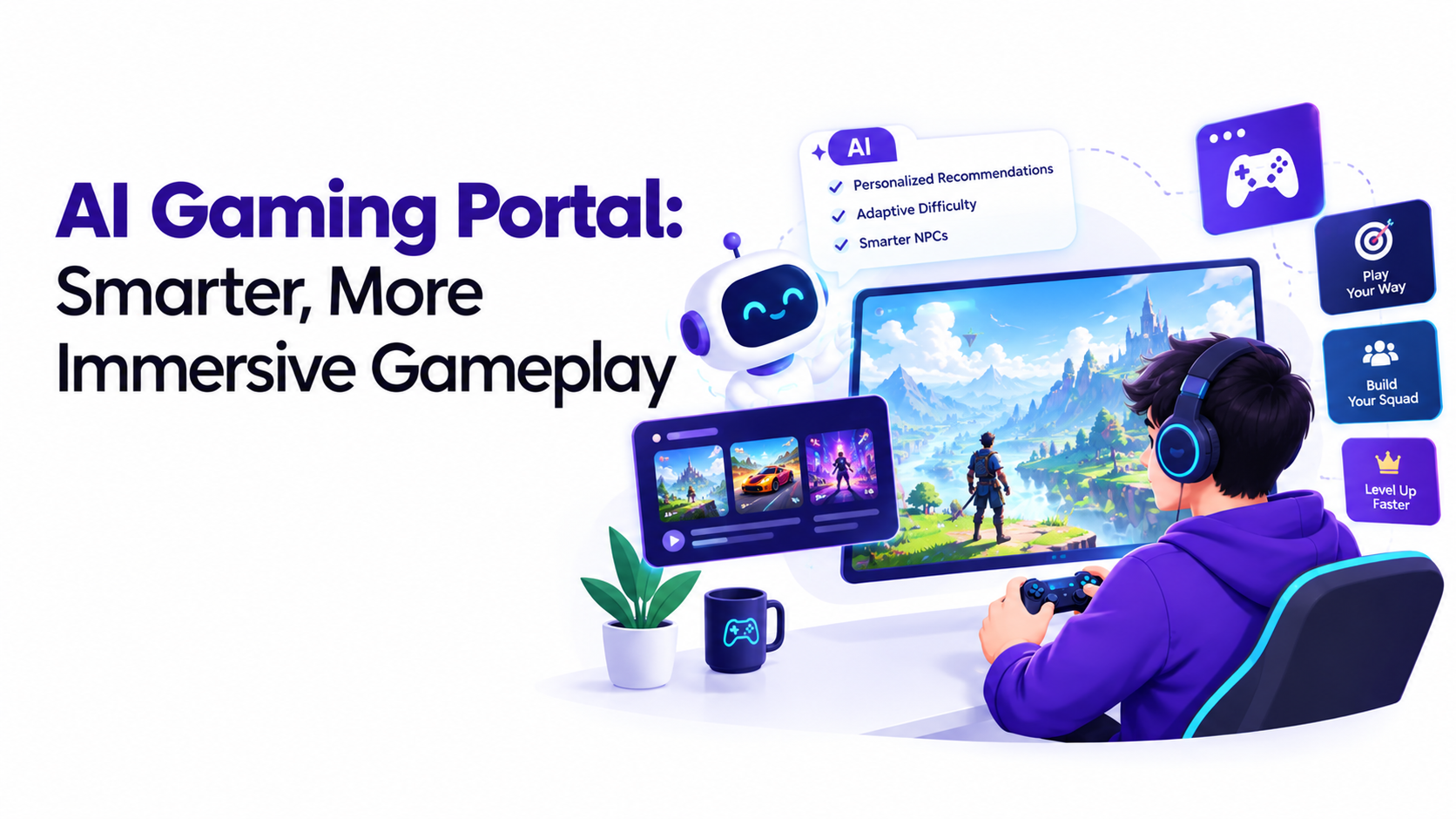
An AI gaming portal flips that setup around. Instead of static menus and one-size-fits-all rules, the platform watches how someone plays, learns from it, and adjusts in real time. Matches feel fairer. Difficulty feels earned. Recommendations start to feel like they were made by someone who actually knows your taste, because in a sense, they were.
This guide breaks down what an AI gaming platform actually does under the hood, why so many studios and publishers are rebuilding around one in 2026, and what a founder or product lead needs to think through before committing budget to the idea.
None of this is theoretical anymore. Studios that shipped adaptive, AI-driven experiences over the past two years are already seeing the retention and revenue difference, and the ones still running static platforms are starting to notice players quietly drifting toward competitors that feel more responsive.
What Is an AI Gaming Portal, Exactly?
An AI gaming portal is a platform layer that sits between players and the games or content they access, using machine learning models to personalize, moderate, and optimize the experience continuously rather than through fixed rules set once at launch.
Think of it as the difference between a jukebox and a DJ who is actually reading the room. A traditional gaming platform serves the same catalog and the same layout to everyone. An AI-driven one watches session length, win rates, in-game behavior, and even how quickly a player abandons a level, then quietly reshapes the experience around that data.
The word portal matters here too. This is not just a single game with a smarter engine underneath it. It is the layer that connects matchmaking, storefronts, recommendations, moderation, and community features into one system, so decisions made in one area inform decisions made in another. A player who consistently rage quits difficult boss fights, for example, might see gentler pacing suggestions, calmer matchmaking pools, and different in-app offers, all shaped by the same underlying model.
This is also why the term gets used loosely in marketing copy far more often than it should. A platform that simply recommends games based on genre tags is not really running an AI gaming portal in the fuller sense described here. The real version relies on continuously updated behavioral models, not a static list of tags applied once when a game was first added to the catalog.
In summary: In short, the portal is the connective layer, and the intelligence running through it is what separates a modern platform from a static one.
Why This Shift Is Happening Right Now
Gaming platforms have collected behavioral data for years. What changed in 2026 is the ability to act on it instantly, at scale, and without a team of analysts manually adjusting settings every week. Machine learning infrastructure that used to require a dedicated data science department is now available through managed cloud services, which has quietly opened the door for far more studios than most people realize.
A few converging forces explain why adoption has accelerated so quickly this year, rather than staying a niche experiment reserved for the largest publishers.
• Player expectations have risen sharply. People who use AI-personalized shopping, streaming, and social feeds every day now expect the same intelligence from the games they play.
• Cloud infrastructure and inference costs have dropped enough that real-time personalization is affordable even for mid-sized studios, not just the largest publishers.
• Retention has become the central metric that boards and investors ask about, and adaptive, AI-driven experiences consistently outperform static ones on session length and return visits.
• Regulatory pressure around loot boxes, addictive design, and content moderation has pushed studios toward AI systems that can flag risky patterns before they become a legal problem.
• Competitive pressure plays a role too, since once one major platform in a genre ships adaptive matchmaking or smarter recommendations, rivals feel the churn almost immediately and move to catch up.
In summary: None of these forces alone would justify the shift. Together, they make it hard for any platform serious about retention to keep ignoring AI much longer.
Core Features Of A Modern AI Gaming Platform
Not every platform that claims to use AI is built the same way. Here is what tends to separate a genuinely intelligent AI gaming platform from one that has simply added a chatbot to its support page.
In summary: A platform does not need all six of these on day one. Most studios start with two or three and expand once the data pipeline is proven to work reliably.
How AI Actually Improves The Player Experience
It helps to separate the marketing language from what players genuinely notice when a platform is built well. The improvements that matter most are usually the ones players cannot quite put into words, they simply notice that a game feels fairer and more responsive than it used to.
• Matches feel closer and more competitive because skill assessment updates after every session instead of once a season.
• Tutorials and onboarding shorten automatically for experienced players and lengthen for newcomers who need more guidance.
• In-game hints and difficulty curves respond to frustration signals like repeated deaths or long pauses, rather than a fixed script.
• Recommendations improve the longer someone plays, since the model keeps refining its picture of what that specific player enjoys.
• Toxic behavior gets caught faster, which keeps communities healthier and reduces the churn that toxic environments usually cause.
• Loading screens and downtime start to feel shorter because predictive systems pre-fetch the content a player is statistically likely to need next.
In summary: None of these changes announce themselves loudly. They just quietly remove the small frictions that used to make players close the app.
The AI Technologies Behind The Scenes
A useful AI gaming portal usually combines several distinct technologies rather than relying on one model to do everything. Understanding the basic building blocks makes it much easier to have a productive conversation with a technical partner later.
In summary: Most portals lean heavily on two or three of these at launch, usually recommendation engines and predictive analytics, then expand into reinforcement learning and computer vision as the platform matures.
Business Benefits Of Building An AI Gaming Portal
For a founder or product leader weighing the investment, the case tends to come down to a handful of measurable outcomes that show up in the numbers within the first two or three quarters after launch. None of these benefits require a massive platform overhaul to start showing results either, since even a single well-targeted AI feature tends to move at least one of the metrics below within the first live quarter.
1. Higher retention, since adaptive experiences keep players engaged longer than static, one-size-fits-all platforms.
2. Lower support costs, because AI moderation and automated flagging catch issues before they escalate into tickets.
3. Better monetization timing, which tends to lift revenue per user without making players feel pressured.
4. Stronger fraud prevention, protecting both revenue and the platform's reputation with genuine players.
5. Faster content decisions, since usage data replaces guesswork about what to build or promote next.
6. More efficient live operations, since teams can prioritize fixes and content drops based on what the data shows is actually driving churn.
In summary: Together, these gains tend to compound. A platform that retains players longer also generates more of the behavioral data that keeps improving the AI models over time.
What To Consider Before You Build One
Before committing a budget, it is worth working through a short list of practical questions. Skipping this step is one of the most common reasons AI projects in gaming stall out midway through development.
Quick Checklist:
• Do you have enough historical player data to train useful models, or will you need to launch with simpler rule-based systems first?
• Which parts of the experience benefit most from personalization? Matchmaking and moderation usually deliver the fastest return.
• How will you handle data privacy and regional compliance, especially if your player base spans multiple countries?
• Will your infrastructure support real-time inference at your expected concurrent user count without noticeable lag?
• Do you have a plan for retraining models as player behavior shifts, rather than treating the system as a one-time build?
• Who on your team, or which partner, will own the ongoing monitoring once the feature is live and generating real usage data?
In summary: Answering these honestly before development starts saves months of rework later, since retrofitting compliance or data pipelines after launch is always harder than planning for them upfront.
In-House Team Or A Specialized Development Partner
This is usually the first real decision point once the business case is settled. Both routes work, but they suit different situations, and it is worth comparing a handful of AI gaming portal development companies before assuming an in-house build is the safer option.
Many studios that lack an in-house data science team choose to work with established AI gaming portal development companies rather than build a machine learning function from scratch. It is often the faster and less risky path, particularly for a first version of the platform.
Whichever direction you choose, the goal is the same: a partner or team that understands both game design and applied machine learning, since the two rarely succeed independently of each other.
In summary: There is no universally correct answer here. The right choice depends more on timeline and existing expertise than on company size alone.
A Realistic Development Process
Once the decision is made, the actual build tends to follow a fairly consistent sequence, regardless of whether it is handled in-house or through a partner.
Step 1: Define the use case
Decide whether you are starting with matchmaking, moderation, personalization, or all three, since trying to solve everything at once usually stalls the project.
Step 2: Audit your data
Review what player data already exists and what gaps need to be filled before any model can be trained reliably.
Step 3: Choose the right models
Match the technology to the problem. Reinforcement learning suits adaptive difficulty, while recommendation engines suit content curation.
Step 4: Build and test in a sandbox
Run the system against historical data before exposing it to live players, so obvious errors get caught early.
Step 5: Launch with a limited rollout
Release the feature to a small player segment first and compare outcomes against a control group.
Step 6: Monitor and retrain
Treat the model as a living system that needs regular retraining as player behavior and content libraries evolve.
In summary: Most teams underestimate the final step. Retraining and monitoring is not a one-time task after launch, it is an ongoing part of running the platform for as long as it stays live.
Common Challenges And How Studios Solve Them
No AI rollout goes perfectly smoothly. Here are the issues that come up most often, along with the approaches studios typically use to work through them.
In summary: None of these challenges are dealbreakers on their own. They are simply the reason a rushed, unplanned AI rollout tends to underperform a carefully sequenced one.
What It Actually Costs To Build One
Costs vary widely depending on scope, but a few factors consistently drive the budget more than anything else: how many AI features are included at launch, how much existing data is available to train models, and whether the team is building on top of existing infrastructure or starting from zero.
A narrow build focused on one feature, such as smarter matchmaking, costs far less than a full AI gaming portal that combines matchmaking, moderation, personalization, and fraud detection from day one. Most studios find it more practical to launch with one or two AI features and expand the platform once the initial results justify the investment.
Ongoing costs matter just as much as the initial build. Model retraining, cloud inference, and monitoring all continue after launch, and studios that budget only for development while ignoring these recurring costs often find themselves underfunded within the first year.
Team composition also shifts the number more than most founders expect. A build that leans on pre-trained models and managed AI services generally costs less than one that requires custom model architecture built from the ground up, so it is worth asking any potential partner which approach they plan to use before comparing quotes side by side.
In summary: Budget conversations go much smoother once both the build cost and the ongoing running cost are on the table together, rather than treating the launch as the finish line.
Where AI Gaming Portals Show Up Across Genres
The way this technology gets used shifts noticeably depending on the genre, which is worth knowing before assuming a single feature set fits every kind of game.
• Mobile and casual games lean heavily on predictive content curation and dynamic monetization, since session lengths are short and every interaction needs to count.
• Competitive multiplayer titles depend most on smart matchmaking and behavioral fraud detection, where a single cheater or mismatched lobby can drive away an entire group of players.
• Role-playing and open-world games benefit most from adaptive difficulty and reinforcement learning driven non-player characters that respond believably to player choices.
• Social and community-heavy platforms rely most on AI moderation and natural language processing to keep chat and voice channels usable at scale.
In summary: Recognizing which category your platform falls into early makes it much easier to prioritize the first one or two AI features to build.
Metrics That Prove The Investment Is Working
Once a feature is live, the next question is always the same. How do you know it is actually working, rather than just adding complexity without a real return?
In summary: Tracking these consistently for at least a full quarter gives a far more reliable picture than judging a new AI feature off its first two or three weeks live.
Where AI Gaming Portals Are Headed Next
The features covered so far are already live on many platforms today. A few trends are shaping what comes next over the following few years.
• Generative AI will increasingly shape dynamic in-game content, including quests and dialogue that adapt to individual playstyles rather than following a fixed script.
• Cross-platform behavioral profiles will let a player's preferences follow them between mobile, console, and PC experiences on the same portal.
• AI-driven accessibility features, such as automatic difficulty and control adjustments for players with different needs, are becoming a standard expectation rather than an add-on.
• Real-time voice and text translation will make multiplayer communities genuinely global instead of splitting players by language.
• Expect closer integration between AI moderation systems and platform trust scores, so player reputation carries more weight across the entire portal.
In summary: None of these trends require abandoning what is being built today. They build directly on the same foundation of matchmaking, moderation, and personalization already covered here.
Bringing It All Together
The platforms winning player loyalty in 2026 are not the ones with the biggest content libraries. They are the ones that pay attention, adjust in real time, and make every player feel like the experience was actually built around them.
That is the real promise of an AI gaming portal. It is not about replacing game design with algorithms. It is about giving good design the ability to respond, learn, and improve continuously instead of sitting static until the next update cycle.
The studios treating this as a genuine platform investment, rather than a marketing checkbox, are the ones pulling ahead on retention and revenue this year. The gap between an adaptive portal and a static one only tends to widen the longer both stay live, which is exactly why so many teams are choosing to act on this now rather than waiting another product cycle.
For any studio or founder weighing this investment, the question is no longer whether AI belongs in the platform. It is which features to build first, how to measure whether they are working, and how quickly the rest of the roadmap can follow once the early results are in.