If you have refreshed a dashboard five times in one afternoon hoping the numbers would suddenly make more sense, you already understand why brand monitoring has become such a headache for founders and marketing teams heading into 2026. Reviews land on a dozen platforms at once, mentions show up in forums nobody checks daily, and customer sentiment can shift within hours instead of weeks. A spreadsheet simply cannot keep up with that pace anymore.
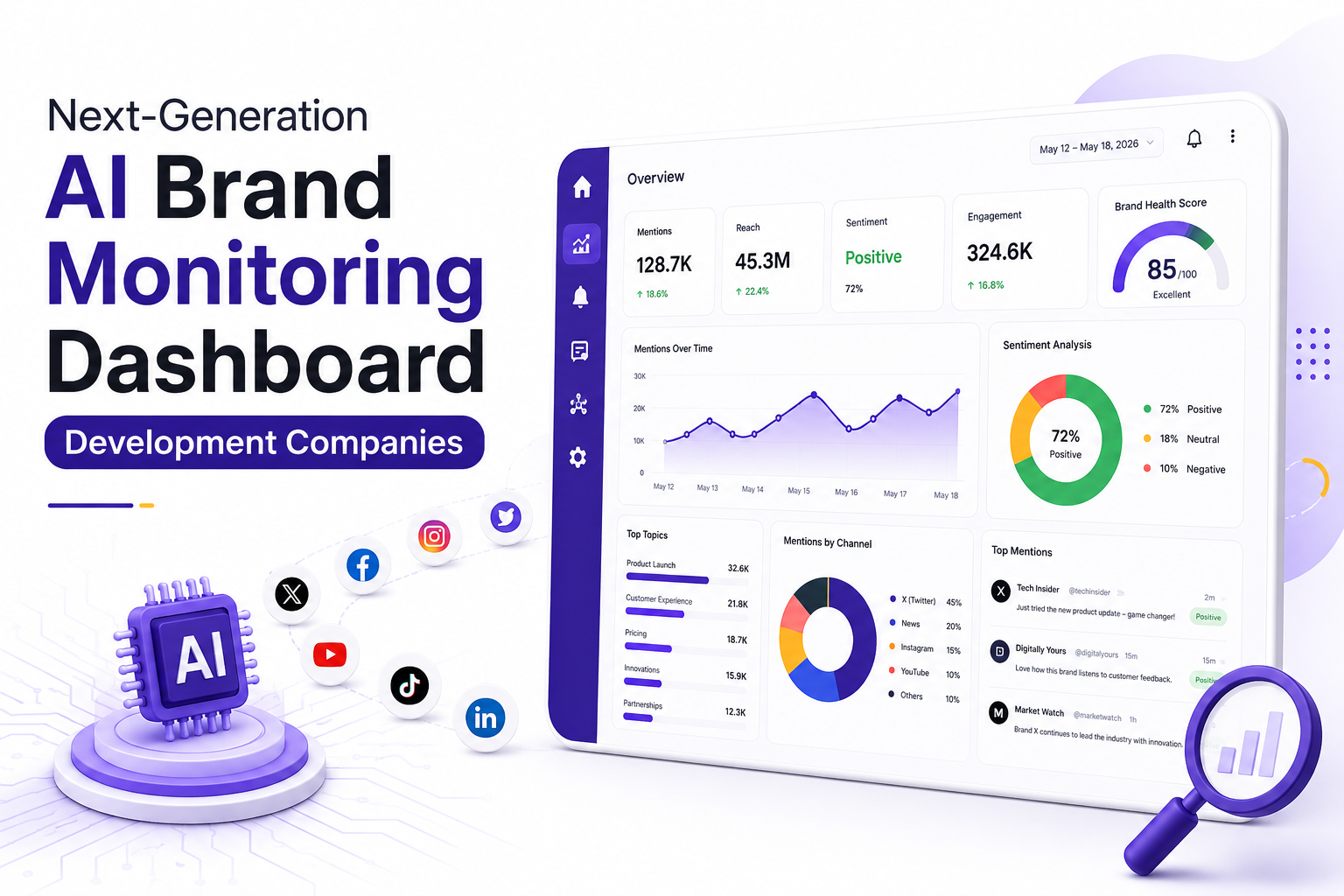
This is exactly where a well-built AI Brand Monitoring Dashboard earns its place in a company's toolkit. Instead of juggling browser tabs and asking someone to compile a weekly report, teams get one screen that pulls in social chatter, reviews, and news mentions, then uses AI to flag what genuinely needs attention. Building something like this is not a weekend project though. It needs the right mix of data engineering, natural language processing, and clean dashboard design, and that is usually more than an in-house team can pull off alongside their regular work. Most product and marketing teams are already stretched thin managing their core responsibilities, so adding a full monitoring system on top, one that needs constant tuning as new slang and platforms emerge, tends to fall down the priority list until a crisis forces it back up.
So this blog walks through some of the companies actively building custom AI Brand Monitoring Dashboard solutions in 2026, along with what each one tends to be known for. The goal is to help you shortlist a partner faster, without spending weeks digging through portfolios and sales calls yourself.
Why Brand Monitoring Looks Completely Different in 2026
A few years ago, brand monitoring mostly meant checking mentions on two or three social platforms and maybe a review site. That is no longer how conversations about a brand actually happen. Comments show up on video platforms, niche communities, messaging app groups, and marketplaces, often within minutes of a product launch or a customer complaint. Manually tracking all of that is not realistic for any team, no matter how large.
What has changed the game is how AI now reads tone and context instead of just counting keyword mentions. A properly trained AI Brand Monitoring Dashboard can tell the difference between a customer joking about a delayed order and one who is genuinely upset enough to churn. That distinction used to take a human analyst hours to work out across hundreds of mentions, and now it happens close to instantly, which is exactly why so many companies are investing in custom-built solutions rather than generic, one-size-fits-all tools. Off-the-shelf tools tend to apply the same sentiment rules to every industry, which works reasonably well for broad categories but misses a lot of nuance for brands with their own slang, product names, or recurring complaints that a generic model was never trained to recognize.
What to Check Before You Hire a Development Company
Not every development company that lists dashboards on its website actually has experience with sentiment models, real-time data pipelines, or the messy job of cleaning social data before it becomes useful. Before shortlisting anyone, it helps to look at a few things directly:
Whether they have handled natural language processing work before, not just standard CRUD dashboards. Whether their integrations cover the platforms your customers actually use, rather than a generic list. Whether the dashboard can scale as mention volume grows, since a tool that works fine at 500 mentions a day can slow to a crawl at 50,000. And whether they offer support after launch, because a monitoring tool that breaks quietly during a PR crisis defeats its own purpose. It is also worth asking how a company handles data privacy and platform terms of service, since scraping certain sources incorrectly can create compliance headaches down the line that have nothing to do with the AI itself.
Pricing structures also vary more than people expect. Some companies bill hourly, some prefer fixed-scope contracts, and others push for monthly retainers regardless of project size. None of these models is automatically better, but they do suit different situations. A short pilot project usually fits an hourly model well, while a large enterprise rollout with several integrations tends to benefit from a fixed scope so both sides agree on deliverables upfront.
18 Companies Building Custom AI Brand Monitoring Dashboard Solutions in 2026
Here is a mixed list of companies actively working in this space, starting with a hands-on option and moving through a range of established software development names.
HireFullStackDeveloperIndia
HireFullStackDeveloperIndia is built around a simple pitch: hire developers who can move between frontend, backend, and basic AI integration work without needing a large team around them. For a first version of an AI Brand Monitoring Dashboard, a full-stack developer can often prototype the core dashboard, connect a few data sources, and get a working sentiment feature live faster than a large, department-heavy team would. This tends to suit early-stage founders who want to test the concept with real users before investing in a bigger build. Because the hiring model is built around individual developers rather than large teams, it also tends to be one of the more budget-friendly ways to get a first version live, though founders should be clear about which parts of the AI work the developer has actually built before, rather than assuming general full-stack experience automatically covers NLP.
Appinventiv
Appinventiv is a larger software development company with a track record across mobile apps, web platforms, and AI-driven products. Their teams tend to be organized around specific technologies, including natural language processing and data analytics, which is useful when a brand monitoring project needs both a strong backend for data ingestion and a polished front-end dashboard. Clients researching them usually appreciate that they can handle the full product lifecycle in one place, from initial architecture planning through to long-term maintenance, rather than splitting the work across multiple vendors. Their project teams are typically larger than boutique agencies, which can be an advantage when a brand needs several workstreams, such as data pipelines, dashboard design, and mobile access, moving in parallel instead of one after another.
Backend Development Company
As the name suggests, Backend Development Company focuses heavily on the infrastructure side of software projects, which happens to be the part of an AI Brand Monitoring Dashboard that most founders underestimate. Pulling in mentions from multiple sources, cleaning that data, and running it through sentiment models all depend on a backend that can handle spikes without slowing down. This company is often considered by teams that already have a front-end design partner or in-house designer and specifically need someone strong on data pipelines, API integrations, and server architecture to support the AI layer underneath. That kind of focus tends to pay off later too, since a dashboard that looks great but chokes under a sudden spike in mentions during a viral moment is far more damaging than one with a plainer interface that simply keeps working.
ValueCoders
ValueCoders has built a name for itself around flexible outsourced development, offering dedicated teams that plug into a client's existing workflow. For brand monitoring projects, this usually means a small team covering data engineering, machine learning, and dashboard UI working together rather than in silos. Their pricing models tend to be structured around monthly retainers, which some founders prefer over hourly billing because it makes budgeting more predictable across a multi-month build. They are also fairly experienced with post-launch support contracts, which matters for a monitoring tool since sentiment models often need periodic retraining as slang, product names, and customer language shift over time. Teams that plan to keep the dashboard running for years, rather than treating it as a one-time project, tend to value that ongoing relationship more than a slightly lower upfront quote from a less established vendor.
Hourly Developers
Hourly Developers sits at the top of this list for good reason. The company works on an hourly hiring model, which means you bring on a dedicated AI or full-stack developer for exactly the hours your project needs, instead of committing to a fixed-scope contract upfront. For an AI Brand Monitoring Dashboard build, this works well because requirements tend to shift once the first version is in front of real users. Teams typically start with a small core group covering backend data pipelines and NLP work, then scale hours up or down as the dashboard evolves. It suits founders who want in-house-style involvement in daily progress without the overhead of a long-term contract, and it keeps costs tied closely to actual work done rather than a lump sum. Because the engagement is flexible, it also works well for teams that want to test a rough version of an AI Brand Monitoring Dashboard before committing budget to a full enterprise build, and then simply extend the same developer's hours once the direction is confirmed.
Matellio
Matellio works across custom software, AI integration, and product engineering, with a fair amount of experience building internal analytics tools for mid-sized companies. Their process usually starts with a discovery phase focused on understanding exactly which data sources and sentiment categories matter most to a brand, before any development begins. This upfront planning step tends to reduce rework later, which matters for a dashboard project where requirements often shift once stakeholders see the first working version. Teams that have worked with Matellio often mention that the discovery phase, while it adds a few weeks upfront, ends up saving time overall because fewer features get rebuilt after launch.
Chetu
Chetu is a large, established software development company with dedicated teams organized around specific industries and technologies, including data analytics and AI. Because of its scale, it tends to work well for companies that need a brand monitoring dashboard integrated tightly with existing enterprise systems such as CRMs or helpdesk software, rather than a standalone tool. Clients considering Chetu are usually further along with existing internal tooling and need a partner comfortable working around those constraints. Its scale also means it can typically staff a project quickly, which is useful for larger brands that want a monitoring dashboard live before a specific launch date rather than working around a smaller agency's existing project queue.
HireAIDevelopers
HireAIDevelopers positions itself specifically around AI and machine learning talent, which is a fairly narrow but relevant focus for this type of project. The sentiment analysis layer of an AI Brand Monitoring Dashboard depends heavily on how well the underlying models are trained and fine-tuned, and this is the specific skill set this company leans into. Founders who already have a dashboard interface built and mainly need strong AI model development to plug into it tend to be the best fit here. It can also work well as a second vendor brought in specifically to improve sentiment accuracy on an existing dashboard that already works technically but keeps misreading tone on certain kinds of mentions, such as sarcasm or industry-specific slang.
OpenXcell
OpenXcell offers software development across web, mobile, and AI products, with dedicated development pods that clients can scale up or down as a project moves through different phases. For brand monitoring tools specifically, their teams often handle both the initial MVP and later feature additions such as multilingual sentiment detection, which becomes relevant once a brand starts tracking mentions across regions beyond its home market. Their pod-based structure also makes it easier to add specialists, such as a data scientist focused purely on model accuracy, without restructuring the whole engagement partway through the project. This tends to suit brands expanding into new regions, where mention volume and language variety can grow quickly enough to catch an under-resourced team off guard.
Konstant Infosolutions
Konstant Infosolutions has been active in custom software development for a while, working across e-commerce, SaaS, and analytics-heavy products. Their approach to dashboard projects usually involves close collaboration on wireframes before development starts, which helps avoid the common problem of building a technically solid dashboard that stakeholders still find confusing to actually use day to day. That focus on usability tends to matter most for internal tools like this, since a monitoring dashboard only helps a brand if the marketing or support team actually opens it regularly instead of reverting to old habits after a few weeks. Their team also tends to encourage a shorter pilot phase before committing to the full feature list, which gives stakeholders a chance to react to a working version early rather than only at the very end of the project.
Space-O Technologies
Space-O Technologies works across web and mobile development, with a growing focus on AI-enabled products in recent years. For an AI Brand Monitoring Dashboard project, they are typically considered by teams that also want a companion mobile app so marketing or support staff can check alerts on the go rather than only from a desktop dashboard. This mobile-first angle can matter a lot for smaller support teams who need to catch a spike in negative mentions overnight or on a weekend, rather than waiting until someone is back at a desk the next morning.
Signity Solutions
Signity Solutions covers custom software and product engineering, with experience building data-heavy platforms that pull from multiple external APIs. This matters for brand monitoring tools since most of the underlying data comes from third-party platforms, and handling those integrations cleanly, including rate limits and inconsistent data formats, is often where projects run into trouble if the development team has not done it before. Teams evaluating Signity Solutions often ask specifically about their experience with data normalization, since messy incoming data is usually the hidden reason a brand monitoring dashboard reports inaccurate sentiment scores months after launch. It is a less glamorous part of the build compared to the AI models themselves, but it tends to determine whether the finished dashboard can actually be trusted day to day.
Binmile Technologies
Binmile Technologies offers software engineering services with dedicated teams that work in a client's existing tech stack rather than pushing their own preferred tools. For companies that already have a data warehouse or analytics setup in place, this flexibility can matter more than raw AI expertise, since the dashboard needs to sit comfortably alongside systems that already exist. This approach can also reduce long-term maintenance headaches, since the internal team is not left supporting an unfamiliar stack after the development company's contract ends.
Aalpha Information Systems
Aalpha Information Systems has worked across custom software projects for a range of industries, with experience in both backend-heavy systems and consumer-facing dashboards. Their project structure tends to involve a fixed initial scope followed by ongoing support retainers, which some founders find easier to plan a budget around compared to open-ended hourly arrangements. This structure works well for companies that have a clear list of requirements already written down and mainly need a reliable partner to execute against that plan rather than one that helps shape the requirements from scratch. Their long-standing presence in custom software development also means they have likely dealt with a wide range of third-party API quirks before, which can shorten the integration phase of a monitoring dashboard project.
Techugo
Techugo works primarily across mobile and web app development, with AI features increasingly built into their newer projects. Teams looking for a brand monitoring dashboard with a strong mobile companion app, rather than a browser-only tool, often shortlist Techugo specifically for that reason. Their app-first background also tends to show up in cleaner notification design, which matters when the goal is getting a marketing manager to actually notice an alert rather than lose it among dozens of other app notifications.
Zealous System
Zealous System offers custom development across several verticals, with a reasonably flexible engagement model that includes both fixed-scope projects and dedicated team hires. For a brand monitoring dashboard, this flexibility can help when a project starts as a small pilot and later needs to expand into a larger, company-wide tool once initial results look promising. Founders comparing options often mention that this flexibility saves them from having to switch vendors midway through, which otherwise means redoing a fair amount of onboarding and context sharing with a brand-new team.
TechAhead
TechAhead has experience building AI-driven mobile and web products, with a portfolio that includes analytics dashboards for consumer brands. Their teams tend to get involved early in the planning stage, helping decide which metrics actually matter for a given brand instead of defaulting to a generic set of sentiment categories that may not fit the client's industry. That early involvement often shows up later as a dashboard that feels tailored rather than templated, since the categories and alerts match how the specific brand's customers actually talk rather than a generic list borrowed from an unrelated industry.
Quytech
Quytech works across AI, AR and VR, and standard web and mobile development, with AI-focused projects making up a growing share of their recent work. For companies that want a brand monitoring dashboard with more advanced features down the line, such as predictive alerts based on historical sentiment trends, Quytech's broader AI experience can be a useful long-term fit beyond just the first version of the tool. Their exposure to other emerging technologies also means they tend to be comfortable experimenting with newer AI models as they become available, rather than sticking rigidly to whatever approach the project started with a year or two earlier.
Bringing It All Together
Picking a development partner for an AI Brand Monitoring Dashboard is less about finding the biggest name on this list and more about matching a company's actual strengths to what your brand needs right now. A very early-stage founder testing an idea does not need the same partner as an established brand plugging a dashboard into an existing enterprise system. Read a couple of case studies, ask each shortlisted company how they have handled sentiment accuracy or data integration challenges in past projects, and pick the one whose answers sound specific rather than rehearsed. A vague answer about using the latest AI, with no detail on how sentiment accuracy is actually measured, is usually a sign to keep looking rather than a reason for confidence.
Whichever company you go with, the real payoff of a good AI Brand Monitoring Dashboard is simple. Instead of finding out about a brewing PR issue two days late from a worried colleague, your team sees it as it happens, with enough context to actually respond well. In 2026, that kind of speed is quickly becoming the baseline expectation rather than a nice extra, and the companies above are simply a starting point for finding a partner who can help you get there without months of trial and error.